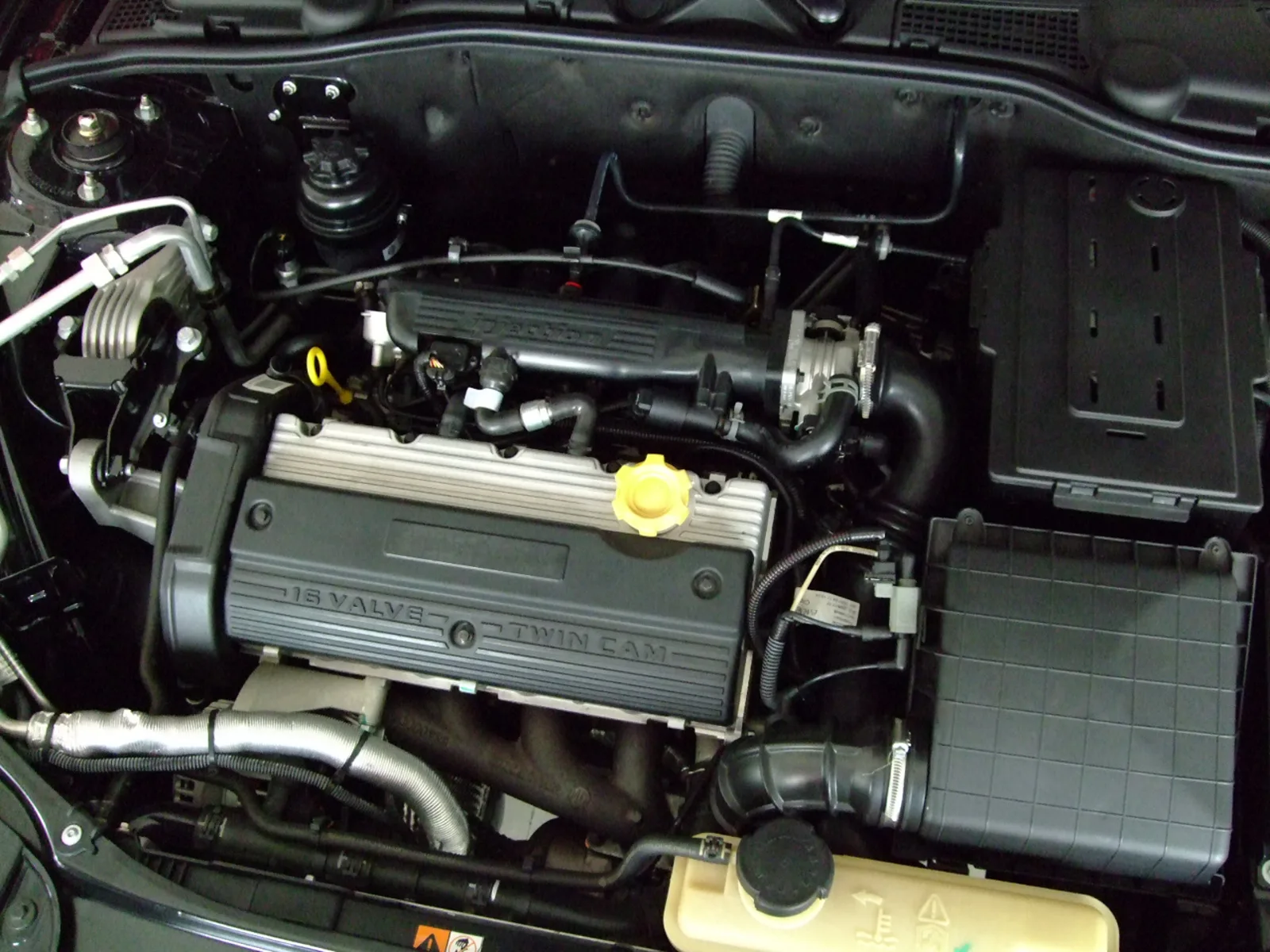
A 1947 tractor engine, a Le Mans twin-cam, a slanted four that Saab needed and a Rover unit that outlived its maker: how four British engines worked and where they ended up.
The Standard wet-liner four began in a 1947 Ferguson tractor and powered Triumph TR cars up to the TR4A. The Triumph Sabrina was a twin-cam four raced at Le Mans from 1959 to 1961. The Triumph slant-four drove the Saab 99 and Dolomite, and the Rover K-series arrived in 1988.
The engine that carried Triumph's TR sports cars from their first prototypes to the TR4A began life in a Ferguson farm tractor in 1947. It belongs to a set of four British four-cylinder designs with more in common than you would expect: a tractor engine, a Le Mans twin-cam, a slanted four that Saab needed and Triumph supplied, and a Rover unit that outlived the company that made it.
The Standard wet liner engine started on a farm
Peace in 1945 left Standard with a problem the size of a factory. Its Banner Lane shadow factory in Coventry had spent the war turning out Bristol Hercules radial aero engines, and now stood empty. Ferguson wanted to keep building tractors in Britain. Ford, which had made them for Ferguson in Detroit, declined to do the job at Dagenham, so Standard took it on.
The first TE20 tractors used an American engine. Later ones switched to a four-cylinder of Standard's own, which appeared in 1947 with an 80 mm bore and a 92 mm stroke, 1,850 cc in all. The long stroke was deliberate. A tractor needs pulling power at low revs, and British practice, shaped by the tax horsepower rules, already favoured long strokes. With a compression ratio of 5.77:1 it was tuned for the weak petrol of the day.
The layout was ordinary, with pushrod overhead valves, a one-piece iron block and crankcase and three main bearings. The detail work was not. Pistons came pre-graded into marked, standard sizes, so no one had to hand-fit them on the line or in a garage. The engine was also among the first mass-produced units with thin-wall bearings, steel shells faced with whitemetal that were simply discarded at the end of their life, where older practice was to re-metal the bearing and scrape it by hand to suit the crankshaft.
A tractor engine from 1947 carried Triumph's TR sports cars all the way to the TR4A.
What is a wet liner?
A wet liner is a separate thin steel tube that forms the cylinder wall, dropped into a hollow block so that cooling water touches it directly. Standard used these instead of boring cylinders into solid iron. The result was one large, uninterrupted water jacket around every cylinder and a quicker route for heat to escape into the coolant.
Picture four thin metal cups standing in a tub of water, rather than four holes drilled in a slab. The water reaches each cup on all sides.
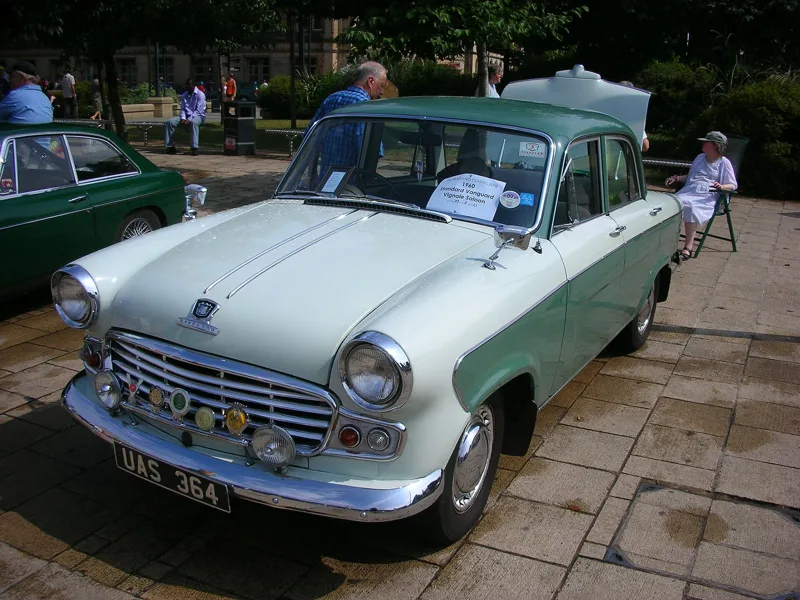
The fit was loose. Liners went in by hand pressure, sealed at the bottom by soft metal spectacle washers, and each stood a touch above the top of the block so the head gasket could squeeze it. Racing engines had used wet liners for years, but in a cheap mass-produced engine rival makers thought them over-elaborate. Standard had the machinery from its wartime sleeve-valve work.
There was one more quirk. Instead of casting the pushrod passages into the head, Standard fitted separate steel tubes between two flanges and expanded them to seal. That saved cores, saved money and left that side of the engine looking hollow, with the rocker cover apparently resting on columns. Volkswagen's Beetle engine used a similar idea. On the whole the Standard unit had a name for being dependable, if slightly staid and tractor-like.
From power take-off to Britain's first diesel car
On a farm of the late 1940s the tractor had to power more than itself. A rear shaft could drive a rotovator or a static thresher, and a governor held the engine at a chosen speed between a 400 rpm idle and 2,200 rpm at full power.
Versions for cheaper fuels followed, TVO in 1949 and lamp oil in 1950. In March 1951 came Standard's first diesel, the 20C, a fresh design with 2,092 cc, for the TE-F20 tractor. In 1954 it was fitted to the Phase II Vanguard, which made that car Britain's first production diesel. Massey-Ferguson moved to Perkins in 1959, and after Leyland took over Standard-Triumph in 1961 the diesel became the Leyland OE.138.
Standard wet liner engine in the Vanguard and the Triumph TR range
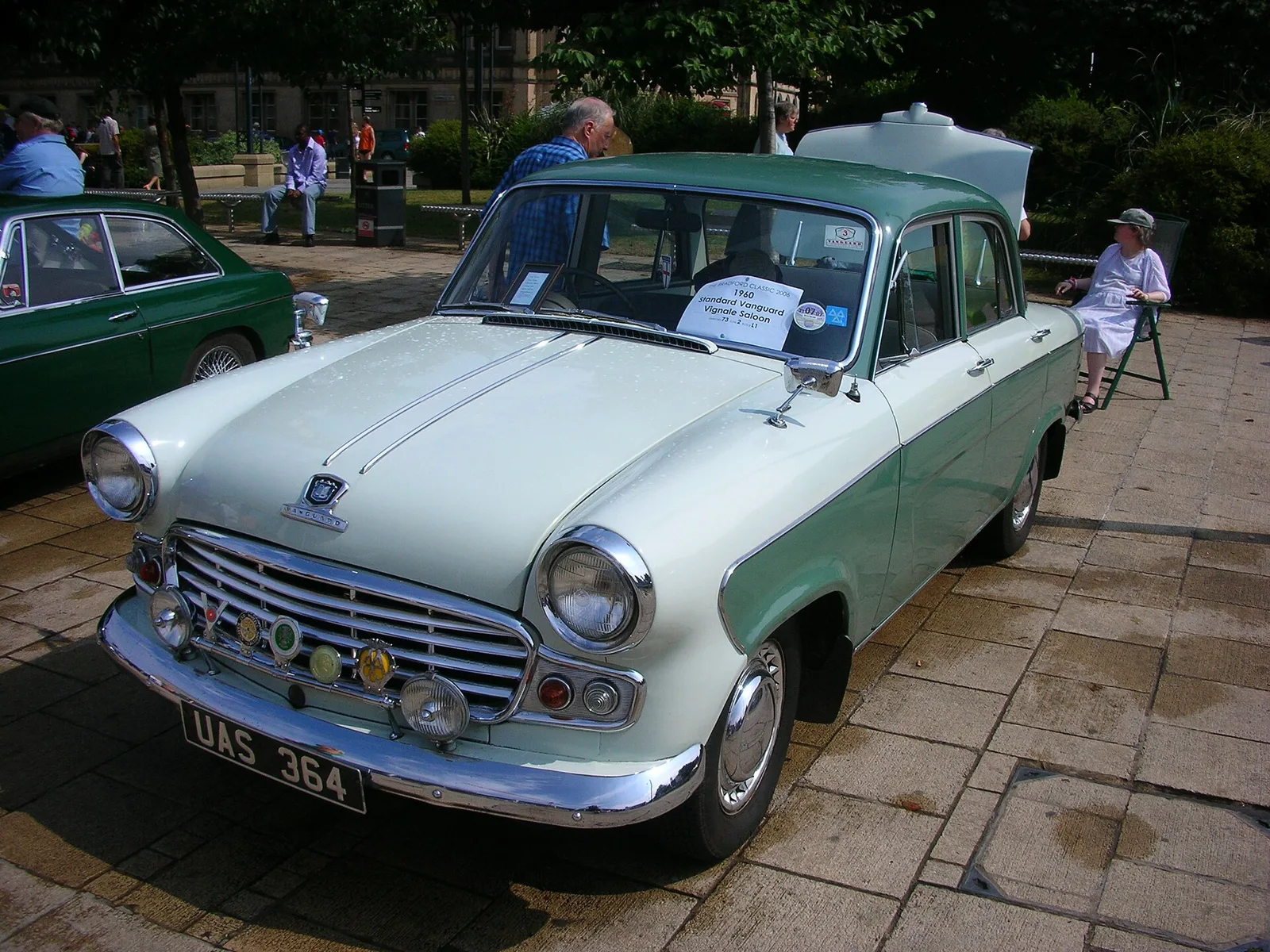
The Vanguard took the 2,088 cc engine nearly as it was. Timing was altered for road use and petrol of steadier quality, the governor was dropped and output reached 68 bhp. Two variants followed.
- The Vanguard Sportsman of 1956 and 1957 added two SU carburettors and an 8:1 compression ratio for 90 hp (67 kW) at 4500 rpm.
- The Ensign of 1957 was the economy model, with sleeved cylinders giving 1670 cc and 60 hp (45 kW).
Standard had bought the Triumph company in 1944. After the war it moved the Triumph Roadster onto the Vanguard drivetrain in October 1948 and the saloon in February 1949. From then every TR-series sports car, up to the TR4A, used the wet liner engine, with two SU carburettors on all but the TR4A, which had two Strombergs. Specialists bought it too: Morgan for the Plus 4, plus Peerless and Swallow Coachbuilding for the Doretti. The last car to use it was the Standard 2000 in India, built until 1988.
Triumph Sabrina engine: a twin-cam built for Le Mans
The Sabrina is the wet liner engine's glamorous cousin. Triumph's Competitions department designed it in the late 1950s as the 20X, and the Standard-Triumph board approved GBP 49,000 for it as Project 51 on 19 September 1960. Its two domed camshaft covers earned a nickname from the British actress Norma Ann Sykes, and the nickname became official. Harry Webster, a Standard-Triumph director, said it was built to try new casting and production methods and to improve on a modest Le Mans showing in 1955.
It was an inline four with twin overhead camshafts. The crankcase was iron, the liners chrome-iron and the rest of the structure, water jacket included, aluminium alloy. An all-alloy crankcase was tried and rejected as too flexible. The forged steel crankshaft ran in five main bearings, two more than the wet liner engine in production TRs. A 90 mm bore and 78 mm stroke gave 1,985 cc. Each of the four hemispherical combustion chambers had two valves, worked through shim-adjusted bucket tappets.
It was 83 mm longer than the wet liner unit, over 25 mm lower and, at 199 kg, lighter. Triumph reported better than 150 hp (112 kW) at 6500 rpm from the 1960 Le Mans engines, and expected over 165 hp (123 kW) from later ones.
Triumph Sabrina at Le Mans, and the road car that never was
In 1959 three modified TR3S cars ran at Le Mans with glass fibre bodies. Two retired when cooling fan blades broke away and punctured their radiators. The third lost time having its blades taken off, climbed to seventh and then retired with an oil pump failure little more than an hour from the finish.
The 1960 TRS cars wore new bodies based on the Zoom prototype. Softer valve inserts than in 1959 were damaged during the race, which wiped out the tappet clearance. All three still finished, 15th, 18th and 19th in formation, but were unclassified for not covering the required distance. In 1961 the updated cars finished 9th, 11th and 15th and won the manufacturer's team prize.
Triumph also explored a road car. Giovanni Michelotti styled Zoom, with its headlamps on top of the front wings, and two prototypes were ready in 1959 with the engine detuned to around 120 hp (89 kW), but the expense of building the 20X in volume ended Zoom.
One last Sabrina car remains. Of four Triumph Conrero cars planned for 1961 only one was built, delivered in 1962 with a Michelotti body on a tubular steel chassis from the Alfa Romeo tuner Virgilio Conrero. It reached nearly 150 mph (240 km/h) on the M1, but Triumph's Competitions department closed before it could race at Le Mans.
Triumph slant-four engine: the unit Saab needed
In 1963 Triumph's chief engine designer, Lewis Dawtrey, studied rotary, flat, V4 and V6 layouts, then proposed an overhead-cam inline four and V8 sharing one set of tooling. The range was meant to replace the Standard SC four and Triumph six, both rooted in the Standard Eight of 1953.
Saab, meanwhile, had drawn up its own prototype fours for the 99 and concluded that finishing them would cost too much and carry too much risk. Ricardo, which advised both firms, put the two in touch. Triumph agreed to supply 50,000 engines a year, capacity rose from 1.5 to 1.7 L, and Saab had it to itself for the first few years. Saab's transaxle was driven from the engine's front, so the Triumph unit had to be turned through 180 degrees, which left the water pump facing the bulkhead. It was moved to the top of the block. The engine reached the market in the Saab 99 in 1968, four years before any Triumph.
The block was iron, with the cylinders leaned at 45 degrees. That allowed the V8's tooling to be reused and gave lower bonnets. The head was alloy, with wedge combustion chambers and a single overhead camshaft driven by a 9.5 mm chain.
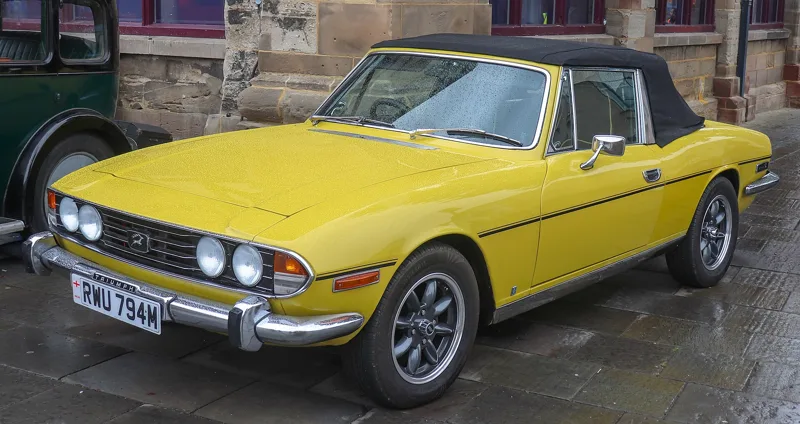
Triumph's first car with the engine was the Dolomite 1850 of 1972. The Dolomite Sprint came in June 1973 with 2.0 L, and the TR7 arrived in 1975 with the same capacity. Production stopped in 1981, when the TR7 did.
The Dolomite Sprint head and the 135 bhp puzzle
The Sprint carried a unique 16-valve head. Jaguar's Harry Mundy and Walter Hassan shared four-valve data with Triumph's Spen King, and King's team, helped by Coventry Climax engineers, put four valves in each cylinder and ran all of them from one camshaft. Inlets were driven through bucket tappets and exhausts through rocker arms. The design won a British Design Council award in 1974.
Triumph expected 135 bhp. On King's return from holiday the first engine on the test bed was already giving 150 bhp, and the car was first to be called the Dolomite 135. The name changed, and published reasons vary. A rumour says the line could not guarantee 135 bhp, but Matthew Vale points to a switch from imperial (SAE) to metric (DIN) measurement, which reads about 5% lower: 135 bhp SAE is 127 bhp DIN.
Some describe the Sprint as the first multi-valve car built in volume. The idea itself dated from 1912, and the Cosworth BDA, Nissan S20 and Lotus 907 came earlier, but none of them was in a mass-production car.
Saab moved production in-house in 1972 to its Scania division and redesigned the engine as the Saab B, at 2.0 L and 1,985 cc, reworking the troublesome water pump and its seal. In competition, Ralph Broad's Broadspeed team claimed 174 bhp (129.8 kW) from the engine and won the Manufacturer's Championship in 1974, and in 1979 Nigel Mansell and Brett Riley each won a Formula Three race in Sprint-powered Marches.
Rover K-series engine: clever casting and a fragile reputation
The K-series arrived in 1988 for the Rover 200. Powertrain Ltd, MG Rover's sister company, built it as an inline four from 1.1 to 1.8 L (1,113 to 1,796 cc), in single-cam and twin-cam forms.
Its clever part was the casting. In low-pressure sand casting, liquid aluminium is pushed up into a sand mould from underneath, a bit like filling a bath from the tap instead of tipping in a bucket. Fewer oxide flaws form, and around 90% of castings came out usable, against about 60% by gravity casting.
The catch was a reputation for fragility. The process needed heat-treated LM25 alloy, and an overheat could anneal it and scrap the part. The mid-engined MGF has a further problem: a leak from beneath the inlet manifold is common there and may stay hidden until the head is badly damaged.
The liners caused trouble as well. The aluminium blocks carried spun-cast iron cylinder liners, first from GKN's Sheepbridge Stokes and then from Goetze, whose liners entered production in 2000. Even so, many aftermarket VHPD engines built by Minister, Lotus and PTP used the old GKN type. Standard's liners, by comparison, never gave this kind of trouble.
It launched as a 1.1 L single-cam and a 1.4 L twin-cam. When Honda stopped supplying engines to Rover, 1.6 and 1.8 versions were created with wider liners and a longer stroke, which meant a block redesign that removed the top deck and moved from wet liners to damp ones. Long through-bolts hold the engine together as a compressed sandwich, an idea shared with First World War fighter engines and the Sabrina.
Heads were K8 (8 valves) or K16 (16 valves). A later head added Rover's Variable Valve Control, derived from an expired AP patent, which keeps altering the inlet cam period. A VVC engine has a nearly flat torque curve, and its power climbs until the 7,200 rpm limiter cuts in.
- The 1.4 L made from 75 PS (55 kW; 74 hp) to 103 PS (76 kW; 102 hp); the 83 PS version was the 103 PS engine with a restrictive throttle body, fitted to lower the insurance group.
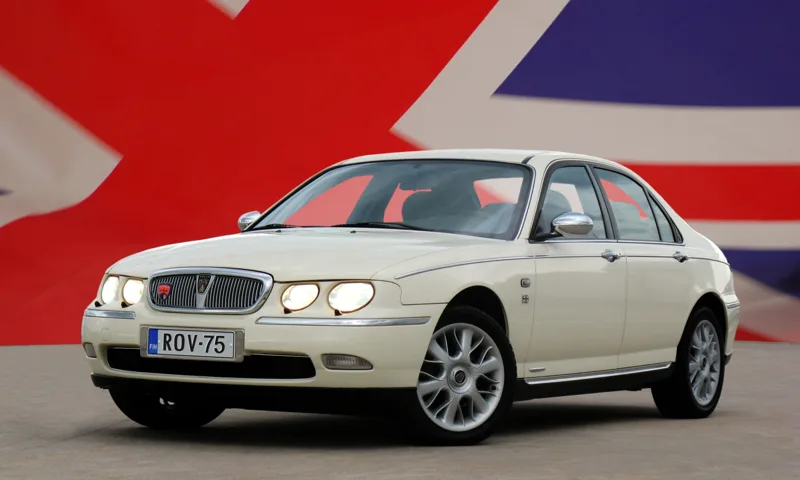
- The 1.8 L base engine made 118 bhp (120 PS; 88 kW) at 5600 rpm, and a turbocharged version gave 150 to 160 PS (110 to 118 kW) in the 2002 to 2005 Rover 75 and MG ZT.
- Lotus-version VHPD engines made 177 or 192 PS (130 or 141 kW; 175 or 189 hp) for the Elise, Exige, 340R, Caterham Seven and Ariel Atom.
Cars with the K-series ranged from the Rover Metro, 25 and 45 to the MG F, the Land Rover Freelander and the Lotus Elise, and small makers such as Caterham, GTM and Reliant used it too. Early VVC engines made 143 hp (107 kW; 145 PS), later tuned to 158 hp (118 kW; 160 PS).
The British engine families side by side
| Engine | Layout | Capacity | Valve gear | Where it appeared |
|---|---|---|---|---|
| Standard wet liner | Inline four, wet liners, iron block | 1,850 cc to 2,088 cc (2,188 cc in tractors) | Overhead valves, pushrods, three main bearings | Ferguson TE20, Standard Vanguard, Triumph TR series to the TR4A, Morgan Plus 4 |
| Triumph Sabrina | Inline four, alloy water jacket, cast iron crankcase | 1,985 cc | Twin overhead cams, two valves per cylinder, five main bearings | Le Mans cars 1959 to 1961, Triumph Conrero |
| Triumph slant-four | Inline four tilted 45 degrees, iron block | 1.7 L to 2.0 L | Single overhead cam, eight valves; 16-valve Sprint head | Saab 99, Dolomite, Panther Rio, TR7 |
| Rover K-series | Inline four, aluminium block | 1,113 cc to 1,796 cc | K8 single-cam, K16 twin-cam, VVC | Rover 200, Metro, MG F, Lotus Elise, Caterham Seven |
What are the known weak points of each engine?
For a Rover or MG with a K-series engine, the weak points are heat and coolant. On a 1.4, the 83 PS and 103 PS cars share an engine, and only a throttle body separates them. A Triumph TR of the wet liner era has an engine with a dependable reputation, and a Saab 99 has its water pump on top of the block. No Sabrina reached a production car.
Where these engines went next
The K-series had the longest afterlife. After MG Rover Group collapsed in 2005, two Chinese firms developed it separately. Nanjing Automobile bought the assets, including the Longbridge plant, the rights and the tooling. With Lotus Engineering it built the N Series, with a redesigned head gasket and oil rail, for the relaunched MG TF and for the MG3 SW and MG7 in China. It ended in 2011 when the MG TF did.
SAIC Motor had the blueprints but no tooling and so reverse engineered the engine. Ricardo redesigned the head for better waterways and rigidity and strengthened the block, using all-new tooling. That engine went into the Roewe 750 and Roewe 550 and, once the two firms merged, the MG 6. The SAIC Kavachi adds a different turbo and gearbox, a better head gasket and a stronger block, and comes only as a 1.8 L (1,796 cc).
The other three ended earlier. The slant-four stopped at Triumph in 1981, though the Saab B went on at Saab. The Standard wet liner engine finished in India in 1988, and the Sabrina never left racing and prototypes.