A supercharged voiturette, a flag-blue Le Mans 1-2, a privateer that beat the works and a team that sold its own name: four ways to go racing without a factory.
ERA built supercharged voiturettes from 1933. Ecurie Ecosse, founded in 1951 in Edinburgh, won Le Mans in 1956 and 1957. Rob Walker's privateer team won Grands Prix with Cooper, Lotus and Brabham chassis. BRP, founded in 1957, ran Stirling Moss and later built its own cars.
Rob Walker never built a Formula One car, and still his blue-and-white entries won Grands Prix. His team became the most successful privateer the sport has seen, and it was the first, and with the FISA team the only, entrant to win a World Championship Grand Prix without making its own car. The story of how it did that sits beside three other British outfits that raced between the 1930s and 1960s without a factory behind them: ERA, Ecurie Ecosse and the British Racing Partnership.
ERA: British racing cars with a Continental ambition
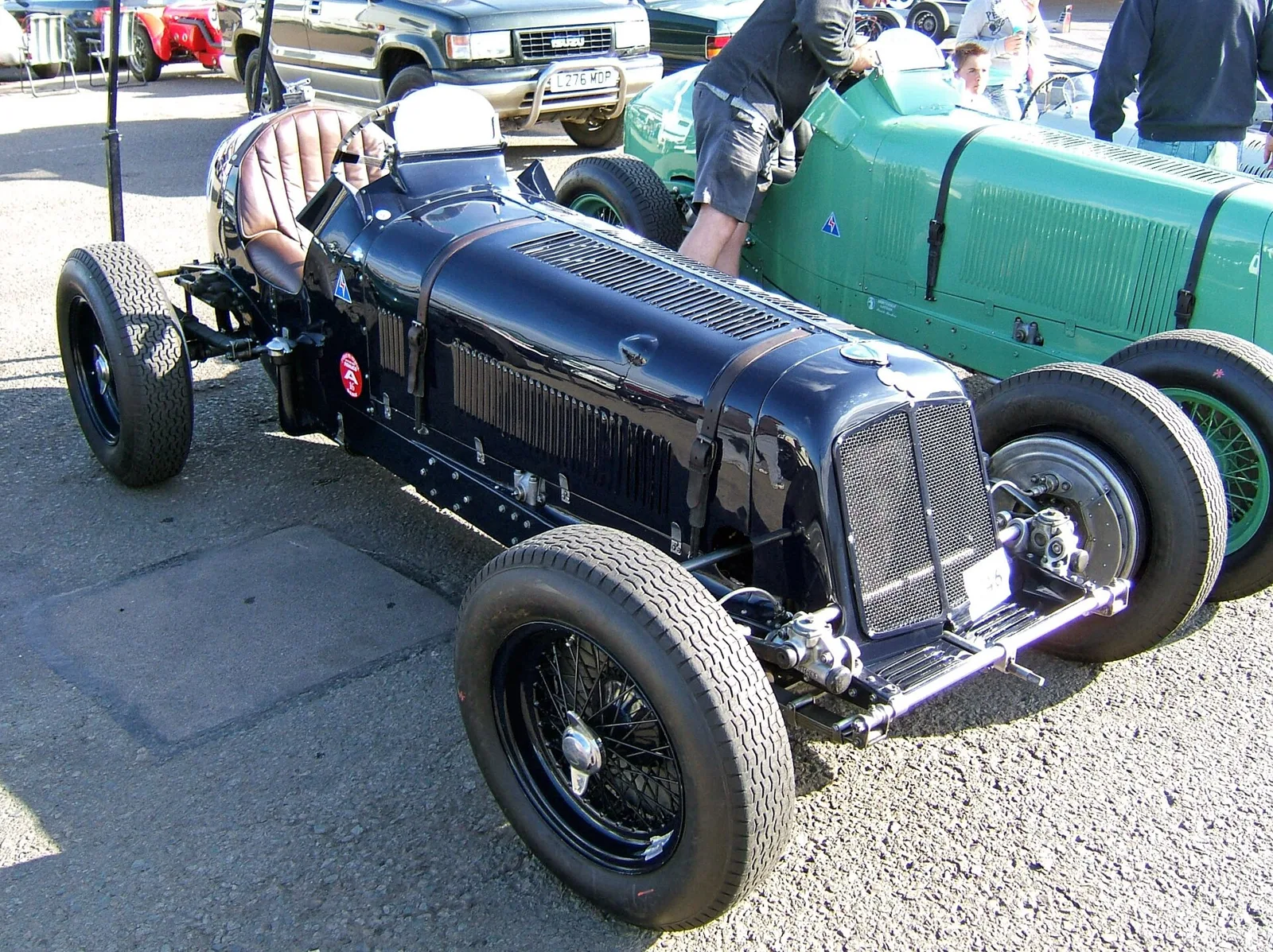
English Racing Automobiles was founded at Bourne, Lincolnshire, in November 1933, with Humphrey Cook, Raymond Mays and Peter Berthon behind it. The site sat beside Eastgate House, the Mays family home. They wanted to build and race single-seaters that could uphold British prestige against Continental opposition. Full Grand Prix racing cost too much, so they targeted the voiturette class, for supercharged cars of 1500cc, the equivalent of Formula 2 today.
Cook paid, using the wealth from his family's drapery business. Berthon led the overall design and Mays, who had raced Vauxhall, Bugatti and Riley cars, drove. Reid Railton, who also designed Malcolm Campbell's Bluebird record cars, drew the chassis, and Thomson and Taylor built it at Brooklands. The engine began as a Riley six but was substantially reworked: a stronger forged crankshaft running on a big central Hyatt roller bearing, an all-new aluminium cylinder head and a purpose-built supercharger by Murray Jamieson. It could run at 1488cc, 1088cc or up to 1980cc on methanol, making around 180 to 200 bhp at 1500cc and 250 to 275 bhp at 2000cc. The brothers George and Jack Gray shaped the aluminium bodywork by hand.
Rob Walker never built a Formula One car, yet his blue-and-white entries won at Monaco, at Pau and in the 1968 British Grand Prix.
The A-, B- and C-Types
The first car, R1A, was shown at Brooklands on 22 May 1934. Early handling problems needed several changes, but ERA was soon winning, and by the end of the year it had beaten much more established makes. At the Nurburgring in 1935 ERAs took first, third, fourth and fifth in a major race. Four A-Types were built, in 1.1, 1.5 and 2-litre forms. Dick Seaman was among the drivers in a team that dominated voiturette racing for the rest of the decade.
The B-Type followed in 1935, little changed, and 13 were produced. Two Siamese princes, Chula Chakrabongse and his cousin Bira Birabongse, ran three of them from the White Mouse Garage in Hammersmith, naming the cars Hanuman, Romulus and Remus. Chula owned the team and Bira drove. The C-Type of 1937 kept the ladder frame and aluminium body but brought a new front suspension, with trailing arms, transverse torsion bars and hydraulic dampers in place of elliptic leaf springs. The D-Type was one B converted in 1938, and the E-Type, seen just before the war, was not fully developed.
ERA after the war
The war ended racing in Europe, and ERA's Bourne site went to the bus operator Delaine. Berthon and Mays had meanwhile moved on to the BRM project, before racing returned. Leslie Johnson bought ERA in 1947 and restarted it at Dunstable, with the second E-Type, GP2. With a Zoller supercharger it shared fastest lap at the 1948 British Empire Trophy and came fifth. In that year's British Grand Prix Johnson topped first practice, then retired from third place on lap one with a universal joint failure. In 1949 GP1, driven by Peter Walker, finished fifth in the International Trophy although the gearbox and steering gave trouble, the radiator leaked and the exhaust scorched his foot. GP1 was destroyed by fire in 1950 after a driveshaft failure at the Isle of Man.
The G-Type was ERA's entry for the 1952 World Championship, the first held under Formula Two rules. Robert Eberan-Eberhorst, the man behind Auto Union's Type D Grand Prix car, laid out the idea and his protege David Hodkin completed it, with a magnesium-tube frame and a modified Bristol engine. Stirling Moss drove it, but the engine proved unreliable. In his words it was a project that made a great fuss about doing very little. Johnson sold the design to Bristol, which used it as the basis for a Le Mans programme that brought class wins in the mid-1950s, and turned ERA toward research and development engineering. Zenith Carburettor later bought the company, and Solex later bought Zenith.
ERA still lives on in the cars. Most prewar examples survive with verifiable histories and compete in historic events, and they have won the Historic Monaco Grand Prix nine times. Mays took the first two British Hill Climb titles, in 1947 and 1948. The ERA name also appeared on the Mini Turbo in the 1980s, and the trademark now belongs to Tiger Racing.
Ecurie Ecosse: Scotland's stable
Ecurie Ecosse, French for Scotland Stable, was founded in Edinburgh in November 1951 by the businessman and driver David Murray and the mechanic Wilkie Wilkinson. Its cars wore a distinctive flag blue metallic paint.
The team's Formula One record was brief. Murray drove a Cooper T20 himself at the 1952 British Grand Prix and went out early with engine trouble. Next year Jimmy Stewart's Cooper T20 and Ian Stewart's new Connaught A-Type both failed to finish. In 1954 Leslie Thorne finished in the Connaught, twelve laps down. After that the team put its efforts into sports cars. Between 1969 and 1971 it also raced in European Formula Two, first with Graham Birrell and later with Tom Walkinshaw.
Two Le Mans wins in a row
Ron Flockhart and Ninian Sanderson won the 1956 24 Hours of Le Mans in a Jaguar D-Type. Flockhart won again in 1957, this time with Ivor Bueb, and the second D-Type, shared by Sanderson and John Lawrence, came home behind it: a rare privateer one-two.
Then the fortunes turned. In 1958 Masten Gregory and Jack Fairman joined the drivers, but both D-Types lost their engines within a few laps. A D-Type retired in 1959 with engine failure after 70 laps, and a newly acquired Tojeiro-Jaguar caught fire after 137. A heavily modified D-Type broke its crankshaft on the 168th lap in 1960, and the second car, a Cooper T49 Monaco, never reached the start. In 1961 the entries, a Cooper T57 Monaco and an Austin-Healey Sebring Sprite, both went out in accidents. A Tojeiro EE failed with gearbox trouble in 1962, the last time the original team entered. Financial troubles and Murray's decision to live in tax exile ended its competitive era by the mid-1960s, and the original team ceased in 1971.
Its drivers included Jim Clark, Innes Ireland and Jackie Stewart, and the name has been revived several times. Hugh McCaig did so in the 1980s, taking the 1986 C2 class title in the World Sportscar Championship after finishing runner-up the year before, and running Vauxhall Cavaliers in British touring car racing in 1992 and 1993. David Leslie won at Thruxton in 1993. Later efforts came in 2011 with Barwell Motorsport and in 2017 and 2018 with Nielsen Racing. To mark 70 years since the 1956 win, Ecurie Ecosse was announced for the Asian Le Mans Series season of 2025-26, with Blackthorn and an Aston Martin Vantage AMR GT3 Evo.
The transporter and the collection
The team's double-deck transporter, built by Alexander of Falkirk on a Commer chassis to a design by Selby Howgate, carried three cars and a support crew, with a mobile workshop. Its Commer TS3 diesel is a three-cylinder two-stroke. The Le Mans wins made it famous, and Corgi sold a 1/48 scale Corgi Major model that is still a collector's item. In 2013 the collector Dick Skipworth's entire Ecurie Ecosse collection went under the hammer at Bonhams, making GBP 8.8 million. The transporter alone sold for a world record GBP 1.8 million.
Rob Walker: the privateer who beat the works
Rob Walker, an heir to the Johnnie Walker whisky firm, founded his team in 1953 when he was 35. It made its debut in the Lavant Cup, a Formula 2 race, with a Connaught for Tony Rolt, who finished third. Eric Thompson gave it its first win at Snetterton, and the team ended the season with eight British club wins. Its first World Championship outing, the 1953 British Grand Prix, ended early for Rolt. The team's cars wore Scottish national colours of blue with a white stripe rather than British racing green.
From 1954 to 1956 Walker made only scattered appearances, taking only a Brands Hatch Formula 2 race, with Tony Brooks, in 1956. He returned full time in 1957 with a Cooper-Climax F2 car. In 1958 he gave up club racing, signed the pre-war veteran Maurice Trintignant and borrowed Moss and Brooks whenever they were free of Vanwall. Moss and Trintignant won in Argentina and at Monaco, the first Grand Prix wins for a Cooper chassis.
Moss stayed in 1959, apart from the French and British races, which he drove for his father's British Racing Partnership. He won in Portugal and Italy, and Trintignant was second in the United States. In 1960 Walker switched to a Lotus and Moss won Monaco, the first Formula One victory for a Lotus. He finished third in the championship in both 1959 and 1960. For 1961 Walker briefly thought of building his own chassis but kept the Lotus 18, and Moss won at Monaco and in Germany.
At the British Grand Prix that year Walker's team was the first to field a four-wheel-drive car in a World Championship race, the Ferguson P99, entered for Ferguson Research. Moss later won the Oulton Park Gold Cup in it, which remains the one victory by a four-wheel-drive car at any Formula One event.
After Moss
The 1962 season began with a Trintignant win at Pau, but Moss crashed at Goodwood in a BRP-entered Lotus, ending his career. Walker had planned a Ferrari for him and had to stay with Trintignant, who scored no points. The year's misfortunes continued when Ricardo Rodriguez and Gary Hocking died at the wheel of Walker cars in Mexico and South Africa.
For 1963 Walker hired Jo Bonnier and went back to Cooper chassis, and in 1964 he added Brabham-BRM cars. Jo Siffert partnered Bonnier in 1965 and scored five championship points. Siffert was alone with the Maserati-engined Cooper T81 in 1966. In 1968 Walker, partnered with Jack Durlacher, bought a Cosworth Lotus 49, and Siffert won the British Grand Prix after the works Lotuses retired, holding off Chris Amon. It was Walker's last win. Siffert left after finishing ninth in 1969, and in 1970 Walker entered a Lotus 72 for Graham Hill, 40 years old and unwilling to retire. Hill's best result was fourth in Spain.
Walker then moved his Brooke Bond Oxo sponsorship to Surtees across the 1971-73 seasons and looked after Mike Hailwood's career. He retired from motorsport in 1974, aged 57. He also wrote reports and historical articles for Road & Track from 1967 into the 1990s. He died in 2002, aged 84.
British Racing Partnership: a team that sold its name
The British Racing Partnership was created in 1957 by Alfred Moss, Stirling Moss's father, and Ken Gregory, his former manager. It existed to run cars for Stirling whenever he was free of other contracts, and for other rising drivers. In 1959 it ran a Cooper-Borgward in Formula Two and occasionally a BRM in Formula One, the BRM being wrecked in a spectacular crash at Avus.
No Formula One team before it had handed over its entire identity in return for sponsorship. From August 1959 it was backed by the hire-purchase firm Yeoman Credit and raced as Yeoman Credit Racing in 1960, receiving GBP 40,000 for equipment and GBP 20,000 a year to run. It ran Coopers in Formula One and Formula Two, with mixed results. Two of its drivers were killed that year, and Yeoman Credit worried that the publicity was not entirely positive, so the deal passed to Reg Parnell Racing. In 1961 and 1962 the team raced as UDT Laystall Racing, sponsored by United Dominions Trust, which owned Laystall Engineering.
For 1963 it reverted to its own name and became a true constructor. It failed to get the Lotus 25 monocoque it wanted, so chief designer Tony Robinson drew a close copy with a thicker skin and a BRM V8 in place of the usual Coventry Climax. Innes Ireland and Trevor Taylor drove the BRP-BRM. Over 13 Grand Prix rounds as a constructor, the team scored 11 championship points in total. It was refused membership of the Formula 1 Constructors Association after 1964, which cost it start money, and it left the sport. It then built two cars for the 1965 Indianapolis 500 for George Bryant, the stepfather of Masten Gregory, with little success.
The four teams compared
| Team | Started | Founders | High point | Fate |
|---|---|---|---|---|
| ERA | November 1933 | Humphrey Cook, Raymond Mays, Peter Berthon | First, third, fourth and fifth at the Nurburgring in 1935 | Moved to engineering research; active to 1954 |
| Ecurie Ecosse | November 1951 | David Murray, Wilkie Wilkinson | Le Mans wins in 1956 and 1957 | Original team ceased in 1971; name revived since |
| Rob Walker Racing Team | 1953 | Rob Walker | Moss's Monaco wins in 1960 and 1961; Siffert's 1968 British Grand Prix | Last raced in 1970; Walker retired in 1974 |
| British Racing Partnership | 1957 | Alfred Moss, Ken Gregory | First to sell its identity for sponsorship; 11 points as constructor | Left Formula One after 1964 |
What is the Ecurie Ecosse revival doing in 2025-26?
The Blackthorn Aston Martin Vantage AMR GT3 Evo is to be driven by Jonny Adam, Giacomo Petrobelli and Kobe Pauwels in the Asian Le Mans Series. The announcement describes the programme as a possible route to qualifying for the 2026 24 Hours of Le Mans and to requesting a place in the 2026 European Le Mans Series.