A bus that collected 64.3% of the power sent into the road, a French truck averaging 200 kW and a Swedish verdict against a national network.
Electric roads charge moving vehicles through overhead lines, ground-level rails or buried inductive coils. French and Swedish studies found rail the most cost-effective, a German wireless test collected 64.3% of transmitted power, and about 10 demonstrators were operating worldwide by 2024.
When a bus in Germany drove over a 200-metre strip of wireless transmitters set into the road, it collected 64.3% of the power the road sent out. That test, from 2023, captures the promise and the problem of charging while driving: electric roads can feed a moving vehicle, but how much energy arrives, and at what cost, depends heavily on the technology under the tarmac.
An electric road can use overhead wires, a metal rail in the surface or buried coils, and governments in Sweden, Germany, France and elsewhere have spent the past decade testing all three. The picture so far is that rails look cheapest, rails and wireless coils can serve any vehicle but wireless has proved the most troublesome to build, and overhead wires suit only commercial vehicles.
What is an electric road system?
An electric road, also called an eroad, e-roadway or electric road system (ERS), supplies power to vehicles as they travel on it. The usual designs are cables strung above the road, conductive rails at ground level, and dynamic wireless power transfer (DWPT), which beams energy from resonant inductive coils or cables buried in the pavement.
The three do not suit the same vehicles. Overhead lines are limited to commercial vehicles, whereas ground-level rails and inductive transfer can serve any vehicle. That opens the way to public charging through a system for metering and billing.
Papers prepared for the Swedish government in 2019 and the French government in 2021 each concluded, independently, that a conductive rail in the road would be the best value. About 10 demonstrators were operating around the world as of 2024, and as of 2025 technical standards existed only for the in-road rail option. The phrase "electric highway" is sometimes used differently: it can also describe an ordinary road fitted with charging stations at regular intervals.
Rails look cheapest; wireless is the hardest to build.
How do electric roads charge a car while driving?
Overhead wires work as trolley buses always have. A pole or arm on the vehicle reaches up to a live line, and the idea has been adapted for highway trucks since the late 2000s. It is not suitable for passenger cars.
A ground-level rail turns that around. A mechanical arm reaches down from the underside of the vehicle and aligns with a powered rail set into the road, and the current flows through the arm. Ground-level supply is generally seen as better looking than wires and works for every type of vehicle.
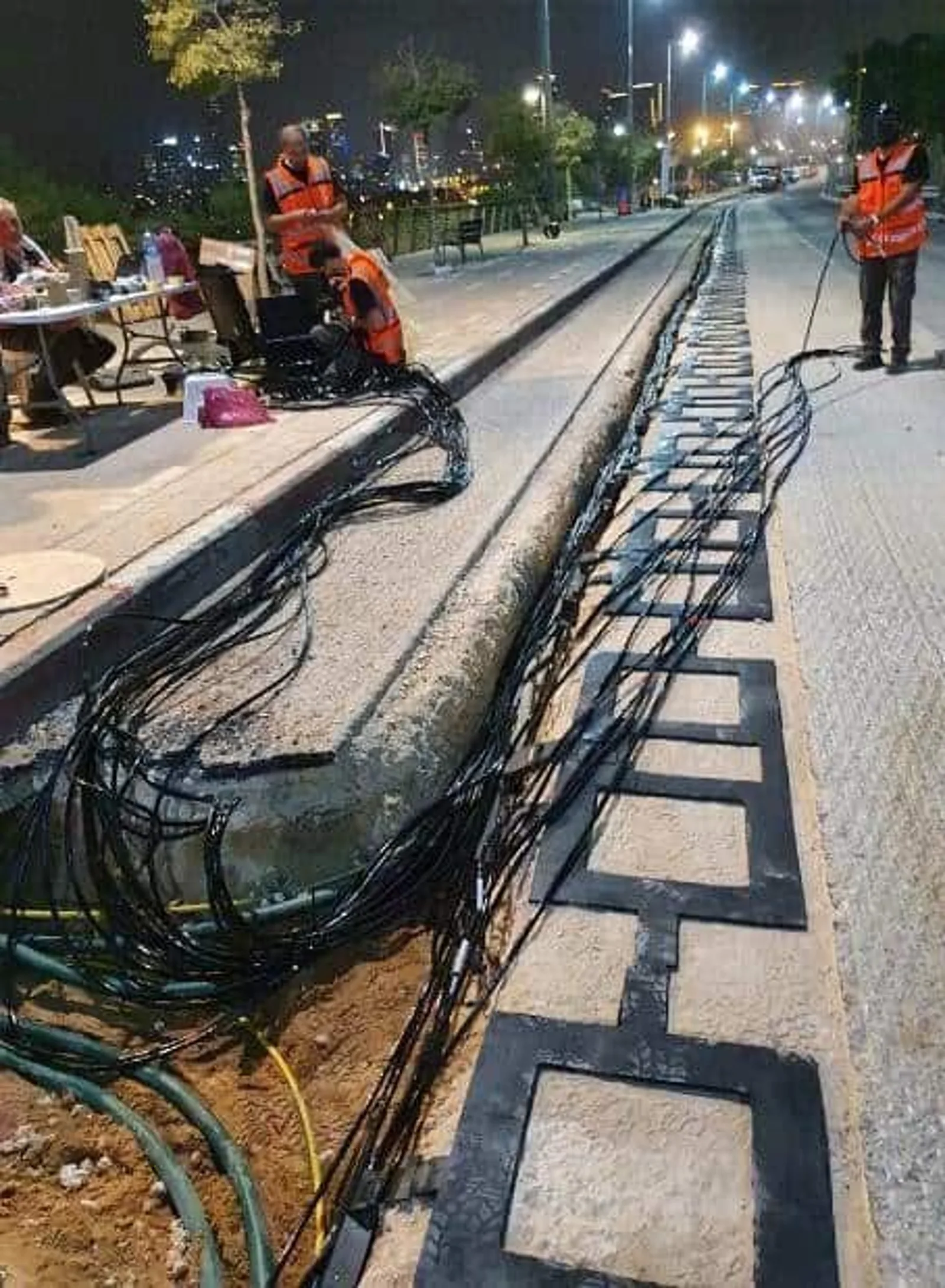
Wireless charging uses no contact at all. Coils or inductive cables below the surface send power across the gap to a receiver on the vehicle.
Overhead lines, rails or coils compared
| Feature | Overhead lines | Conductive rail | Inductive coils |
|---|---|---|---|
| Power level | Highest | High | Lowest |
| Vehicles | Commercial only | Any | Any |
| Maturity | Most mature | Mature | Still under test |
| Standards (2025) | None | CENELEC 50717 and 50740 | None specific to electric roads |
| Main concern | Safety for emergency services and poles as a collision risk | Snow, ice and salt (tested) | Roadside equipment, road strain, heat, foreign objects |
A short history of electric roads
Overhead supply for road transport dates back to at least 1882, when Werner von Siemens ran trolley buses in Berlin. By 2018 more than 300 trolley bus systems were in operation. The notion of a wireless ground-level supply is only a little younger: it was first patented in 1894.
A static-charging system for shuttle buses using inductive coils was demonstrated in New Zealand in 1996. Conductix-Wampfler and Bombardier Primove later built similar stationary systems, and Primove was enhanced to charge while driving using inductive cables. Several companies developed electric road systems during the 2010s.
Korea ran the first public electric road based on induction, with a commercial bus line, in 2013, following an experimental shuttle in 2009. That road and three later trials were closed because the infrastructure was ageing and public funding had become controversial.
Electreon and the wireless wager
Electreon is an Israeli company that develops inductive charging, both stationary and in roads. Two former Elbit Systems engineers, Oren Ezer and Hanan Rumbak, set it up in 2013, and a reverse merger put it on the Tel Aviv Stock Exchange in 2017. It showed a car running on induction over 25 m (82 ft), then won a $12.6 million Swedish Government grant in 2019, awarded via the Swedish Transport Administration programme. In December 2025 it acquired InductEV, paying $10.5M in shares after InductEV entered an insolvency assignment in August 2025.
Its first commercial product, announced in September 2026, is an 11 kilowatt charger installed as a mat over a parking space, branded Lite DOT and shown at the International Motor Show in Hannover. The output equals that of most private home chargers, and it is set to compete with SAE J2954 wireless chargers.
What the road trials found
- Sweden, 2019 to 2024: Electreon first fitted three 25 kW receivers to an electric bus, then five 20 kW receivers to an electric truck, which averaged 14 kW per receiver. Testing was extended twice to cover seasonal damage and maintenance. After construction offers in 2023 exceeded the programme's budget, the final report of 2024 advised against funding a national network, as it would not be cost-effective unless trading partners such as France and Germany adopted the technology first.
- Germany, 2023: the bus mentioned above collected 64.3% of the transmitted power. Installation proved complex and costly, finding sites for the roadside power cabinets was hard, the infrastructure blocked access to utilities beneath it, and internet outages stopped the system entirely. Separately, Germany trialled overhead lines in three projects and reported them too expensive, difficult to maintain and a safety risk.
- United Kingdom: council-level studies in 2015 and 2021, among them Coventry University's DynaCoV, judged wireless roads financially unfeasible.
- Norway, 2025: receivers on buses, nominally rated at 120kW, took in 62 to 65 kW on average.
- France, 2023 to 2027: an initial government report found inductive charging not yet mature, since it delivers the least power and loses 20% to 25% of the supplied power on trucks. In a trial of four 80 kW receivers on one truck, a 320 kW total, transfer peaked above 300 kW and averaged 200 kW.
On the A10 autoroute in 2025, an electric truck carried several 40-kilogram receivers, each 130 by 80 centimetres, and achieved a combined average of 200 kW along the wireless stretch. Electreon says its Israeli bus system has run for three years with a large public transport operator, topping up at short stops at around 90 kW.
Does wireless charging damage the road?
A 2017 study found more reflective cracks in roads containing inductive coils. The French government study that began in 2023 went further: standard road materials suffered excessive strain from in-road coils, while tougher materials brought it down to a satisfactory level. The coils also risked thermal damage, with temperatures above 100 C (212 F), and the 2023 tests showed a risk of the coil casing separating from the top layer. Researchers at ETS and Universite Laval saw similar evidence of debonding in 2025.
Tests at Nantes in 2023 found Electreon's standard way of laying coils beneath asphalt unsatisfactory, producing critical strains, though specific bonding resins performed well. The A10 stretch of about a kilometre used asphalt reinforced with woven glass fibre to meet the road's mechanical needs and limit early reflective cracking. In the United States, INDOT began studying a DWPT installation in 2024 using polymer-concrete previously used for bridges.
Are electric roads safe?
Each technology carries its own risks. Germany's economy ministry (BMWK) assessed overhead lines in 2024 as a hazard for emergency services and their poles as a collision risk for motorists. French studies ruled overhead lines out on safety grounds.
For wireless roads, SAE International noted in 2023 that foreign object detection was not well established. Metal or living things caught between the ground pad and the receiver while it is active create a fire or burn risk, so SAE proposed safety tests. France is testing a wireless inductive system in 2026 for compliance with the allowed electromagnetic noise levels.
Rail has been tested with snow ploughs and exposure to snow, ice, salt and saturated brine. Road tests in France in 2024 and 2025 validated its robustness and safety, including cases such as an electrical failure, a contact arm stuck in the lowered position, debris striking the arm, a stopped vehicle in the electrified lane and tailgating.
Standards for electric roads
In the early 2020s, governments and research bodies urged standardisation before any one technology was chosen, and they named power targets. The Research Institutes of Sweden (RISE) recommends inter-city infrastructure of 300 kW or more, and Sweden's road and transport research institute VTI likewise suggests 300 kW per truck. A French Ministry of Ecology working group proposes 400 kW for a 44-ton truck at 90 km/h on a 2% grade, or at least 250 kW so a truck can charge on flat or gently sloping roads. In 2021 the European Commission published a request for regulation and standardisation.
For ground-level rail, CENELEC Technical Standard 50717 covers on-board equipment and was published in 2022, while 50740, a complete ground-level supply standard drafted in line with EU directive 2023/1804, was approved and published in 2025.
Wireless is behind. Inductive charging standards have existed since 2020 but are not immediately suited to roads; the CEO of IPT calls the existing ones "extremely expensive" for the purpose. IPT bought Primove inductive cable technology from Bombardier in 2021. Electreon and WiPowerOne, which grew out of the KAIST OLEV project, have worked on dynamic inductive standards since 2021, and ENRX, which includes IPT, announced in November 2024 a plan to cooperate with InductEV. SAE began developing DWPT standards in 2023.
What do electric roads cost, and who pays?
A Swedish Transport Administration report in 2020 expected a national network to need interfaces between seven parties: the electricity supplier, grid company, vehicle maker, road owner, system operator, metering and billing provider and road user. Ownership could vary, for example in who holds the roadside substations.
For freight, a 2026 review by participants in the French trials argues that operators could buy electricity at around EUR 0.09 per kWh and sell it at around EUR 0.19, below the average French home charging rate. That would leave a gross margin above 50%, though upfront, maintenance and operating costs bring the return on investment down to 4% a year over 32 years. French toll roads charge significantly more per kilometre than ERS charging would at that margin, so the toll concession model could carry the cost. According to the review, big diesel fleets switching to battery-electric trucks on ERS would earn back more than 93% of the toll through fuel savings.
The power level decides how much road must be electrified. A model for eRoadMontBlanc, one of the French trials, estimates that a 44 tonne truck on the A6 autoroute would need ERS along 94% of the route at a 300 kW charging rate, 52% at 400 kW, or 41% at 500 kW, which is as much as the system can currently deliver.
Buses are harder to justify. A Michigan study published in 2026 using 2025 data concluded that for most bus rapid transit systems worldwide a wireless charging lane would not pay its way; Beijing, Xiamen and Bogota were the exceptions. Success needs high fleet utilisation and high traffic density. The study assumed 90% transfer efficiency and a fixed cost of $3M per mile of infrastructure plus $10k per kW-mile, giving $4M per mile for a 100 kW system.
What it means for someone buying or driving a car
For a private driver the near-term options are narrower than the headlines suggest. Overhead lines are limited to commercial vehicles, and most of the cost studies above are about trucks and buses. Rails and coils could serve any vehicle, which is what would allow public charging with metering and billing, but only the rail option had published technical standards as of 2025.
The closest thing on offer to a consumer product is Electreon's 11 kW parking-space mat, which equals most home chargers. It is stationary charging, not charging on the move.
Where this goes next
France is the main test bed. It began testing inductive and rail systems in 2023, and its programme runs from 2023 to 2027, with inductive testing scheduled to conclude in September 2026. Electreon announced in 2026 that it had applied for a follow-up French project aimed at meeting the government's cost requirements.
Sweden's final report, by contrast, recommends against a national network unless its trading partners adopt electric roads first. On the standards side, SAE, Electreon and other organisations are jointly developing a dynamic wireless inductive charging standard, ENRX and InductEV planned to collaborate on one, and the Electreon charging mat is slated to compete with SAE J2954 chargers.