A Ghia-built Hemi roadster, a four-door whose fenders and doors swapped sides, and a 1967 electric car that never went on sale.
The Chrysler Falcon was a 1955 Ghia-built Hemi roadster that never reached production. The AMC Cavalier was a 1965 compact with interchangeable panels, and the AMC Amitron a 1967 electric city car with regenerative braking and a 150-mile range, which stayed a prototype.
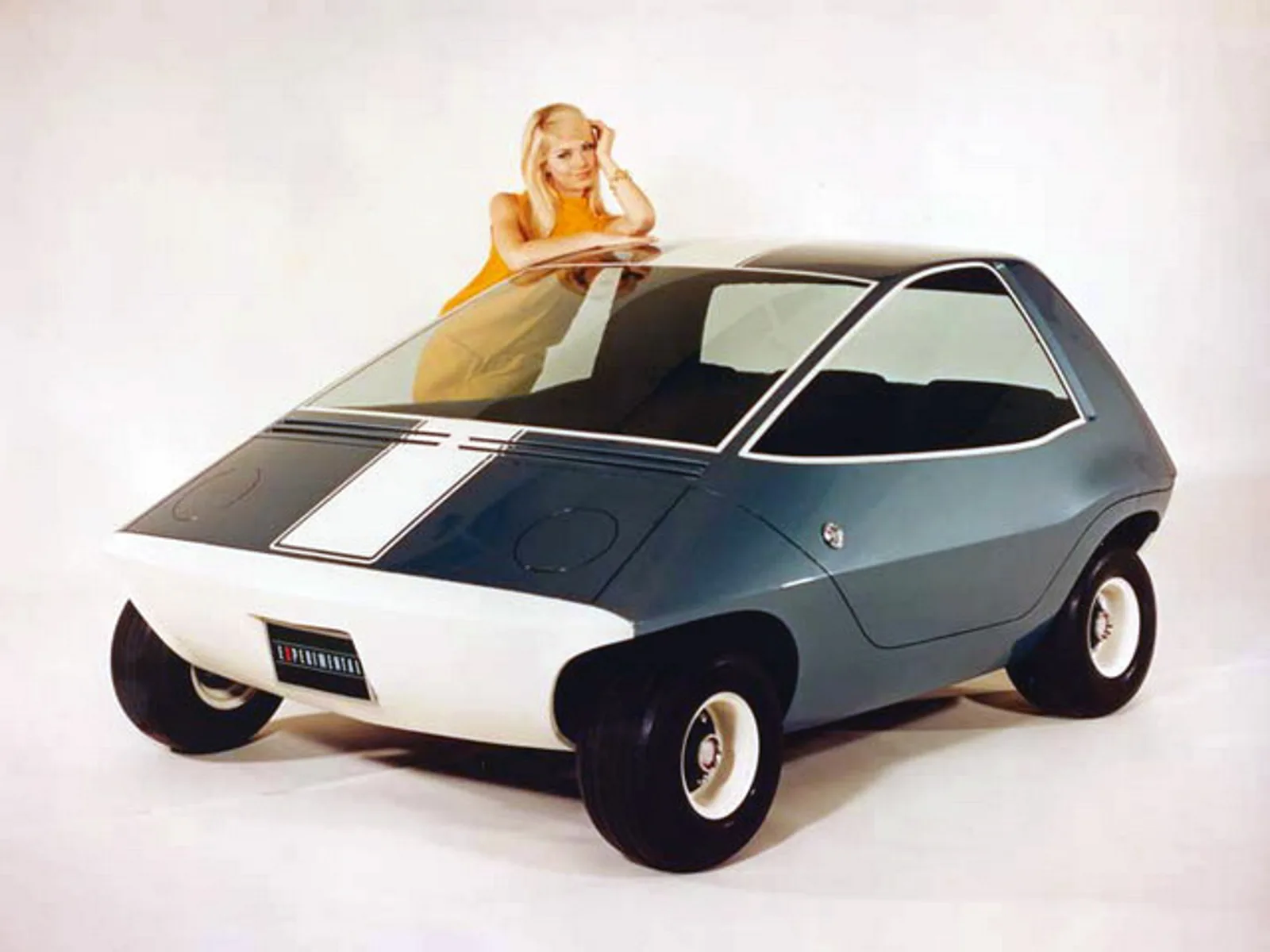
In 1967, American Motors showed an electric car that claimed a 150-mile (240 km) range and recovered energy when it slowed, a braking approach that, one description says, took 50 years to become common in the industry. It was a snub-nosed three-seater with a canopy that hinged up and back instead of doors, and it never reached production.
The AMC Amitron is one of three Detroit show cars here. The others are a Ghia-built open two-seater that Chrysler used to test its ideas in 1955 and a four-door AMC that swapped body panels from side to side. None went on sale, yet all three left marks on cars that did.
What was the Chrysler Falcon?
Chrysler had a reputation for dull design. Virgil Exner left Studebaker for Chrysler in 1949, recruited by K.T. Keller, then Chrysler's president and later chairman of the board, to head the Advanced Styling Studio and rescue falling sales. Exner turned out "Idea cars", most of them built in Italy by Ghia. The 1955 Chrysler Falcon was one of several sporty open two-seaters, and it is often described as Chrysler's answer to the Ford Thunderbird and Chevrolet Corvette. Maurice Baldwin gets much of the credit for the design.
The Falcon debuted on 17 August 1955 at the Chrysler International Salon, next to the Flight Sweep I and Flight Sweep II. It was built from many parts of existing Chrysler products and could have been made with production methods already in use. The cars that were built were treated as pre-production examples, with full production expected. Chrysler's engineering staff ended those plans.
Engine, chassis and cabin
The Falcon sits on a unitary chassis, a modified version of the Chrysler C-300 platform, and weighs 3,300 lb (1,497 kg). Two versions of Chrysler's first-generation "double rocker" Hemi V8 went into the cars. One was the Chrysler FirePower, displacing 331 cu in (5.4 L), and the other the DeSoto FireDome, displacing 276 cu in (4.5 L). They differ in bore, stroke and spacing between cylinders. The car now in the Bortz collection has its original 331 FirePower.
A two-speed PowerFlite automatic is selected by a floor lever. The cabin has leather trim, an adjustable split-bench seat, power windows, dished inner door panels and a wooden Nardi steering wheel. The brakes are drums at all four corners, and both brakes and steering are power assisted.
How many Falcons were built
For a long time people believed only one Falcon existed. It is now generally accepted that at least two were completed, partly because original photographs show differences between the bodies. The first was painted black and served as Exner's personal car, and he drove it in some SCCA events. Its fate is unknown, though there is no record of its destruction. A letter from Ghia designer Luigi Segre mentions three cars, one called a "DeSoto Sports Roadster" (Model A-489) and two Chrysler Sports Roadsters (Model A-488), and on that basis it is suggested that as many as three were built.
One Falcon is reported to have been shipped back to Ghia and then to South America. A Falcon was offered as the prize in a 1955 Venezuelan Red Cross fundraiser, supplied through Chrysler's official representative in Venezuela. By the mid-1970s the car had returned to North America and belonged to Paul Stern. After a few more owners, it joined Joe Bortz's collection in the late 1980s.
What the Falcon passed on
The Falcon was never produced, but Exner's influence reached showrooms with the Forward Look cars of 1955 and the major restyle of 1957. Specific Falcon details reappeared too. The egg-crate grille turned up on the 1957-59 Chrysler 300. The exposed side exhaust pipes returned on the 1960 Plymouth XNR, only on the driver's side of that Slant-6 concept, and again on the 1992 Dodge Viper. Daimler-Chrysler has referred to the Falcon as "Exner's Viper".
Chrysler planned to reuse the Falcon name for the new-for-1960 Plymouth Valiant, but Ford released the Ford Falcon with the name first.
None of the three went on sale, yet all three left marks on cars that did.
What was the AMC Cavalier?
American Motors presented the Cavalier in 1965 as a compact concept noted for symmetrical design and interchangeable body parts. It was one of four prototypes hinting at AMC's future cars. In 1966 it joined "Project IV" on the show circuit with the Vixen (a four-seat coupe with "flying buttress" pillars), the AMX prototype (a two-seater that grew into the production AMX), and the AMX II, a notchback hardtop 8 inches (203 mm) longer than the AMX. None carried the Rambler name, which AMC began phasing out in 1966.
Of the four, only the Cavalier, a four-door sedan, was designed by Dick Teague in AMC's advanced design studio. Elements of it went into the 1970 AMC Hornet, which needed tooling and final stampings by summer 1969.
Symmetry as a cost saver
The Cavalier was a study in symmetry, built to show how many panels could be shared. The fenders at opposite corners were identical. The doors swapped from side to side, which worked because the rear doors were hinged at the back, in suicide fashion, an idea that originated with the Cord prototype 935 Saloon. The bonnet and boot lid were interchangeable as well. The Nash Metropolitan, sold by AMC until 1962, also shared inner panels, though its outer skins differed. AMC said the aim was to cut tooling costs by thirty percent and to demonstrate ways to lower production costs.
Another small independent maker was chasing the same savings near the end of its life. Studebaker developed the Familia design study on a 113-inch (2,870 mm) wheelbase, in fibreglass, with interchangeable bonnet and boot, doors, bumpers, lamp housings and glass. Its concepts never reached Studebaker production cars.
Styling and safety
The Cavalier had curved sides like a fuselage, full wheel arches, 13-inch (330 mm) "mag" wheels and whitewall tyres. The rear roof pillars used the flying buttress design, which gave a profile with a swept-back roof and what looked like a short rear deck. The rear window was recessed between the pillars, making the tail resemble General Motors' 1966 and 1967 A-body two-doors, such as the Chevrolet Chevelle and Pontiac GTO. Black vinyl covered the swept-back panels and roof, set against a deep red metallic finish.
It carried far less ornament than the production cars of its day, since AMC wanted to sell it overseas. Dual-action scissor hinges on the boot lid let it open like a normal lid or rise to roof height for tall, bulky loads. Wrap-around rear lights were designed to flash warnings in alternating green, yellow and red. A built-in roll bar permitted thin pillars and a thin roof panel. Flush push-buttons replaced exterior door handles, and the dashboard was a diagram of the car, with its profile and interior cavities drawn into the design.
Under the unusual panels sat a conventional front-mounted AMC V8 of 343 cu in (5.6 L) making 280 bhp (209 kW), driving the rear wheels. The wheelbase was 108 inches (2,743 mm), and seating was for six adults.
Project Europa
In 1967 Teague proposed Project Europa, which would adapt the Cavalier into a compact front-wheel-drive "world car". European taxes and road conditions made big American models such as the Rambler Classic and Rebel, which Renault assembled from kits in Belgium, expensive executive cars. Europa would reuse the Cavalier's interchangeable parts, including diagonal door swapping and shared stampings, to cut tooling costs by an estimated 35 percent. Front-wheel drive removed the centre tunnel and allowed six passengers. The plan called for locally sourced four-cylinder engines of 75 to 120 cu in (1.2 to 2.0 L) from Renault, Lancia or Triumph, and assembly by European contractors such as Vignale and Farina. Officine Stampaggi Industriali gave an unofficial quote of $3.5 million for tooling and fixtures, with output of 25,000 to 100,000 cars a year. The cars could also have been exported to the United States. AMC management saw it as a cheap way to expand abroad and to get a small car for the gas crises of the 1970s, but Project Europa was not pursued.
Where the Cavalier ended up
Robert B. Evans, then AMC chairman, said the Cavalier toured the show circuit to help restore public confidence while sales sagged. Its horizontal lines, flat surfaces, minimal overhangs and blocky face anticipated the 1970 Hornet, which Teague also directed. The production Hornet did not use interchangeable panels, though its front and rear bumpers came from the same stamping. The Vixen coupe, designed without parts swapping, also forecast the Hornet's blunt face, dual headlamps and flared wheel openings. For the 1973 Hornet GT concept Teague did the opposite of symmetry, with differently styled sides and pillars to test visibility, roof strength and interior space.
In January 1971 Sharjah's post office issued a 3 dirham airmail stamp showing the Cavalier beside a 1904 Rambler. It mislabels the Cavalier as a 1970 car, perhaps because of its resemblance to the Hornet.
Even the name was lost. AMC planned to call a new pony car for 1968 the Cavalier, but General Motors had secured the name, which it used fourteen years later on the Chevrolet Cavalier. AMC took second choice instead: Javelin.
What was the AMC Amitron?
The Amitron was an experimental electric subcompact built in 1967 by AMC and Gulton Industries. Its purpose was to predict future commuter cars. Development was spurred by three bills passed by the 89th United States Congress, known together as the Electric Vehicle Development Act of 1966, plus a fourth amending the Clean Air Act of 1963. The laws funded research as emissions worsened air quality, and electric cars were also seen as a way to cut dependence on imported oil. The big three automakers and AMC all took part.
Batteries and regenerative braking
AMC teamed up with Gulton Industries of Metuchen, New Jersey, to develop the battery and power electronics. The system used two kinds of battery, one for slow and one for fast release and charging, plus regenerative brakes to stretch the range. The main supply was a pair of lithium-nickel-fluoride batteries weighing 75 lb (34 kg) each, storing 150 watt-hours per pound (331 watt-hours per kilogram) and 22.5 kWh in total. Lithium has a strong appetite to give up electrons, which is why the designers picked it. But these batteries delivered power slowly, too slowly for brisk acceleration or for absorbing the surge of regenerative braking.
The fix was a second pair of batteries, two 24 lb (11 kg) nickel-cadmium units for peak demand. With them the car could reach 50 mph (80 km/h) in 20 seconds. In use, the lithium batteries kept topping up the nickel-cadmium ones, which kept feeding the motor. A solid-state controller ran the whole system.
The regenerative system switched the drive motors to generators on slowing so the nickel-cadmium cells could recharge, extending range. It was tuned to give the same pedal feel as a conventional car, and it was the first regenerative braking in the American car industry. The total range was 150 miles (241 km) at 50 mph (80 km/h). Battery weight was only 200 lb (91 kg), whereas lead-acid cells for the same job would weigh nearly a ton (907 kg).
The first road tests of the powertrain came in 1968 in a converted Rambler American sedan. At the time AMC's design vice president, Dick Teague, was working on a car called "the Voltswagon". Backers were upbeat, saying they saw no major technical obstacle and that it was just a matter of time.
The body and the plan
The Amitron was shaped to keep rolling resistance, drag and weight low. The prototype was a snub-nosed three-passenger city car only 85 inches (2,159 mm) long. Its seats had air-filled cushions rather than foam, and instead of doors the whole canopy hinged up and back on rear pivots. AMC worked to make it more attractive than rival electrics. At its public introduction in December 1967, chairman and chief executive Roy D. Chapin Jr. said it could remove many of the problems that had made electric cars impractical.
AMC first planned to offer it to commuters and urban shoppers within five years. Chapin said bankers and creditors were about as enthusiastic as the company, and the public liked it. Competitors doubted the pace, saying a practical battery would take ten years. In the end, US clean transport research programs stopped, and the Amitron did not go beyond the prototype. The expensive batteries made AMC halt advanced electric vehicle experiments for several years.
The Amitron's afterlife
The Pacer drew on the Amitron's short, wide proportions, and optionally offered three front seats. The car's abruptly cut-off tail influenced the Gremlin. Through a partnership with Gould, AMC's electric development led to mass production of the Jeep DJ-5E from 1974, a rear-wheel-drive mini delivery van also called the Electruck. Its regenerative braking worked above 22.5 mph (36.2 km/h), with current limiting to protect its lead-acid batteries from overcharging.
In 1977 AMC launched its "Concept 80" experimental line, including the AM Van, Grand Touring, Concept I, Concept II and Jeep II. The Amitron was renamed the Electron, given side mirrors on the windows and fresh paint. As a show car with no powertrain, it could not be driven.
The angular, polygonal design looked ahead too. Wedge-shaped bodies did not reach production cars until the 1970s, and one description says it resembles a miniature Cybertruck, the Tesla model unveiled in late 2019.
How do the three show cars compare?
| Car | Year | Builder | Power | What came of it |
|---|---|---|---|---|
| Chrysler Falcon | 1955 | Chrysler and Ghia | 331 cu in (5.4 L) or 276 cu in (4.5 L) Hemi V8 | Never produced; grille and exhausts reused |
| AMC Cavalier | 1965 | AMC | 343 cu in (5.6 L) V8, 280 bhp (209 kW) | Styling went into the 1970 Hornet |
| AMC Amitron | 1967 | AMC and Gulton Industries | 22.5 kWh lithium battery plus nickel-cadmium cells | Prototype only; later renamed Electron |