From an 1896 patent to Mercedes-Benz racing cars and Rover's pitched-roof F-head: two ways engineers tried to rethink the valve.
A desmodromic valve is closed by a second cam and rocker instead of a spring, which prevents valve float at high revs. Mercedes-Benz used it on the W196 and 300SLR, but better springs and cam design made it unnecessary, while the F-head put inlet valves overhead and exhaust valves in the block.
A way to close an engine valve without a spring was patented in 1896. By 1910 it was running in a 300 bhp speedboat engine, by 1954 it was on a Formula One Mercedes-Benz, and by the 2000s computer modelling had made most of its advantages unnecessary. The desmodromic valve is one of the great what-ifs of engine design.
It also makes a neat contrast with a quite different compromise, the inlet-over-exhaust, or F-head, engine, which put the inlet valves overhead and left the exhaust valves in the block. One tried to remove the spring problem altogether; the other tried to get the best of two layouts. Both shaped real cars, from Rover and Willys to Mercedes.
What is a desmodromic valve?
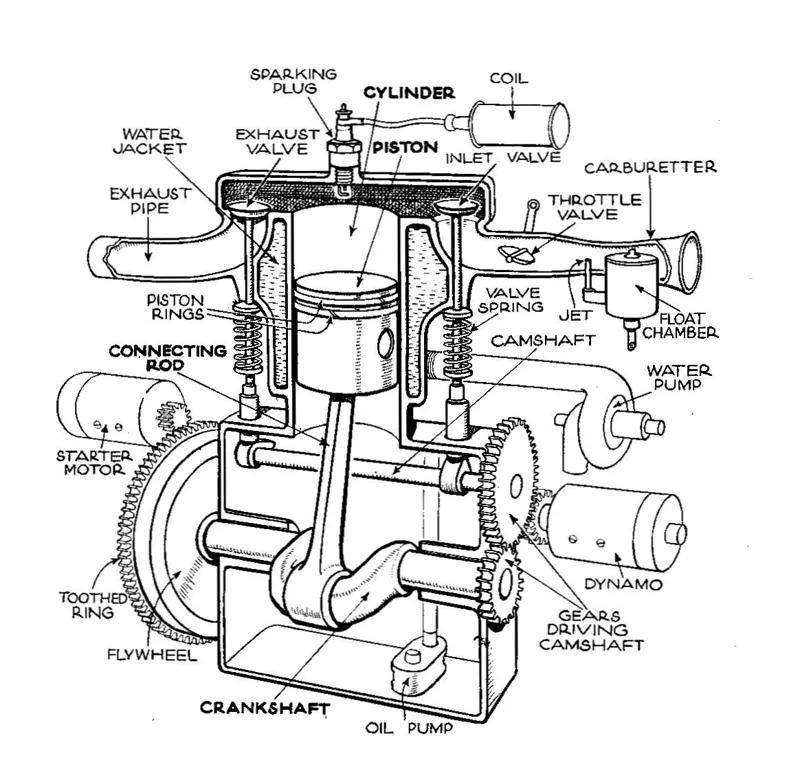
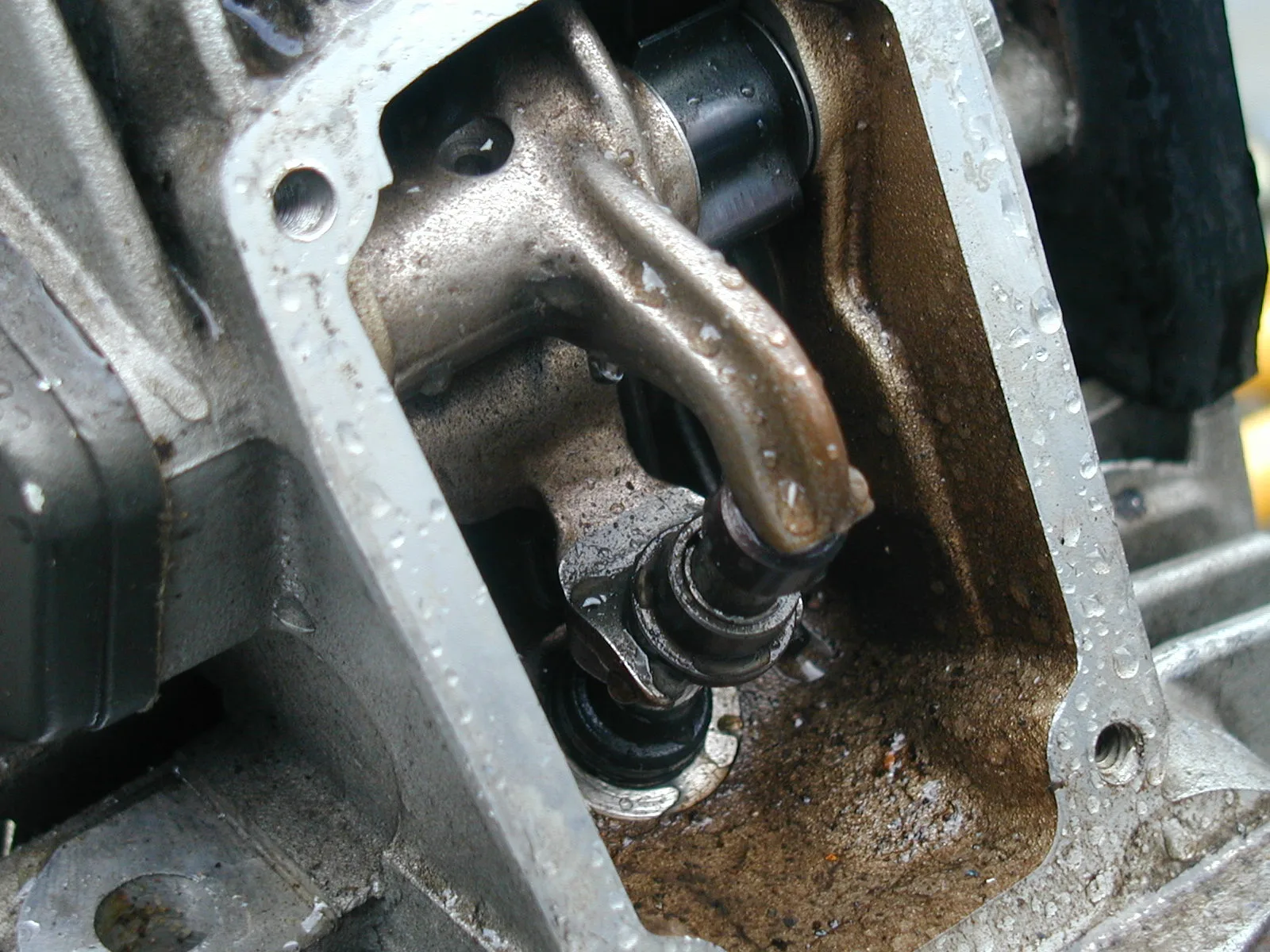
A desmodromic valve is a poppet valve shut by a cam and lever linkage rather than a spring. In an ordinary four-stroke a cam pushes the valve open and a return spring shuts it. A desmodromic design has two cams and two actuators, so the valve is driven both ways and needs no return spring at all.
The name comes from the Greek desmos, meaning bond or knot, and dromos, meaning track or way, and it reflects the main trait: the valve is continuously bound to the camshaft.
A desmodromic valve is bound to the camshaft in both directions.
How does a desmodromic valve work, and why did anyone want one?
Think of closing a door. A spring-loaded closer swings it shut by itself, but only at a certain speed. If you pull it shut by hand with a second handle, it closes exactly when you tell it to. That, loosely, is the difference between a valve spring and a desmodromic closing cam.
The need grew out of the weakness of the spring. Ordinary valve springs do fine in everyday engines that rarely rev hard and need little upkeep, but in the early years they broke from metal fatigue. Vacuum melt processes in the 1950s removed impurities from the metal and extended spring life greatly, yet many springs still failed in sustained running above 8000 rpm.
Higher revs bring a second problem, valve float. As engine speed rises the valve's own inertia eventually beats the spring, and the valve fails to reach its seat before the piston arrives at top dead centre. Combustion gases escape early, cylinder pressure falls, and performance drops sharply. The valve can overheat and warp. Worst of all, the piston can hit the valve, destroying both.
The usual cure is a stiffer spring, which raises the seat pressure holding the valve shut. It works, but it adds load, friction, heat and wear throughout the valvetrain, plus a bigger spring with more mass and more inertia. It also creates cam drag, since energy is needed to compress the spring. The desmodromic mechanism sidesteps all of this by removing the spring.
Desmodromic valve history
Fully controlled valve movement is as old as the engine itself, but a design that worked reliably without being overly complex took a long time. Gustav Mees mentioned such systems in patents in 1896. Austin's 1910 marine engine made 300 bhp in a speedboat named Irene I; it was all-aluminium with twin overhead valves, two magnetos, two carburettors and desmodromic valve gear. Delage and Nagant also used a desmodromic system on their 1914 Grand Prix cars, though it was quite unlike the modern Ducati arrangement.
Spanish engineer Wifredo Ricart obtained a patent for a similar mechanism in 1925. Azzariti, a short-lived Italian maker in 1933 and 1934, built 173 cc and 348 cc twins, some with desmodromic gear in which a separate camshaft closed the valve. A later Daimler-Benz inverted V12, in the 601 and 603X versions used in the Messerschmitt Bf 109 in the 1930s, had desmodromic valves.
The best-known car applications came from Mercedes-Benz. The W196 Formula One car of 1954 to 1955 and the 300SLR sports racing car of 1955 both used desmodromic valve actuation. In 1959 the Maserati brothers brought out one of their last designs, a desmodromic four-cylinder 2000cc engine for the final O.S.C.A. Barchetta.
In 1956 Ducati engineer Fabio Taglioni developed a desmodromic system for the Ducati 125 Grand Prix machine, creating the 125 Desmo. Taglioni explained the purpose in simple terms: make the valves obey the timing diagram as faithfully as possible, which wastes almost no energy, evens out the power curves and improves dependability. Ducati engineers carried the work on, the company holds a number of desmodromic patents, and the system has been used on its top production motorcycles since 1968, when the widecase Mark 3 single introduced it.
Desmodromic vs spring valve gear
| Point | Spring valvetrain | Desmodromic |
|---|---|---|
| What closes the valve | Return spring | Second cam and closing rocker |
| Valve float at high rpm | Risk rises with speed; stiffer springs needed | Prevented, the main benefit |
| Moving mass | Half the spring mass for symmetric springs plus the retainer | Two rocker arms per valve |
| Cam contact | Roller tappets easy to fit | Sliding friction, so more wear; Ducati hard-chromes its contact points |
| Valve clearance | Hydraulic adjusters possible | Hard to fit; two adjustments per valve |
Why desmodromic never took over
Today's engines have largely cured spring breakage at high revs, so the main remaining benefit is stopping float. Even that case weakened. The desmodromic system depends heavily on its designer, because two rocker arms per valve add inertia, and a roller on a rocker arm would add so much moment of inertia that it cancels the advantage. Another snag is lash: hydraulic adjusters are hard to add, so clearances need frequent checks. To be fair, few high-revving conventional engines use hydraulic adjusters either.
Computers changed the argument. Before multibody dynamics software arrived in the noughties, desmodromic drive seemed to offer answers to problems that worsened with engine speed. Modelling of lift, velocity, acceleration and jerk showed that cam dynamics were not what they seemed, and with proper analysis, valve float, hydraulic tappets, pushrods and rocker arms stopped being obstacles without needing desmodromic drive. Most engines today have overhead cams pressing on flat tappets, which gives the shortest, lightest and stiffest route from cam to valve.
Cam design improved as well. Some high-speed engines now use asymmetrical profiles that open the valve quickly and settle it back on its seat more gently, an idea that production cars have used since the late 1940s, when the 1948 Ford V8 had asymmetric inlet and exhaust profiles. Cosworth's 2.3 litre crate motors use hard-working profiles to make 280 brake horsepower or more.
Spring design improved too. Researchers found valve float was largely caused by resonance in the springs, with waves of compression running up and down the coils, as in a Slinky toy. Photographed at high speed, the springs were seen to lose contact at certain speeds. Makers sometimes nested as many as three concentric springs, the inner ones acting as snubbers. Norton's Manx engines used mousetrap or hairpin springs, which avoided resonance but were awkward to fit, and beehive springs, wound with varying pitch or diameter, do not resonate at all. Those advances removed valve float and with it the impetus for desmodromic drive.
Where desmodromic valves are still famous
The Mercedes-Benz W196 and 300SLR remain the famous car examples. Ducati motorcycles have carried the idea into the modern era, winning the Superbike World Championship many times between 1990 and 2011. The desmodromic V4 990 cc GP3 (Desmosedici) finished first and second in the last 990 cc MotoGP race, at Valencia in 2006, and in 2007 the GP7 carried Casey Stoner to the title and Ducati to the constructors' championship.
What is an inlet-over-exhaust engine?
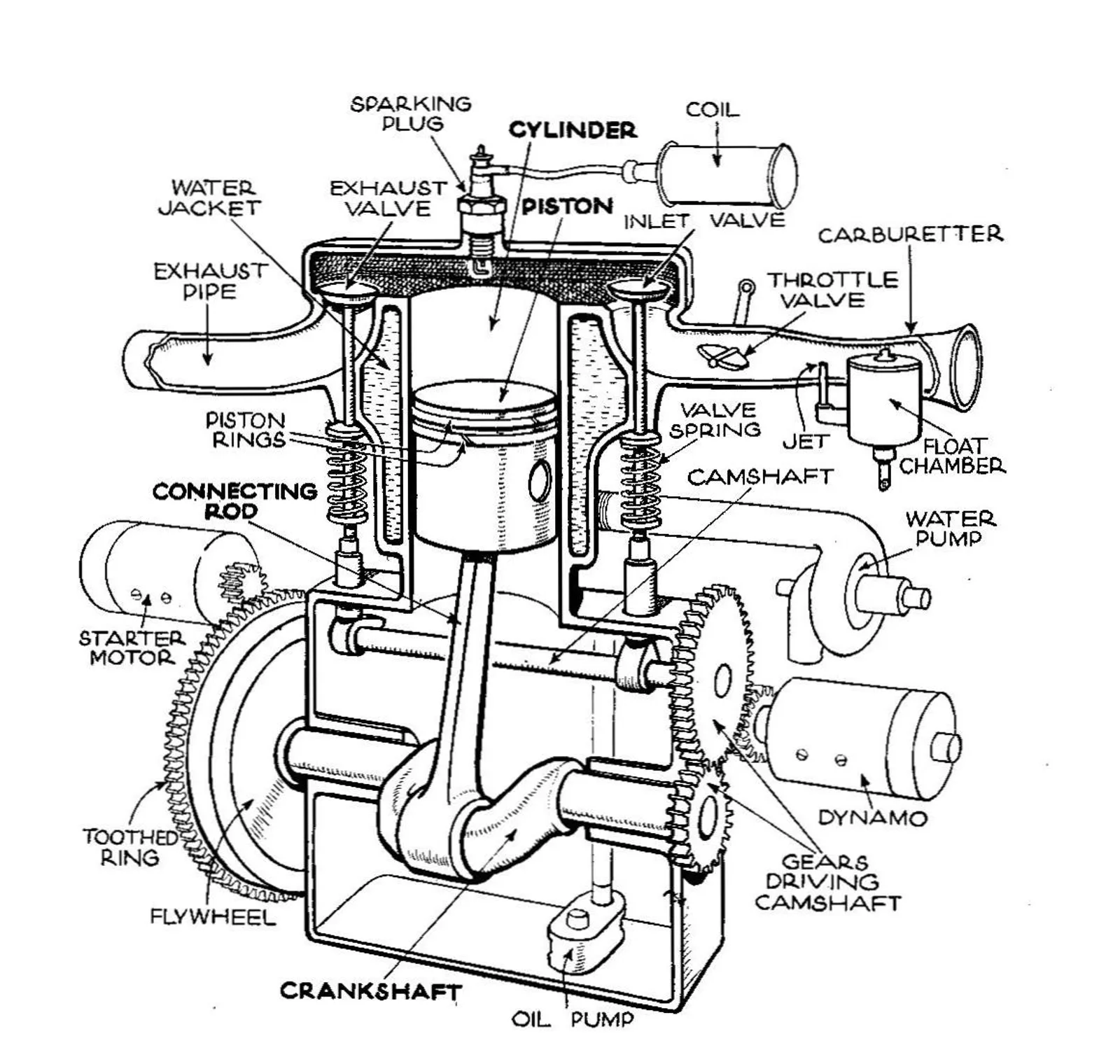
An inlet-over-exhaust engine, known in the United States as an F-head, is a four-stroke whose valvetrain mixes two layouts. The inlet valves sit in the cylinder head, driven overhead, while the exhaust valves sit as side valves in the engine block.
The inlet valves are worked by rocker arms that reverse the motion of the pushrods, so they open downward into the combustion chamber. The exhaust valves lie beside the cylinder with their faces pointing upward, driven by the camshaft through a tappet and an integrated stem and pushrod. Offset to one side, the valves seemed to sit in a pocket, which is why IOE engines were also called pocket-valve engines. In effect an F-head borrows its inlet side from the overhead-valve engine and its exhaust side from the flathead.
How the IOE layout began
The earliest IOE engines used atmospheric inlet valves, held shut by a weak spring and sucked open by the pressure difference created as the piston descended. That worked well in slow early engines and was simple and cheap, but as speeds climbed the weak spring could not close the valve fast enough. Stronger springs needed direct mechanical opening, because atmospheric pressure of 15 PSI limits the force suction can deliver, which puts the theoretical limit at a 15 pound (6.8 kg) spring. Makers then added a mechanical system to open the inlet valves, with stronger closing springs, without major changes to the head casting.
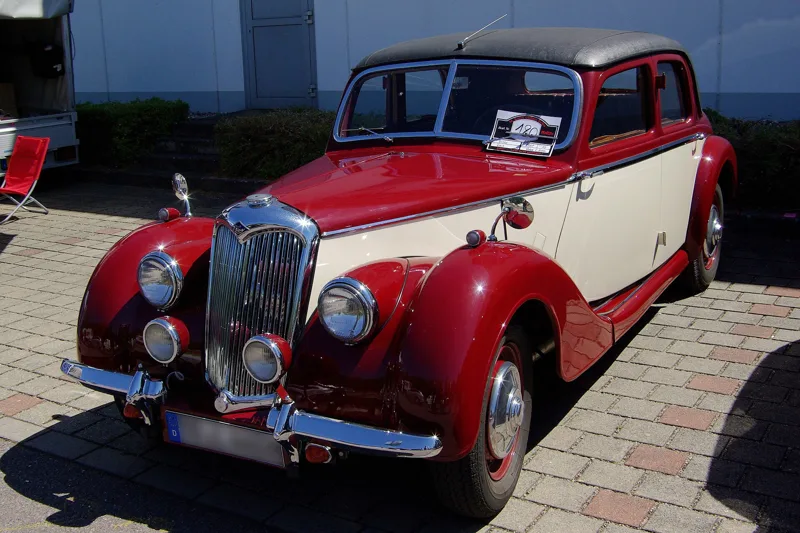
The layout was widely used in early motorcycles. In cars, Willys, Rolls-Royce and Humber made IOE engines, for civilian and military use, and Rover built inline fours and sixes with a particularly efficient version.
IOE advantages and disadvantages
IOE allows larger valves than a sidevalve or an overhead valve engine can fit. It beats the flathead with a compact combustion chamber, a well-placed spark plug, a cooling effect from swirling mixture and better inlet flow.
The drawbacks are real. The chamber shape is more complex than an overhead valve engine's, which affects combustion rates and can create hot spots on the piston, and the valve position is inferior, which hampers efficient scavenging. With rocker arms and pushrods it is also more complex and costly than a sidevalve and physically larger, and it needs an inlet valve and ports in the head.
Which cars used IOE engines?
At the 1923 Olympia Motor Show, Coventry Climax listed four F-type four-cylinder water-cooled engines. All shared a 100 mm stroke, with bores of 59, 63, 66 and 69 mm giving 1,094, 1,247, 1,368 and 1,496 cc. In the early 1930s came the OC, 1,122 cc, producing 34 bhp (25 kW), also built under licence by Triumph; by 1933 it had become the MC, which cooled by thermosyphon without a pump or fan. A six-cylinder development, the JM, displaced 1,476 cc for 42 bhp (31 kW), and the JMC reached 1,683 cc and 48 bhp (36 kW).
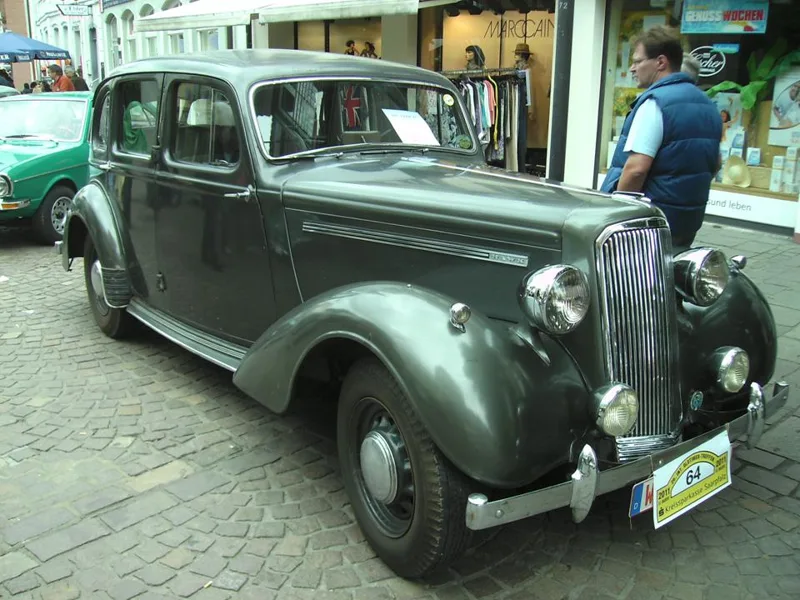
Hudson used an IOE four in its Essex line from 1919 to 1923 and an IOE six in Hudson cars from 1927 to 1929. Humber produced a full range of IOE cars in Coventry, but phased them out at the end of the 1920s for cheaper L-head models shared with Hillman. After World War Two, Willys and later Kaiser-Jeep built versions of the Hurricane engine between 1950 and 1971.
Rolls-Royce used an IOE straight-six, designed just before the war, in the post-war Silver Wraith. It then derived the B series of four-, six- and eight-cylinder engines, the B40, B60 and B80, for British Army combat vehicles, fire appliances and even buses, the B40 powering the Austin Champ. A shorter-stroke car development, the 3909cc FB60, claimed 175 bhp and powered the BMC Vanden Plas Princess 4-litre R, of which more than 6000 were made.
Rover's IOE engine
Rover took the layout furthest. Jack Swaine designed its engine in the mid to late 1940s, and it ran from 1948 until the early 1990s. Where the conventional F-head put ease of manufacture first, this one had a chamber shaped for good burning. The block's top face was cut at an angle, with pitched-roof piston crowns to match, so the piston almost touched the angled inlet valve at top dead centre and produced strong squish. The result was a near-ideal hemisphere, inverted and tilted, with a central spark plug and a short flame path.
The thin layer of gas between piston and inlet valve cut the risk of detonation on poor fuel, one reason it served Land Rover for so long. In the late 1940s and early 1950s, when only low-octane pool petrol was on sale, it also let Rover run higher compression ratios than rivals with side- or overhead valve engines. As a small-bore, long-stroke design it kept the RAC horsepower rating, and so the road tax, low, and IOE let Rover fit larger valves than a small bore would normally allow.
The family covered straight-fours of 1.6 and 2.0 litres and straight-sixes from 2.1 up to 3.0 litres, and powered the P3, P4 and P5 models, with 1.6 and 2.0 versions used in early Land Rovers. Output ran from 50bhp in the Land Rover 1.6 to 134bhp in the P5 3 litre Mk II and III. The 2.6 six had a particularly long career: after the P4 saloon it went into long-wheelbase Land Rovers from 1963, in the 2A Forward Control and then the bonneted 109 in 1967, and stayed an option until 1980, when the Rover V8 replaced it. A similar inverted hemi chamber with pitched-roof pistons appeared earlier in the 1930 Van Ranst Packard V12, though that engine had both valves in the block and a poorly placed spark plug.
Exhaust over inlet
A few engines reversed the arrangement, with the exhaust valve overhead and the inlet valve down in the block. The Ford Quadricycle of 1896 was one, and the ABC Skootamota began production with the layout before switching to overhead valves. The Indian Four tried it in 1936 and 1937: in theory it improved fuel vaporisation, and the engine was more powerful, but it made the head very hot and the exhaust valve linkage needed frequent adjustment, so the design went back to IOE in 1938.
Where this goes next
Neither layout dominates today. Most modern automotive engines use overhead cams acting on flat tappets, and the quest for faster valve action has moved to cam profile and spring design. Desmodromic valves live on in Ducati's top production motorcycles, which have used them since 1968, while the best-known IOE car engine, Rover's, ran until the early 1990s, with its 2.6 six leaving Land Rover production in 1980.