Speakers that play a synthetic engine note, a Porsche pipe that works like a bottle, and a steel diaphragm buzzing hundreds of times a second: the engineering behind what a car sounds like.
Active sound design uses speakers, filters and sensors to cancel unwanted noise and add synthetic engine sound from live rpm and torque, which also gives electric cars an identity and pedestrian warning. Car horns work by a diaphragm buzzing hundreds of times a second.
Owners of recent BMWs have found a whole genre of online video that shows, step by step, how to switch off the engine sound. They felt cheated. The note coming from the speakers was partly composed by software, and they could tell.
Carmakers now build noise on purpose, from synthetic engine notes to the pitch of a horn. Some of it goes back more than a century and some is written in code. All of it answers the same question: what should a car sound like, and who gets to hear it?
What is active sound design in a car?
Active sound design, or ASD, is the use of acoustic technology to change or improve the sound both inside and outside a vehicle. It draws on active noise control and on acoustic enhancement to arrive at a synthesised result. The approach varies from simply amplifying or reducing a sound that already exists to creating an entirely new one, and there is no unified model. Each manufacturer uses its own software and hardware, and the systems go under different names: Acura's Active Sound Control, Kia's Active Sound System, Volkswagen's Soundaktor and the Acoustic Management System from the software firm QNX.
The demand comes from two directions. Smaller engines and tighter environmental limits have made the inside of a combustion car less pleasant to listen to, because efficient engines are less audibly appealing. Electric and hybrid cars have no distinct engine sound at all, only a quieter high-frequency noise that annoys passengers and puts pedestrians at risk if they do not recognise an approaching car. Customers want a better interior sound, and makers want a brand sound inside and out that is recognisable and reduces the safety risk.
The old way to tame noise was mechanical. Balance shafts and sound-deadening material added manufacturing time and cost. ASD cuts both, because the sound does not have to be built into the engine structure. It can be settled late in development and tuned to the finished vehicle.
The note coming from the speakers was partly composed by software, and they could tell.
How does engine sound enhancement work?
Engine sound enhancement, or ESE, is the part of ASD that makes the fake engine sound. It composes synthetic noise from live engine data, such as revolutions per minute and torque, and plays it through speakers inside the cabin or outside the car. Makers can use it to enhance the perceived power of an engine without the mechanical changes that other methods would need.
The physics starts with the cylinders. They fire periodically, so their noise can be reduced to a series of sine waves, in the manner of a Fourier transform. The waves are set by the speed of the crankshaft and by the firing order. In a cabin, some of the harmonic orders of the engine sound are missing, and digital signal processing can put them back.
To find the missing orders, the system first has to know how hard the engine is working. In older vehicles acceleration sensors on the engine tell it, and in modern cars the information arrives over the controller area network bus. Dynamic band-pass filters, which let only chosen frequencies through, pass the missing orders. To stop disruptive clicks during the handover, the signal runs through cascading high-pass and low-pass filters. Adapted to the engine speed signal, the orders are then amplified through the firewall, which is the body panel between the engine and the interior, and through the car's sound system.
ASD takes in more than engine data. Its inputs include vehicle speed, pedal position, exhaust noise and vibration, and different systems pick one or several of these. In passive sound generation, signals from the engine are relayed into the cabin. Passive and active generation takes the exhaust input and amplifies it into a new output for the exterior noise. Active mounts take inputs from outside the car and turn them into vibration for the interior, and synthetic sound is generated through the car's stereo.
Can a car cancel noise as well as add it?
It can. Active noise cancelling, or ANC, is a software process that uses hardware already in the infotainment system to remove unwanted sound from the cabin. Sensors identify the unwanted audio signals, which are then filtered out, a technique known as harmonic order reduction. The first in-vehicle system was developed by Lotus and appeared in the 1992 Nissan Bluebird. In 2009 Lotus teamed up with Harman International on an improved system that removed noise from the road, the tyres and the chassis. Manufacturers may use ANC to improve the effect of ASD.
How do BMW, Kia and Porsche shape the sound?
In models such as the BMW M5, the engine management system filters the audio data it receives to enhance the sounds that come from speed and engine power. The driver can choose a setting that changes both the interior acoustics and the actual performance of the car.
The Kia Stinger offers eco, comfort, smart, sport and custom modes, which adjust how loud and aggressive the cabin sound is. Its turbocharger forces extra compressed air into the engine, which creates a consistent, clean sound output.
Porsche goes at it with plumbing. Its system combines a Helmholtz resonator with what it calls a sound symposer to carry engine noise straight into the cabin. The resonator works through an electronically controlled valve that resonates with the air in the way a bottle does when you blow across its mouth. The symposer is a run of plastic tubing with a membrane and a flap valve. Pressing the Sport button opens both fully to amplify the engine sound inside.
For most drivers none of this registers. It is only with recent BMWs, as the online videos suggest, that consumers have complained about a false-sounding synthetic noise.
Why do electric cars need a designed sound?
An electric or fuel cell car has no combustion note to lean on, so makers often use virtual, synthetic sounds to fill the gap. To get them right, they have to take account of psychoacoustics, the study of what listeners prefer. Studies of preference inside vehicles led makers to reduce increases in loudness and high-frequency content. In many modern EVs the stock noise is masked with a low-pass-filtered sound that follows engine speed and is based on real parameters such as speed and load.
A simple-integer ratio technique for harmonic orders is applied to this virtual noise, and subharmonics, which are lower-frequency copies, are isolated from the original high-frequency components. When people evaluated several generated sounds, they judged the subharmonics preferable for the interior of an EV.
A brand sound needs more than one tone, because combustion cars respond to the way they are driven. A base sound signature is built from sub-signatures and micro-signatures, which can be assigned to load, speed or particular manoeuvres and so make the sound more dynamic. Synthesising micro-signatures in an EV drivetrain gives a result that is richer and more emotional than the bare base frequencies.
The difficulty is that an EV behaves differently. With a single gear and its arrangement of power converters, the frequency of sound changes very little during acceleration, and it matches the speed and load badly. The missing engine noise also leaves a spectral gap between wind and road noise, and individual components of the vehicle become more audible, lowering the sound quality in the cabin. Makers must choose between reproducing the sound of a combustion engine and creating an entirely new sound concept.
Imitating a combustion engine has its own limit. Current systems may not reproduce the variations in the microstructure of combustion from one cylinder firing to the next. The force from the cylinders is periodic, but it varies from one cycle to another, which makes it impossible to replicate the natural component of engine noise.
What does a car horn do and how does it make its noise?
A horn lets a driver tell other road users that a vehicle is there or coming, or draw attention to a hazard. Some countries require motor vehicles, ships and trains to carry one by law. In many places public transit vehicles and even bicycles must have an audible warning device.
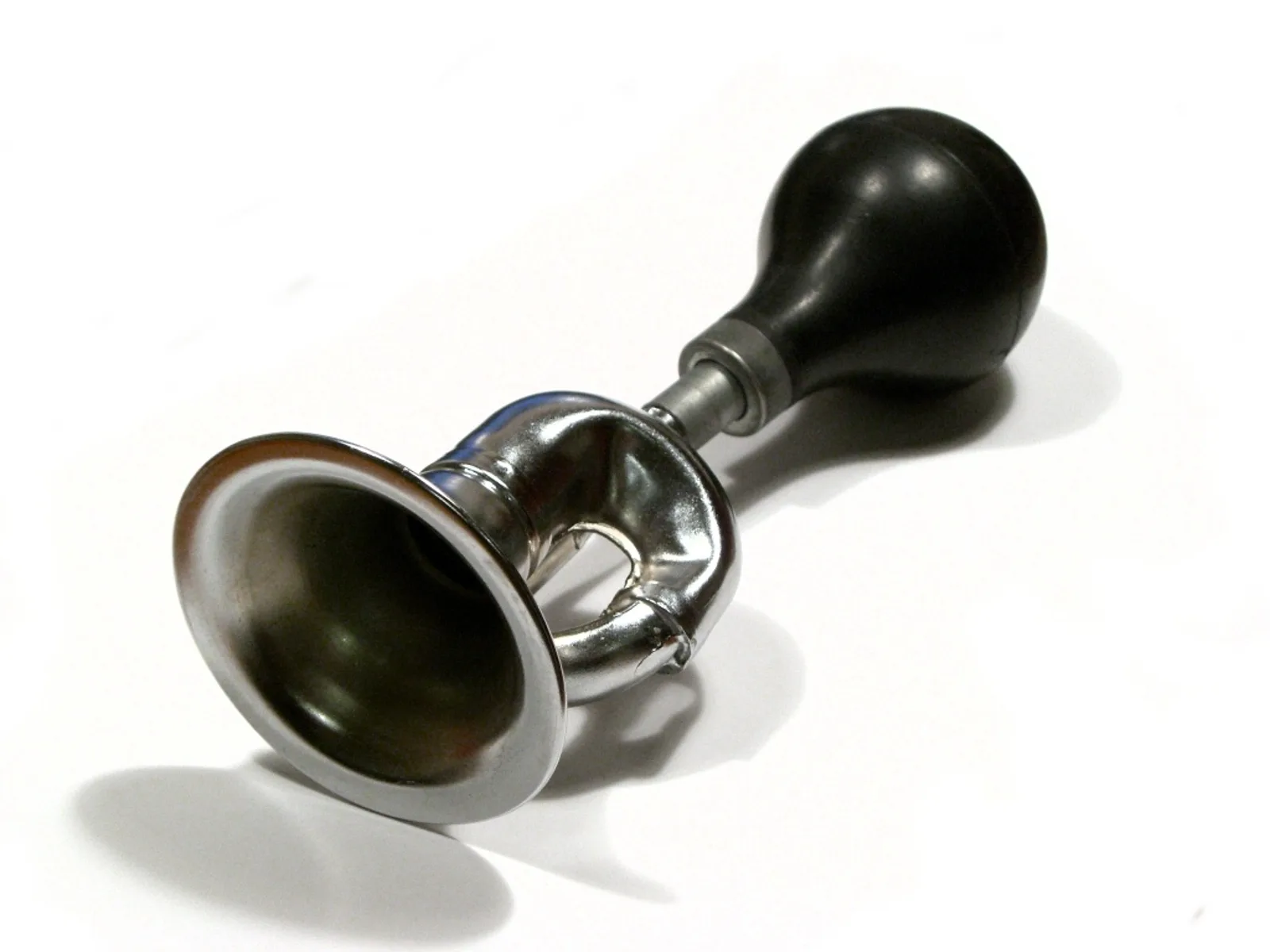
The usual car horn is electric. A flat circular steel diaphragm has an electromagnet pulling on it one way and a spring pulling the other. Contact points fixed to the diaphragm break the current to the magnet, so the spring returns the diaphragm and closes the circuit again. This sequence repeats hundreds of times per second, producing a buzz like an electric bell, and the buzz then passes into a horn that amplifies it.
In the traditional design the horn body includes an expansion chamber, formerly spiral in shape, which matches the diaphragm better to the open air and so transfers the sound energy more effectively. Cars often carry horns in pairs, because two different frequencies are more noticeable to the human ear than two of the same, especially where background noise is high. A typical pair sounds at 500 Hz and 405-420 Hz, roughly B4 and G#4, a minor third.
Most cars, motorcycles and scooters now use a cheaper and smaller design. It keeps the name but drops the horn ducting and gets its volume from a larger flat diaphragm. Some designs have a horn grille.
How loud are horns, and at what pitch?
| Horn | Sound level | Frequency |
|---|---|---|
| Traditional electric car horn (5-6 A) | 107-109 dB | Pair at 500 Hz and 405-420 Hz |
| Flat-diaphragm car horn (2.5-5 A) | 109-112 dB | Pair at 420-440 Hz and 340-370 Hz |
| Truck and bus air horn | 117-118 dB | 125-180 Hz |
| Train horn | 146-175 dB | Lower than road vehicles |
| Ship's horn, vessels over 200 m | Heard up to fifteen kilometres | 70-200 Hz |
Big air horns on trucks and buses are supplied by compressors or by the reservoirs that charge the air brakes. The air is forced past a diaphragm in the throat of the horn. Two are usually fitted, at different frequencies.
Trains need to be heard from much farther away, so locomotives carry pneumatic horns that are both louder and deeper than a road vehicle's. They run on compressed air from the brake system. In the United States a train horn must measure between 96 dB and 110 dB at 100 ft (30 m) ahead of the locomotive. To set them apart from truck and bus horns, American train horns are clusters of two to five horns, known as chimes, each on a different note so that together they make a chord. In Japan, most modern trains from the first half of the 1990s onward, such as the 209 series and E233 series, use electric horns as their main warning, though air horns had been the norm before that.
Ships use air horns, sometimes called whistles, driven by compressed air or by steam tapped from the power plant. They use low frequencies because those travel further, and horns from ships have been heard from as far as fifteen kilometres (ten miles). Traditionally, the lower the pitch, the bigger the ship. The ocean liner RMS Queen Mary, launched in 1934, carried three horns built around 55 Hz, a note picked because it sat low enough for such a loud blast not to hurt passengers' ears. Modern International Maritime Organization rules set the horn range at 70-200 Hz for vessels over 200 m (660 ft), 130-350 Hz for vessels from 75 to 200 m (250 to 660 ft) and 70-700 Hz for those under 75 m (250 ft).
What is a klaxon?
A klaxon is an electromechanical horn, the origin of the sound often written as "awooga". It began as a brand name. Inside, a spring-steel diaphragm carries a central rivet that the teeth of a spinning cogwheel hit over and over, and a horn on the diaphragm shapes and aims the sound. The earliest klaxons turned the wheel by hand or with an electric motor.
In 1908 Miller Reese Hutchison, an American inventor who would become Thomas Edison's chief engineer, patented the mechanism. The Lovell-McConnell Manufacturing Company, based in Newark, New Jersey, acquired the rights, and the klaxon became standard equipment on General Motors cars. The company's founder, Franklyn Hallett Lovell Jr., took the name from the Ancient Greek verb klazo, meaning "I shriek". Klaxons were first fitted to cars and bicycles in 1908. They ran at first on six-volt dry cells, and from 1911 on rechargeable batteries. Later hand-powered versions served as military evacuation alarms and factory sirens, and from the Second World War they were used as submarine dive and surface alarms.
Solid-state electronic alarms have largely replaced mechanical horns of this kind, yet the tone has persisted. The word itself has travelled. In Japanese, French, Italian, Greek, Dutch, Russian, Polish, Spanish, Romanian, Bulgarian, Czech, Turkish, Indonesian and Korean, and in some Arabic dialects, it now means a car horn in general.
When may a driver sound the horn?
In countries that follow the Vienna Convention on Road Traffic, audible warnings are limited to two cases: to avoid an accident, and, away from built-up areas, to tell the driver ahead that an overtaking manoeuvre is under way.
Horns have found a place in music. George Gershwin wrote four taxi horns into his 1928 orchestral piece An American in Paris. In Gyorgy Ligeti's opera Le Grand Macabre, two Car Horn Preludes are scored for 12 bulb horns, each tuned to a pitch. The hornophone is a set of bulb horns tuned chromatically and mounted like the bars of a xylophone, and the klaxophone does the same with klaxons. Too Many Zooz built the song Car Alarm around a honking horn, and Van Halen's Runnin' With The Devil opens with recorded car horns that swell and are then slowed to drop the pitch.
Where this goes next
For electric and fuel cell vehicles, manufacturers have yet to settle the basic question of what the car should sound like. They can reproduce a typical combustion engine sound or build an entirely new sound concept, and either way the sound now has to carry a brand identity as well as a safety role. For combustion cars, the aim is the same as ever: to improve the reception of the car by lifting the quality of its interior and exterior sound.