Switzerland sells only an annual sticker, Austria fines 240 euros plus a substitute toll, and Norway has no manual toll stations left. How Europe charges for its roads.
A vignette is a time-based motorway charge, usually a windscreen sticker or electronic record, used in nine European countries from Austria to Switzerland. Toll roads charge by distance instead, and Norway differs by running tolls entirely through AutoPASS tags and photographed number plates, with no manual toll stations.
A visitor who drives Switzerland's motorways for a single day pays the same 40 francs as a resident, because the country sells only an annual pass. In Norway, by contrast, no staffed toll station survives at all. Europe's road charges run from windscreen stickers to number-plate cameras.
What is a motorway vignette?
A vignette is a road charge based on how long a vehicle may use the road, rather than how far it travels. It is usually paid on top of compulsory road tax, and most countries issue it as a windscreen sticker or an electronic record.
The term dates from 1950s France, where the stickers had nothing to do with motorways and have since vanished. The idea took hold across Central Europe and Italy. Today Switzerland, Slovenia, Slovakia, Romania, Moldova, Hungary, the Czech Republic, Bulgaria and Austria all use them. Bulgaria, the Czech Republic, Hungary, Romania, Slovakia and, since 2021, Slovenia have swapped their stickers for electronic vignettes. Coverage differs: Moldova requires one for any road, Bulgaria and Romania for any road outside urban areas, and the rest only for motorways and expressways.
An annual passenger car vignette costs between 30 and 150 euros depending on the country. Every vignette country except Switzerland sells short-period versions to visiting or transiting vehicles. They are normally on sale at border crossings and petrol stations, and a lost or wrongly used one is usually not refunded. Stickers are made so that peeling and reapplying them destroys them, so they cannot serve a second vehicle. Roadside cameras monitor traffic, border guards and national police check vignettes, and fines tend to be heavy. Tunnels and bridges often add their own tolls.
Nine European countries sell time, many others charge by distance, and Norway has no manual toll stations left.
How the vignette countries compare
| Country | Format | Where it is required | Penalty or note |
|---|---|---|---|
| Austria | Sticker since 1997, electronic option since 2019 | Motorways and expressways, vehicles up to 3.5 tonnes | 240 euros plus a substitute toll |
| Bulgaria | Electronic | Public roads outside settlements, vehicles under 3.5 tonnes | Heavier vehicles pay a distance-based toll |
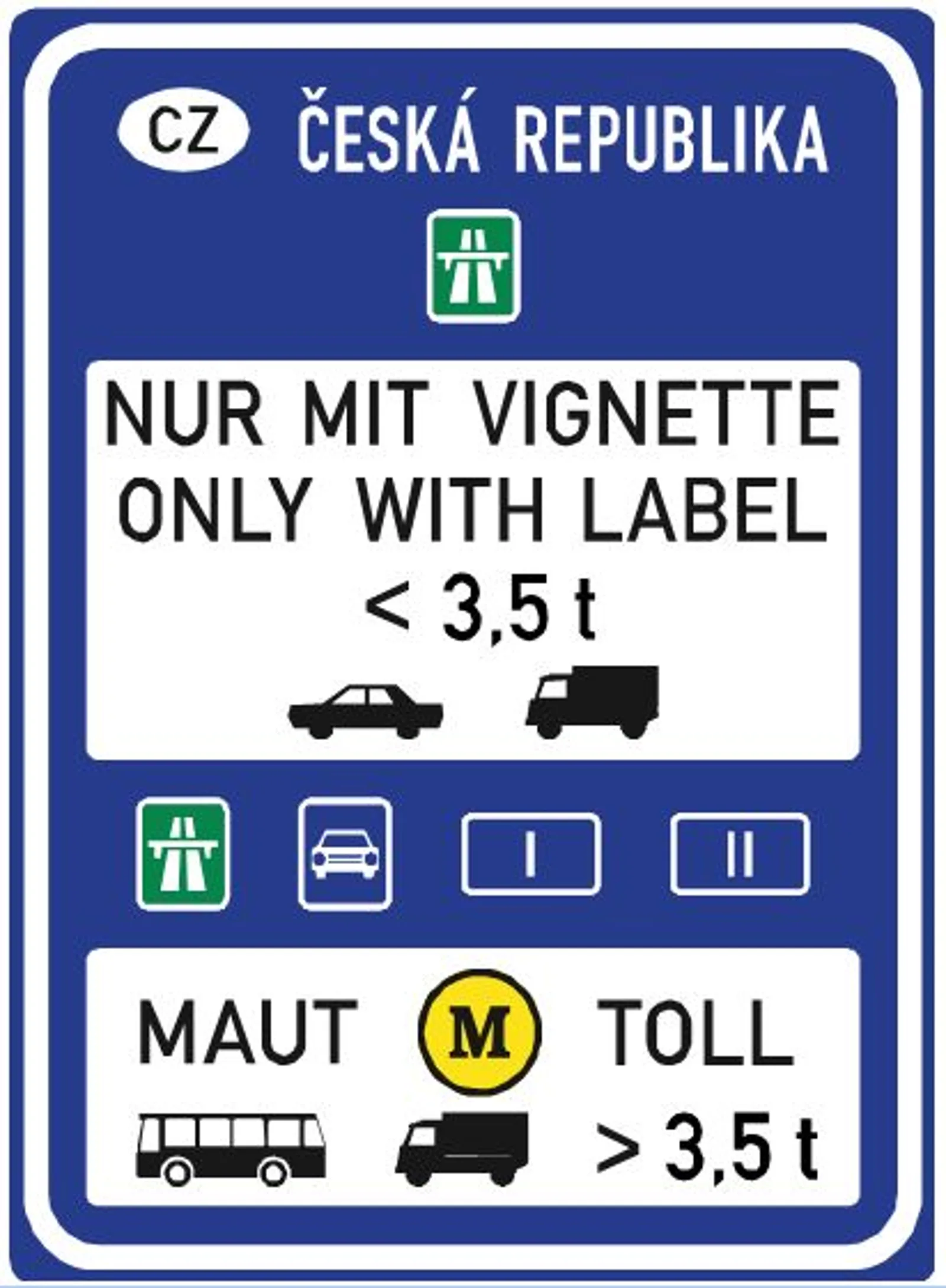
| Czech Republic | Digital by 1 January 2021 | Motorways and expressways, up to 3.5 tonnes | 80 to 200 euros |
| Hungary | Electronic since 1 January 2008 | Every motorway | 50 to 200 euros |
| Moldova | Electronic | Any public road, foreign-registered personal vehicles | 125 to 375 euros |
| Romania | Electronic since 1 October 2010 | National roads and motorways | 100 euros or more |
| Slovakia | Electronic since 1 January 2016 | Motorways, up to 3.5 tonnes | 100 to 500 euros |
| Slovenia | Electronic since 1 December 2021 | Motorways, up to 3.5 tonnes | 300 to 800 euros |
| Switzerland | Sticker since 1985, e-vignette from 1 August 2023 | Motorways and expressways | 200 francs plus the annual vignette |
How much does a vignette cost?
It depends on the country and the period. In Austria in 2017, a twelve-month sticker for a car or motorhome up to 3.5 tonnes cost 86.40 euros, a two-month sticker 25.90 euros and a ten-day sticker 8.90 euros.
Motorcycles paid 34.40, 13.00 and 5.10 euros for the same periods. Bulgaria in 2017 charged 97 leva for an annual vignette valid until 31 January of the following year, 30 for a month and 15 for a week. In 2024 the Czech Republic priced vehicles under 3.5 tonnes at 2,300 koruna for a year, 430 for a month, 270 for ten days and 200 for a day. Switzerland, with a single annual product at 40 francs, or around 43 euros, is the dearest vignette in Europe for passenger cars passing through or visiting, because every other country sells cheaper short-term options.
Why is Austria so strict about vignettes?
Since 1997, vehicles up to 3.5 tonnes need one on motorways and expressways with the prefix A or S. Federal motorway administration staff known as toll sheriffs, along with the police, check them, and the penalty is a 240 euro fine plus a substitute toll.
Unpaid fines escalate to penalties between 300 and 3,000 euros, and officials may confiscate a foreigner's vehicle to guarantee payment. Some sections also have tollgates and video tolling, and some require electronic toll cards. Vehicles over 3.5 tonnes have used distance-based GO-Boxes since 1 January 2004, and electronic vignettes arrived alongside stickers in 2019. Special-toll tunnels and bridges are in theory free of the vignette duty, though most are reached by motorway, which makes the exemption mostly academic.
How did Switzerland's vignette start?
It began on 1 January 1985 after a successful referendum the year before. The scheme was meant to last ten years, but a follow-up referendum in 1994 made it permanent.
Roland Hirter designed the sticker, showing a green motorway symbol, the year in two digits and a coloured backdrop, and his son Thomas designed the e-vignette introduced on 1 August 2023. Driving the motorways without a valid vignette breaks the Public Highways Act and brings a fine of 200 francs plus the obligatory purchase of the annual vignette. The annual product runs from December of the preceding year to January of the following year. Heavy vehicles pay a performance-related charge on all roads and have been tolled since January 2001 if over 3.5 tonnes.
Where does Europe charge by distance instead?
Much of Europe uses tolls that rise with the length of the journey. Italy was first, charging with a 50 km stretch of motorway outside Milan in 1924, followed by Greece in 1927, then France, Spain and Portugal in the 1950s and 1960s, who built motorways with concessions.
Tolls have a long English pedigree. They were common on roads and bridges in the 12th century, turnpike trusts appeared in 1706, and by the mid-1830s more than 1000 trusts controlled 35,000 km of main road. The railways ended the era, and from the 1870s Parliament stopped renewing the acts. Modern tolls mostly pay for construction, with bonds repaid from user charges, and operators typically maintain the road until the bonds are cleared, after which it usually reverts to the government.
Croatia runs a closed system: drivers take a ticket on entering and pay on leaving, in proportion to distance and vehicle group. Its first motorway, between Zagreb and Karlovac, opened in 1972, and about 1,306.5 km (811.8 mi) are tolled as of 2020, run by three concessionaires. Italy tolls only its autostrade, either by distance or by flat rate, collecting payment at the exit even when the operator changes; city beltways and an ANAS-run stretch of the A3 are free. Greece has 2133 km of tolled motorway and Ireland has eleven tolled schemes, with car tolls from 1.65 to 12 euros. Finland has no toll roads at all, and Germany keeps autobahns free for lighter vehicles.
How do Hungary and Bulgaria run their electronic vignettes?
Both have dropped physical stickers. Hungary has run its system electronically since 1 January 2008, and the only item a buyer receives is a control coupon, because roadside cameras check licence plates against a register of valid vignettes.
Every Hungarian motorway is tolled and run by National Toll Payment Services, including the M0 half ring around Budapest and the M2 and M15, where most sections need a vignette even though the roads are divided multilane. Ten-day, monthly and yearly versions allow unlimited trips within their validity, and buyers are told to keep receipts for at least half a year. Bulgaria's electronic vignettes can usually be bought in person at border crossings, at most petrol stations, post offices and some banks, or online through the National Toll Administration. Most start when they are bought, but some types can be set to begin on a later date.
How does the European Union regulate tolls?
Mainly for heavy lorries. The Council began collecting data on road charging in the 1960s, and Directive 1999/62/EC, known as the Eurovignette, set the legal basis for tolls on lorries over 12 tonnes, limited to infrastructure costs.
Directive 2006/38/EC widened it. It lets member states vary tolls by distance, place, vehicle, time of day and congestion, requires them to include all vehicles over 3.5 tonnes after 2012 and to differentiate by environmental performance after 2010. The Commission has proposed a further amendment that would let states add air and noise pollution to heavy vehicle tolls and charge for congestion at peak times. A separate agreement from 1994, signed by the Netherlands, Luxembourg, Germany, Denmark and Belgium, created a shared vignette system for trucks, with Sweden joining by protocol in 1997. Germany left it in 2017, Belgium in 2019 and Denmark in 2024.
National truck systems followed: Switzerland in January 2001, Austria in January 2004, and Germany on 1 January 2005 with the satellite-based Toll Collect scheme. Hungary began charging lorries over 3.5 tonnes on 1 July 2013 and Latvia on 1 July 2014.
How do tolls work in Norway?
Through the AutoPASS system, run by the Norwegian Public Roads Administration. No manual toll stations remain, and drivers fit a radio transponder on the windscreen and sign a contract with a toll service provider.
Tolls have funded Norwegian bridges, tunnels and roads for a long time. Oslo, Bergen and Trondheim built toll rings between 1986 and 1991 to discourage urban traffic and pay for projects, and rings now surround Oslo, Kristiansand, Stavanger, Haugesund, Bergen, Askoy, Bodo, Harstad, Grenland, Forde and Trondheim. Some tolls use congestion pricing or rates tied to emissions. A vehicle that passes without a valid tag is photographed. Operators bill Norwegian-registered vehicles directly, while foreign plates are billed through Epass24.
For visitors there is a Visitors' Payment scheme. Registration is optional, but a foreign vehicle going through an environmentally differentiated toll is charged the highest rate unless its Euro class and fuel type are registered, and signing up usually shortens the wait for an invoice. A hire-car renter should register the car, or the invoice goes to the car's owner, the rental company, which may add administration fees. Vehicles over 3.5 tonnes used for business or registered to a business or public body must have a valid tag or agreement.
What discounts does Norway's system give?
A tag brings savings. Vehicles in price group 1 with an electronic tag and valid agreement get an automatic 20 per cent discount, while group 2 gets none. Visitors' Payment carries no such benefits.
Zero-emission cars, meaning electric and hydrogen vehicles in group 1, pay at most 50% of the ordinary fee after discount, so a 10 krone toll becomes 8 with a tag and no more than 4 for a zero-emission car. A tag and agreement are needed, except in the environmentally differentiated tolls of Oslo and Akershus and of Bergen, where the agreement adds the ordinary tag discount to the reduced zero-emission price. On ferries, AutoPASS customers with a tag and agreement get 10% off, and a prepaid ferry account brings 50% off for vehicles (40% for corporate accounts) and 17% for passengers at manual payment crossings.
A reform proposed by Prime Minister Solberg's cabinet aimed at fewer operators, separating toll and ferry ticket services from the operators, an interest compensation scheme for toll loans and simpler prices. It created regional operators owned jointly by the counties: Bompengeselskap Nord, Vegamot, Ferde, Vegfinans and Fjellinjen.
What is changing in European road charging?
Norway's reform of the toll sector is described as ongoing, and zero-emission toll charges are being introduced in a growing number of projects. Norway's road administration also left the EasyGo partnership in December 2021, with a transition until 31 March 2022, after which toll service providers need EETS registration and operator approval.
Elsewhere, Slovakia has exempted motorways that bypass or cross cities, such as the D4 ring around Bratislava, from 1 August 2024, and Bulgaria launched a tender in April 2016 for electronic tolling of vehicles over 3.5 tonnes on all roads.