One joule of electricity can deliver 28 joules of heat in theory. The physics behind the EV heat pump, how it compares with a resistive heater, and why cold hits an electric car twice.
An EV heat pump warms the cabin by moving heat in from outside rather than generating it. For each 1 kWh of electricity a heat pump can deliver 1 to 4.5 kWh of heat, while a resistive heater gives no more than 1 kWh, which spares the battery in winter.
In theory, one joule of electricity can put 28 joules of heat into a room. Nothing about that breaks the laws of physics, because the machine doing it is not making the heat. It is carrying it in from outside, and carrying turns out to be far cheaper than creating. That is the idea behind the heat pump, and it is why the device matters to anyone who drives an electric car through a cold winter.
Why does winter hurt an electric car?
A battery electric car draws its energy exclusively from an on-board pack. It has no fuel tank, and hybrids differ because they carry a combustion engine next to the motors. Everything a battery electric car does, it does on stored electricity, so warming the cabin is one more call on the same supply that turns the wheels.
The pack has its own troubles in the cold. Lithium nickel manganese cobalt oxide cells, known as NMC and the most common type in electric cars, are sensitive to temperature, weaker at delivering power when it is cold, and prone to losing performance as they age. Early cells would neither take nor give charge when extremely cold, and in some climates heaters are fitted to keep them warm.
Other chemistries cope differently. Lithium titanate cells work effectively across a wide temperature range and have a high safety profile, though they hold less energy than other lithium-ion types. Lithium iron phosphate cells are cheaper, safer and more sustainable than NMC, but give a shorter range. Older designs show the other extreme: nickel-metal hydride cells perform poorly below -20 degrees C, while the Zebra battery, used in early electric vehicles between 1997 and 2012, had to be heated to about 270 degrees C (518 F) to work, so cold weather hardly affected it beyond adding to its heating costs.
A heat pump does not make warmth; it carries it, and carrying is far cheaper than creating.
What is a heat pump?
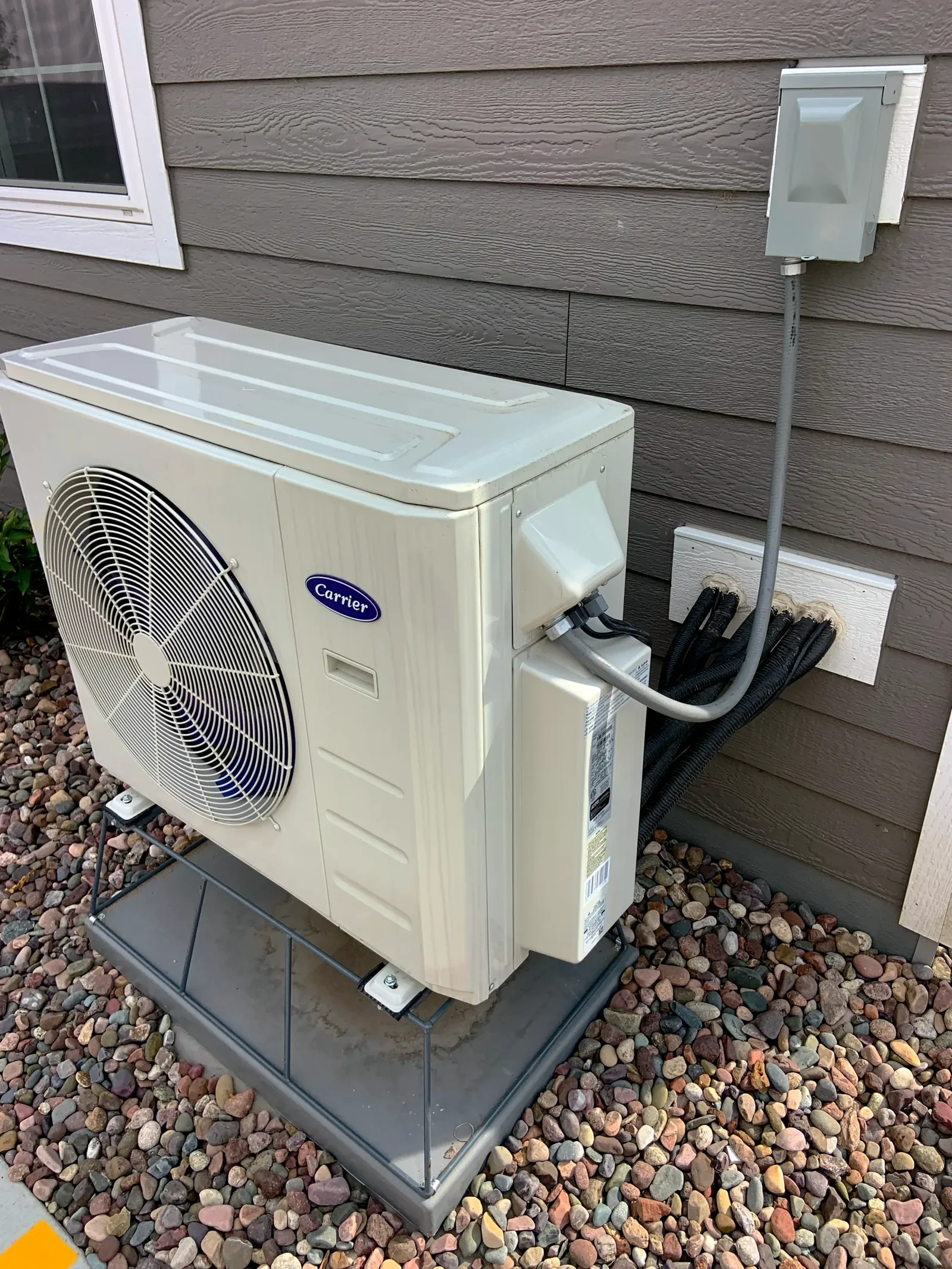
Put simply, a heat pump shifts warmth from one place to another using energy. The mechanical type, which is the kind relevant to cars, runs on electric power and a refrigeration cycle, cooling one space while warming the other. In winter it can pull warmth out of the cold outdoors and push it into the warm space inside. In summer it can run the other way and behave as an air conditioner.
Think of it as a pump in the plain sense of the word. Water will not run uphill unaided, and heat will not flow from a cold place to a warm one unaided either. It can be made to flow that way if work is done on it. Here is the useful part: the effort of shifting heat is usually well below the heat that arrives.
How does the cycle work?
Most heat pumps are the vapour-compression type, and the cycle goes round in four steps.
- A gaseous refrigerant is compressed, which raises its pressure and temperature.
- The warm gas runs through a heat exchanger inside the space being heated. Some of its thermal energy passes into that space, and the gas condenses into a liquid.
- The liquid flows to a heat exchanger outdoors, where the pressure falls and the liquid evaporates. Its temperature drops as it does so.
- The refrigerant is now colder than the outdoor air, so it can take up energy from that air. It is compressed again and the cycle repeats.
A reversing valve changes the direction in which the refrigerant travels, which is how the same machine can deliver either heating or cooling. Air-source models are the most common, and the family also includes ground-source, water-source and exhaust-air designs.
What does the coefficient of performance mean?
It is the number that sums up how well a heat pump is doing at a given moment. The work the compressor does equals the heat delivered divided by the coefficient of performance, or COP. A heat pump's COP is above one, so the work put in is less than the heat released, which makes it more efficient than heating by electrical resistance.
The headline figures are these: for each 1 kWh of electricity, a heat pump can move between 1 and 4.5 kWh of heat into a building. A resistive heater converts what it is given into heat at one for one, and no more.
The COP is not fixed. As the temperature on the hot side rises, the COP falls, and more work is needed for each unit of heat moved. An ideal heat pump, running on the reversed Carnot cycle, shows how steeply:
| Heater | Conditions | Heat delivered per unit of electricity |
|---|---|---|
| Electric resistance heater | Any | 1 unit |
| Real-world heat pump | Typical range | 1 to 4.5 kWh per kWh |
| Ideal heat pump | Outside 270 K (-3 C), inside 280 K (7 C) | 28 joules per joule (COP of 28) |
| Ideal heat pump | Outside 270 K (-3 C), inside 300 K (27 C) | 10 joules per joule (COP of 10) |
The wider the gap between the outside air and the space being heated, the lower the figure. With the outside at 270 K and the inside at 280 K, a single joule of work yields 28 joules of heat, with 27 of them moved from the cold side. When the inside climbs to 300 K, each joule moves 9 joules out of the cold and adds 10 to the interior.
These are theoretical figures, and real machines deliver less. An outside unit installed where there is too little airflow is one example of how practice falls short. Wider sharing of data with owners and researchers, perhaps from heat meters, could lift efficiency over time.
What does the reversible design cost?
A heat pump that can also cool has to make a compromise. Its two heat exchangers, the condenser and the evaporator, swap jobs when the valve flips, so each is tuned to work adequately in both modes. As a result, a reversible unit's seasonal efficiency rating is typically slightly lower than that of two machines each optimised for a single task.
Ratings put numbers on the spread. In the United States a unit needs at least 14 SEER to earn an Energy Star rating, and 18 SEER or above counts as highly efficient. The best heat pumps made reach up to 24 SEER. A related measure, the seasonal performance factor, divides the heat delivered in a year by the electricity consumed, which makes it the average COP over the year.
A heat pump is a 170-year-old idea
William Cullen demonstrated artificial refrigeration in 1748, and Jacob Perkins patented a practical refrigerator using dimethyl ether in 1834. Lord Kelvin described the theory behind heat pumps in 1852. Between 1855 and 1857, Peter von Rittinger developed and built the first one, a small pilot plant for salt works, and in 1877 Switzerland's first, installed at the Bex salt works, followed.
In 1928 the Slovak engineer Aurel Stodola designed a water-source system for Geneva City Hall, using Lake Geneva as its supply of heat. Ten years later came a 100 kW system for Zurich City Hall that drew on the Limmat river. Coal shortages pushed Swiss firms to build roughly 35 of them from 1937 to 1945. One, built by Escher Wyss in 1937/38 as the successor to the wood stoves at Zurich City Hall, heated the building for 63 years until 2001.
In 1945 John Sumner installed an experimental water-source system in Norwich, fed by a nearby river. Its seasonal efficiency ratio was 3.42, with an average delivery of 147 kW and a peak of 234 kW. Robert C. Webber is credited with building the first ground-source heat pump in 1948. The Royal Festival Hall in London opened in 1951 with a reversible water-source unit fed by the Thames, the first large-scale installation, providing winter heating and summer cooling.
What other kinds of heat pump exist?
Water-source machines work like ground-source ones but draw heat from a body of water, which must be big enough to withstand the cooling effect without freezing or harming wildlife. The biggest, in the Danish city of Esbjerg, dates from 2023. Exhaust-air models extract heat from the stale air leaving a building.
Not every design uses a refrigerant. A thermoacoustic heat pump needs no refrigerant: a loudspeaker drives a standing wave inside a sealed chamber, and that creates the temperature difference. Electrocaloric heat pumps are solid state. American window-mounted units plug into standard 120V AC outlets and handle heating, cooling and humidity.
What this means when you choose or drive an electric car
Two separate effects are at work in winter, and they deserve separate thinking. The first is the energy spent warming the people inside. A resistive heater gives one unit of heat for every unit of electricity, while a heat pump can deliver between 1 and 4.5 kWh of heat for each kWh it uses. The second is what the cold does to the battery itself, which is a matter of cell chemistry.
Chemistry is therefore worth a look when buying. Battery capacity in available models ran from 21 to 123 kWh in 2023, averaging 80 kWh. Lithium iron phosphate, which gives a shorter range in exchange for lower cost and better safety, reached 41 per cent of global market share by capacity for battery electric vehicles in 2023. Since 2023 it has led in China, while its share in Europe and North America stays below 10 per cent.
Sodium-ion batteries, which avoid critical minerals, began arriving in smaller and cheaper Chinese electric cars in early 2024, and in 2026 they are fitted to mass-production models such as the Changan Nevo A06. Solid-state batteries could offer high energy density and safety improvements, and lithium-sulfur cells are expected to meet high performance demands.
The sums favour the heat pump in one more way. Electric cars already go roughly three times further than similar-size combustion cars on each megajoule of stored energy, and a cabin warmed by moving heat rather than making it asks less of that store.
Where this goes next
The wider heat pump business has plenty of room to grow. Heat pumps could meet over 80 per cent of global space and water heating needs at a lower carbon footprint than gas condensing boilers, yet in 2021 they met only 10 per cent. Three million were sold in Europe in 2023. By the International Energy Agency's estimate, the heat pumps in buildings as of 2021 added up to more than 1000 GW.
Larger machines are in prospect too. About 90 per cent of district heat came from fossil fuels as of 2022, and heat pumps supplied just 1 per cent of the heat in European district networks, but several countries aim to decarbonise their networks sometime from 2030 to 2040. In industry, heat pumps can reach up to 200 degrees C, and payback periods of under 2 years are possible. Across Europe alone, 15 GW of them could go into 3,000 paper, food and chemicals plants.