A secret engine deal blown at a dinner, a French V12 that won at Le Mans, BRM's lean years and a Yamaha that never won a race.
Matra's 2,993 cc V12 won Le Mans in 1972, 1973 and 1974. BRM built its own V12 from 1967 to 1977, winning at Monaco in 1972. Honda's V8s left Formula One after 2008, and Yamaha's engines, supplied from 1989 to 1997, never won a race.
A remark at a British motor industry dinner ended a secret deal to build the engine for a new all-French Formula One car. The man speaking was Sir Alfred Owen, head of BRM, and what he revealed was that BRM had been quietly helping Matra design its new V12. Matra cancelled the contract and finished the engine with someone else. The same stretch of Formula One history, from the late 1960s to the late 2000s, also holds BRM's own V12, Honda's V8 engines and a run of Yamaha engines that never quite won a race.
How the Matra V12 engine began
The Matra Sports V12 was built for Formula One and for sports car endurance racing. Cars running versions of it took victory at Le Mans in 1972, 1973 and 1974, and carried Matra to the Makes world title in 1973 and 1974. It is also remembered for its distinctive sound.
The story starts with a rule change. From the 1966 season the FIA lifted the capacity ceiling for unsupercharged F1 cars to 3.0 litres. Georges Martin, a French engineer, joined Matra at the end of that year on the invitation of Philippe Guedon, a former colleague from Simca. The company's chief executive, Jean-Luc Lagardere, told Martin that his first job would be an engine for the new rules, aimed at an output of 150 horsepower per litre. Lagardere had already decided it would be a V12.
Work began in 1967, funded by a French government loan of six million francs, roughly US$1,200,000. After Lagardere met Jean Prada, head of what became the oil company Elf Aquitaine, in April of that year, a further two million francs (US$400,000) followed. Martin and his colleague Georges Chariatte led the design at Matra's base in Velizy-Villacoublay, while Rene Fortin took charge of testing and development.
The deal that fell apart
Martin had quietly arranged for BRM to take on a large share of the design, among it the camshafts and their drives, plus the tappets, with his own team handling cylinder heads and combustion chamber shapes. Then Owen, who chaired Rubery Owen as well as heading BRM, mentioned the arrangement at that dinner. BRM's contract was cancelled, and Matra carried on with Moteur Moderne, a French engine specialist.
Moteur Moderne was asked for three prototype engines. The prototype blocks were aluminium. Production engines, however, were to use magnesium for the block and perhaps the heads. Building that first test engine took just seven months, and the V12 was first run on a test bench on 19 December 1967.
Matra's French engine was nearly built with BRM's help until a dinner-table remark ended the deal.
What is inside the Matra V12
Every member of the family is a water-cooled, four-stroke V12 with the banks set 60 degrees apart. All share the same dimensions: a bore of 79.7 mm and a stroke of 50 mm (3.14 by 1.97 in), giving 2,993 cc (182.6 cu in). Because the bore is far wider than the stroke, the pistons travel only a short distance on each stroke, which is the standard route to high engine speeds, much as a short-legged sprinter turns his feet over faster than a long-striding walker.
The block and heads are light alloy, and the block uses wet liners, meaning the cylinder sleeves sit directly in the coolant. The crankshaft, cut from a solid billet, has six throws and runs in seven main bearings. Two overhead camshafts per bank are driven by a straight-cut gear train, and each cylinder has four valves. Over the life of the family, power ranged from 295 to 388 kW (395 to 520 hp; 400 to 527 PS) and torque from 268 to 343 Nm (198 to 253 lb ft).
The Matra MS9 and MS12
The MS9 was the first to race. Its intake ports sat between the camshafts on each head, so the intake trumpets on the finished engine angled outward. Some versions had a 'pipe organ' exhaust of three long straight pipes down each side. The valves were set 56 degrees apart, which raised the combustion chamber and needed a high dome on the piston to reach the intended compression. Unlike the Cosworth DFV, it was not designed to carry loads from the car's structure. Matra showed it to motoring journalists on 11 January 1968 at Velizy-Villacoublay.
The MS12 was a deep redesign. Moteur Moderne built a single-cylinder test engine to experiment with combustion chambers, and the results narrowed the valve angle to 33 and a half degrees. Early engines had 31 mm intake and 27 mm exhaust valves, later enlarged to 33 mm and 27.2 mm. The intake ports moved to the side of the head, with two rows of six trumpets standing vertically in the vee.
The dry-sump pumps moved from below the crankshaft to the front of the crankcase under the water pump, which lowered the engine. The 120-degree steel crankshaft carried over from the MS9, though there was less free room around it to cut windage. The connecting rods were titanium, 116 mm long with 44 mm big ends, and the pistons were flat-topped, fully skirted forgings in aluminium. The block and heads were cast in AS9KG aluminium alloy, with 14 studs holding each head and 6 further cap screws on the exhaust side. The MS12 was meant to take suspension loads through a strengthened sump and new structural members attached either side of the top of each head.
| Variant | Introduced | Output | Fitted to |
|---|---|---|---|
| MS9 | 1968 | 291 kW (395 PS) at 10,500 rpm | Matra MS11, MS630, MS640, MS650 |
| MS12 | 1970 | 320 kW (435 PS) at 11,000 rpm | Matra MS120, MS120B, MS660, MS670 |
| MS71 | 1971 | 324 kW (440 PS) at 11,000 rpm | Matra MS120C, MS120D |
| MS72 | 1972 | 357 kW (485 PS) at 11,800 rpm | Matra MS120C, MS120D |
| MS73 | 1975-1976 | 360 kW (490 PS) at 11,500 rpm | MS670 series, Shadow DN7, Ligier JS5 |
| MS76 | 1977-1978 | 382 kW (520 PS) at 12,300 rpm | Ligier JS7, JS9 |
| MS81 | 1981-1982 | 382 kW (520 PS) at 13,000 rpm | Ligier JS17, Matra Murena prototype |
A MS78 version, also making 520 PS at 12,300 rpm, was the Ligier team's engine for two models in 1978.
The Matra V12 on the road and its replacements
A V12 road car was due to be revealed by Matra in 1971. In the end a later MS81 was fitted by the factory to an extensively modified Matra Murena, detuned for road use. In 1972 the rule-makers combined the old Group 5 and Group 6 sports prototype classes into a single Group 5 with a 3.0-litre limit and no minimum production, which removed the 5.0-litre cars and opened a fresh competition for the Matra V12.
Two proposed replacements never took over. In 1971 Matra built a 3.0-litre flat-twelve for the MS120B, and Matra's museum at Romorantin-Lanthenay displays a prototype of it, cased in aluminium. At the end of the 1980 season work began on a turbocharged F1 engine, with Martin leaving the layout to the customer paying for it. The result was the MS82, a V6 with a 120-degree bank angle, 80 mm by 49.6 mm dimensions and 1,496 cc, weighing 144 kg (317 lb). A test in 1982 recorded 480 kW (650 PS), with up to 592 kW (805 PS) predicted later. At the end of that year Peugeot, which owned Matra, declined to fund further development, and Ligier chose Renault engines instead.
The V12 itself has had a second life. Nicholson-McLaren, which had become established as a rebuilder of original MS76 engines, was commissioned to build ten reproduction engines. It produced full drawings of the block, heads, crankshafts and ancillaries from the original blueprints, scans of surviving components and reverse-engineering of original parts.
The BRM V12 engine and its up-and-down years
BRM designed, developed and built its V12 between 1967 and 1977. It replaced the H16 and was designed by Geoff Johnson, with bore and stroke of 74.61 mm by 57.15 mm (2.9375 by 2.25 in). It had been planned for sports cars but made its F1 debut in the McLaren M5A. Back at the factory team, the early V12 seasons brought little.
The two-valve layout of 1967 gave about 270 kW (360 bhp) at 9,000 rpm, rising to 290 kW (390 bhp) at 9,750 rpm in 1968. Johnson then added a four-valve cylinder head derived from the H16's, lifting output to 337 kW (452 bhp) at 10,500 rpm, and eventually to a claimed 347 kW (465 bhp) during 1969. In 1973 Louis Stanley claimed 370 kW (490 bhp) at 11,750 rpm.
From Teretonga to Monaco
Len Terry's Transatlantic Automotive Consultants was given the job of designing and building the first V12 chassis, the P126. It first appeared in the 1968 Tasman Championship with 2.5 litre versions of the engine, driven by the temporary team driver Bruce McLaren, who won the fourth round at Teretonga but was generally unimpressed with the car. BRM built further examples of the design, called the P133. Mike Spence and Pedro Rodriguez looked competitive in early races away from the championship, at Brands Hatch and Silverstone, but Spence was killed in qualifying for Indianapolis while driving the Lotus 56 turbine. His replacement, Richard Attwood, took a good second place behind Graham Hill's Lotus at Monaco. Results then slid downhill and the season petered out.
For 1969 the four-valve engine was developed and a slimline new car, the P139, was built, with John Surtees leading the team and Jack Oliver behind him. Rodriguez was pushed to the semi-works Parnell team. A ground-effect wing car was designed but never built, and Surtees left after a single season, together with Tony Rudd, who went to Lotus, and Geoff Johnson, who left to work for Austin Morris.
The wins, and the losses
The team regrouped around the designer Tony Southgate and brought Rodriguez back to partner Oliver. The first V12 victory came when Rodriguez took the 1970 Belgian Grand Prix in a P153. Jo Siffert and Peter Gethin added wins in 1971 with the P160, one of the team's occasional peaks. Siffert and Rodriguez both died before 1972 began, leaving the team to start over.
The final championship win belonged to Jean-Pierre Beltoise, who took the rain-hit 1972 Monaco Grand Prix in the P160. Later that year he also took the non-championship Victory Race. The 1972 campaign was chaotic. With major sponsorship in hand, Stanley planned to field up to six cars in P153, P160 and P180 forms, three for established drivers and three for paying journeymen and young drivers, and actually ran up to five before the sponsors insisted on a cutback. Only three cars ran in 1973, for Beltoise, Lauda and Regazzoni.
The Honda V8 F1 engine
Honda has built two four-stroke, naturally aspirated V8 engines for Formula One. The first, a 3-litre unit in 1968, had its only competitive outing at the 1968 French Grand Prix, the race in which the driver Jo Schlesser was killed. The second was the 2.4-litre RA8 series, introduced in 2006 to meet the new regulations.
Honda pulled out of Formula One after 2008 because of the financial crisis of that year. Its customer engines had been used by both the Honda team and Super Aguri. Across its V8 engines, Honda's tally is one race win, one pole position and four podium finishes.
The Yamaha F1 engine, from 1989 to 1997
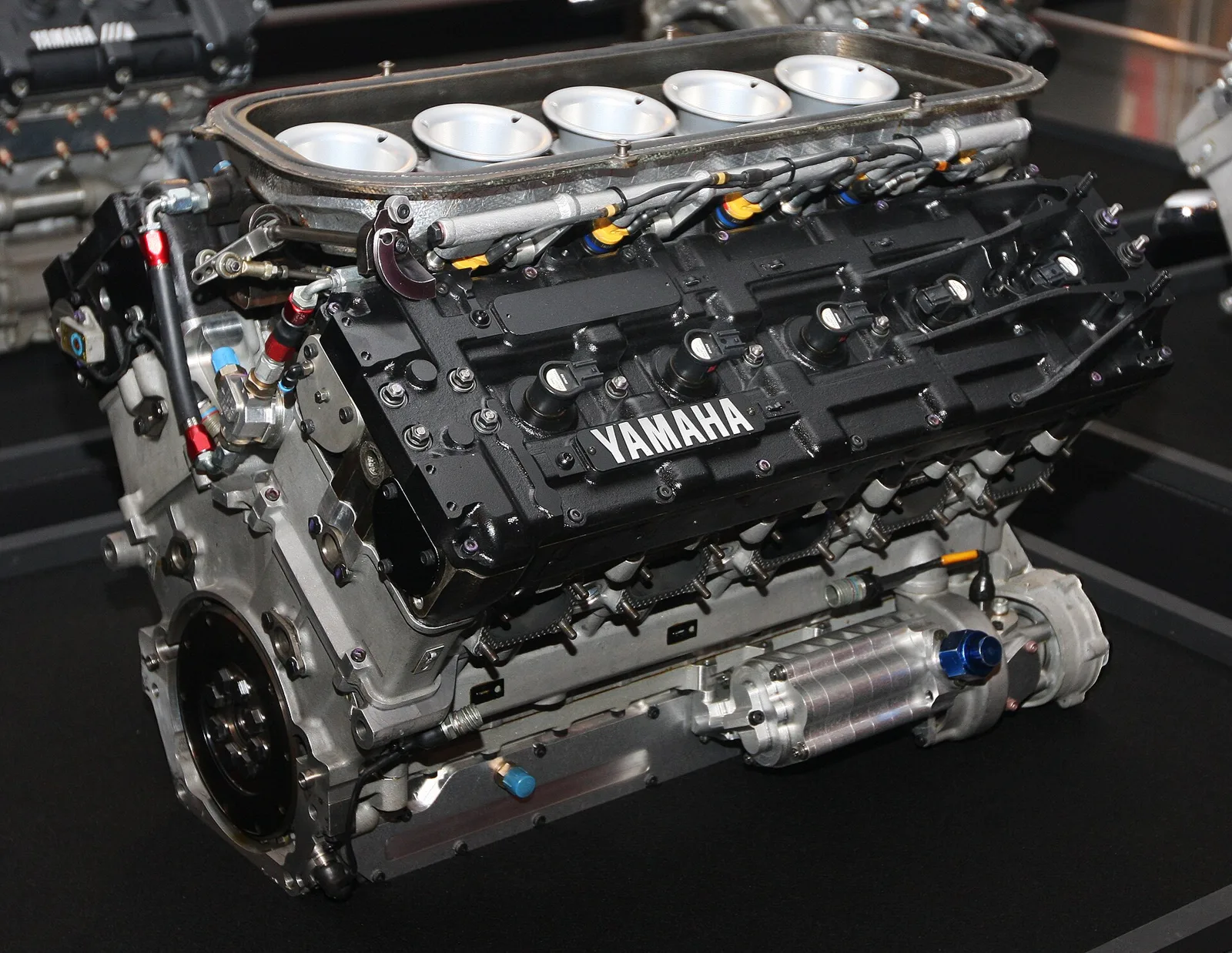
Between 1989 and 1997 Yamaha built several naturally aspirated Formula One engines. Zakspeed was the first customer. Brabham followed in 1991, Jordan in 1992, Tyrrell from 1993 to 1996, and Arrows in 1997. The engines never won a race, although Damon Hill nearly did so in the 1997 Hungarian Grand Prix. Drivers including Hill, Ukyo Katayama, Mark Blundell and Mika Salo took respectable results from them, but the engines were often unreliable and usually regarded as lacking power.
They were fitted to the Zakspeed 891, the Brabham BT59Y and BT60Y, the Jordan 192, the Tyrrell 020C through to the 024, and the Arrows A18. Yamaha also put an engine in a road car, the OX99-11.