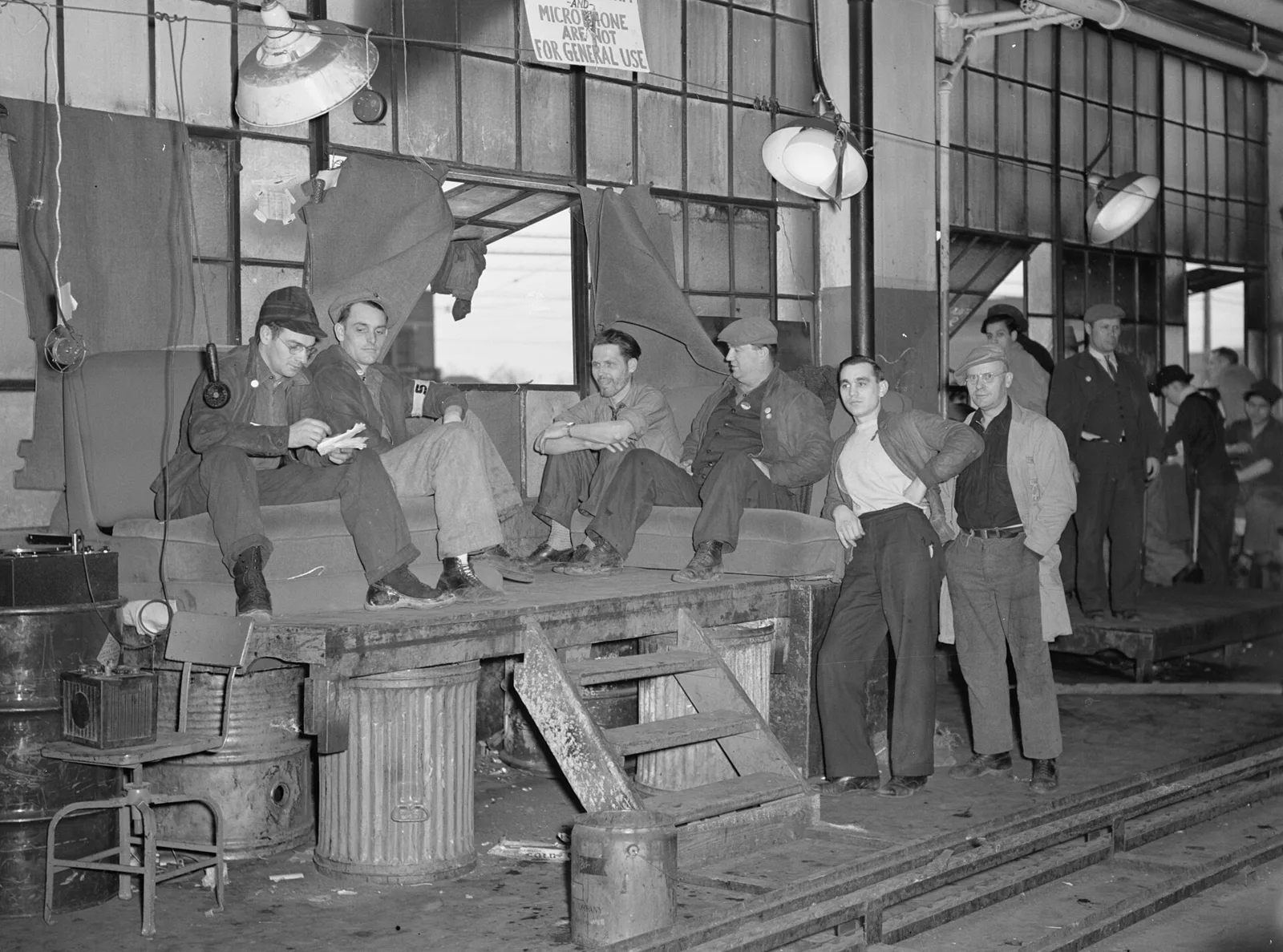
Forty-four days inside Fisher Body in 1936, and a film that began shooting on the strike's 50th anniversary to show what happened when the plants closed.
The Flint sit-down strike was a 44-day occupation of General Motors plants from 30 December 1936 to 11 February 1937 that won recognition for the UAW. Michael Moore's 1989 documentary Roger and Me shows Flint's later decline, as GM cut local jobs from 80,000 in 1978 to about 50,000 in 1992.
Michael Moore began filming Roger and Me on 11 February 1987. That was exactly fifty years after the Flint sit-down strike ended in a one-page agreement that recognised the United Auto Workers at General Motors. The two stories belong to the same city. In 1936 Flint workers took over GM plants and won a union. In the 1980s the company shrank its Flint payroll, and a native son went looking for its chairman with a camera.
Flint gave American labour its most famous factory occupation, and later gave American film a documentary about what happens when the factories close.
Why did the Flint sit-down strike happen?
Before the Great Depression, General Motors employed 208,981 hourly workers, paid around $1,195 a year. After it, jobs were growing, but GM had 30,000 fewer employees than before, and the people who remained were pushed to work faster. Pay was rising across the country in 1936, though at GM it was stagnant.
| Measure | Annual figure |
|---|---|
| Average GM hourly pay before the Depression | $1,195 |
| GM records for full-time workers, 1936 | $1,200 to $1,300 |
| Works Progress estimate for a four-person family | $1,434.79 |
The UAW had been formed in 1935 and held its first convention in 1936. Soon afterwards it decided it could not survive by organising small plants, as it had until then. It would go after the biggest and most powerful employer, General Motors, by focusing on the company's most valuable plants in Flint. Chevrolet and Buick there employed 14,000 and 16,000 men, the largest of GM's 60-odd factories, and Chevrolet Plant No. 4 produced the engines for every Chevrolet sold at the time. A strike there could cripple production nationwide.
The strike ended on 11 February 1937. The film began shooting on 11 February 1987.
Organising in a company town
Flint was hard ground. GM controlled city politics and watched outsiders. When Wyndham Mortimer, the first UAW officer put in charge of the Flint campaign, arrived in early June 1936, he was being followed the next day. GM also ran a network of spies through its plants. The existing locals had only 122 members out of 45,000 Flint auto workers and, Mortimer concluded, were riddled with informers. So he bypassed them. He and colleagues including Roy Reuther, Henry Kraus, Eric Branoff and Ralph Dale met workers in their homes, keeping the names of new recruits secret even from UAW headquarters.
The union also studied GM's weak points. The company had only two factories making the dies from which car body parts were stamped. One, in Flint, supplied Buick, Pontiac and Oldsmobile. The other, in Cleveland, supplied Chevrolet. The plan was to strike both in the new year, once Frank Murphy took office as Michigan's governor.
How did a sit-down strike work?
Events moved faster than the plan. Workers at Cleveland's Fisher Body plant struck on 28 December 1936 after two brothers were fired, and the UAW declared it would not settle until it had a national agreement covering every GM plant. On 30 December at 8 am the union heard that GM was moving dies out of Fisher #1 in Flint. Organiser Bob Travis gathered members for lunch at the union hall opposite the plant, explained what was happening and sent them over to occupy it.
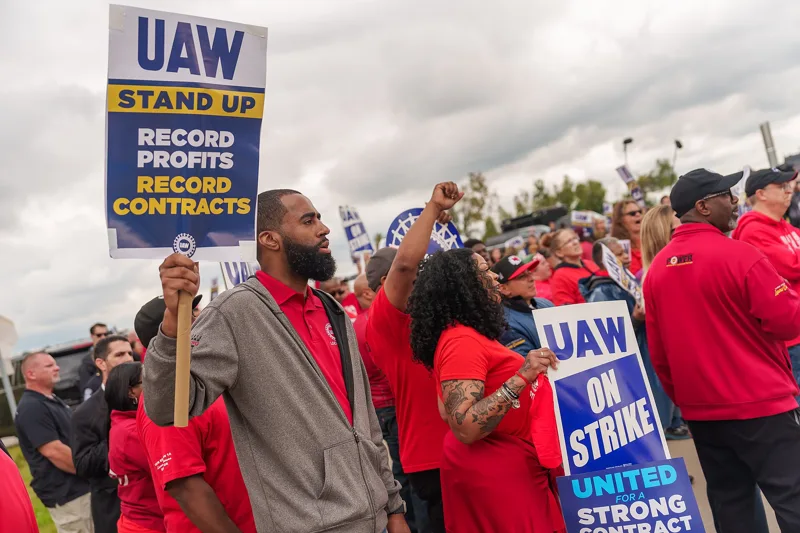
In a conventional strike workers leave and picket outside, hoping to stop others entering. In a sit-down they stay in the building, which keeps management out and prevents strikebreakers being brought in. Think of it as the difference between blocking a shop door and locking yourself in the stockroom. Morale was easier to hold, too. The occupiers were shielded from outside hostility and from the weather that wore down pickets.
The strikers built a small civil society. They elected a mayor and officials, with departments for recreation, information, postal service and sanitation. A workers' court that they called the Kangaroo Court tried rule-breakers, with punishments from washing dishes to expulsion. Order mattered because any property damage would give the governor a reason to send in the National Guard. Friendly vendors kept supplies flowing, and a diner across the street gave most of the meals for the roughly 2,000 occupiers free of charge. Genora Johnson Dollinger, one of the main organisers, formed the all-female Emergency Brigade to protect strikers inside the factory.
How the strike spread
Once Flint was held, other GM workers followed:
- 31 December: Fisher Body and Chevrolet in Norwood, Ohio, and the Guide Lamp plant in Anderson, Indiana
- 4 January: Chevrolet in Toledo
- 5 January: Chevrolet and Fisher Body in Janesville
- 8 January: the 3800-worker Cadillac plant in Detroit, organised by Walter Reuther's West Side local
- 12 January: Fleetwood in Detroit, a Cadillac supplier, where about ninety workers sat down until 15 January
- 13 January: a conventional strike at St. Louis Fisher Body and Chevrolet, after a sit-down failed the day before
By 25 January the secondary effects on GM's supply chain had closed fifty plants and suspended work for 150,000 employees. Solidarity protests took place at the GM buildings in New York City on 1 February and in Detroit on 6 February.
The Battle of the Running Bulls
On 11 January police armed with guns and tear gas tried to enter Fisher Body 2. The strikers inside, led by Bob Travis and Roy Reuther, threw hinges, bottles and bolts and withstood several waves of attack until the standoff ended. They named it the Battle of the Running Bulls, a jibe at the police. Fourteen strikers were hurt by gunfire.
Washington took notice. Vice President John Nance Garner favoured federal intervention to break the strike, but President Franklin D. Roosevelt rejected the idea and urged GM to recognise a union so the plants could reopen. Governor Murphy would not use force on the strikers. He sent in the National Guard to shield them from police and company guards.
On 2 February GM obtained a second injunction from Judge Edward S. Black, who owned more than three thousand GM shares and was removed from the case when the union found out. The UAW ignored the order and extended the strike to Chevrolet Plant 4. It misdirected GM first, letting it be known in the hours beforehand that it was after a different plant in the complex, and changing course at the last minute. An informant inside the union had tipped GM off, so the company waited at the wrong plant and was caught completely off guard at Plant 4.
The one-page agreement
That forced GM to negotiate. John L. Lewis, who headed the United Mine Workers and led the Congress of Industrial Organizations, negotiated on the UAW's behalf, while its own president, Homer Martin, was packed off on a speaking tour so that he would not interfere. GM's representatives would not share a room with the union's, so Murphy carried messages between them. On 11 February 1937 the two sides signed a one-page agreement recognising the UAW as exclusive bargaining representative for GM employees who were members, for the next six months.
GM agreed to rehire strikers, allow union buttons and symbols and grant six months of negotiations at plants that had struck. Short as it was, the agreement gave the UAW instant legitimacy. Workers got a 5% pay rise and could talk about the union at lunch. The UAW signed up 100,000 GM employees and built strength through grievance strikes. In the next year its membership grew from 30,000 to 500,000, and workers at Ford and other makers joined as the industry unionised. The BBC later observed that the strike was heard round the world.
Participants who later became prominent included Walter Reuther and Charles I. Krause, as well as future D-Day hero and wrestling champion Dean Rockwell, and an uncle of Michael Moore. Moore's film contains a clip from the strike.
The tactic did not last. Public support for sit-down strikes waned after years of corporate media campaigns, and a 1939 Supreme Court ruling, NLRB v. Fansteel Metallurgical Corp., found sit-down strikes illegal, which put strikers beyond the protection of the labour board.
What is Roger and Me about?
Roger and Me is a 1989 documentary written, produced and directed by Michael Moore, who also stars. It was his directorial debut. The film portrays what happened when GM chairman Roger Smith closed several plants in Moore's home town of Flint, cutting GM's local workforce from 80,000 in 1978 to about 50,000 in 1992. It took the People's Choice Award at the Toronto International Film Festival's 14th edition, and in 2013 the Library of Congress selected it for preservation in the National Film Registry.
Moore begins with home movies of his family, and describes himself as the son of a GM employee who assembled AC spark plugs. He notes that Flint is where the sit-down strike gave birth to the UAW. After a failed stint at Mother Jones magazine in San Francisco, he returns to Flint in 1986, just as GM announces thousands of layoffs, with jobs going to cheaper non-union labour in Mexico, even though the company is making record profits.
He disguises himself as a TV journalist to talk to workers and finds they despise Smith. Repeatedly he tries to reach Smith, at GM headquarters, at the Grosse Pointe Yacht Club and at the Detroit Athletic Club, and is turned away each time. Along the way he meets auto worker Ben Hamper, who had a nervous breakdown on the assembly line, and Deputy Fred Ross, a former factory worker now carrying out record numbers of evictions. He films the local tourism bureau's efforts to revive the city: a Hyatt Regency that goes bankrupt, a Water Street Pavilion whose stores close, and AutoWorld, billed as the world's largest indoor theme park, which shuts six months after opening. President Ronald Reagan visits and suggests unemployed workers move away to find jobs. Moore attends a GM shareholder meeting in disguise, and Smith adjourns the meeting when he speaks.
Crime in the film rises sharply. Someone steals the Nightline van during a live broadcast about the plant closings, the county jail fills and a second one is built, and Money magazine puts Flint last among American places to live. At the climax Moore confronts Smith after his 1988 Christmas message in Detroit, asks him to come to Flint and is refused. The closing titles say the film cannot be shown in Flint, because all the cinemas have closed.
How Moore made it
Moore decided to make the film in 1984 with no filmmaking experience and no money. He had lost his job as editor of Mother Jones and returned to Flint, where his attempt to revive his Flint Voice newspaper stalled. He won a $160,000 wrongful termination suit against the magazine, mortgaged his house, sold most of his belongings and ran weekly bingo games for three years to find the rest of a $200,000 budget. Grants came from foundations and Ralph Nader, although the Mackinac Center and Nader later asked for money back. His first title was The Moores and the Motts, contrasting his working-class family with the family descended from Charles Stewart Mott, but he shifted to the current auto industry. He intended it as a personal statement against GM and against Reagan-era economic policy.
The working title was A Humorous Look at How General Motors Destroyed Flint, Michigan. After viewing a 15-minute bumper, Moore and his crew decided that a portrait of mass unemployment would drive away ordinary audiences, and gave the film a comic slant. Production began on 11 February 1987, the 50th anniversary of the end of the Flint strike, and a large share of the filming happened in a 60-day period in summer 1988. Moore got interviews by pretending to make University of Michigan poverty videos or booster films for the city. Production ended in August 1989.
Release and reaction
The film premiered at the Toronto International Film Festival in September 1989. A few weeks later GM announced it would close its Toronto truck plant and move production to Flint. Warner Bros paid Moore $3 million for distribution, a very large sum for a first-time filmmaker and then unprecedented for a documentary, and agreed to pay two years of rent for the evicted families shown in the film. To promote a national release in 965 theaters, Moore and his crew toured 65 GM plants. GM refused to let its car advertising run during television programmes promoting the film, among them The Phil Donahue Show and The Tonight Show, and its media relations chief mailed Jay Leno a packet of articles disputing Moore's claims.
The film opened in Flint on 19 December 1989 and in New York and Los Angeles the next day. It became America's most successful documentary of its run, earning $12 million, of which Moore gave $1 million to charities. It missed out on a nomination for Best Documentary Feature. Three years later an anonymous Academy member told the Los Angeles Times that the documentary committee had deliberately left it out because it considered the film dishonest and unfair to its subjects.
Inside GM, the film's comic portrait of Smith made it widely popular despite the company's public stance. By its release GM had already lost 8% of its market share and was posting heavy losses, and many staff and executives had lost faith in Smith. Outside, critics questioned its accuracy. Flint was recovering slightly by the time of release, with unemployment, violent crime and the city budget deficit all improving. Lawyer Larry Stecco, filmed at a fundraiser, sued Moore and Warner Bros, and a jury ordered Moore to pay $6,250, well below the $50,000 sought. Reviews were overwhelmingly positive. Emanuel Levy called the film scathingly funny, and Gene Siskel and Roger Ebert both listed it among the 10 best of 1989.
What both stories show
For GM buyers and car historians, Flint explains why one city could matter so much: its Buick and Chevrolet plants fed the company's brands, its die factory made the parts, and Plant No. 4 built Chevrolet engines. The strike shows how dependent GM was on those plants in 1937, and the film shows the local effect of closing them. In 1992 the film aired on PBS with a new epilogue, Pets or Meat: The Return to Flint, and Moore revisited Flint's economic decline in later films including Bowling for Columbine, The Big One, Fahrenheit 9/11, Capitalism: A Love Story and Fahrenheit 11/9.
Where this goes next
The strike left a union that grew from 30,000 members to 500,000 within a year, and the film, selected in 2013, holds a place in the National Film Registry.