From a 1963 derby that packed twice the crowd a speedway could hold to cone courses in car parks, here is how three cheap forms of motorsport work and how to enter.
Autocross is a timed run round a cone course, banger racing is contact racing on an oval in scrapped cars, and a demolition derby is a smash-up where the last running car wins. All three welcome newcomers, with autocross the gentlest and Back to Basic the cheapest banger format.
In January 1963 a reported 20,000 people crammed into Rowley Park Speedway in Adelaide to watch Australia's first demolition derby. That was about twice what the venue could hold, so police shut the gates. The derby went ahead regardless, with more than 75 entries and a running time of over 100 minutes. Three forms of grassroots motorsport, autocross, banger racing and the demolition derby, still run on the same appeal: you need neither a fortune nor a pit crew to join in.
What are autocross, banger racing and demolition derbies?
Autocross is a timed run round a short course, usually marked out with cones. Banger racing is wheel-to-wheel racing on a track in cheap, scrapped cars, with knocks allowed. A demolition derby abandons laps altogether: drivers ram each other until one car is still running. All three use ordinary or old cars, and all three welcome newcomers.
They differ in aim. Autocross rewards precision and a clean line. Banger racing rewards tactics on track, and damage along the way. The derby rewards survival.
Autocross rewards precision, banger racing rewards tactics and damage, and the demolition derby rewards survival.
How do the three compare?
| Feature | Autocross | Banger racing | Demolition derby |
|---|---|---|---|
| The aim | Fastest time against the clock | Win a race over several laps | Be the last running car |
| Contact | None intended; cones mark the route | Allowed and encouraged | The whole point |
| Where it began | UK, early 1950s | UK, 1960s | United States, first held by independent promoters in the 1950s |
| Typical cars | Anything from production touring cars to purpose-built racers | Scrapped or written-off cars, usually not newer than 10 to 20 years | Scrap sedans and wagons, usually bought for under US$500 |
| Setting | Grass, stubble or dirt; paved surfaces in the US | Oval, tri-oval or figure-eight tracks | County fairs, speedways and race tracks |
| Who can enter | Novices welcome; juniors from 14 at many Australian events | Back to Basic is the cheapest and easiest route in | Drivers often at least 16 with a valid licence |
How does autocross work, and how do you try it?
British clubs started timing runs across grassy fields in the early 1950s, using temporary courses so that nobody's car would be harmed. Competitors race the clock rather than each other, and the rules differ by sanctioning body: how long the course is, how many attempts each driver gets, and whether cars start singly or together. When several cars go at once, heats or other timing methods settle the order instead of a straight race for position.
The American version looks different. Events, known as Solo, Auto-x or Autoslalom, are held on flat paved ground such as car parks and airport tarmacs, with a fresh course of rubber cones laid out each time. The Sports Car Club of America publishes the rules most clubs follow, and the National Auto Sport Association runs its own take as NASA-X. Cars go one at a time against the clock, and handling and precise driving count for everything.
Getting in is the easy part. Autocross is among the most affordable and accessible ways into motorsport, open to novices, with low hazards because cones define the route and the surfaces are paved and clear of obstructions. Speeds are generally no higher than legal highway driving, yet the concentration needed gives an experience close to a full road course race. Local car clubs run novice driving schools, and entrants range from people in commuter cars to dedicated racers on special tyres.
What does autocross look like in the UK, Australia and Europe?
UK autocross runs on grass or stubble, with cars against the clock individually, though more than one may start together if the circuit is long and wide enough. The ground is bumpy and contact is possible, so most competitors arrive with specially prepared cars on trailers, from very cheap builds to engineered racers. In the south-west the ASWMC runs 13 championships that attract around 250 contenders each year, and Taunton MC organised the first series back in 1954.
Australia keeps it short: MotorSport Australia defines autocross as an event on a course under four kilometres. Ordinary road cars can enter alongside buggies and rally machines, and many events accept juniors as young as 14.
The top of the sport is the FIA European Autocross Championship, on natural-terrain circuits between 800 and 1,400 metres long. Up to 10 cars run at once through qualifying heats, two semi-finals and a final, in buggy categories named SuperBuggy, Buggy1600 and JuniorBuggy. It began as a European Cup in 1977 and became a Championship in 1982. Since 2021 some rounds also host Cross Car events, including an academy trophy for drivers aged 13 to 16.
Which autocross event is the biggest?
The SCCA National Championship, held each September in the Midwest, in Lincoln, Nebraska as of 2024 and before. It runs for 4 days, with winners decided by combining best times across two courses. The event is considered the biggest amateur motorsport gathering anywhere, and 2024 entries were limited to 1,300 drivers, with more on a wait list.
How does autocross differ from motorkhana, autotesting and gymkhana?
Names and rules shift from country to country. Motorkhana, in Australia and New Zealand, and autotesting, in the UK and Ireland, rarely top 60 km/h (40 mph), involve hand-braking and send drivers backwards through some sections. American-style autocross can pass 100 km/h (60 mph), generally bans reversing and seldom needs the handbrake. Japanese gymkhana is tighter again, with numerous 360-degree turns around cones, and quick times demand sliding, so it feels like autocross crossed with drifting.
What is banger racing?
Banger racing sends cars, traditionally derelict or totalled classics from scrapyards, round oval, tri-oval or figure-eight tracks for several laps. Contact is not a hazard but a feature. The sport is cousin to British stock car racing and the demolition derby, and it thrives in the UK, where it originated in the 1960s, and in Ireland, Belgium and the Netherlands.
The story goes that a race promoter noticed in the early 1960s that crashes were the biggest draw at a meeting. Early cars had almost no preparation beyond taking out windows and headlights. By the 1980s safety had improved, with roll cages, driver's door plates and relocated interior fuel tanks all compulsory.
What are National, Rookie and Back to Basic banger racing?
In the UK, banger racing generally follows one of three rule presets. National is the only full-contact version, allowing hard hits such as t-bones, head-ons, follow-ins and jack-ups. National meetings are very popular and usually the most destructive.
Rookie was devised in the mid-1990s for people who wanted to race through a season on a small budget. Limited contact keeps cars alive longer, and gives a safer, less aggressive atmosphere and a show that fans like less. Many drivers treat it as a stepping stone to National. Its first idea, non-contact opening laps, was dropped because the fields were too big to police.
Back to Basic is an emerging format and growing. It usually copies Rookie, but preparation is pared back, so dashboards and key ignition can stay in, and cars remain close to their road form. For anyone counting pennies, it is the budget route into the sport.
What kinds of car do banger racers use?
The Unlimited class has no engine size limit, is usually among the most competitive, and is favoured for speed and strong cars. Entries must be rear-wheel drive unless they come from the American market, and the SsangYong Rodius and Chrysler Imperial are banned as too strong. Under 2000cc, the engine must be under two litres, and the class is dominated by Ford models such as the Mondeo and Cougar, which leads some events to add rules forcing other makes.
Domestic Bangers have an engine cap that varies by track and are most common in Rookie and Back to Basic. The Micro class takes the small A-segment and B-segment cars that cannot compete elsewhere, and is increasingly popular because they are everywhere in Europe and cheap to run and repair. Special events add classes for vans, lorries, double-deckers and even Siamese cars, two bodies stacked one on the other, the lower one braking and accelerating and the upper one steering.
How big has banger racing been?
Very big. Around 13,000 cars competed in the peak season of 2003, and around 9,500 of them were fresh, never raced before. World finals date from 1971, when a Wimbledon event was staged at Harringay Stadium, and the Spedeworth Unlimited Banger World Final began in October 1974 at Wimbledon Stadium; Ipswich's Foxhall Stadium has been its home since 2008.
Grids can get crowded. A meeting at Swaffham Raceway on 8 February 1998 drew 209 cars, the first over 200, and the largest accurate turnout is 269, at the 2017 Unlimited National World Final. In 2013, 232 drivers turned up in Mark I or Mark II Ford Granadas at Arena Essex Raceway, the biggest single-make gathering. That venue's Firecracker 500 was its biggest meeting until it closed in 2018.
Who are the rodders and the wreckers?
Despite the racing, the community splits drivers into two camps. Rodders, a word taken from the Hot Rod formulas that also race on short ovals, aim to win by any means. Wreckers set out to destroy their own cars and other people's, and are often the crowd's favourites.
Yellow flags warn of caution, and stalled cars stay where they are while the race goes on. Drivers are told to remain in a disabled car, judged the safest place, and leaving one under green flags is a punishable offence unless it is an emergency. A red flag stops the race if someone is in particular danger, including fire.
What is a demolition derby?
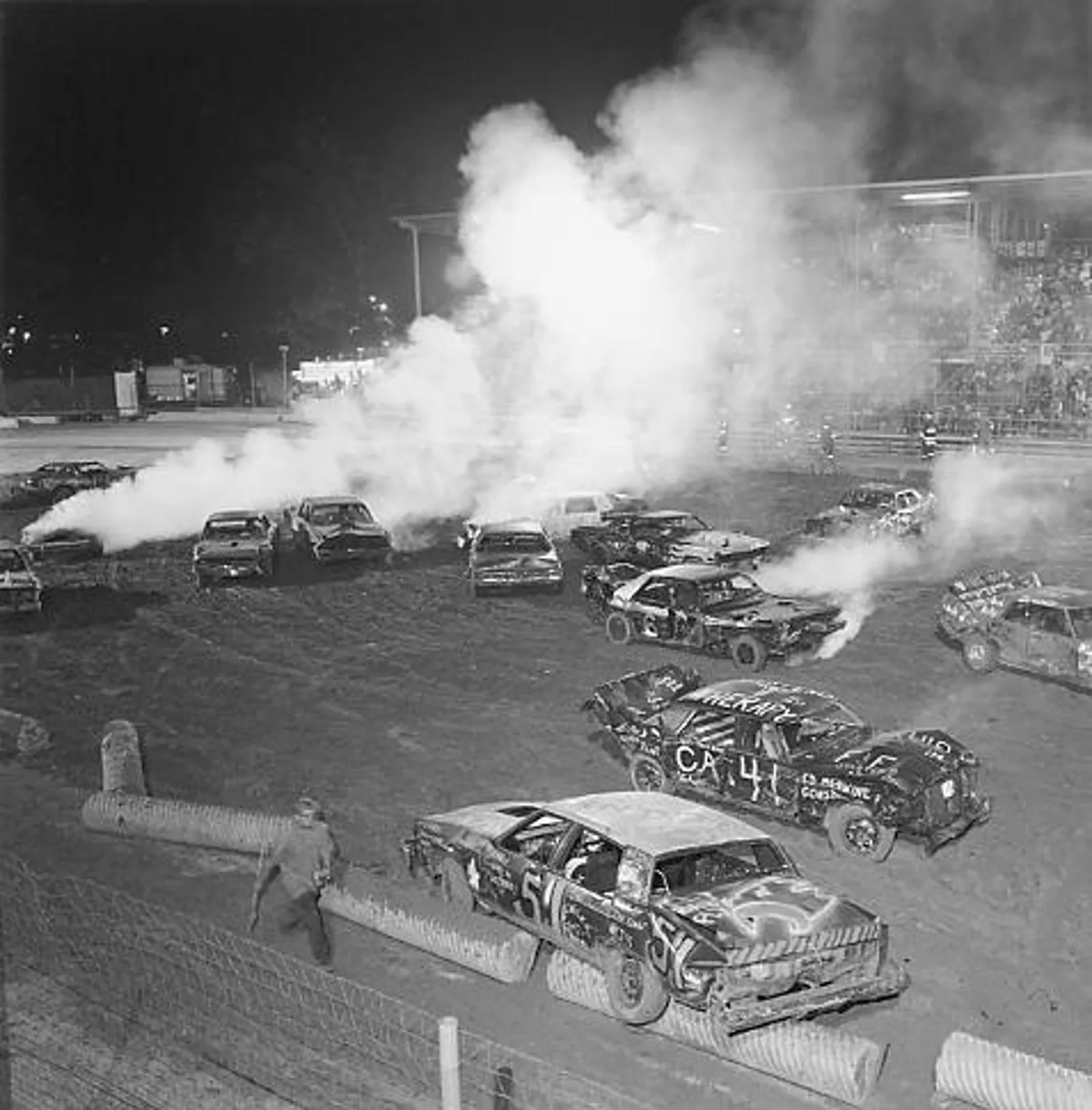
A derby is usually staged at county fairs and national events. Rules vary, but a typical one pits five or more drivers against each other, ramming on purpose. The last driver whose vehicle still works wins. It started in the United States and spread quickly to other Western nations. In the UK and parts of Europe a derby, sometimes called a destruction derby, often closes a full day of banger racing, and at special events racers tow caravans or small boats into it for extra destruction.
Who invented it is disputed. Don Basile is often credited with creating it at Carrell Speedway near Gardena, California, in 1947. Another account names the stock car racer Larry Mendelsohn, at Islip Speedway in New York State in 1958, after he realised many people preferred wrecks to racing.
What are the rules of a demolition derby?
Entrants are often expected to be 16 or older with a valid driving licence, and to wear a seat belt and a helmet, with roll-over bars or cages depending on the rule set. Most rule sets demand a hit at least every 2 minutes; fail, and you are labelled a sandbagger and disqualified. Deliberately hitting a driver's door is grounds for disqualification, as is sometimes rolling another car on purpose.
If a car dies, its driver usually gets 30 seconds to a minute to restart and move off, or concedes and is out of the heat. A flagged slat of wood fits into the door column on most events: a judge snaps it to disqualify, or the driver snaps it to resign. Heats typically run 10 to 30 minutes, with the first and second finishers going through, and a whole event can stretch over a few days. Many derbies also give a Best in Show or Mad Dog prize for the most spectacular driver without a win, chosen by the crowd. Some add a rollover competition, in which drivers hit a ramp on one side until the car rolls over and over.
What does a derby car cost, and how is it prepared?
Traditional derby cars are full-size American sedans and wagons from the 1960s and 1970s, which have bigger, heavier and tougher frames than later ones. The 1964-1966 Imperial earned a reputation for crashworthiness and is banned from most events. Scrap cars come from junkyards and private owners, usually for under US$500, although rust-free mid-1970s sedans and wagons can fetch more than $1,000. Cars from the 1980s to the 2000s are common, and they are often patched up and reused.
Smaller cars are becoming common. Smaller full-size cars from the late 1980s and 1990s appear more often, and a separate compact class is increasing in popularity because the supply is large and the cars are more mobile. They are largely front-wheel drive, so the rear can absorb plenty of damage before the car stops, but they are less crashworthy and injuries are more frequent. Other variants use combine harvesters, riding lawn mowers, minivans, motorhomes and semi trucks.
Preparation is blunt. Interior fixtures, trim, plastic, lights and glass come out, and cars are repainted in loud designs, often with spray paint. Doors are welded shut, and the battery and fuel tank are moved; the radiator sometimes ends up on the back seat. Roll bars and fire extinguishers are common. In most cases parts must be stock, though some derbies have a gladiator or outlaw division that permits heavy modification.
How popular have demolition derbies been?
The derby became a fixture at county fairs through the 1960s. American television carried a world championship from the mid-1960s until 1992, and in 1972 the Los Angeles Coliseum put on a derby with Mario Andretti, A. J. Foyt and Bobby Unser at the wheel of mint late-model cars. The sport peaked in the 1970s, then faded in the 1980s as television coverage dried up, safety worries grew and full-size cars ran short.
The Nashville Network revived it in 1997 with a series called Motor Madness. Broadcasts had to fit a slot, so the winner was whoever landed the most hits in a set time, not the last car running. Prize money climbed from a few hundred dollars to more than $50,000, and the programme was dropped in 2000. A newspaper estimate for 2001 put between 150,000 and 225,000 drivers in at least one of the 2,000 derbies held in the US that year. By 2017 the Tour of Destruction, which mixed school buses, trailers, car soccer and a big derby, drew crowds of up to 5000.
Are they safe, and what do critics say?
Serious derby injuries such as whiplash are rare but do occur, and drivers typically sign a waiver releasing the promoter from liability. Almost every derby tries to improve safety: glass is removed and ramming the driver's door area on purpose is forbidden.
Banger racing draws sharper criticism. Classic car enthusiasts and historians say it destroys restorable cars and hard-to-find parts, and say it has made models from Austin, Rover, Jaguar and others rarer, along with hearses and some pre-war cars. Racers reply that most banger cars are already damaged or beyond restoration, and that racing one is a better send-off than crushing or shredding. Critics also point to the rare use of stolen cars: two stolen American cars were raced and wrecked at Ringwood Raceway in August 2022 before anyone noticed.
Which grassroots formats are growing
Growth is coming from the cheapest corners. Back to Basic banger racing is described as growing in popularity, and Micros are increasingly popular. Compact car derbies are increasing in popularity as older full-size cars become scarce. In European autocross, selected championship events have hosted Cross Car rounds since 2021.
How do you get started?
Autocross is the gentlest entry: find a local car club with a novice driving school, or an event that takes ordinary road cars. For banger racing in the UK, Back to Basic and Rookie are the doors in. For a derby, expect to need a licence, be at least 16, wear a helmet and belt, and follow a rule set that limits how much welding your car may have.