From Formula 4 through F3 and F2, what each step demands, what it costs and how the FIA points system opens the door to Formula 1.
To become an F1 driver, you climb the FIA Global Pathway from Formula 4 through Formula 3 and Formula 2, then earn a Super Licence. That requires at least 40 points over three seasons, an International Grade A licence, a theory test and a minimum age of 18.
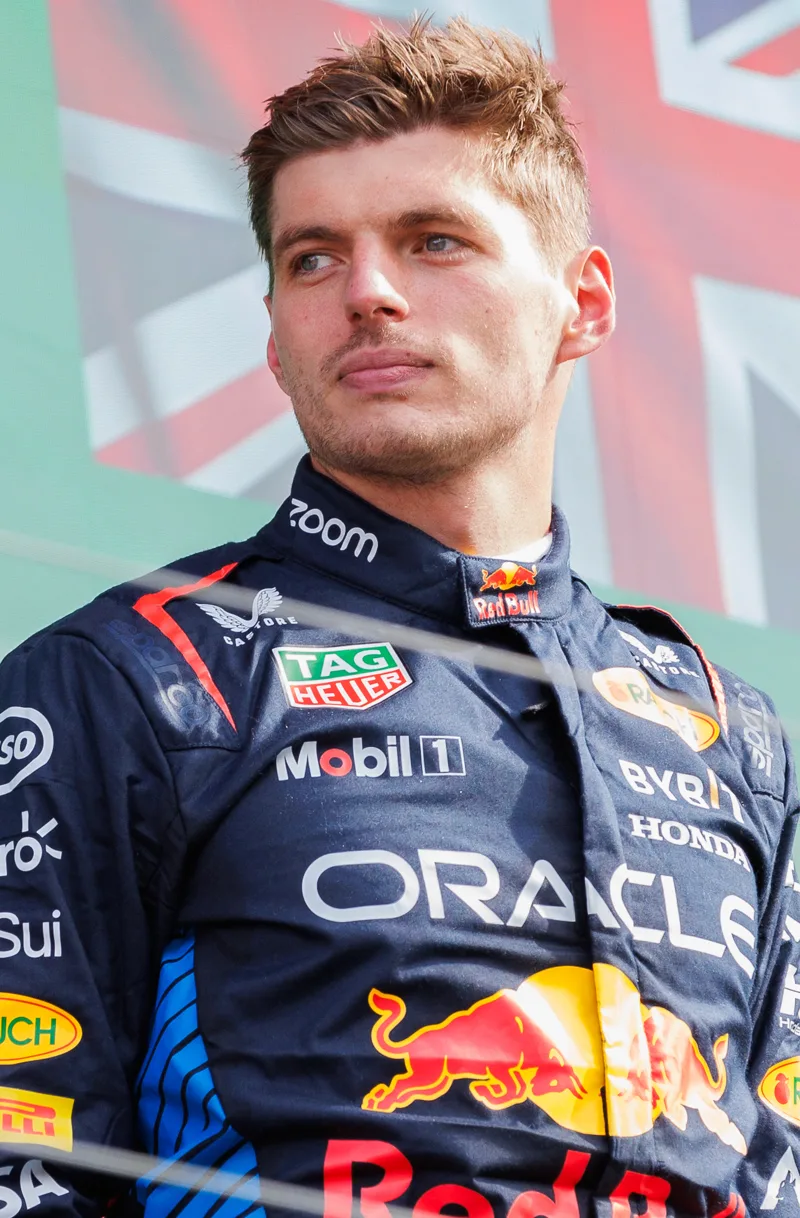
Max Verstappen's 2024 Super Licence cost a record EUR 1,217,900, a fee set by his 2023 results. That one invoice explains a good deal about how to become an F1 driver: the licence you need to start a Formula 1 race is rationed by points, priced by performance, and earned on a ladder of junior categories that costs millions of dollars a season at its upper rungs.
How to become an F1 driver: the ladder at a glance
The FIA calls its route the Global Pathway. Formula 4 is where karting ends and single-seaters begin, Formula 3 sits in the middle and Formula 2 is the final rung before Formula 1. Racing in F2 is not compulsory, yet most current F1 drivers have raced in F2 or in GP2, the series it replaced, before graduating.
Formula 3 and Formula 2 are spec series. Every F2 team runs the same Dallara chassis, engine and tyre supplier, and the aim is a training ground that mirrors Formula 1 in safety, systems and performance while keeping the racing relatively affordable.
The licence is rationed by points, priced by performance and earned on a ladder that costs millions a season.
Formula 2 vs Formula 3 vs Formula 4 at a glance
| Feature | Formula 4 | Formula 3 | Formula 2 |
|---|---|---|---|
| Place on the ladder | First step out of karting | Third tier | Second tier, last step before F1 |
| Who runs it | National and regional championships under shared rules | One FIA championship, started 2019 | One FIA championship, started 2017 |
| Engine | Four-cylinder, 1,600 cc, power cap of 160 bhp (119.3 kW) | 3.4-litre Mecachrome V6, 380 hp (283 kW) | Single-turbo Mecachrome V634 |
| Chassis | Tatuus, Mygale, Dome or Ligier | Dallara carbon monocoque | Dallara carbon chassis |
| Estimated cost per season | Aim of under EUR 100,000; EUR 118,000 in the 2022 French series | About US$1.2 million | About US$3 million |
Formula 4: the first step out of karting
The FIA created Formula 4 in March 2013 with the approval of the World Motor Sport Council. Gerhard Berger, a former F1 driver, was put in charge of the FIA Single-Seater Commission to build it. Interest in national Formula 3 championships was falling because of rising costs and rival routes to Formula 1, and several had been dropped. Formula 4 was meant to be the cheaper, simpler way in.
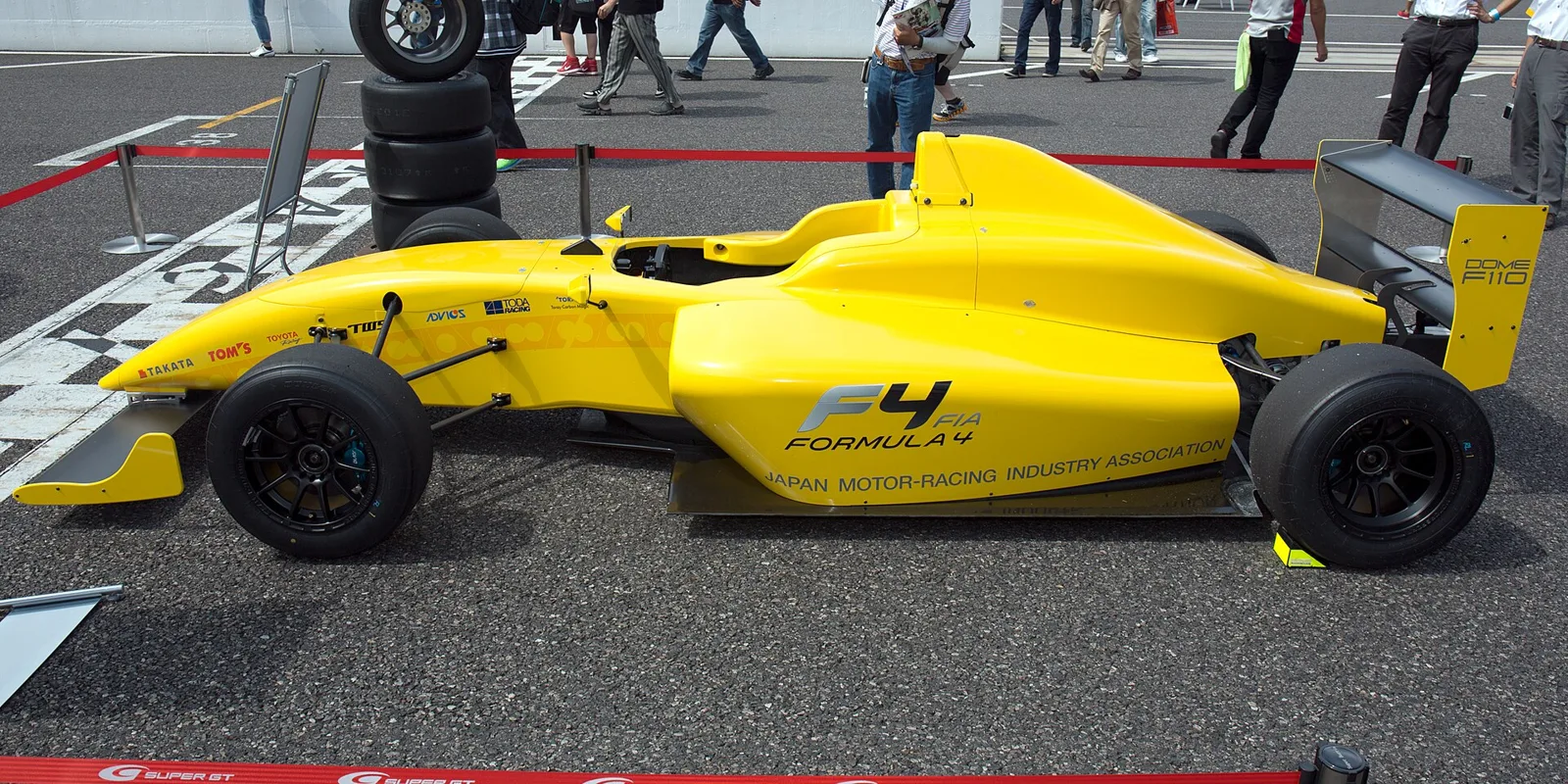
There is no world championship. Instead, countries and regions run their own series under one universal set of rules, and the FIA recognised thirteen of them as of 2025. Four chassis makers are approved: Tatuus, Mygale, Dome and Ligier. Engines are equalised so that no national series is quicker than another.
A typical car has a 1,600 cc engine limited to 160 bhp (119.3 kW), sitting above Formula Ford and below Formula Renault. The engine homologation rules allow four-cylinder units only, naturally aspirated or turbocharged, capped at 140 kW with unlimited displacement. An approved engine has to last at least 10,000 km and cost no more than EUR 14,000, and seven are currently homologated.
How fast is a Formula 4 car?
Fast enough to humble a road car, slow by the standards of everything above it. Top speed is approximately 240 km/h, while most modern supercars can pass 300 km/h. Where the single-seater wins is in the corners. Its peak lateral acceleration is about 2.0g, according to figures published by the F1 Academy for the Tatuus car, whereas a typical non-sporting road car peaks at under 1g.
The gap to Formula 1 is easy to measure. The fastest qualifying lap at a 2023 F4 round on the Silverstone Grand Prix circuit was 2:01.651, against 1:25.819 for pole in an F1 car at the 2024 British Grand Prix. Even so, an F4 pole lap would beat the Porsche Carrera Cup lap record by about 2 seconds and the TCR Touring Car record by about 10.
What Formula 4 costs
The long-term aim is a season for under EUR 100,000. Reality has not obliged. The 2022 French series cost EUR 118,000 including all equipment, excluding tax, and one estimate for a serious campaign in the defunct German series topped EUR 350,000.
That German series, ADAC Formula 4, raced between 2015 and 2022. The organiser announced on 3 December 2022 that there would be no 2023 season, citing a low number of drivers because of high costs compared with other championships, and steered German juniors towards the French series.
Formula 3 vs Formula 2: what changes at each step
The step up from Formula 4 is a step into a different sport. Formula 3 and Formula 2 are single FIA championships with one car for everyone, and both race on Formula 1 weekends.
Formula 3: the middle rung
The FIA Formula 3 Championship started in 2019, formed by merging the GP3 Series with the FIA's European Formula 3 series. Unlike its European predecessor, it runs only in support of Formula 1 races. The car is a Dallara carbon monocoque with a naturally aspirated, direct-injection 3.4-litre Mecachrome V6, and the 2019 to 2024 version weighed 673 kg (1,484 lb) with driver and fuel. A halo cockpit protection device arrived in 2019, and a second-generation chassis has been in use since 2025.
A 2019 to 2024 car made 380 hp (283 kW), scaled down from 400 hp. It drives through a 6-speed sequential gearbox with paddle shifts, and its steering is manual rack and pinion with no power assistance. Drag Reduction System flaps help overtaking and switch off automatically in the rain.
On numbers alone, an F3 car is closer to a road car than you might expect in a straight line: it tops out around 300 km/h and reaches 100 km/h from rest in 3 seconds, comparable with high-end sports cars. Through corners and under braking it is in another league, cornering at up to 2.6 g and braking at up to 1.9 g.
At the 2023 Melbourne round the fastest F3 lap was 1:34.405, roughly 14 seconds slower than the 1:20.235 set in the Australian Grand Prix. The fastest Supercars qualifying time at the same event, 1:49.317, was 15 seconds slower than that F3 lap.
In its first season, 2019, Prema Racing won the teams' title and its three drivers filled the top three places: Robert Shwartzman was champion, ahead of Marcus Armstrong and Jehan Daruvala. In 2020 Oscar Piastri took the title in his first season in the series, three points ahead of Theo Pourchaire.
Formula 2: the last step before F1
F2 was introduced in 2017 as the rebrand of GP2, confirmed on 8 March 2017 following a deal with Liberty Media, which had acquired the Formula One Group and the series earlier in 2017. The first title went to Charles Leclerc, a rookie and the reigning GP3 champion. Flavio Briatore and Bruno Michel, now managing director, founded the original series.
The current car is a carbon-fibre Dallara powered by a single-turbocharged Mecachrome V634, with an engine update pencilled in for 2029. Minimum weight is 755 kg (1,664 lb) including the driver. Gears come from a Hewland gearbox, the clutch is from ZF Sachs and is worked by a hand paddle, and the steering is again manual. Pirelli supplies four slick compounds, running from purple supersoft through red soft and yellow medium to white hard, plus a blue-sidewall wet. Since 2020 the wheels have been 18 in (457 mm) magnesium alloy, up from 13 in (330 mm), a change made ahead of Formula 1's 2022 wheel rules.
The fuel tank is a 125-litre FIA unit and refuelling in races is banned. A new Dallara F2 2024 chassis was designed to resemble the latest generation of Formula 1 cars, with advanced safety features and the aim of better accommodating female drivers.
The format changed in 2021 as a pandemic-era cost cut, with three races per round and circuits trimmed from twelve to eight. It returned to two races per round in 2022, with twenty-eight races across 14 rounds and reduced points for sprints, poles and fastest laps.
The sport has also carried a loss. Anthoine Hubert was killed in the 2019 feature race at Spa-Francorchamps, the first death in the second tier of FIA formula racing in 10 years. The race and the next day's sprint were cancelled. The FIA created the Anthoine Hubert Award for the highest-placed rookie, with Zhou Guanyu its first recipient, and the numbers 19 and 18 have been retired in his memory.
A race weekend on the ladder
Both series use the same shape. Friday brings a 45-minute practice and a 30-minute qualifying session. Saturday has the sprint race, with the grid set by reversing the top finishers from qualifying: the top 12 in F3 and the top ten in F2. Sunday has the feature race, run before the Formula 1 Grand Prix.
In F3 the sprint lasts 40 minutes plus one lap and the feature 45 minutes plus one lap. In F2 the sprint is about 120 km (75 mi) or 45 minutes, whichever comes first, and the feature about 170 km (110 mi) or up to one hour. Both award 2 extra points for feature-race pole and 1 point for fastest lap if the driver finishes in the top ten, and the most a driver can take from one round is 39. Ties are settled on race wins, then second places, then third places.
Which F1 feeder series sends drivers to Formula 1?
Since the 2017 rebrand, F2 has become the principal feeder series, and the list of graduates reads like a current F1 grid. Leclerc went to Sauber and Sergey Sirotkin to Williams in 2018. A year later the top three from 2018 followed: Russell (champion) to Williams, Norris (runner-up) to McLaren and Albon (third) to Toro Rosso.
Nicholas Latifi, the 2019 runner-up, joined Williams for 2020. The 2021 grid took Mick Schumacher, the 2020 champion, and fifth-placed Nikita Mazepin to Haas, and Yuki Tsunoda, third, debuted with AlphaTauri. Zhou Guanyu, third in 2021, signed with Alfa Romeo for 2022.
Oscar Piastri, 2021 champion, and Logan Sargeant, fourth in 2022, reached F1 in 2023, as did Liam Lawson, third in 2022, who raced as a reserve for AlphaTauri before a full-time seat in 2024. Oliver Bearman, sixth in 2023, drove as a reserve for Ferrari and Haas, then won a Haas race seat for 2025. Franco Colapinto quit his 2024 F2 campaign mid-season for Williams, and Jack Doohan, who had been third in 2023, made his Alpine debut in the last race of 2024.
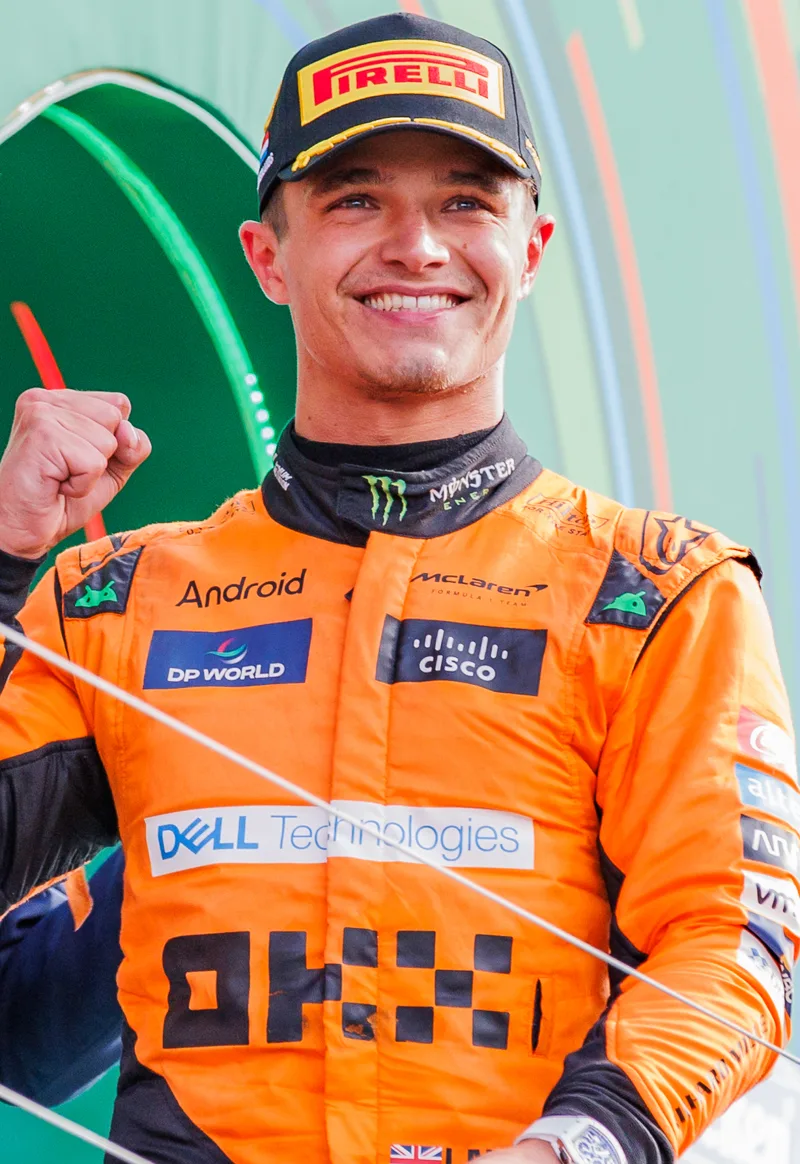
The 2025 intake: Gabriel Bortoleto (2024 champion) to Sauber, Isack Hadjar (runner-up) to Racing Bulls, and Kimi Antonelli (sixth) to Mercedes. That same year Lando Norris became the first F2 graduate to win the Formula 1 World Drivers' Championship.
F1 super licence points: how the system decides
The FIA Super Licence is the qualification that lets a driver compete in the Formula 1 World Championship. It was introduced in the 1990s to keep less-qualified drivers out, then revamped in 2015 following Verstappen's debut. Under Appendix L, Article 13 of the FIA's International Sporting Code, as stated in October 2025, an applicant needs:
- an International Grade A competition licence;
- to be at least 18 when their first F1 event begins, with 17 possible at the FIA's discretion in exceptional circumstances;
- a pass in an FIA theory test on the F1 sporting codes and regulations, on a first application;
- to have finished at least 80% of the programme in each of two full seasons in the listed championships;
- 40 or more points across the previous three seasons, from any mix of those championships.
A driver who has held a licence in any of the previous three seasons needs to have driven 100 km in a free practice session within the last 3 years. One whose licence has lapsed for longer can ask the FIA for an exemption on the grounds of a "recent and consistent demonstration" of outstanding single-seater ability. Since June 2024, applicants no longer need a road-legal driving licence.
What counts for points
Each qualifying championship carries a points value in a table in the regulations' first supplement. To count at all, a series must run at least five events spread over at least three different circuits, with alternative layouts treated as separate circuits. Where a first race starts with fewer than sixteen cars, points shrink by 10% per missing driver: 90% with fifteen starters, 80% with fourteen.
A driver can collect points from one series or two in a single calendar year, as long as the second starts after the first ends. Smaller rewards sit on top: 1 point for driving at least 100 km in a free practice session, up to 10 points; 2 points for finishing a championship that has a penalty points system without a single penalty; and a win at the Macau Grand Prix, worth 2 points in F4, 3 in Formula Regional and 5 in F3.
Sharing a car splits the reward. Platinum and Gold categorised drivers keep 100% of the points, Silver drivers 75% and Bronze drivers 50%, and a driver without a categorisation gets none.
Free practice, probation and bans
Since the 2019 season, a driver who only takes part in free practice needs a separate Free Practice Only Super Licence. The route is a minimum age of 18, an International Grade A licence, the theory test and either six races in Formula 2 or 25 Super Licence points earned in eligible championships over the previous three years.
Every licence begins with a 12-month probation and runs for a calendar year, after which it has to be renewed. Yuji Ide lost his in 2006 after a crash at the San Marino Grand Prix, when the FIA decided he lacked the experience to hold one. Penalty points are recorded on the licence as well. Twelve in a 12-month period brings a one-race ban, and the only driver to be banned this way is Kevin Magnussen, who missed the 2024 Azerbaijan Grand Prix.
How much does an F1 Super Licence cost?
The FIA charges an annual fee, and it has long been a sore point. In 2009 the cost of maintaining a licence rose by an average of GBP 8,700, with a per-point charge of EUR 2,100 for points earned in 2008, up from EUR 447 in 2007. Lewis Hamilton paid GBP 242,000 that year.
In 2009 FIA president Max Mosley told drivers who could not pay to race elsewhere. A further increase was proposed in November 2012: according to McLaren's Martin Whitmarsh, a basic fee of EUR 10,000 plus EUR 1,000 for each World Championship point. Jenson Button argued that every driver should pay a flat fee.
As of December 2024 the basic fee is EUR 11,453, and the per-point fee is estimated at EUR 2,313. Verstappen's record EUR 1,217,900 followed from that formula and his 2023 results.
Where this goes next
The ladder itself is still being refitted. F2's engine is due an update in 2029, and F3 has been on its second-generation chassis since 2025. The F2 calendar swaps Imola for the Madring from 2026.
On the driver side, Arvid Lindblad, sixth in F2, joined Racing Bulls for 2026, and Rafael Camara is due to join Haas in 2027.