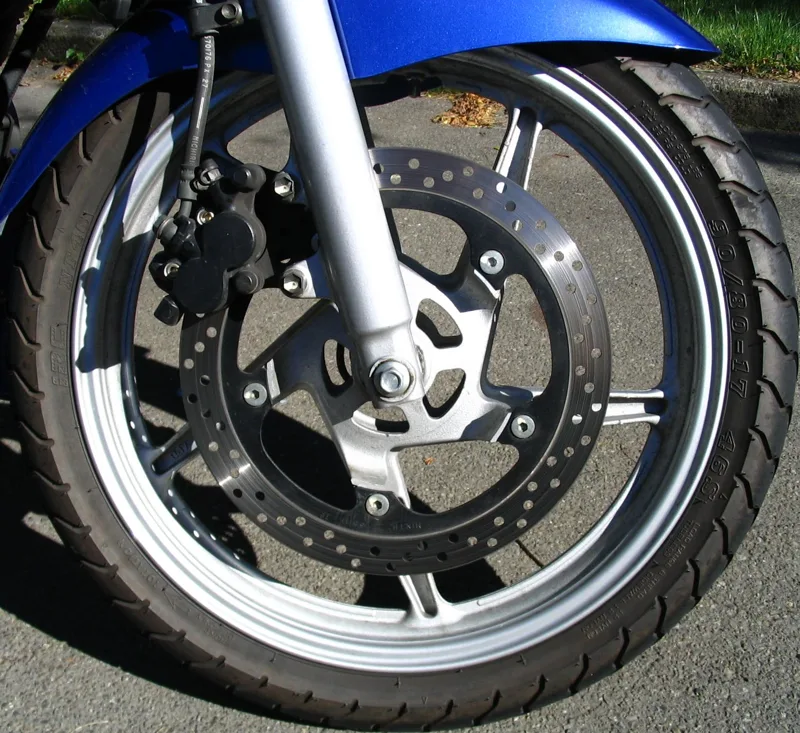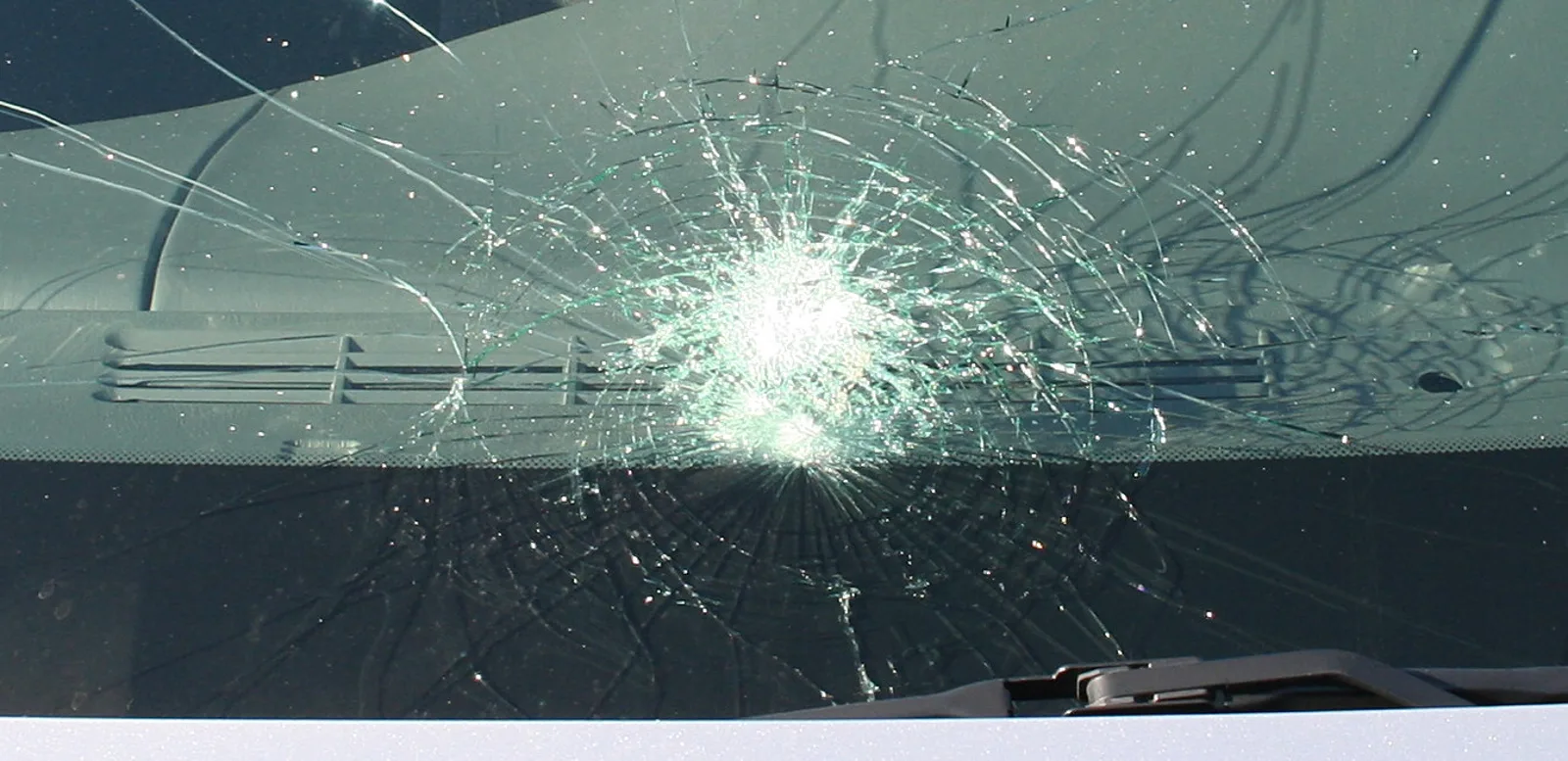
A glass sandwich in front, stressed single sheets at the sides: how each type is made, how it fails and why a car needs both.
Laminated glass bonds layers of glass to a plastic interlayer, so it cracks like a spider web and stays in place; it is used for windscreens. Tempered glass is heat or chemically treated so the surface is in compression, and it breaks into small granular chunks; it is used for side and rear windows.
In about 1660 Prince Rupert of the Rhine showed King Charles II a curiosity: a teardrop of glass that could take a hammer blow on its fat end without breaking, and yet would burst explosively into powder if the thin tail was nipped. Those drops show the principle behind tempered glass: stress locked inside holds the glass together until something releases it.
Your windscreen works on an entirely different principle.
Laminated vs tempered glass: the quick difference
Laminated glass is a sandwich. Two or more layers of glass enclose a thin polymer film, and the film keeps the glass from splitting into big, sharp fragments. Tempered glass is a single sheet that has been treated, by heat or chemicals, so its outer surfaces are squeezed into compression while the inside is in tension. When laminated glass is hit, it cracks but stays together. When tempered glass is hit hard enough, it explodes into small granular chunks.
Prince Rupert's Drops can take a hammer blow on the bulb, then burst into powder if the tail is nipped.
How is laminated glass made?
Modern laminated glass joins two or more sheets of plain annealed or tempered glass using a plastic interlayer. The usual choices are polyvinyl butyral (PVB), thermoplastic polyurethane (TPU) and cross-linked ethylene-vinyl acetate (EVA). Ionoplast polymers and cast-in-place liquid resin are also used. The interlayer improves impact strength, fracture toughness and the way the glass fails.
The sequence is simple in outline. The plastic sheet is sandwiched between the glass, and the assembly passes through rollers or vacuum bagging to push out air pockets. It is heated for an initial melt, then heated again under pressure in an autoclave to make the final bond. The tint band you can see at the top of some windscreens is in the PVB.
How thick is a car windscreen?
A typical laminated makeup is 2.5 mm of glass, a 0.38 mm interlayer and another 2.5 mm of glass, which gives a product known as 5.38 mm (0.212 in) laminated glass. In automobiles the panel is around 6.5 mm (0.26 in) thick, while aircraft glass is about three times as thick. The Boeing 747's cockpit side windows are among those built from three 4 mm plies of toughened glass with 2.6 mm of PVB between them, and the forward pressure windscreens of Concorde had seven plies, four glass and three PVB, for a total of 38 mm (1.5 in).
How laminated glass breaks
When an impact is not strong enough to pierce the glass completely, it leaves the characteristic spider web: radial cracks running out from the point, joined by concentric ones. The interlayer holds the fragments. Laminated glass fails either when the interlayer itself gives way or when its bond to the glass lets go, and the interlayer transfers shear stress to the glass as the panel bends. Its stiffness largely sets the stiffness of the whole panel.
The benefit in a crash is plain. The windscreen stays intact, which keeps fragments from injuring the occupants. The same property makes it hard to break through, which helps against intruders.
Acoustic laminated glass and UV protection
The interlayer also does jobs unrelated to crashes. Laminated glass significantly improves sound attenuation compared with a single pane of the same thickness, and mixing sheets of different thicknesses, such as 3, 4, 5 and 6 mm, is more effective still for extreme noise. EVA and TPU need nothing extra for sound, while PVB must be a special acoustic grade. A good interlayer can also block nearly all ultraviolet radiation, and a thermoset EVA can block up to 99.9 per cent.
A history of the laminated windscreen
The idea began with an accident in a laboratory. In 1903 the French chemist Edouard Benedictus dropped a glass flask that had become coated in cellulose nitrate. It shattered, but did not fall apart. In 1909 he patented the idea after learning of a car crash in which two women were severely hurt by flying glass, and in 1911 he formed the Societe du Verre Triplex to make a glass and plastic composite. Production was slow and expensive, so car makers did not rush to adopt it, but it found a use in the eyepieces of gas masks in the First World War. The process was licensed to British Triplex Safety Glass in 1912.
Meanwhile, in 1905, John Crewe Wood, a solicitor from Swindon, patented a laminated glass for windscreens, with the layers bonded by Canada balsam, and founded the Safety Motor Screen Company in 1906. A key advance came in 1927, when two Canadian chemists, Howard Matheson and Frederick Skirrow, invented PVB. By 1936 American firms had found that a layer of PVB between two sheets of glass did not discolour and resisted penetration in accidents, and within five years it had largely replaced what came before.
The law followed slowly. The British Road Traffic Act 1930 required new cars to have safety-glass windscreens, though it did not specify laminated glass. By 1939 about 56,000 square metres (600,000 square feet) of Indestructo safety glass a year was going into cars at Ford's works in Dagenham.
What is tempered glass?
Tempered or toughened glass is processed to be stronger than normal glass, by thermal or chemical treatment. The treatment squeezes the outer skin into compression and leaves the core stretched in tension. Annealed glass, by contrast, has almost no internal stress and carries microscopic cracks on its surface. Under tension those cracks spread at very high speed, because stress concentrates at the tip, so ordinary glass breaks into irregular, sharp pieces. In tempered glass the compression at the surface holds flaws shut and stops them growing.
The result is about four times the strength of annealed glass. For fully tempered 6 mm glass the minimum is either 69 MPa (10 000 psi) of surface compression or 67 MPa (9 700 psi) at the edge, and for it to count as safety glass the surface stress should exceed 100 megapascals (15,000 psi). When it breaks, it breaks into small, rounded chunks. Such pieces carry less momentum and penetrate less deeply than large jagged shards.
How is tempered glass made?
The common route is thermal. Annealed glass rides a roller table into a furnace that takes it well past its glass transition point of 564 degrees Celsius (1,047 degrees Fahrenheit), up to around 620 degrees Celsius (1,148 degrees Fahrenheit). Forced air then cools the surfaces rapidly while the inner portion stays free to flow briefly. Because the outside contracts faster, it locks into compression with the core in tension.
The alternative is chemical. A glass is immersed in a bath of molten potassium nitrate, and potassium ions, which are 30 per cent larger, take the place of sodium ions in the surface, forcing a layer at least 0.1 mm thick into compression. Chemical toughening gives more toughness than thermal tempering and suits objects of complex shape.
Either way, tempering comes last. Cutting, grinding, polishing edges and drilling holes must all be done beforehand, because cutting, grinding or sharp impacts after tempering make the glass fracture.
Which glass goes where in a car?
A car window has to cope with three demands at once: strength, thermal resistance and safety. A car lives outdoors, so it faces constant heating and cooling and big temperature swings through the year, and it has to survive small impacts from stones and road debris as well as accidents. Large sharp shards would be an unacceptable danger to passengers, so tempered glass is used: when it breaks, the pieces are blunt and largely harmless.
The windscreen is the exception. It is laminated, because laminated glass does not fall apart when it breaks. The side windows and rear windscreen have historically been tempered, although some newer luxury vehicles use laminated side glass to satisfy occupant-retention rules, to deter theft or to deaden sound.
| Feature | Laminated glass | Tempered glass |
|---|---|---|
| Construction | Two or more glass layers bonded to a polymer interlayer | Single sheet with surfaces in compression, core in tension |
| When broken | Spider web cracks; fragments held in place | Small granular chunks |
| Usual car position | Windscreen; some newer luxury side windows | Side windows and rear windscreen |
| Strength | Interlayer adds impact strength and toughness | About four times stronger than annealed glass |
| Weakness | Cutting is difficult; interlayer hard to recycle | Cannot be reworked; can shatter completely |
| Extra properties | Sound reduction; blocks nearly all UV | Resists heat swings |
Why do car windows shatter?
Because the stresses in tempered glass are balanced, damage to any portion will eventually bring the whole pane down in thumbnail-sized pieces. Edge damage is the most dangerous, because tensile stress peaks there, but a hard blow in the middle can do it as well, and so can an impact concentrated on a point, such as a hardened tip. That tendency is why tempered glass can be a security risk: it shatters completely rather than leaving shards in the frame.
Sometimes there is no impact at all. Spontaneous breakage can come from nickel sulfide inclusions, tiny stones that arise when shavings from stainless-steel machinery find their way into the glass. They change structure and grow over time, building internal stress until the pane fails, even years after it was made. The pattern they leave is distinctive, a figure eight whose loops are about 30 mm across. Small chips or nicks in the edge, made while the glass was being installed, can also develop into large breaks as the glass expands and contracts, and a pane bound too tightly in its frame can build up stress for the same reason.
Repairing and recycling laminated glass
Minor impact damage to laminated glass can be repaired. According to the US National Windshield Repair Association, the process involves drilling down through the cracked glass to the lamination layer, injecting a clear adhesive resin under pressure and curing it with ultraviolet light. Done properly, it restores strength and clarity sufficiently for most safety purposes, and it is widely used on large industrial automotive windscreens when the damage stays out of the driver's field of view.
Recycling is harder. Waste laminated glass can no longer go to landfill in most European countries under the End of Life Vehicles Directive. The interlayer cannot easily be recycled, though a University of Surrey and Pilkington study proposes feeding waste glass through a rolling mill to fragment it and detach the film, then melting the plastic so both materials can be reused. Recycled PVB has structural variations and lower strength than the original, while TPU is easy to recycle because, like other plastics that are not cross-linked, it can simply be melted again.
Where tempered glass came from
The first method for tempering glass is credited to Francois Royer de la Bastie of Paris in 1874, who quenched glass that was nearly molten in a warm bath of oil or grease; the result is sometimes called Bastie glass. In 1877 the German Friedrich Siemens produced a stronger version by pressing the glass in cool moulds. The first patent on a whole process was held by Rudolph Seiden, a chemist born in Austria in 1900 who emigrated to the United States in 1935.
Where this goes next
Some newer luxury vehicles already use laminated side windows. Interlayer chemistry has widened beyond PVB to include EVA and TPU, and since 2004 electroconductive interlayers have been used to embed LEDs, or to make a switchable panel that is clear when a small current runs through it and opaque when the current is off.
What it means for a buyer or a driver
If you wear polarising sunglasses, look at a tempered side window: the strain pattern left by tempering becomes visible. A chip in a windscreen outside the driver's line of sight is the kind of damage that can be repaired with injected resin. And if you want a quieter cabin, remember that the glass itself is part of the answer: laminated panels cut noise better than ordinary glass of equal thickness, and an acoustic interlayer goes further.