A 1973 Wheels Car of the Year winner built on a shoestring, hit by a fuel crisis and strikes, and shut down within two years.
The Leyland P76 was a large Australian car launched in 1973 by Leyland Australia, with a 4416 cc aluminium V8 and a wedge shape. It won Wheels Car of the Year in 1973, but rushed assembly, strikes and the oil crisis ended production by October 1974.
The Leyland P76 won Wheels Car of the Year in 1973, and by October 1974 the factory that built it had been shut. Few cars have gone from the top of the podium to the scrapheap so fast. The P76 collected its trophy for the V8 model, yet it also collected a reputation as a lemon, and the second label stuck harder than the first.
What was the Leyland P76?
The Leyland P76 was a large family car made by Leyland Australia, the local arm of British Leyland. It rode on what the company described as the standard Australian wheelbase of 111 inches and was meant to give Leyland a real challenger to three local best-sellers: Ford's Falcon, Holden's Kingswood and Chrysler's Valiant.
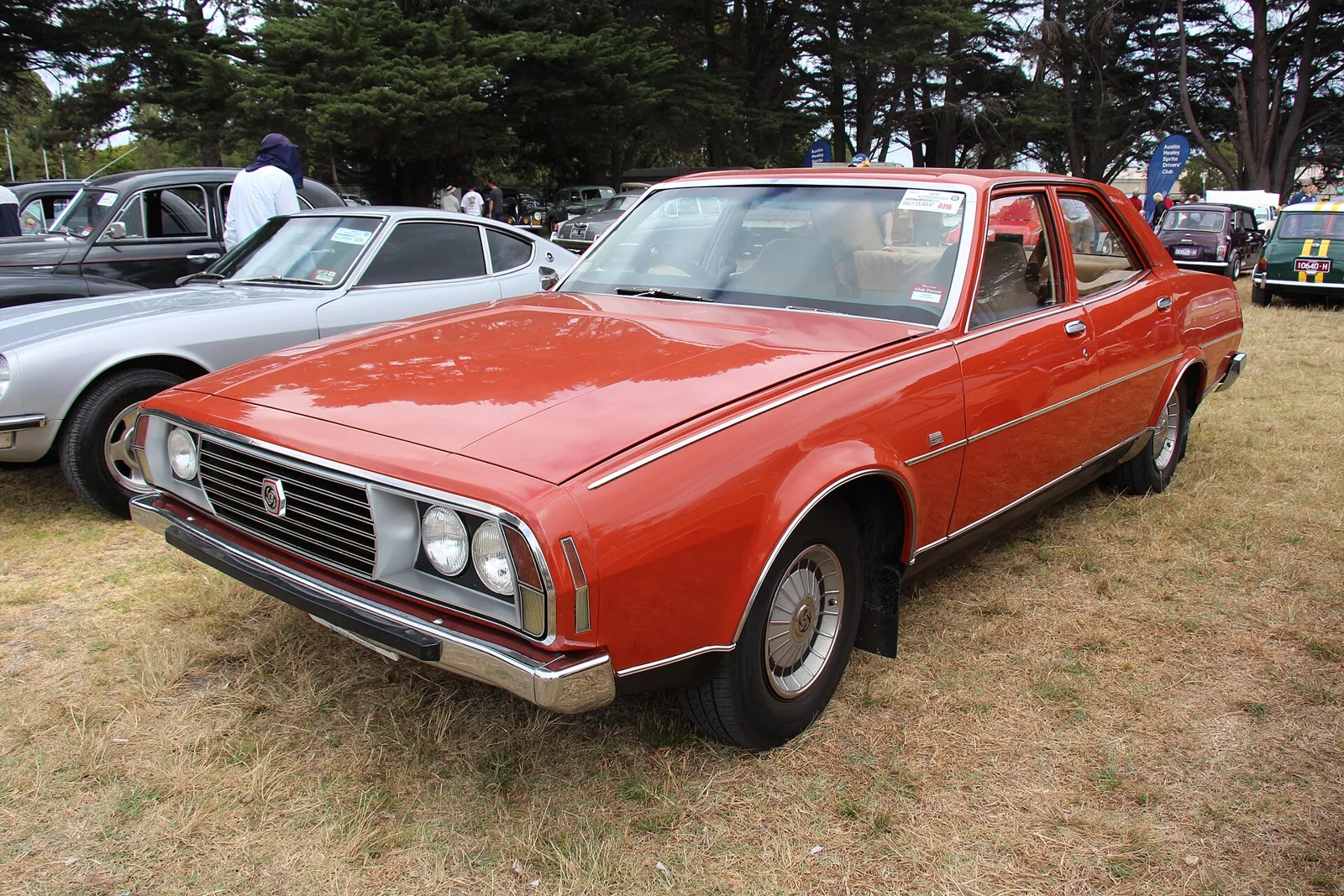
Launched in 1973, it quickly picked up the nickname of the wedge, from its shape, and the boot was big enough that a 44 gallon drum slid in without fuss. Giovanni Michelotti, the Italian stylist, designed it. A station wagon and a coupe called the Force 7 were drawn up as well, but neither reached mass production.
A Car of the Year winner, a lemon and a cult classic, all inside a few short years.
Why did Leyland Australia build it?
In 1969 Leyland Australia was cleared to build a big car for the home market, and it was a high-stakes bet. When the car was launched, the company was reported to carry an accumulated deficit equal to 8.6 million pounds, and it had borrowed the same sum again to pay for the P76. The whole car, designed and built from scratch, had a development fund of just A$20m. Commercial success was seen as vital to the survival of Leyland in Australia.
The pressure from Britain made things worse. British Leyland had been put together on 17 January 1968 by a merger of Leyland Motor Corporation and British Motor Holdings, with Sir Donald Stokes as chairman. It brought together most of what remained of the independent British car industry, along with truck, bus and other businesses, yet it was a troubled conglomerate with strikes, duplicated products and rivals in its own showrooms. By the end of 1974 it was on the brink of bankruptcy, and the government-ordered Ryder report of April 1975 led to the company being effectively nationalised.
The cars that came before
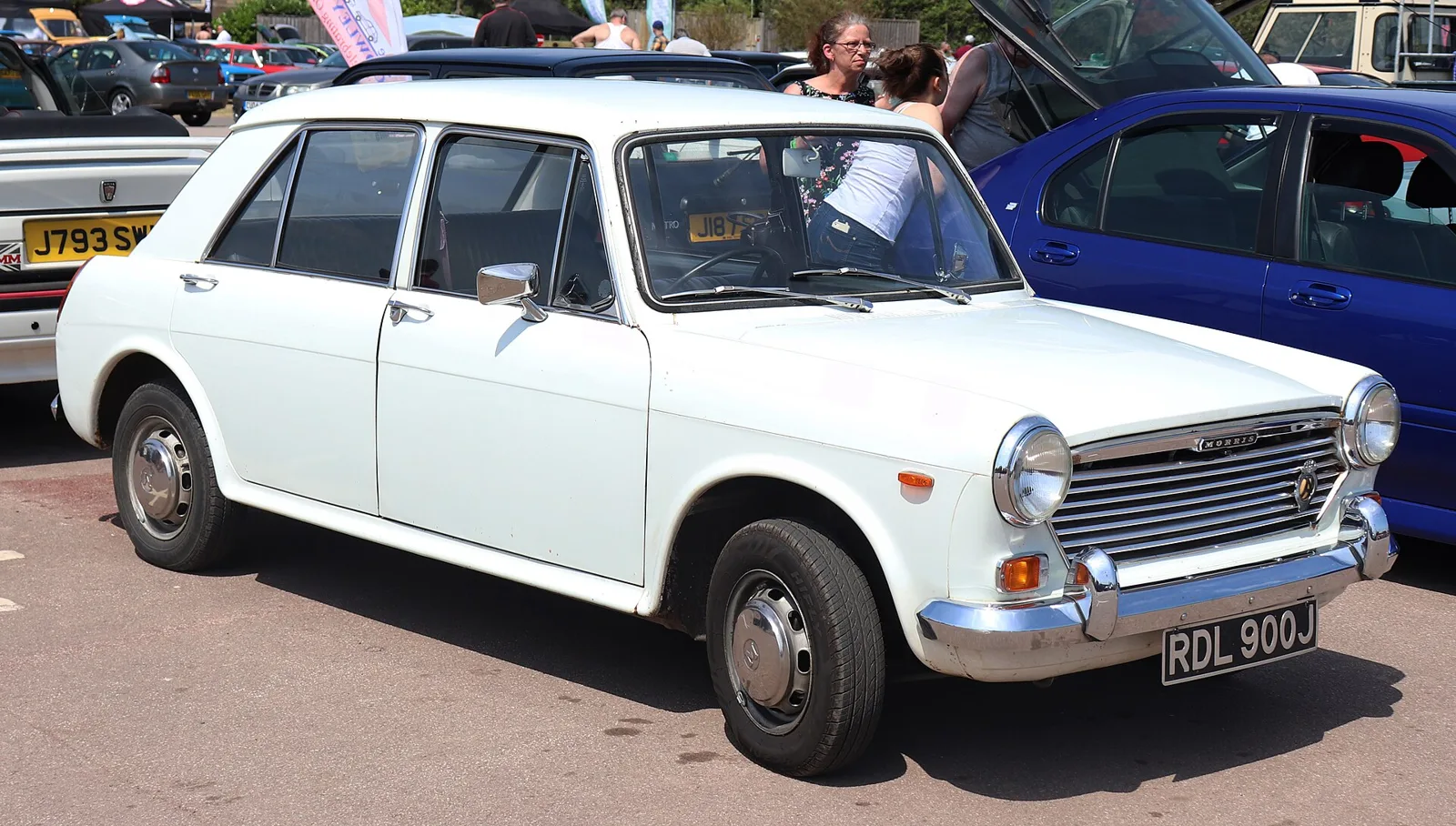
The P76 was not Leyland's first attempt at the large-car market. Its Australian predecessor BMC had tried several times and never quite landed a blow. There was the 1958 Morris Marshal, which was a rebadged Austin A95. In 1962 came the Austin Freeway and the Wolseley 24/80, the Freeway being an Austin A60 given Riley tail lights, a distinctive full-width grille and a 2.4-litre six built from the 1622 cc B-series engine. The 1971 Austin X6 Tasman and Kimberley were facelifted Austin 1800 models with a 2.2-litre six.
Each was a compromise. Buyers by a wide margin stayed with the established products from Holden and Ford. Even so, the Freeway, the 24/80 and the X6 each found a loyal niche following, which hints at the pattern the P76 would follow.
How was the P76 engineered?
Underneath the wedge the P76 was a conventional car with a few clever choices. The entry-level engine was an enlarged six of 2663cc producing 121 bhp (83 kW), developed from the unit in the smaller Austin Kimberley and Tasman. The top engine, an aluminium V8 of 4416 cc and 192 bhp (143 kW), was exclusive to the P76 and was derived from the former Buick V8 that powered the Rover 3500 and the Range Rover.
The aluminium block mattered. Leyland Australia claimed a weight advantage approaching 500 lb (230 kg), most of it down to the lighter engine block compared with the cast-iron blocks, of bigger capacity, used for the rival V8s at Chrysler, Holden and Ford. Think of it as the difference between carrying a steel toolbox and an aluminium one: the cargo is the same, but you feel the weight on every corner. The company hoped lighter weight would lead to better fuel economy and longer tyre life.
Equipment ahead of its time
Safety equipment arrived before the coming Australian Design Rules required it. Front discs were standard on every model, door handles were recessed, and all doors had full-length side-intrusion reinforcements. For the class and the market, the list of features was advanced: MacPherson-strut front suspension and rack-and-pinion steering, with power-assisted disc brakes, a front-hinged bonnet, a glued-in windscreen and hidden wipers. A live rear axle and Borg-Warner gearboxes, including a three-speed column shift, kept the mechanical layout familiar to Australian buyers. Borg-Warner Australia already supplied transmissions to Ford and Chrysler.
The advertising slogan was Anything but average, though the engineering followed conventional lines. Engineers paid particular attention to structural rigidity, a traditional British Leyland strength, and deliberately reduced the number of panels in the body to a reportedly low 215, which is said to be only five more than a Mini needs. When production stopped, Leyland was working on a V6 to replace the six. The plan was to take the 4.4-litre V8 and simply remove its two rear cylinders.
What does P76 stand for?
The name came from the codename used during development, Project 76. Officially, the P76 was a wholly original Large Family Car, designed and built in Australia with no equivalent overseas, and the letters stood for Project 1976.
There is a less formal theory, which has the letters and digits borrowed from the army service number belonging to Lord Donald Stokes, who chaired British Leyland at the time. The oddity in the official story is that the P76 was out of production by 1976, the year the Rover SD1 appeared sharing several engineering features with it, among them MacPherson strut front suspension, an aluminium V8 and a live rear axle.
Why did a Car of the Year winner fail so quickly?
Rushed assembly, a fuel crisis and strikes at component factories combined to give the P76 a reputation for poor build quality and reliability problems. Demand outstripped supply, so Leyland hurried the first cars off the line. By 1974 sales had slumped, and production was brought to an end.
The timing could hardly have been worse. Inflation was racing under a controversial new Labor government, strikes hit component makers and the Zetland plant, and the car arrived just as the 1973 oil crisis sent fuel prices sharply upwards. Demand for all larger cars subsided. Press and public reaction to the car had been generally favourable, but sales still fell short of expectations.
The Zetland plant closed in October 1974. British Leyland had announced plans to sell the P76 in the United Kingdom, but production stopped before they could be carried out.
How many P76s were made?
| Trim | Production | Notes |
|---|---|---|
| Deluxe | 8,169 | Six and V8 cars; column auto, column manual and four-speed manual |
| Super | 7,462 | Includes T-bar automatic cars and the Targa Florio model |
| Executive | 2,376 | V8 with T-bar automatic only |
Within those totals the most popular single line was the Deluxe column manual six at 2,342 cars. The Super T-bar automatic V8 followed at 2,256, a figure that includes 488 Targa Florio cars. The Executive was offered in only one form, the T-bar automatic V8.
Did the P76 ever win anything?
It did. In the 1974 World Cup Rally a P76 won the Targa Florio section and placed 13th overall. Leyland Australia marked the result with a limited-edition Targa Florio model, a V8 Super fitted with a limited-slip differential and sporting wheels and steering wheel, finished in special paint with side stripes.
The car has also had a long second career in classic events. Gerry Crown and Matt Bryson took the Classic Category in the 2013 Peking to Paris Endurance Rally in their P76, and repeated the win in 2019. In 2015 the same pair came second on the Road to Mandalay classic rally, and their car was fastest overall, earning the Malaysian Cup.
What was the Force 7, and what never reached the showroom?
The Force 7 was a coupe that had proper room for five adults and a big rear hatchback, a layout not seen before from an Australian factory, and few of its body panels came from the sedan. The plan called for a six-cylinder Force 7 at the bottom, the V8-powered Force 7V in the middle, and the Tour de Force at the top. Every surviving car is a Force 7V.
Only 10 pre-production coupes survived the closure of the factory: one was already in England for secret testing, another went to an Australian museum, and the remaining eight were auctioned to private buyers in 1975. Those cars are all still around, and their private owners drive them regularly. As of 2018, all 10 coupes and the single wagon had survived.
The wagon story is just as unusual. At the launch, the company said an estate version would follow later that year, and at least three prototypes were built. One was cut up to study the body's strength, another was crash tested by Ford Australia to help Leyland gain part of its registration approval, and the last and only survivor spent time as a factory runabout before being sold at the same auction. None of the coupes sold had registration compliance plates, because final approval testing was never completed.
The medium car that never came
A smaller car, called the P82, was also planned to replace the Morris Marina in Australia. Michelotti and Leyland Australia's own design department competed on the styling. Only one prototype and some mock-ups were built, along with at least two experimental V6 engines, one of about 2.6 L based on a cut-down Rover V8 and another of about 3.3 L based on the P76 V8. A single clay model at 1/5 scale survives.
What happened to the P76 after Australia?
Kit assembly carried on at Petone in New Zealand, as a swap for Rover P6s put together in New Zealand and sent to Australia. The P76 sold well there, though only as a V8 and in Deluxe, Super and Executive trim, until August 1976. New Zealand cars can be identified by a Z stamped on the chassis plate after the 076 model designation, giving 076Z. When production ended, the surplus V8s were sold off by the local distributor and proved popular as boat engines.
A Venezuelan company was reported to have expressed interest in buying the production line, with a different engine. Leyland Australia itself went on to limit local production to the Mini and the Mini Moke at Enfield, plus commercial vehicles and buses, and the Zetland site was taken over by the Australian military.
Why is the P76 a cult classic?
Because enthusiasm has outlasted the reputation. The P76 has a loyal body of owners who are devoted to the car, with at least seven owners clubs spread across Australia and New Zealand, the one in New Zealand dating from 1983. Some Australians view it as an icon of the country's motoring history despite, or perhaps because of, its labelling as a lemon.
Where this goes next for the people involved
The parent group did not recover. After the Ryder report of April 1975 British Leyland became BL, and in 1986 BL was renamed the Rover Group, which later passed through British Aerospace and BMW. The surviving MG Rover Group went into administration in 2005, ending mass car production by British-owned makers.