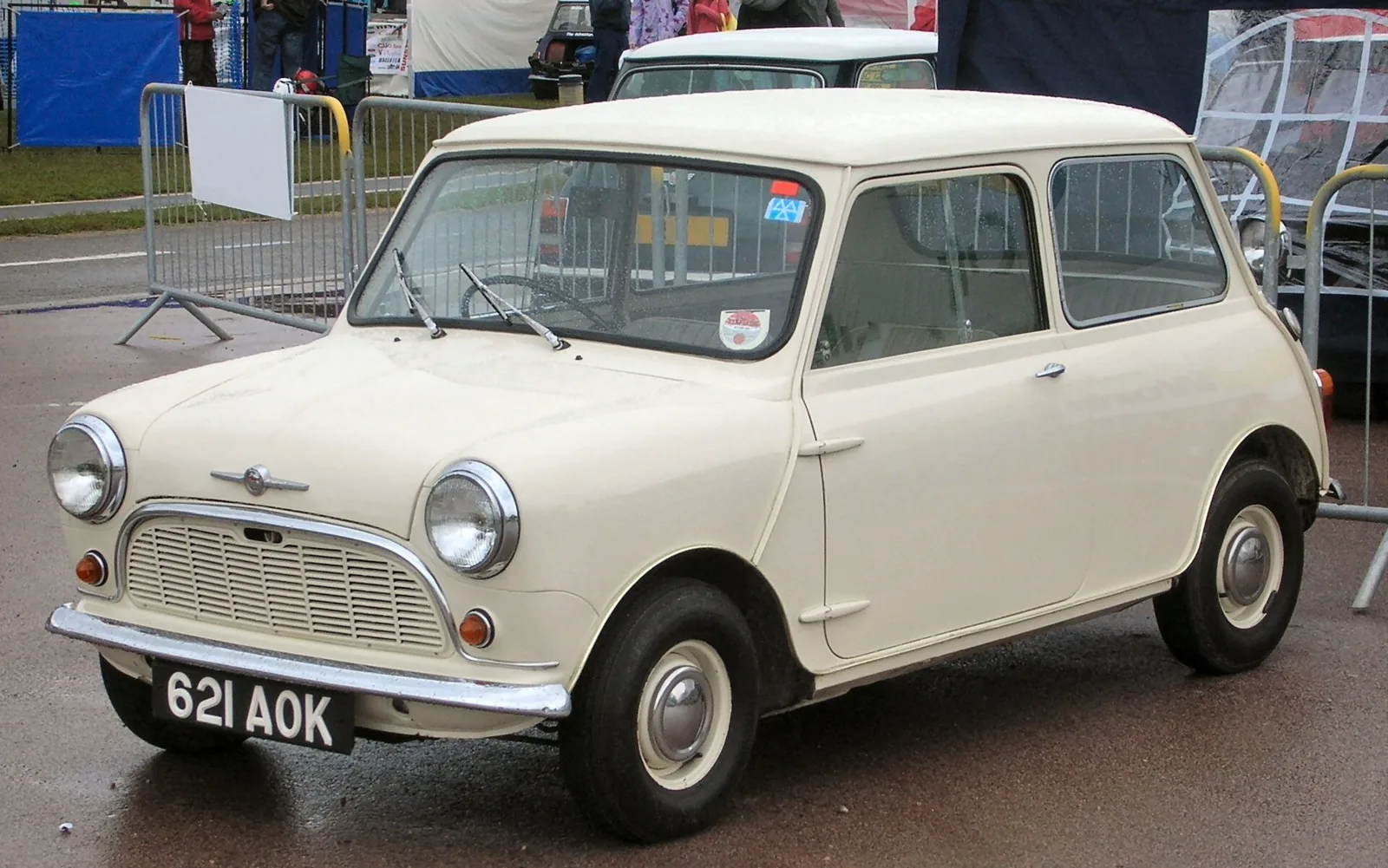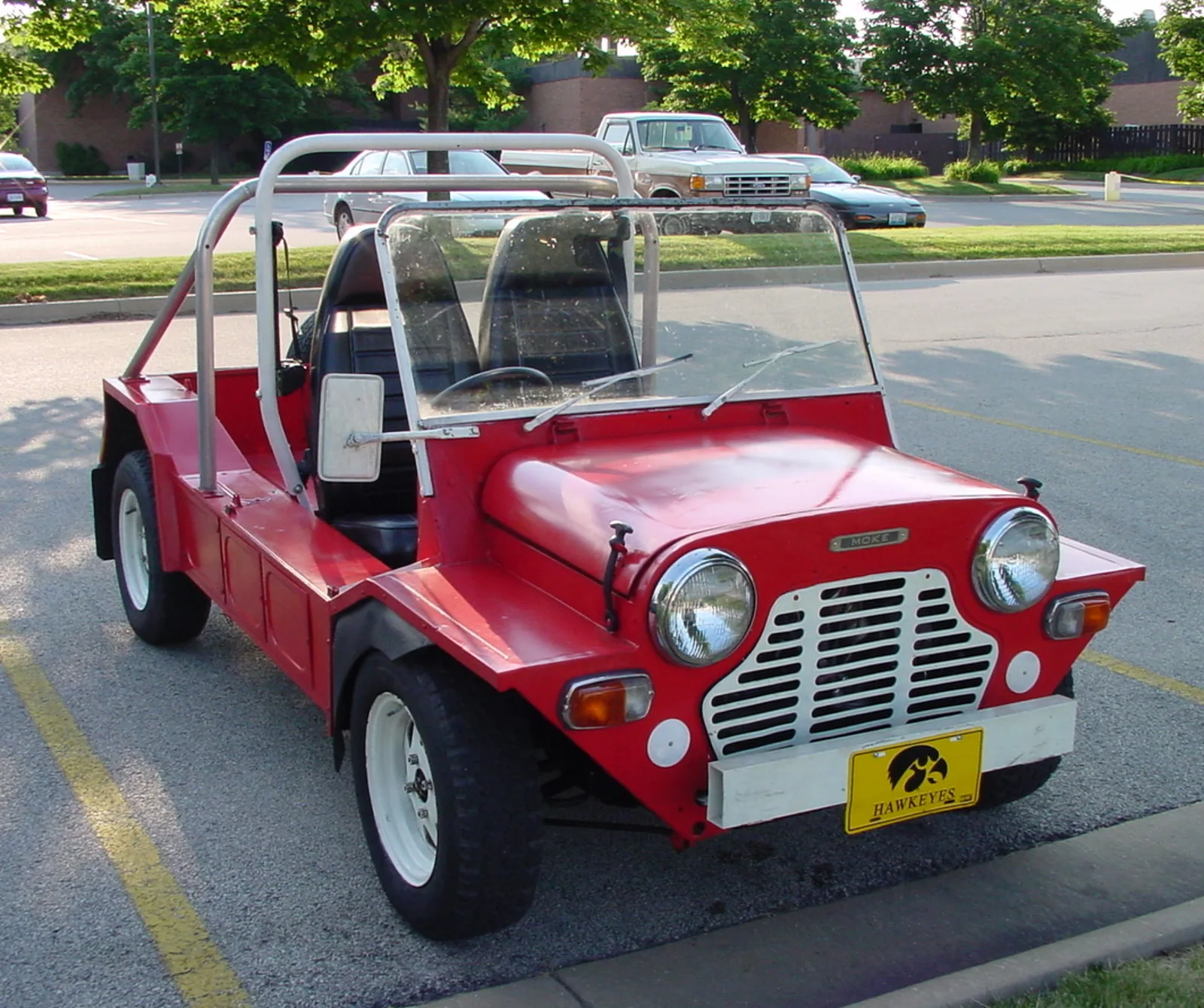
The British Army turned down one and the Australian Army never bought the other, yet 26,000 Mokes came out of Australian factories between 1966 and 1981 while the Country Buggy lived on in the Philippines.
The Mini Moke and the Volkswagen Country Buggy were light utility vehicles designed with armies in mind that found civilian buyers instead. Australia built 26,000 Mokes from 1966 to 1981, while Volkswagen made the Country Buggy there in 1967 and 1968 before the design moved to the Philippines as the Sakbayan.
The British Army turned down the Mini Moke, and the Australian Army never bought a single Volkswagen Country Buggy. Both found other customers. Australian factories built 26,000 Mokes between 1966 and 1981, and the Country Buggy, in production for little more than a year, lived on in the Philippines as the Sakbayan until 1980.
What is the Mini Moke?
The Mini Moke is a compact front-wheel-drive convertible for work and leisure, dreamed up by the British Motor Corporation (BMC) as a lightweight army vehicle and later sold to civilians as an Austin, a Morris, a Leyland and finally simply a Moke. The name pairs "mini" with "moke", an old word for a mule. Its doorless, no-frills design is what people remember.
BMC's Cowley plant began building Mokes in January 1964. Three countries then took turns, and the total across all of them came to about 50,000.
One was rejected by the British Army, the other bought by no army at all, and both kept going anyway.
Where the original Moke was built
| Country | Years | Cars | Notes |
|---|---|---|---|
| United Kingdom | 1964 to 1968 | 14,518 | Cowley plant, from January 1964 |
| Australia | 1966 to 1981 | 26,000 | Morris Mini Moke, then Leyland Moke from 1973 |
| Portugal | 1980 to 1993 | 10,000 | Setubal, then Vendas Novas from 1984 |
Why did the army turn the Moke down?
Sir Alec Issigonis and John Sheppard designed the Moke as a rugged-bodied sibling of the Mini, sharing its mechanical parts. The aim was to win some military business from Land Rover, a market Issigonis had already failed to break into with the Nuffield Guppy. By 1959 BMC had running prototypes, codenamed "The Buckboard".
The British Army saw them as a parachute-droppable vehicle and was not impressed: ground clearance was poor and the engine weak, so they missed the basic needs of an off-road machine. Only the Royal Navy showed interest, picturing it as a runabout for aircraft carrier flight decks. Early publicity played up the lightness, with four soldiers driving one off-road and then carrying it by the tubular bumpers when the low ground clearance (inevitably) stopped it.
A few four-wheel-drive Mokes were built by adding a second engine and gearbox at the back with linked clutches and gear levers. Called "The Twini", it did nothing for ground clearance, failed with the US Army, and the extra complexity ended development at prototype stage. Three Mokes served the Brazilian Army after being captured from Guyanese rebels in the 1969 Rupununi Rebellion, and the Rhodesian Security Forces tried an armoured version that seemingly failed. A handful were apparently used by British forces in the Falkland Islands, and at least one commandeered civilian Moke was used by Argentine forces during the occupation.
How did the Moke become a civilian car?
With the military route closed, BMC marketed the Moke in 1963 as a civilian vehicle for farmers and light commercial work. A prototype from that year survives in Pinner, outside London. It was launched in Britain in 1964, but Customs and Excise classed it as a passenger car instead of a commercial vehicle, which meant purchase tax and hurt sales in its intended market.
British Mokes used an 848 cc transverse four-cylinder engine, detuned for low-octane fuel, with the Mini's suspension, gearbox and 10-inch wheels. Passenger seats, grab handles, a heater, a washer and a removable canvas top came as optional extras that the owner fitted. The base price was 405 pounds. The first cars had a single wiper, a floor-mounted headlight dip switch and only one colour, Spruce Green. The 1967 Mk II added a passenger-side wiper, moved the horn and headlight controls to the indicator stalk and brought a white option.
John Player and Sons ran a team of Mokes in grass-track autocross through 1968, fitted with roll protection and the Mini Cooper S 1275 cc engine. British production ended that year.
What made the Moke Australian?
Production began in Australia in 1966 under the name Morris Mini Moke, which became Leyland Moke in 1973. Australian cars started with the British 10-inch wheels, but in 1968 these gave way to 13-inch wheels on longer rear trailing arms, with widening pieces welded to the arches for wider rims. That made the Moke far more practical for gentle off-road driving or the beach.
Solid metal seats gave way to tubular-framed "deck-chair" seats. The engine began as a 998 cc unit and switched mid-production to 1,098 cc, and in 1976 new anti-pollution rules (Australian Design Rule 27A) brought back an imported 998 cc engine, to which an air pump and exhaust-gas recirculation were added.
Around 1971 Leyland Australia built a "Moke, special export", usually called the "Californian", with a 1,275 cc engine, side marker lamps and altered rear lights to meet US standards. A tank borrowed from the Austin Sprite or MG Midget sat under the rear load area. Its roof and seats were trimmed in tiger-striped black-and-white vinyl or in "Orange Bali", and it was briefly pitched at the American "flower power" crowd. The Californian name and the 1275 cc motor returned in 1977 for Australian buyers, with denim seat covers, spoked wheels and tubular "roo bars".
Australian Mokes were exported widely and led the way in shipping Australian-made cars abroad on a large scale, something Leyland Australia made much of in its advertising. The Israeli Army's use of them, with a machine-gun tripod bolted in the back, drew controversy and media attention. A pickup variant followed in 1975, with a drop-sided bed of 1.45 by 1.50 metres (55 by 59 in) that stuck out behind the car, with a cloth top over the cab.
Leyland Australia also built at least two four-wheel-drive prototypes in the late 1970s, using a single engine, and planned to sell them, but production ended in 1981. One prototype survives with an enthusiast in Western Australia. In 1977 a Coca-Cola-sponsored Moke with a Cooper S engine of 1275 cc entered the Singapore Airlines London-Sydney Marathon, covering over 30,000 km (19,000 miles) in 30 days and finishing 35th.
How did Moke production end?
As Australian output wound down, British Leyland's Portuguese subsidiary took over. It made 8,500 Californian Mokes at the Setubal plant from 1980 to 1984, then moved to Vendas Novas. Early Portuguese cars matched late Australian ones, but they soon switched to current British Mini parts, including standard-length rear trailing arms and 12-inch wheels with low-profile tyres.
In April 1990 Rover Group, as British Leyland had become, sold the Moke name to the motorcycle maker Cagiva, of Bologna. Production continued in Portugal until 1993, when Cagiva shifted the tooling to its factory in Varese, Italy, planning to restart in 1995. It never did, though some unfinished cars were assembled. Cagiva paid far more for Rover-made parts than British Leyland's Portuguese arm had, so the venture never made financial sense. It did not own the Mini name, so its 2071 cars were sold simply as Mokes.
What is the electric Moke?
A 2012 partnership between MOKE International, designer Michael Young, Chery and Sicar Engineering produced a redesigned Moke, intended for Thailand, Australia, the Caribbean, the Seychelles, Mauritius and Egypt by 2016. Chery began building it in China in 2013. The 2020 version has a 1,083 cc fuel-injected four-cylinder petrol engine with a manual or automatic gearbox, and France built it too.
A battery-powered edition of that design has been made in Britain since 2021, and EV Technology Group acquired the Moke brand in 2022. Outside China the brand now sells only electric cars. The new car shares nothing with the original, and assembly and distribution are handled by several companies in England, France and the US, with ownership of the trademark disputed.
What should a buyer know about an old Moke?
The construction is simple. Two box-section sideboxes run between the wheels, tied together by a floor pan, a firewall and a torque box under the front seats. The left box holds the fuel tank, and the right has the battery and a small lockable store. There is no chassis: wheels, brakes and suspension sit on front and rear subframes bolted straight to the shell, as on a Mini.
Only three panels are curved, the bonnet, firewall and floor, and each curves in one direction only, so body parts can be reproduced without sophisticated machine tools. Because the A-Series engine, manual gearbox and suspension match a standard Mini, which stayed in production up to October 2000, most spares are still easy to find. Mokes do tend to demand a lot of structural maintenance to stay in good order.
The true Moke was never sold as a kit car, but Mini parts were so plentiful that many firms built look-alikes under names including Mini-Cub, Nomad, Gecko, Hustler, Jimini, Mule, Navajo, Warrior and Yak, and one of them, the MPV, had six wheels. Lazareth Auto-Moto built a one-off with a 454 hp Maserati V-8. Away from the road, the Moke became a popular beach buggy, often rented to tourists in tropical resorts such as Mauritius and Barbados.
What was the Volkswagen Country Buggy?
The Country Buggy was Volkswagen's own Australian-designed, Australian-built light utility vehicle, assembled from Type 1 and Type 2 parts. Production ran from 1967 to 1968. A relative named the Sakbayan stayed in production in the Philippines until 1980.
Work began in the early 1960s at Volkswagen Australia's Clayton factory on a vehicle intended for the Australian Army but also saleable to the general public. The army wanted an amphibious four-wheel-drive machine for Australian conditions. Rudi Herzmer, the managing director of Volkswagen Australasia, headed the project, with engineer Cyril Harcourt, and it was codenamed Kurierwagen. A prototype was finished by late 1965 and two more followed, with test engineer Paul Kochan logging 50,000 km (31,000 mi) of road testing.
Two prototypes went to Wolfsburg for approval. Herzmer found Volkswagen there had begun a comparable project, the future Volkswagen 181, but Germany approved the Australian project subject to changes. Dealers saw a prototype in February 1967, March brought its public debut at the Melbourne auto show, and by then it had become the Type 197 Country Buggy. Production began in July 1967, but sales were held until 3 April 1968 so problems found in testing could be solved. Because the production car could neither drive all four wheels nor float, the army bought none.
Why did Country Buggy production stop so soon?
Volkswagen Australasia was struggling in 1967. It lost $2.6 million and slipped to sixth place by sales, behind Toyota. Auditors from Germany blamed the heavy investment needed to reach the 95% local content demanded by the government's "Plan A", and recommended a switch to assembling German-supplied kits under the "SV Plan", which asked for only 60% local content.
The company accepted in July 1968 and said local manufacturing would stop, with Volkswagen Australasia replaced by a wholly German-owned firm called Motor Products Limited. After eight months and 842 cars, the Country Buggy was phased out, with production stopping in September or October 1968. Kits kept flowing until the parts stock ran out in 1970, and another 181 export vehicles were built.
Of the Country Buggies built, 459 went abroad as kits to places such as Singapore, New Zealand, small Pacific nations and, above all, the Philippines. A registry of Country Buggies lists 363 vehicles, and many of them are recorded as scrapped or of unknown whereabouts.
How was the Country Buggy built?
Underneath lay an Australian-made Type 1 chassis, a tubular spine with a platform welded on. The body was designed and made in Australia from folded flat steel. It had very high sills and no doors, a windscreen that folded flat, and Type 1 headlamps on a sloping nose. Short overhangs gave a laden approach angle of 51 degrees 30 minutes and a departure angle of 32 degrees, and the exhaust exited above the rear bumper so it would not catch the ground.
Front trailing arms from the first Type 2 went in with portal axles from the Kubelwagen and early Type 2 went on the rear hubs, together lifting ride height to 230 mm (9.1 in). Ground clearance measured 234 mm (9.2 in), with payload topping out at 366 kg (807 lb). The steering box and wipers came from the Type 3, and the electrics were a 6-volt system.
Power came from an air-cooled four-cylinder boxer. The standard unit displaced 1,285 cc and made 50 bhp SAE at 4600 rpm or 40 bhp DIN at 4000, while the optional engine, shorter in stroke, displaced 1,192 cc and made 41.5 bhp SAE at 3900 rpm. Drive went to the rear wheels through the Type 1's four-speed transaxle and swing axles, on 5.60 x 15 tyres and 250 mm (9.84 in) drum brakes. Options included a soft top, hard top, side curtains, an engine guard and a power take off, but no heater was offered. The base 1300 cc version cost A$1598.00.
What was the Sakbayan?
The Sakbayan was the Philippine version of the Country Buggy. In 1968 the Volkswagen distributor DMG Inc. began importing Country Buggies as kits for final assembly, left-hand drive and with some local parts. When the Australian supply ran out, DMG used Type 181 running gear and made a copy of the body locally. In April 1972 Volkswagen was announced as putting over US$6,000,000 into a Sakbayan 817 venture alongside DMG.
The name combines the Tagalog words for "vehicle" and for "country, people or town" and mirrors the German Volkswagen, meaning "people's car". Many consider it the first car both designed and built in the Philippines. Its body had one raised strake on the side rather than two, inset headlamps and the option of a hardtop. Later cars drew on parts from Volkswagen do Brasil, and engines went from 1600 cc to 1500 cc.
In the 1970s the phone utility PLDT, the Philippine Long Distance Telephone Company, bought large numbers as service and maintenance vehicles, used until the mid-eighties, and the government-owned Philippine National Bank ran them too. Sakbayans are now being restored, partly because of interest in the Beetle, as either a two-door coupe with windows and doors or a doorless, roofed version much like a jeep. Several featured as police cars in Black Mama, White Mama, a 1973 Pam Grier film shot in the Philippines.