A semi-final decided by 0.0002 seconds, 5/8-scale race cars at $17,500 and trucks flying off ramps: four formats built to level the field.
Identical machinery runs through all four formats. The Race of Champions began in 1988, Legends cars in 1992, Stadium Super Trucks in 2013 and SRX in 2021. Each is built around either show value or low running costs, and SRX postponed its 2024 season.
In 2006 Mattias Ekstrom beat Heikki Kovalainen in a Race of Champions semi-final by 0.0002 seconds. That margin only means something because both men were driving mechanically identical cars. Identical machinery is the thread that links the Race of Champions, the Superstar Racing Experience, Stadium Super Trucks and Legends cars: four racing formats that trade development budgets for show and a level field.
The Race of Champions: the best drivers in the same car
The Race of Champions is an international event held at the start or end of each year. It brings together some of the best drivers from Formula One, the World Rally Championship, IndyCar, NASCAR, sports car racing, touring cars and motorcycle racing to compete in identical cars. Former rally driver Michele Mouton and Fredrik Johnsson, president of International Media Productions, organised the first one in 1988. It began as a contest between the world's best rally drivers and has since widened to most other disciplines.
The top individual is named Champion of Champions and receives the Henri Toivonen Memorial Trophy. A Nations' Cup, added in 1999, pits teams of two drivers against each other for their countries.
How a Race of Champions works
Drivers meet head-to-head in a single race around the track. A round-robin format gradually eliminates them, and the best eight go into a knockout tournament. Before the individual event, eight teams of two drivers compete in the Nations' Cup using a similar format. In both competitions the final consists of three runs, and the first team or driver to win two is champion.
Before each run, both drivers are assigned the same type of car, and every machine is mechanically identical, so over the event each driver gets to try several different cars. The line-up changes from year to year. In 2012 it ranged from a purpose-built ROC Car buggy and the KTM X-Bow to the Audi R8 LMS and a NASCAR European Stock Car. In 2022 the FIA RX2e and the off-road Polaris RZR PRO XP were on the list, alongside SuperCar Lites powered by fossil-free biofuel.
From Montlhery to stadiums
The first event was held in 1988 at the Autodrome de Linas-Montlhery near Paris, to honour Henri Toivonen, killed while leading the 1986 Tour de Corse, and to mark ten years of the rally world championship. Every world rally champion from 1979 to 1988 took part, among them Walter Rohrl, Ari Vatanen, Hannu Mikkola and Miki Biasion. Two Finns reached the final, where Juha Kankkunen beat Timo Salonen and so became the first Champion of Champions. The cars were an Audi Quattro S1, a BMW M3, a Ford Sierra RS Cosworth, a Lancia Delta Integrale, an Opel Manta 400 and a Peugeot 205 Turbo 16.
Extra events came and went. The International Rally Masters, from 1990, gave the season's best drivers who had yet to win a title a chance at a place in the main event. The Classic Rally Masters, first run in 1994, used pre-1965 Porsche 911s. Both have been discontinued. After one-off appearances at the Nurburgring, Barcelona and Madrid, the event settled on Gran Canaria from 1992 to 2003. Circuit drivers and motorcyclists joined with the Nations' Cup in 1999, and in 2001 non-rally drivers became eligible for the main title.
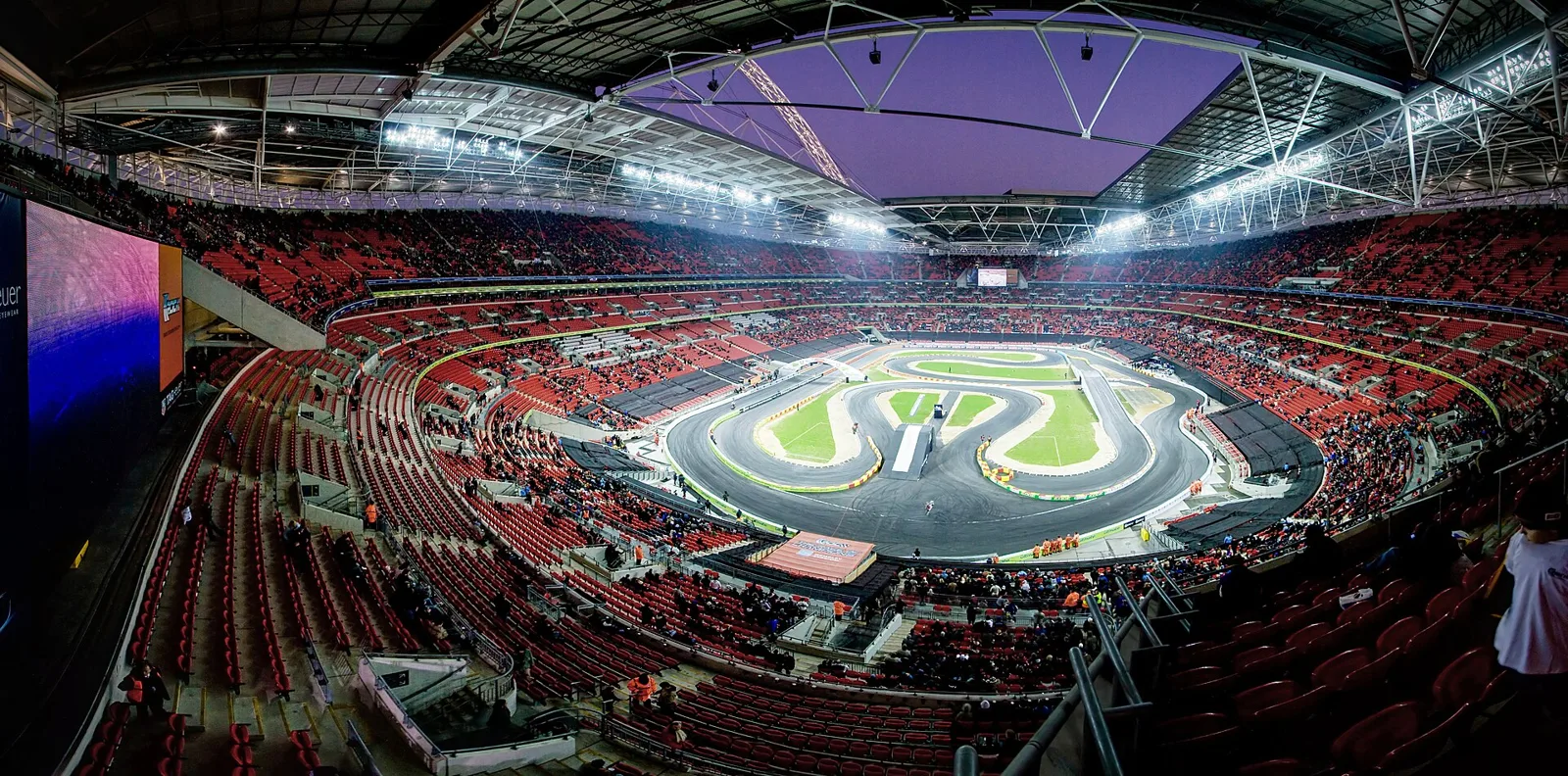
The move to stadiums from 2004 swapped gravel for tarmac, and rally drivers lost their dominance. By 2007 only a handful were left, and most of the field came from F1, touring cars and sports cars. Venues have included the Stade de France in Paris, Wembley, the Beijing National Stadium, Dusseldorf's Esprit Arena, Bangkok's Rajamangala Stadium, London Stadium, Marlins Park in Miami, Riyadh's King Fahd International Stadium and Mexico City's Foro Sol. Variations include the Bushy Park circuit in Barbados in 2014, a virtual edition in Assetto Corsa in 2020 during the pandemic, and the frozen Baltic Sea at Pitea in northern Sweden in 2022 and 2023.
Who has won
| Year | Venue | Champion of Champions |
|---|---|---|
| 1988 | Linas-Montlhery, Paris | Juha Kankkunen |
| 2004 | Stade de France | Heikki Kovalainen |
| 2005 | Stade de France | Sebastien Loeb |
| 2006 | Stade de France | Mattias Ekstrom |
| 2007 | Wembley Stadium | Mattias Ekstrom |
| 2008 | Wembley Stadium | Sebastien Loeb |
| 2009 | Beijing National Stadium | Mattias Ekstrom |
| 2010 | Esprit Arena, Dusseldorf | Filipe Albuquerque |
| 2011 | Esprit Arena, Dusseldorf | Sebastien Ogier |
| 2012 | Rajamangala Stadium, Bangkok | Romain Grosjean |
| 2014 | Bushy Park, Barbados | David Coulthard |
| 2015 | London Stadium | Sebastian Vettel |
| 2017 | Marlins Park, Miami | Juan Pablo Montoya |
Kovalainen in 2004 was the first non-rally driver to win the crown. The 2004 event also staged a World Champions Challenge between Michael Schumacher and Loeb, which Schumacher won. In 2005 Loeb won the individual title after Tom Kristensen crashed out of the final, and in 2006 Ekstrom beat Kovalainen in the semi-final and then defending champion Loeb in the final. Germany took the Nations' Cup in a long run: three in a row by 2009, a fifth straight in 2011 and a sixth in 2012. The 2013 event in Bangkok was cancelled because of political unrest.
The venues kept moving. Barbados in 2014 was the first time the event had been held in North America, and Miami in 2017 and Mexico City in 2019 followed. Riyadh in 2018 became the first international motorsport event in Saudi Arabia and introduced eROC, in which sim racers competed for a chance to join the main event. The 2025 event, held on 7 and 8 March at Stadium Australia in Sydney, was the first in the Southern Hemisphere. The 2027 edition is scheduled for 9 and 10 January at Wellington Regional Stadium.
Ekstrom beat Kovalainen in the 2006 Race of Champions semi-final by 0.0002 seconds, in identical cars.
Legends cars: the cheap way into racing
Legends car racing exists to deliver close racing at low cost. In 2022 a brand-new car could be bought in the USA for $17,500. The bodyshells are 5/8-scale replicas of American cars of the 1930s and 1940s, powered by Yamaha XJ1250 or FJ1200 air-cooled engines or, from 2018, the water-cooled FZ-09. INEX is the worldwide sanctioning body. All cars are mechanically identical apart from body style, and they race on dirt tracks, ovals and road circuits.
The idea came in 1992, when Charlotte Motor Speedway officials wanted cheaper cars that needed little maintenance. They found the motorcycle-engined dwarf car, a 5/8-scale, steel-bodied, fenderless 1935 Ford coupe made by the Dwarf Car Company in Phoenix, Arizona, but judged steel bodywork too expensive and designed cars that resembled the 1930s and 1940s machines of the early NASCAR modified tour. The main difference is that Legends cars have fenders over the tyres. Track president Humpy Wheeler and road racer Elliott Forbes-Robinson unveiled the first one in April 1992. US Legend Cars in Harrisburg, North Carolina, builds them and is the largest mass-producer of race cars in the world.
What the rulebook locks down
A Legends car has a wheelbase of 1,854 mm (73.00 in), a width of 1,524 mm (60.00 in), a length of 3,200 mm (10 ft 6 in) and a height of 1,168 mm (46 in). Its Yamaha engine is a sealed 1,250cc unit or an open 1,200cc one, producing 140 hp (100 kW), and the car weighs 590 kg (1,300 lb) with the driver. It has a full tube frame with an integral roll cage, coil-over suspension with Bilstein shocks and an FIA-approved five-point harness.
All cars use the same parts, engine and tyres. Teams can adjust camber, caster, ride height, tyre pressure, spring rates, wheelbase and gearing, and even those adjustments are strictly regulated. The result is that races turn on the driver and the set-up rather than on who spends the most.
Legends cars around the world
In the United States, drivers race in four divisions: Pro, Masters for drivers aged 40 and older, Semi-Pro, and Young Lions for ages 12 to 16. Alumni who went on to NASCAR include Ryan Blaney, Joey Logano, Bubba Wallace, Kyle Busch and Kurt Busch. The world finals are held each November in the US, except in 2017 when they went to the Botniaring circuit in Finland.
Legends Racing UK has run since 1996 and visits tracks all over the country, with two heats and a final at each round. The grid for the final reverses the points order from the previous two races, so the most successful driver starts near the back. In Scotland, six cars took the grid at Knockhill in April 2000, and 20 or so is now typical. In Finland, where racing began in 1999, over 40 cars regularly race and 54 entered one street event in 2010. France has had Legends since 2004, Italy has sold more than 80 cars, and Kevin Liguori won the Semi-pro Road Course World Final for Italy in 2019. A series announced for Mexico in 2009 was pitched as the step before NASCAR Mexico T4, and Georgia's national championship started in 2012 at Rustavi. In Australia, Phil Ward developed the Aussie racing car on Yamaha motorcycle engines.
The richest Legends race was the Legends Million at Charlotte in July 2010, which drew three hundred and one cars and was won by Daniel Hemric for $250,000. It returned as the Legends Big Money 100 in 2011, won by Kyle Plott, and in 2012, won by Tyler Green.
Stadium Super Trucks: off-road racing built for spectators
Stadium Super Trucks, formerly Speed Energy Formula Off-Road, is an American short-course off-road series created in 2013 by Robby Gordon, an off-road racer and former IndyCar and NASCAR driver. Every competitor drives an identical truck. The trucks originally raced mainly in American football stadiums, but from 2014 they ran mostly on street circuits and road courses, often alongside the IndyCar schedule. The series is sanctioned by the United States Auto Club.
Gordon announced the series on 29 May 2012, modelling it on Mickey Thompson's MTEG stadium series, which Gordon won at age 20 in 1989. He compared the idea to the International Race of Champions: drivers or sponsors could run a team for a year, while the series provided everything else. The first official race, on 6 April 2013 at the University of Phoenix Stadium, was won by Rob MacCachren. Gordon passed P. J. Jones' flipped truck on the last lap for third, and won the 2013 championship by seven points.
The trucks
Each truck has a 600 hp (450 kW) Chevrolet LS V8, weighs 2,900 pounds (1,300 kg), and is built on a steel-tube frame with a fibreglass body. It is 4.09 m (13 ft 5 in) long, has a three-speed transmission and can reach 140 mph (230 km/h). On street courses, aluminium ramps are placed on the track, 17 feet 6 inches long, and the trucks hit them at 70 miles per hour (110 km/h).
From stadiums to Supercars
Gordon said the shift away from stadiums came under pressure from Feld Entertainment, which runs Monster Jam and AMA Supercross and wanted venue exclusivity, though he felt street courses brought the trucks to a completely different audience. In 2014 SST ran an X Games final at the Circuit of the Americas and appeared at the Race of Champions in Barbados, and it returned to the Race of Champions in Mexico City in 2019. In 2017 it raced at Texas Motor Speedway, its first oval, and at the Beijing National Stadium.
Australia was the biggest expansion. From 2015 to 2021 the trucks supported the Supercars Championship. In 2018 the Confederation of Australian Motor Sport revoked the series' licence over safety concerns, sparked by a May race at Barbagallo Raceway in which a truck's wheel came off in a crash and struck a spectator bridge. After a court hearing, Judge John Digby ruled in favour of CAMS on 11 October, and six days later the series aligned with the Australian Auto Sport Alliance to stay in the country. In August 2019 CAMS and SST announced an agreement lifting the ban.
From 2020 the series split into the Speed Energy Stadium Super Trucks in America and the Boost Mobile Super Trucks in Australia, each with its own champion. After new owners of Supercars did not agree to keep supporting the trucks for 2022, 12 stadium trucks were shipped back to the United States in January 2022. A return was secured for the 2024 Adelaide 500, where two accidents in practice led to a hearing with Motorsport Australia and the four-race slate was cut to two. The series did not return to Australia in 2025.
Who drives them
The field has mixed off-road specialists such as Robby Gordon, Rob MacCachren, Sheldon Creed and Jeff Ward with drivers from other worlds: Paul Tracy and E. J. Viso from IndyCar, Rusty Wallace and Travis Pastrana from NASCAR and the X Games, Supercars winners Paul Morris and Russell Ingall in Australia and Super2 driver Jake Kostecki. Paul Morris won the 2017 championship. Sara Price, a motocross rider, made her debut in 2016 as the series' first woman driver. As of 2025, Max Gordon is the latest champion, Matthew Brabham and Robby Gordon share the most titles with three each, and Sheldon Creed leads in wins with 39.
Superstar Racing Experience: short tracks, identical cars
The Superstar Racing Experience, officially the Camping World SRX Series, was an American stock car series launched by Tony Stewart, Ray Evernham, Sandy Montag and George Pyne. Plans were revealed on 13 July 2020, and racing began on 12 June 2021 with CBS broadcasting on Saturday nights. Stewart compared the concept to the International Race of Champions, with identical cars and an all-star cast of drivers. It set itself against NASCAR with shorter races on shorter tracks and a random pairing of driver and crew chief for each race.
Evernham designed the cars, which were built by Fury Race Cars with naturally aspirated Ilmor 396 cubic inch V8 engines, Edelbrock components and Performance Friction brakes. Drivers received their cars by random draw before each race, and each car kept its colour all season.
The SRX format
Races lasted 90 minutes with no pit stops, though a halftime break allowed adjustments. Two 12-minute heats came first, the second grid set by inverting the first race's results, and the feature ran 100 laps at paved ovals, 150 at Slinger and 50 laps on dirt. The races were held mainly on half-mile dirt and asphalt short tracks, and the first season took in Stafford, Knoxville, Eldora, Lucas Oil Raceway, Slinger and the Nashville Fairgrounds.
The full-time inaugural field featured Tony Stewart, Bobby Labonte, Helio Castroneves, Paul Tracy, Bill Elliott and Marco Andretti among others, with part-timers and local legends including Tony Kanaan, Hailie Deegan, Chase Elliott, Matt Kenseth and Kyle Busch. A Rocky Balboa car went to a local champion at each track, and a ringer entry to notable guest drivers.
What happened to SRX
CBS aired six-race seasons in 2021 and 2022 with Allen Bestwick as lead announcer, and the third season moved to ESPN on Thursday nights from 13 July 2023. On 11 January 2024, with five of six races scheduled, SRX announced that its 2024 season was postponed because of market factors. Evernham later told Forbes that poor television ratings for the third season were the main reason.
On 22 March 2024 the Skip Barber Racing School announced it had acquired the series and tried to put together a 2024 season, but the sale was reported to have fallen through in August, and SRX management filed a lawsuit. In September 2025 GMS Race Cars bought the series' fleet of cars.