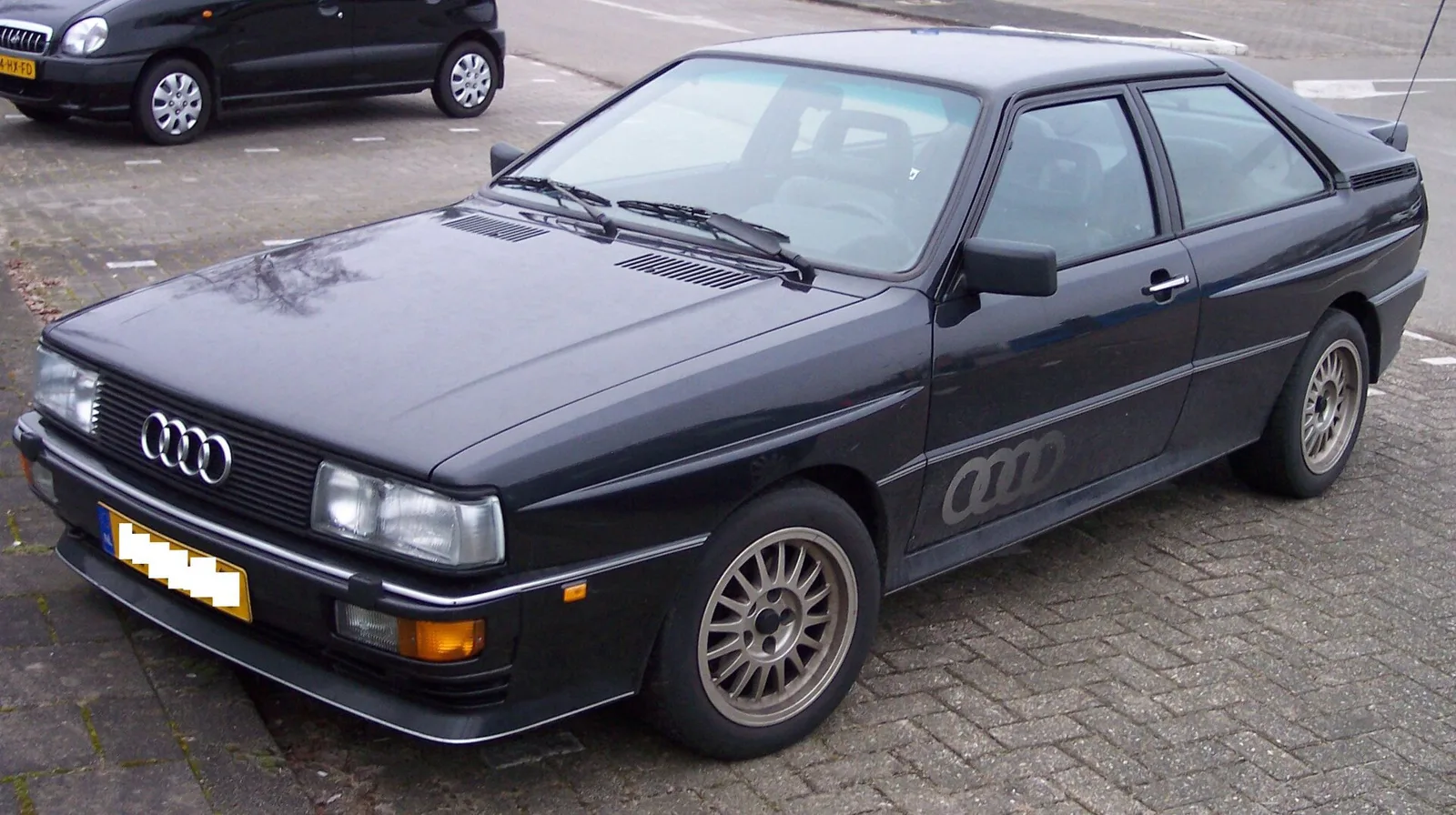
A turbocharged coupe with permanent four-wheel drive that won rallies, spawned the Sport Quattro Group B cars and gave its name to Audi's all-wheel-drive family.
Launched in 1980, the Quattro was a permanent four-wheel-drive coupe with a 2,144 cc turbocharged inline-five. Audi built 11,452 examples until 1991, and its rally success made quattro the name for every four-wheel-drive Audi that followed, a badge still used today.
The Audi Quattro was a turbocharged road and rally car that Audi first showed at the Geneva Motor Show in March 1980. Its permanent four-wheel drive gave it traction on slippery surfaces that impressed road testers and rally teams alike. It went on to win rallies and hill climbs before production ended in 1991, and every four-wheel-drive Audi since has carried the name.
Where did the idea for the Quattro come from?
The idea came from Audi chassis engineer Jorg Bensinger, who proposed a high-performance four-wheel-drive car in 1977. He had watched a Volkswagen Iltis military vehicle outperform rivals in snow trials. Walter Treser, Director of Pre-Development, worked with the team on an Audi 80 based variant.
Bensinger's proposal arrived at a moment when competition rules were about to change. The original Quattro became the first rally car to exploit those new regulations, which allowed four-wheel drive in competition, and it won consecutive events in the seasons that followed.
Much of the car was borrowed from the Audi 80 Coupe, which shared many parts with it and carried the internal code Typ 85. Martin Smith shaped the broad wheel arches that gave the body its muscular stance, and they remain one of the car's signature features.
A turbo five-cylinder with permanent four-wheel drive gave Audi a rally weapon and a name that still defines its range.
What does the Quattro name mean?
Quattro is the Italian word for four, and the name points to power reaching all four wheels. Audi later applied it to the four-wheel-drive system itself, so the word now describes both a car and a technology. Enthusiasts also call the original car the Ur-Quattro, with Ur meaning original or first of its kind.
Every subsequent Audi production car that used the system carried the name, which turned a single competition-inspired car into a family badge. That legacy is why the name still appears on models that are nothing like the 1980 coupe.
How did the Quattro's engine develop over its life?
The original car used a 2,144 cc inline-five turbo rated 147 kW (200 PS; 197 hp) and 285 Nm at 3,500 rpm. Later competition versions reached 225 kW (306 PS; 302 hp), and the 1989 road engine grew to 2,226 cc with 20 valves and 162 kW (220 PS; 217 hp).
Audi reworked the engine across the production run rather than leaving it fixed. The 1989 update introduced a 20-valve DOHC head and raised the top speed to 230 km/h (143 mph), a worthwhile step up from the early car's figure of more than 220 km/h (137 mph).
Competition cars were tuned far harder than road cars. Their 2,133 cc unit reached 302 hp (306 PS; 225 kW) at 6,700 rpm, with its peak torque arriving lower in the rev range. The gap between the two specifications came from a different rulebook.
How did the Quattro's styling change?
The body changed little across the car's eleven-year life. Early cars had a flat grille with four headlamp lenses, which gave way to combined units in the 1983 model year. A 1985 facelift introduced a sloping front grille, new headlights and revised badging.
The interior changed too. A green LCD instrument display arrived for 1983 and became orange in 1988. Wheels grew from 6x15-inch to 8x15-inch for 1984, while the suspension was dropped by 20 mm, and the Torsen centre differential arrived in 1987.
Badging helped buyers tell the variants apart. Some cars carried a vinyl quattro decal, others a brushed aluminium emblem, and the top models wore chrome-plated Audi rings and quattro lettering on the boot lid.
What were the US and Canadian cars like?
US sales began in the 1983 model year, and the cars were rated at 160 hp (119 kW; 162 PS) with a catalytic converter fitted. Total US sales reached 664 units, and Canada took 99 cars, which were identical apart from a metric speedometer.
North American cars were built alongside the European models, and they matched the European design of the 1982 model year rather than the 1983 cosmetic changes. Their emissions equipment and tuning set them apart from the European engines.
The cars were a small part of the Quattro story, but they arrived as the all-wheel-drive market was opening up. Earlier American all-wheel-drive models had already shown that buyers would accept four-wheel drive in an ordinary passenger car.
What did Autocar think of the Quattro?
Autocar road tested a left-hand drive Quattro in May 1981 and praised its thrilling performance and traction on wet surfaces. The magazine priced the car at GBP 14,500 in 1981 and said rivals from BMW, Porsche and Jaguar cost GBP 5000 more.
The road test editor warned that the 60/40 weight split made the car tricky in extremis when cornered very hard. Yet after learning its habits, a driver found it thoroughly rewarding on damp, empty roads, and the cabin was praised for its refinement.
The verdict was a reminder that the Quattro was not simply a rally car with lights. It was a road car that a magazine could recommend for everyday use, provided the driver respected its handling character.
What was the Sport Quattro?
The Sport Quattro S1 existed to homologate the car for Group B rallying in 1984, and a small batch reached customers. Of those, 224 short-wheelbase cars were built, and their 2,133 cc engines produced 302 hp (306 PS; 225 kW) in road trim.
Competition versions carried the Group B programme, and the Sport Quattro also won the 1985 Pikes Peak hill climb with Michele Mouton at the wheel. That victory tied the road-going model to a rally career built on four-wheel traction.
The Sport Quattro was shorter in wheelbase than the standard car, and its wider wheels and carbon-kevlar bodywork reflected its purpose as a homologation special. Those changes made it a far more focused machine than the car that had launched in 1980.
How fast was the S1 E2?
The S1 E2 was an update of the Sport Quattro S1, with an officially quoted 480 PS (353 kW; 473 hp) and a weight of 1,090 kg (2,403 lb). It accelerated from 0-100 km/h in 3.1 seconds, and it debuted at the 1985 Rally Argentina with Blomqvist at the wheel.
The RS 002 was a mid-engined Group S prototype, rated at 700 PS (515 kW; 690 hp) with a top speed of 300 km/h (186 mph). It was built for regulations that were scrapped before it raced, so it stayed a prototype and never competed in the series it was designed for.
Together the S1 E2 and RS 002 show how far the Quattro engineering team pushed the concept. Each car took the all-wheel-drive idea further than the production coupe had gone.
How did the Quattro's rally career unfold?
The original competition car debuted in 1981 at the Janner Rallye in Austria. Michele Mouton became the first female world rally champion in 1981 while driving an Audi Quattro. Later evolutions were built to meet the Group B rules, which rewarded raw power and grip above all else.
The A1 evolution made its debut at the 1983 Monte Carlo Rally. The A2 went on to take eight world rally victories, three of them in 1983 and five in 1984, which kept Audi at the front of the sport.
Group B ended after the 1986 season, following a series of accidents, and the regulations that followed made the era's cars obsolete. The Quattro's record remains one of the strongest in the sport's history.
What is the Quattro's legacy?
The Quattro became a fixture of British television when DCI Gene Hunt drove a red 1983 model in Ashes to Ashes. In the run-up to the 2010 election, a Labour poster used the car and Hunt's image, and the Conservatives answered with the slogan Fire up the Quattro.
The name carried into concept work too. The quattro Spyder concept shown at Frankfurt in 1991 used a 2.8-litre V6 rated 174 PS (128 kW; 172 hp), while the 2010 quattro concept at Paris had a 2.5 TFSI with 408 PS (300 kW; 402 hp) and weighed 1,300 kg (2,866 lb) dry.
The 2013 Audi Sport quattro concept revived the idea in a hybrid form, pairing a 4.0 TFSI V8 with an electric motor. Its combined output reached 700 PS (515 kW; 690 hp), which showed how the four-wheel-drive idea could grow with each generation of technology.
What are the key Audi Quattro specifications?
The table sets out the production car, the rally-spec engine, the Sport Quattro S1 E2 and the RS 002 prototype. Each row is labelled by version, so a road figure is never read as a competition figure. Where a value applies to one model only, the table says so.
| Specification | Detail |
|---|---|
| Production | 11,452 units, 1980 to 1991 |
| Original engine | 2,144 cc inline-five turbo, 197 hp (200 PS; 147 kW) |
| Original torque | 285 Nm at 3,500 rpm |
| 0-100 km/h | 7.1 seconds |
| Top speed | Over 220 km/h (137 mph) |
| 1989 engine | 2,226 cc, 20-valve, 217 hp (220 PS; 162 kW) |
| Rally engine | 2,133 cc, 302 hp (306 PS; 225 kW) at 6,700 rpm |
| Weight distribution | 60/40 front to rear |
| Sport Quattro S1 E2 | 473 hp (480 PS; 353 kW), 1,090 kg (2,403 lb), 0-100 km/h in 3.1 seconds |
| RS 002 prototype | 690 hp (700 PS; 515 kW), top speed 300 km/h (186 mph) |
| 2010 quattro concept | 402 hp (408 PS; 300 kW), 1,300 kg (2,866 lb) dry |
How did the Quattro compare with other four-wheel-drive cars?
Four-wheel drive was not new to road cars, since AMC's Eagle offered full-time automatic all-wheel drive and Subaru's small Leone wagon offered part-time four-wheel drive in the US from 1975. The Quattro was distinctive for pairing permanent drive with a turbocharged front-engined coupe.
Earlier efforts such as the 1966 Jensen FF had shown that all-wheel drive could suit road cars, but the Quattro brought the technology into a sporting coupe that rally teams and magazine testers could push hard.
Its success in rallies gave the system a public profile that few other four-wheel-drive cars achieved, which helped Audi turn quattro into a marketing and engineering identity.
Why did the Quattro matter beyond rallying?
The Quattro showed that a road car could borrow rally technology without becoming uncomfortable to live with. Its permanent four-wheel drive and turbo power made it a showcase for Audi's engineering, and the system later spread across the range. It also set the template for later Audi performance models.
It also gave the marque a clear identity. Audi's marketing leaned heavily on the rally wins, and the car became a symbol of the company's ambition during the 1980s. Owners valued the surefooted feel in wet and cold weather, which made the coupe useful well beyond the rally stage.
The lasting result was a badge that stood for traction and performance, and it remains one of the most recognisable names in the German car industry.
Frequently asked questions
What made the Quattro so good in slippery conditions?
Its permanent four-wheel drive gave traction on wet and slippery surfaces, which Autocar praised in its 1981 road test. The idea itself came from snow trials of a Volkswagen Iltis, and the car used a turbocharged inline-five engine.
How many Quattros were made?
Audi made 11,452 cars between 1980 and 1991, with the final original car built on 17 May 1991. Of that total, 664 went to the US and 99 to Canada.
Who was the first female world rally champion?
Mouton, driving a Quattro, took the 1981 title as the first woman to win a world rally championship. The A2 evolution later added eight world rally victories.
Did the Quattro's name come from a racing series?
No. The name is simply the Italian word for four, and Audi used it to describe the four-wheel-drive system and any model that carried it.