The FIA regulations behind some of the fastest rally cars ever built, the 1986 crashes that ended them and what came after.
Group B was a set of FIA regulations from 1982 for grand touring cars in sports car racing and rallying. Its rally cars were among the fastest ever built, but fatal crashes led the FIA to ban the class from the World Rally Championship from 1987.
Group B was a rulebook from the FIA, introduced in 1982, that covered grand touring cars in sports car events and rallies. The cars it produced were among the quickest and most advanced ever to tackle rough stages, and fans often call the years from 1982 to 1986 the golden age of rallying. A run of serious accidents, however, ended the class in the World Rally Championship from 1987.
What were the Group B rules?
The rules came out of a 1982 restructuring of production car categories, which created Groups N, A and B. Group B was for grand touring cars with at least two seats, and it replaced the older Groups 3 and 4 along with the Group 5 silhouette cars.
The outgoing Groups 1 and 2 were replaced by Groups N and A, which catered for production touring cars, unmodified and modified respectively. Those cars had to be built in large numbers, with 5,000 needed in a year-long window between 1982 and 1992, a figure that fell to 2,500 from 1993.
In 1986 the class was reworded to sports grand touring cars, but the core idea stayed the same. A maker could homologate a sports car with a small production run, which suited competition-oriented designs built around a racing chassis.
Some of the fastest rally cars ever built, banned from the World Rally Championship after the 1986 deaths at Corsica.
Why was the homologation requirement so low?
Group B needed 200 cars for homologation, which was 4% of the figure required by some other groups and half of the 400 that Group 4 had demanded. Makers could extend the period by producing 20 more cars each year, against 500 for Groups A and N.
The low figure made it easier to build competition-oriented designs. Cars already homologated in Groups 2, 3 and 4 could be moved into Group B, and many were transferred automatically by the FISA secretariat.
Evolutions could be added within the original homologation, so a maker could produce 20 evolved cars rather than 200 new ones. The rules also produced homologation specials, extremely rare cars built only to satisfy the quota. Production sports cars that could not meet the Group N and A seat or volume rules, for example the Ferrari 308 or Porsche 911, could still qualify.
How were engine sizes and power limits set?
Forced induction counted as 1.4 times the actual engine capacity, so a turbocharged 2,500 cc engine fell into the 1,785 cc class. Wankel rotary engines were counted at twice their combustion chamber volume, and turbine engines followed a more complicated formula.
The 15 displacement classes spanning Groups N, A and B each carried weight and wheel limits. The rule makers initially thought weight and displacement were the only practical way to control speed.
| Class | Equivalent with forced induction | Minimum weight | Examples |
|---|---|---|---|
| 2,000 cc | Renault 5 Turbo, whose 1.4 L turbo engine placed it here | Unlisted | Renault 5 Turbo |
| 2,500 cc | 1,785 cc | 890 kg | Peugeot 205 T16, Lancia Delta S4 |
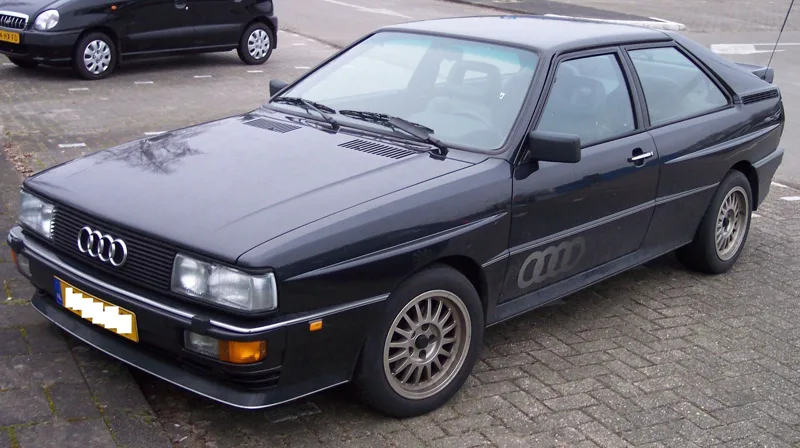
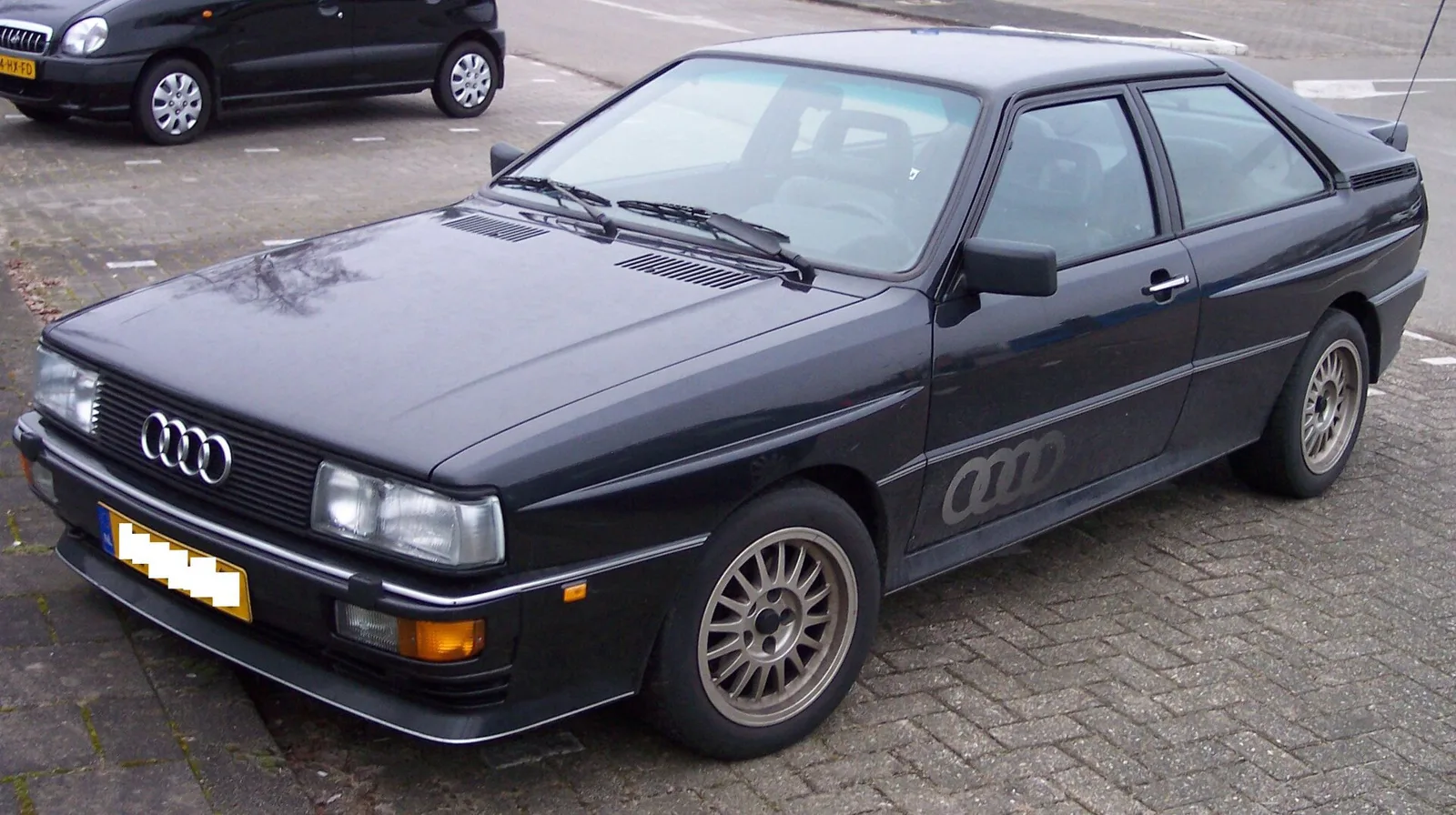
| 3,000 cc | 2,142.8 cc | 960 kg | Audi Quattro, Lancia 037 |
| 4,000 cc | 2857 cc | 1,100 kg | Ferrari 288 GTO, Porsche 959 |
How were the cars built?
The rules placed few limits on technology, design or materials. Fibreglass bodywork appeared on the Ford RS200, while silhouette race cars with space frames, such as the Peugeot 205 T16 and Lancia Delta S4, were common even when their road-car equivalents were mass produced.
The regulations allowed mid-engined, rear-wheel-drive and four-wheel-drive layouts. That let makers build specialised homologation cars without committing to producing large numbers of road examples, which was the appeal of the low homologation count.
How much power did Group B cars make?
Winning rally cars made 250 hp in 1981. There was no limit on boost, and by 1986 at least two cars were producing more than 500 hp. Engineers learned how to extract large amounts of power from turbocharging, which was new to road cars.
Peugeot used a Formula One-derived anti-lag system, although the idea was new and had limited effect. Lancia twincharged the Delta S4 with both a turbocharger and a supercharger, and the Audi Sport Quattro S1 had more than 600 hp by 1986.
How did Group B cars perform in rallying from 1982 to 1985?
No Group B car made a podium at any of the 12 rallies in 1982. The following year Audi's Quattro, still essentially a Group 4 car, carried Hannu Mikkola to the drivers' title, while Lancia's 037 won the manufacturers' title.
Opel's Manta 400 and Toyota's Celica were also rear-wheel-drive Group B cars. They were successful in national rallies but less so at world level, although a 1983 Ivory Coast Rally win for Toyota came with Bjorn Waldegard driving.
In 1984 Audi won both championships, with Stig Blomqvist taking the drivers' title. Peugeot then arrived with the four-wheel-drive 205 T16, with Ari Vatanen driving and Jean Todt overseeing the operation.
Peugeot dominated 1985 despite Vatanen's serious injuries in Argentina, when his seat mounts broke in a crash. Timo Salonen won the drivers' title that year with five wins.
Late in 1985 several new cars debuted, including Lancia's Delta S4, Ford's RS200 and Sierra RS Cosworth, Citroen's BX 4TC and Rover's Metro 6R4. The BX was judged too heavy and awkward to win with.
What happened at the 1986 rallies?
In March 1986 Joaquim Santos lost control of a Ford RS200 on the opening stage of the Portugal rally and slid into a group of spectators. Three people were killed and 31 were injured, and most of the top teams withdrew from the event.
The crash came amid wider concerns about crowds. Spectators had pushed so close to the road that some drivers could barely see it, and Ari Vatanen described driving through what he called a human corridor. Michele Mouton said she could drive competitively only by treating the crowd like trees.
In May, Lancia's Henri Toivonen was leading the Tour de Corse when his Delta S4 went off the road on a corner and tumbled down a wooded slope. The car burst into flames, and Toivonen and Cresto were killed inside the car.
The cause was never established because there were no witnesses. Some pointed to Toivonen's illness, others to the long itinerary without rest, and others to the difficulty of driving such a car, although Toivonen had a long record of crashing out while leading.
Why did the FIA ban Group B?
The FIA banned Group B cars from the World Rally Championship for the 1987 season, immediately after the deaths of Toivonen and Cresto. The decision followed the Portugal tragedy and the Corsica deaths, and Audi quit rallying after the Corsica event.
Marc Surer's televised crash in another RS200 killed his co-driver Michel Wyder, and the combined events compelled the FIA to act. Audi said the decision did not take steps to improve spectator safety, and it withdrew from rallying altogether.
How did the final season end?
The 1986 season finished with a dispute. Peugeot's cars were thrown out of the Rally Sanremo over body skirts, but the British scrutineers passed the same cars as legal at the RAC Rally. FISA annulled the Sanremo result eleven days after the final round.
The annulment moved the drivers' title from Markku Alen to Juha Kankkunen. Salonen had won two more rallies in 1986, which made him the most winning driver of the Group B period, with seven rallies won.
Did Group B cars race after the WRC ban?
Yes. Group B cars stayed eligible for some regional championships in the years that followed, provided they met the 1,600 cc limit for four-wheel drive or had been homologated before 1984. They also appeared in rallycross and in events outside Europe.
Mohammed Ben Sulayem, later president of the FIA, took part in some 1987 Middle East rallies in an Audi Quattro A2 and an Opel Manta 400. The Porsche 959 won the Paris-Dakar Rally in 1986, and Vatanen took the Dakar crown in 1987, 1989 and 1990 driving a Peugeot T16.
Walter Rohrl's Quattro S1 won Pikes Peak in 1987 and set a record at the time. Audi turned its Group B know-how into production-based racers for the Trans-Am series in 1988 and the IMSA GTO championship in 1989.
Former rally machines competed in European rallycross between 1987 and 1992, with the MG Metro 6R4 and the RS200 appearing often. From 1993 the FIA swapped the Group B cars out for prototypes built on Group A models.
Group S: the replacement that never raced
Group S was the planned successor, and it would have limited engines to 300 hp. Ten built examples would have sufficed for a homologated Group S car, against 200 for Group B, a deliberate push toward new designs.
When the plan was dropped, at least four Group S prototypes already existed, including the Lancia ECV, the Toyota 222D, the Opel Kadett Rallye 4x4 and the Lada Samara S-proto. Audi and Ford were also developing cars for the category.
The idea returned in 1997 under the World Rally Car name, a specification that lasted until 2021. Those cars were capped at 380 hp, and a model needed 2,500 built examples before it could compete. They also shared some parts with the production models.
Did Group B cars race on circuits?
Yes, although they were secondary to the Group C prototypes. The 1983 World Endurance Championship grid included the Porsche 930, the BMW M1 and a Ferrari 308 GTB LM, and Porsche won the FIA GT Cup that year before BMW took it in 1984 and 1985.
The Porsche 961 won the GTX class at Le Mans in 1986, but it crashed and burned in 1987. The Ferrari 288 GTO met the homologation minimum but never raced in its intended category, although it did appear in an IMSA GTO race in 1989.
From 1986 the championship dropped Group B in favour of IMSA-regulated cars, and it became the World Sports Prototype Championship.
What is the legacy of Group B?
Many fans see the Group B years as rallying's high point, and nothing in its class has beaten those cars for performance in the three decades since. Some fans also gave the class the nickname Killer B's, a reflection of its poor safety record.
The cars live on in video games. Gran Turismo Sport featured a Gr. B rally category in 2017, which used mostly fictional cars based on newer models, and Gran Turismo 7 later added the Peugeot 205 T16. In Art of Rally the class never ended, so its cars are fictional and set in an alternate timeline.
Homologation for the class ran to 1993, and domestic series kept racing the cars until 2011.
Frequently asked questions
What was the power limit for Group S?
Group S was planned with a 300 hp limit, and it would have required only ten examples of a car for homologation. The World Rally Car specification that revived the idea in 1997 was limited to 380 hp instead, and it required 2,500 examples of a model.
How many cars were needed to homologate a Group B car?
The base requirement was 200 cars, a small fraction of what most groups had to build. A maker that wanted more time could add 20 cars a year, while the two road-car groups faced a demand of 500 a year.
Which cars were in the 2,500 cc class?
The 2,500 cc class, which counted as 1,785 cc with forced induction, included the Peugeot 205 T16 and the Lancia Delta S4. Its minimum weight was 890 kg, and the class sat between the 2,000 cc and 3,000 cc groupings.
Who won the 1985 drivers' title?
Timo Salonen won the 1985 drivers' title for Peugeot with five wins. Peugeot dominated the season, although Ari Vatanen was seriously injured in Argentina when his seat mounts broke, and Vatanen had a record of crashing out while leading rallies.