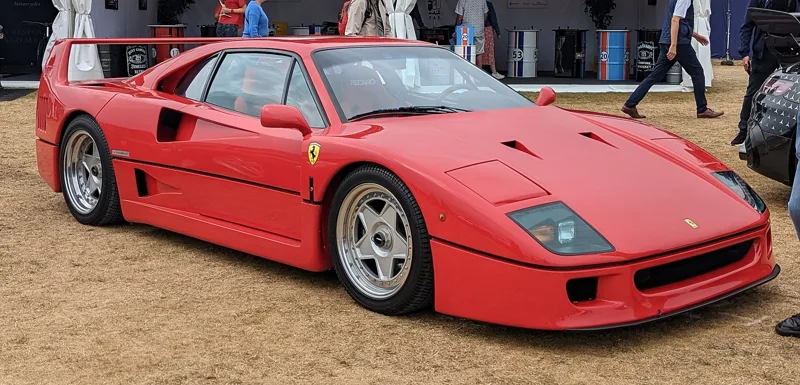
A twin-turbo V8 derived from the 308 GTB, built from 1984 to 1987, and the Evoluzione racers that never got to race.
The Ferrari 288 GTO was a turbocharged homologation version of the 308 GTB, produced from 1984 to 1987 at Ferrari's Maranello factory. Its 2.85 litre twin-turbo V8 gave 400 PS, and six Evoluzione racers were built alongside the road cars.
The Ferrari 288 GTO was a homologation version of the 308 GTB, built at Maranello from 1984 to 1987. Its twin-turbocharged V8 and reworked body made it one of the most sought-after Ferraris of the decade, and the Evoluzione version was built for a racing series that ended before it could race.
Where did the GTO name come from?
The GTO name is an acronym. GT means Gran Turismo, and O stands for Omologata, the Italian word for homologated. The 288 part of the name refers to the engine's 2.8 litre capacity, which was smaller than the 308's unit.
The car was not created immediately for the 1982 Group B series, despite what was often reported at the time. Enzo Ferrari lacked full authority over the road car side, which other managers ran in that period.
A turbocharged V8 in a 308 body, and a racing version built for Group B that never raced.
Why did Ferrari turn to turbocharging?
Turbocharging had succeeded in Formula 1, and new tax rules set a threshold above 1999cc that made larger turbo engines attractive. Ferrari first built the 208 Turbo, then studied a 3 litre turbo for the road, aiming at 330 bhp.
The first 208 Turbo had no intercooler, so its performance and reliability were delicate because combustion temperatures ran high.
Ferrari's Formula 1 experience with turbo engines made the project easier to justify, since the team already understood the tuning challenges. Ferrari turned to Nicola Materazzi, who had joined from Osella in 1979, to judge the proposed specification for the new 3 litre turbo engine. He had experience with forced induction from earlier work.
Materazzi promised that 400 bhp could be extracted from the 3 litre engine, which works out to 133 bhp per litre. Ferrari backed him on the condition that the promise was kept.
Ferrari also half-jokingly suggested that Materazzi look at the Lancia LC2 engine, which had similar displacement and parts.
How did the 288 GTO differ from the 308?
The GTO was based on the 308 GTB, but several layout features changed. The engine was turbocharged, mounted longitudinally rather than transversely, and the wheelbase grew by 110 mm. Each change served the same goal of more performance without a complete redesign.
The 308's bodywork had to be altered to keep the proportions pleasing. The GTO's wider panels covered much larger Goodyear tyres, and the body used lighter materials.
At 2,555 lb (1,159 kg), it weighed noticeably less than the 308 and 328, which ranged from 3,085 to 3,350 lb. Major body panels were moulded fibreglass, which helped keep the car light.
A Kevlar hood and a Kevlar and carbon fibre roof kept weight down further.
Retained details from the 250 GTO included slanted rear fender vents and a rear wing borrowed from that car. Drivers got bulging wheel arches, larger spoilers, flag-style mirrors and four driving lights at the grille.
What styling did the GTO inherit?
Pininfarina had sketched a 308 GTB exercise in 1977 that previewed some GTO styling, shown in Geneva. The look therefore had roots in a design study, even though little of the donor car survived the process. It also shows how a styling exercise could travel into production.
The 288 GTO began as a modified 308 or 328 designed to hold down costs and speed up the build, but little of the donor car was left by the end.
Buyers were prepared to spend more for performance and styling that few rivals could match, so the cost overrun did not necessarily prove a problem.
What engine did the GTO use?
The GTO's 2.8 litre DOHC V8 had four valves per cylinder and was de-bored by 1 mm from the 308's 2.9 litre unit. It used IHI twin turbochargers, Behr intercoolers and Weber-Marelli injection, with a compression ratio of 7.6:1. Each element was tuned for the turbo layout.
The 2.85 litre capacity came from the FIA rule that multiplied a turbo engine's capacity by 1.4, which gave an equivalent figure of 3,997 cc, narrowly below the Group B ceiling of 4.0 litres.
The engine sat longitudinally where the 308's rear trunk space had been, which made room for the twin turbochargers and intercoolers. Those changes turned a practical sports car into a much more focused machine.
The engine produced 294 kW, which is 400 PS or 395 bhp, at 7,000 rpm, and 496 Nm of torque came at 3,800 rpm. That mix of changes made the engine a race-derived unit in a road car. The output and torque figures show what that work achieved.
How fast was the road car?
Ferrari's figures put 125 mph (201 km/h) within 15 seconds and quoted 189 mph (304 km/h) as the top speed. Road and Track recorded 0-60 mph in about 5 seconds and a top speed of 179 mph (288 km/h), and the quarter mile took 14.1 seconds at 113 mph.
Contemporaries regarded the car as among the quickest road-going machines of its era, and that reputation rested on its straight-line figures.
How many were built?
The FIA required at least 200, the factory built 70 more plus a couple extra, and the total came to 272 units. That total was set by the rules and by the factory's own decisions, and collectors still quote it today.
Ferrari did not offer the car for sale in America, so grey import specialists brought in European cars and modified them to meet US rules.
Enzo Ferrari offered GTOs to a number of Formula 1 drivers, among them Michele Alboreto, Keke Rosberg and Niki Lauda, who received the last unit.
What was the Group B plan?
The aim was a racing version built on the road car, which the Group B rules were designed to allow. Materazzi argued that road speed limits and stricter fines made it harder for owners to explore a car's potential. He proposed a return to GT racing, a class Ferrari had left after the 512 BB LM.
Modifying the road car into a racing version needed approval from Eugenio Alzati, who allowed it on the condition that engineers worked outside the normal Monday to Friday timetable.
The FIA allowed 20 racing cars per year, and the Evoluzione was designed to meet that rule with bodywork, chassis and safety changes. Its bodywork was more aggressive and aerodynamic than the road car's, and its power went up.
What did the Evoluzione add?
Six Evoluzione models were built, five production cars and one prototype, with more aggressive bodywork and increased power. The changes were aimed at racing rather than comfort, and those goals drove every alteration. The aim was a car able to compete in Group B, not one for ordinary road use.
Under the bodywork, the Evoluzione's V8 was a developed 2.9 litre unit with twin turbos, and its power reached 485 kW (659 PS, or 650 hp) at 7,800 rpm.
Its weight is put at 940 kg (2,072 lb), and reported top speed was 225 mph (362 km/h). The front end had canards, channels and vents, and a large carbon fibre rear spoiler.
Group B circuit racing was suspended at the end of 1986 after multiple deaths in rally competition, so the Evoluzione never raced.
The Evoluzione influenced the F40 that followed, and all six are thought to survive, with one held by the factory in Maranello.
Why road car sales mattered
Concern grew in 1983 as road car sales slipped. Enzo Ferrari believed rivals had grown stronger, and he also questioned what he called the excessive gentrification of the lineup.
That concern shaped the GTO. A road car with a racing pedigree offered a way to win back buyers who wanted performance rather than comfort.
The turbo engine's development
The F114B road-car engine and the Lancia V8 race engine were developed side by side. Abarth draughtsmen completed detail design on some components when Ferrari's own staff were fully occupied.
Turbochargers were a key choice. IHI water-cooled units were chosen over the KK&K types used in Formula 1, and the Japanese maker had bought patents from Brown Boveri (Baden), the Comprex supplier.
Materazzi had earlier worked at Lancia Reparto Corse, and his experience included forced induction experiments on the 126 F1 car, a background that made him a natural choice for the turbo engine.
Road test figures
Road and Track timed the car to 100 mph in 11.0 seconds, a figure that sat below the manufacturer's headline numbers for the car.
The test figures and the manufacturer's claims did not always agree, which was common for cars of this performance level. Test results are most useful when read alongside the car's weight, which was 2,555 lb (1,159 kg).
Colours and conversions
All GTO road cars and Evoluziones were left-hand drive, and the standard paint was the factory's most common Ferrari shade, Rosso Corsa, known as Racing Red.
The 1990 car sent to Pininfarina for right-hand-drive work was repainted Dark Slate with a red stripe. Its owners were the Brunei Royal Family. The conversion shows that individual owners could still ask the factory for unusual specifications.
The Evoluzione race plan
The GTO Evoluzione drew on lessons from the Lancia LC2 engine. Engineers carefully shaped the intake plenums so that air flow and pressure reached each cylinder in balance, and the turbocharger setup was tuned for more than 650 bhp.
Ferrari planned a run of 20 Evoluzione cars to satisfy Group B homologation, and the Evoluzione was introduced in 1986.
What the drivers said
Michele Alboreto, who tested several Ferraris, described the GTO as cattiva, meaning angry. He praised its low engine centre of gravity compared with the Testarossa.
His view fitted the wider push toward fiercer machines that the GTO was meant to represent. A driver's praise for a car's centre of gravity matters because it bears on handling and braking, not only on straight-line speed.
Where did the GTO stand in the reviews?
In 2004 Sports Car International put the 288 GTO second among the decade's sports cars of the 1980s, behind the Porsche 959. The result is one reason the GTO remains a reference point for collectors. A ranking that places a Ferrari high on such a list reflects the car's status in the decade it was built.
What are the Ferrari 288 GTO specifications?
The table lists the core figures for the road car and, where a figure belongs to the Evoluzione, the table says so. The layout keeps the production car and the racing version apart, so readers can compare them directly. The 0-60 and top speed figures are taken from the numbers quoted by the manufacturer and by the test magazine.
| Item | Detail |
|---|---|
| Type | F114, based on the 308 GTB |
| Years | 1984 to 1987, Maranello |
| Engine | 2.85 litre twin-turbo V8, 3,997 cc equivalent |
| Output | 400 PS (395 bhp; 294 kW) at 7,000 rpm |
| Torque | 496 Nm (366 lb ft) at 3,800 rpm |
| Weight | 2,555 lb (1,159 kg) |
| Acceleration | 0-60 mph in about 5 seconds; 0-125 mph in 15 seconds |
| Units | 272 built |
| Evoluzione | Six built; 650 hp (485 kW; 659 PS) at 7,800 rpm |