The last Ferrari signed off by Enzo himself is now a blue-chip collectible, but buying one demands patience, specialist knowledge and deep pockets.
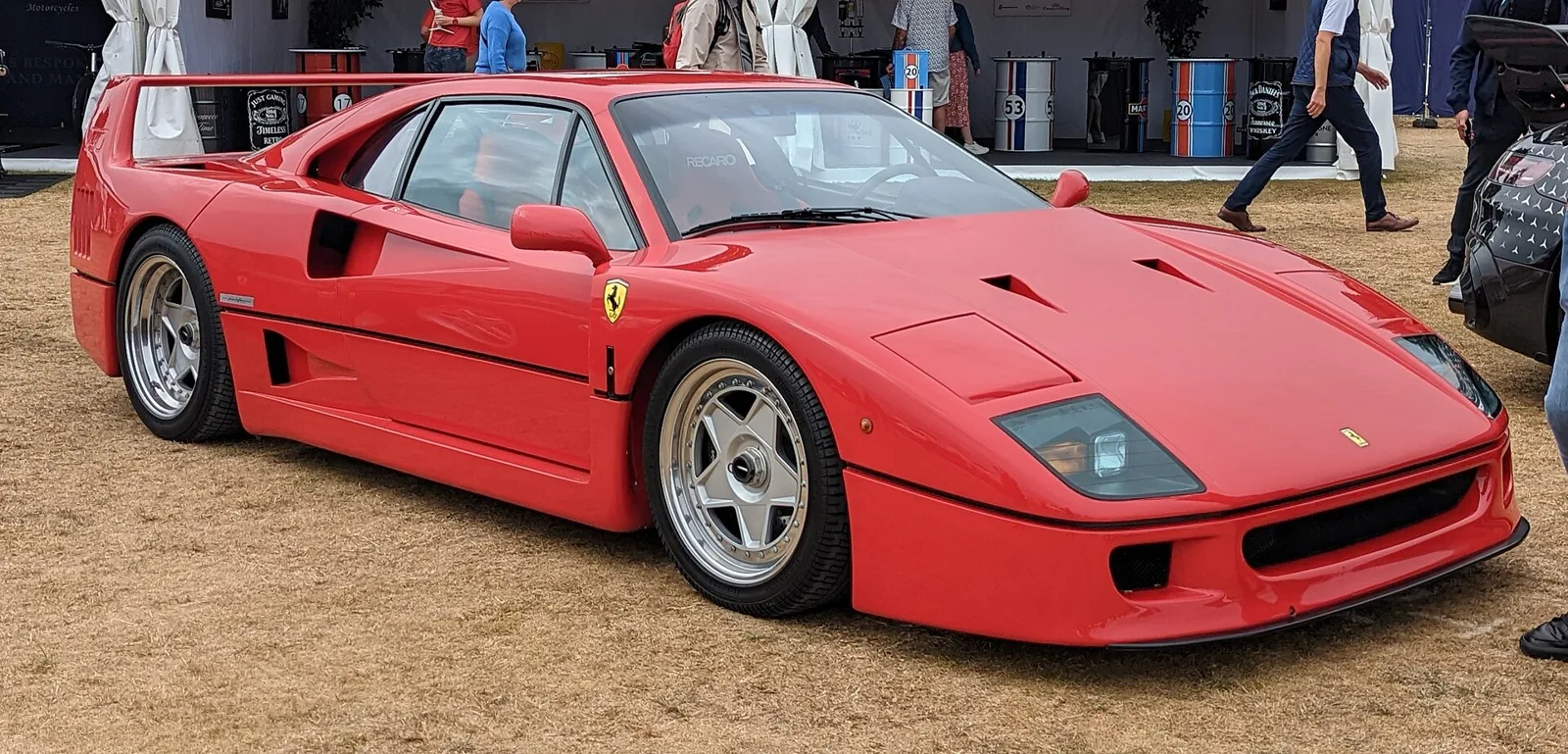
The Ferrari F40 is a mid-engined, rear-wheel-drive twin-turbo V8 supercar built from 1987 to 1993. Around 1,311 to 1,315 were made, with 213 sent to the United States. Values have climbed far beyond the original US$400,000 list price, so condition and history matter more than mileage alone.
Between 1987 and 1993, Ferrari turned out its F40: a supercar with a twin-turbo V8 mounted in the middle and driving the rear wheels. Production totals fell somewhere in the range of 1,311 to 1,315 units, and 213 of those were allocated to the American market.
Enzo Ferrari wanted a legacy machine, and he got one. The F40 was the final Ferrari personally approved by the old man, and it arrived as a road-going distillation of the 288 GTO Evoluzione racer that never got its Group B moment. That provenance explains both the car's raw character and its enduring place in the collector market. It is not a comfortable classic. It is a stripped, Kevlar-and-carbon machine with no carpets, no glove box, no door handles and no sound system, built for people who wanted the closest thing to a race car with number plates.
What should you pay for a Ferrari F40 today?
There is no single answer, because F40 values swing enormously with mileage, history and originality. Expect any genuine, well-documented road car to command a substantial seven-figure sum in most currencies, with exceptional low-mileage examples at the very top of the market.
The original factory suggested retail price was approximately US$400,000 in 1987, roughly five times that of the 288 GTO it replaced. Speculation began almost immediately: cars changed hands at rising prices, and by 1989 some were selling for more than seven times list. The market has cooled and reheated several times since, but the F40 has never been a cheap car. One of Nigel Mansell's F40s sold for a then-record GBP 1 million in 1990, a figure that stood into the 2010s. The practical advice for a buyer is to ignore the headline number and focus on what you are actually getting: a car with continuous history, original panels, correct engine and gearbox, and a documented service record is worth a premium over a car with gaps in its story.
The F40 rewards use, and the community around it rewards owners who understand that.
Which Ferrari F40 version should you buy?
For most buyers the standard road car is the sensible target. It is the version with the broadest usability, the clearest history and the most stable market. The competition cars are a different proposition entirely.
Nineteen racing cars were produced in total. Michelotto, based in Padua, prepared them, having already worked on the GTO Evoluzione and parts of the road F40. Three F40 LM chassis were prepared, of which two raced: serial numbers 79890 and 79891. The third, 88521, stayed at Michelotto as a reserve and never competed. The F40 Competizione was a more powerful, non-sponsored evolution, with ten built. The F40 GTE, or GT Evoluzione, was an upgraded LM for the BPR Global GT Series, with seven converted. GTE engine capacity grew to 3.5 litres in 1995 and 3.6 litres in 1996, producing 620 PS. The Competizione was rated at 700 PS at 8,100 rpm and could reach about 367 km/h. One Competizione was later upgraded to over 710 PS by G-Tex and Michelotto. Race car production continued from 1994 to 1996, after road car assembly ended.
What are the running costs of a Ferrari F40?
Running an F40 is not like running a modern supercar. It is a 1980s machine with race-car maintenance rhythms, and the bills reflect that.
The engine is a 2,936 cc (2.9 L; 179.2 cu in) four-stroke, 90-degree twin-turbocharged and intercooled V8, an enlarged and high-revving development of the 288 GTO unit. It produces 478 PS (471 hp; 352 kW) at 7,000 rpm and 577 Nm (426 lb-ft) at 4,000 rpm. That is 78 PS (57 kW; 77 bhp) more than the 288 GTO, which is why Pirelli had to develop a new tyre for the car. Materazzi contacted Pirelli's head of development, Mario Mezzanotte, and the resulting carcass used light materials including Kevlar. Tyres are therefore a specialist purchase, not an off-the-shelf item. Major services involve engine-out work on many examples, and the twin turbos, wastegates and exhaust systems are all bespoke. There is no catalytic converter on early cars; US regulations required them from 1990. Suspension is double wishbone like the GTO's, but with many upgraded parts and different settings. Ground clearance is unusually low, and later cars gained hydraulic lift chambers in the front dampers, a useful feature if you plan to use the car on real roads.
What is the Ferrari F40 like to drive?
Autocar tested the F40 at Fiorano in 1988, and Mel Nichols described it as scintillatingly fast on a smooth road, yet docile and charming. He found it demanding but not difficult to drive, with massive grip and superb balance, and called it the closest any production car maker had come to race car levels.
That is the paradox of the F40. It has no sound system, no leather trim, no carpets and no door panels, yet it is not a punishing machine in the way its specification suggests. The polycarbonate windscreen and windows save weight, the moderate air conditioning keeps the cabin tolerable, and the mid-engined, rear-wheel-drive layout gives the car a natural balance that flatters a careful driver. The first fifty cars had sliding Lexan windows; later cars switched to wind-down windows. The drag coefficient is 0.34, and top speed is 321 km/h (199 mph), with 0-100 km/h in 4.7 seconds. For a car of its era, those are extraordinary numbers, and they still feel quick today.
What are the red flags when inspecting an F40?
Originality is everything. The body panels are constructed from Kevlar, carbon fibre and aluminium, and replacements are difficult to source and expensive to fit correctly. Check panel fit, paint depth and the condition of the composite structures.
Every car was painted Rosso Corsa at the factory, and each one departed Maranello with left-hand drive. Right-hand drive was not standard: a batch of no fewer than seven examples was converted and sent to the Sultan of Brunei, which means any right-hand-drive F40 requires thorough paperwork to establish where it came from. Watch out for unclear ownership histories, absent service records or signs of crash repairs. Production of the F40 was limited, handled by a compact crew that frequently put in Saturdays beyond the usual Monday-to-Friday schedule, and standards on the line were not always consistent. By this point Enzo Ferrari no longer controlled manufacturing and required approval from GM Eugenio Alzati before moving ahead, a detail that reveals the internal politics around the project. A pre-purchase inspection by a marque specialist should be treated as mandatory rather than optional.
How does the F40 compare with its rivals?
The Porsche 959 stood as the F40's chief competitor. Ferrari brought a 959 to Fiorano in 1988, when it invited journalists there to put the two machines side by side. Both Automobile Magazine and Car judged the Porsche the superior machine on the whole - a result that hurt at the time, yet the F40's allure has survived it intact.
In the July 1990 issue of Motor Trend, Gordon Murray examined the F40. He decided that its low mass was what made it thrilling, and that it held no other mystique. Such a verdict carries weight coming from someone whose grasp of lightweight engineering surpassed most. Whatever enchantment the F40 possesses lies in its candour: absent are a stereo, door handles, a glove box, leather upholstery, carpeting and door cards. What remains is a twin-turbo V8, a five-speed manual transaxle and coachwork styled by Pietro Camardella beneath Aldo Brovarone of Pininfarina. Although the shape took inspiration from the 288 GTO Evoluzione, it was a wholly fresh design, refined via rigorous aerodynamic testing.
| Specification | Ferrari F40 |
|---|---|
| Production years | 1987 to 1993 |
| Total manufactured | 1,311 to 1,315 cars |
| Engine | 2,936 cc (2.9 L; 179.2 cu in) twin-turbocharged V8 |
| Power | 478 PS (471 hp; 352 kW) at 7,000 rpm |
| Torque | 577 Nm (426 lb-ft) at 4,000 rpm |
| 0-100 km/h | 4.7 seconds |
| Top speed | 321 km/h (199 mph) |
| Drag coefficient | 0.34 |
| Launch price | approximately US$400,000 |
| US-bound cars | 213 units |
How many Ferrari F40s were built and where did they go?
Ferrari planned to build four hundred units, but demand and ambition pushed the final total to between 1,311 and 1,315 cars. Of those, 213 were destined for the United States.
When the model made its debut in 1987, opinion was divided. Road & Track's Dennis Simanaitis approved of its styling, yet plenty of people found it disappointing to look at. A number of onlookers regarded it as a shameless bid to profit from speculators, who had already been banking on Enzo Ferrari's passing and climbing values. By 1990, estimates suggested that just one in ten F40s handed to customers was ever driven, which accounts for the survival of so many examples with low mileage today. Buyers chasing originality benefit from this, though it also means numerous cars have stood idle for years, bringing the mechanical knock-on effects that follow: hardened seals, degraded rubber, stuck brakes and turbos requiring cautious recommissioning.
What motorsport history does the F40 have?
Jean Alesi was at the wheel when the F40 LM made its first appearance, run by Ferrari France under Jean Sage's direction, in IMSA's GTO class at Laguna Seca on 15 October 1989. Two Audi 90s crossed the line ahead of it, so it took third, defeating rival factory-supported spaceframe machines.
Jean-Pierre Jabouille took over from Alesi for the following round, held at Del Mar on 22 October 1989, but his race lasted only eighteen laps. During 1990, Ferrari France entered six of the fourteen IMSA GTO and GTU races, fielding Hurley Haywood, Jacques Laffite, Jean-Pierre Jabouille and Jean-Louis Schlesser. Three second places and a single third were the team's finest outcomes. A consistent rather than commanding campaign, it showed that the F40, the LM variant among them, remained closer in character to a road car than to a machine built purely for competition.
Should you buy a Ferrari F40 as an investment?
Think of it as a machine built to be used, not an asset bought to sit on in hope of a profit. Values for the F40 have held up well over time, yet markets move through cycles, and examples kept in the finest condition usually reward their owners the most.
The F40 was the fastest, most powerful and most expensive Ferrari available for sale at the time of its launch. That combination of attributes has kept it in demand for decades. But the cars that hold value best are the ones with complete histories, original specification and evidence of proper maintenance. A car that has been driven regularly and looked after by a recognised specialist is often a better buy than a garage queen with no recent mechanical attention. The F40 rewards use, and the community around it rewards owners who understand that.
What should you check on a pre-purchase inspection?
Begin with the chassis and body. Composite repairs are specialist work, and hidden accident damage is the single biggest risk. Then move to the engine: check for oil leaks around the turbochargers and cam covers, and confirm the wastegate and exhaust systems are in good order.
The flanking exhaust pipes guide gases from each cylinder bank, while a central pipe handles wastegate gases from the turbochargers. Any corrosion or cracking in these systems is expensive to remedy. Check the suspension for wear in the double wishbone bushes and joints, and inspect the hydraulic lift chambers if fitted. The gearbox should engage cleanly, and the clutch should not slip. Verify the tyre date codes and condition, since the Pirelli tyres developed specifically for this car are not cheap to replace. Finally, confirm the car's identity against Ferrari Classiche documentation if available, and ensure the VIN, engine number and gearbox number all tally with the original build records. A car with a clear, documented story is worth far more than a mystery.
Which F40 is the one to have?
For a usable, investable, historically significant supercar, the standard road F40 remains the benchmark. It is the version Enzo approved, the version that made the headlines, and the version with the deepest pool of specialist knowledge behind it.
Granted, the LM, Competizione and GTE versions are superb, yet each is a racing tool: costly to campaign and not suited to everyday roads. Anyone whose aim is to compete will find them the clear pick. For those who would rather hold a piece of Ferrari's closing chapter of unassisted supercars, the standard road model is the right choice. Before the California T arrived in 2014, the twin-turbo V8 stood as Ferrari's most recent engine of that type, so the F40 marks both the close of one era and the beginning of a legend. Choose wisely, choose a sound example, and use it.