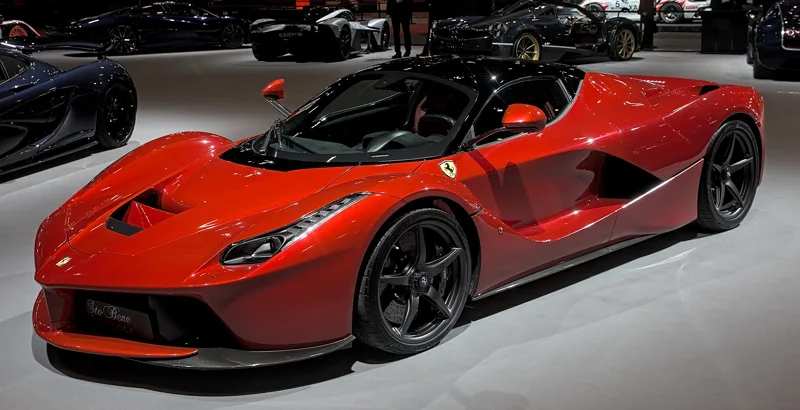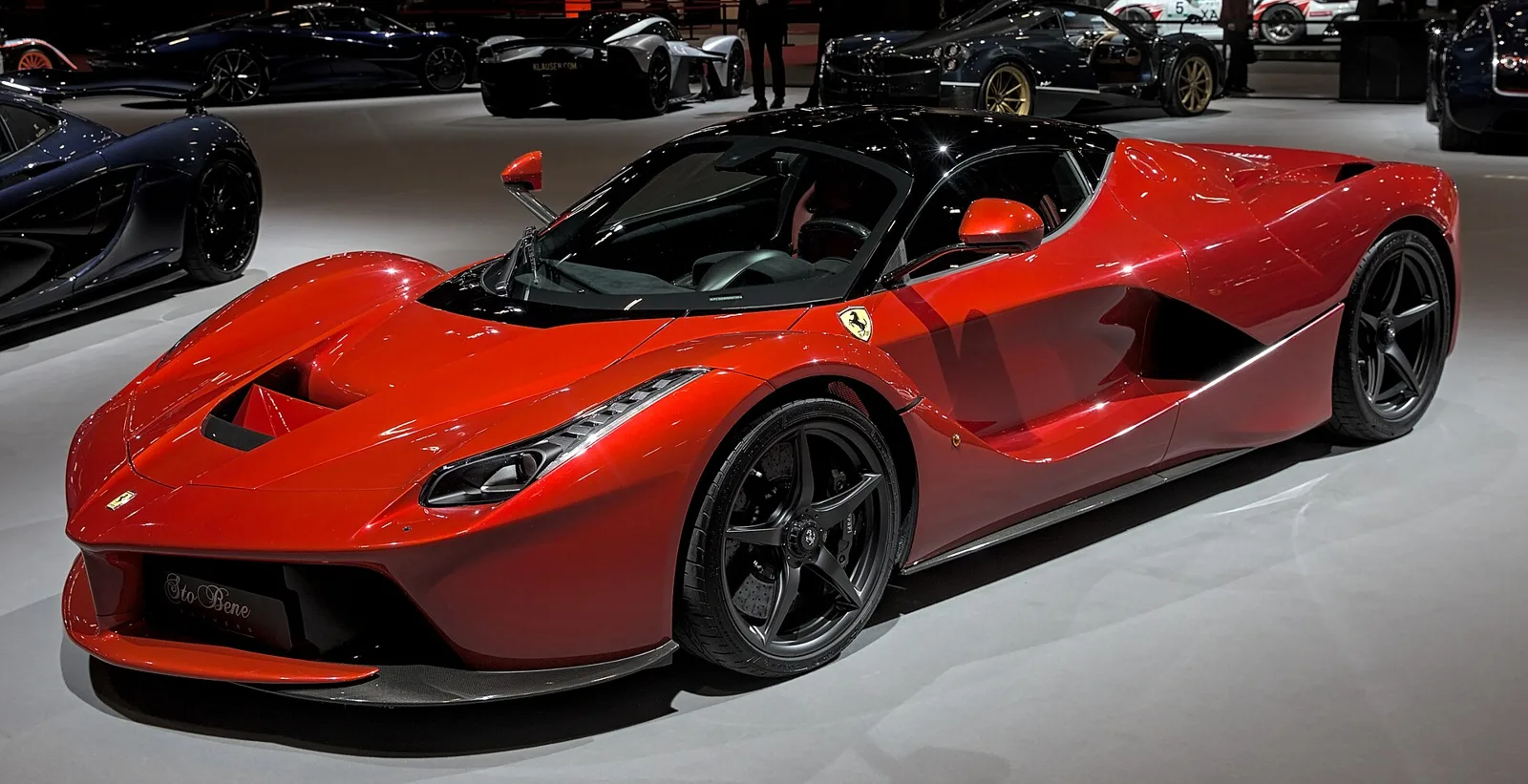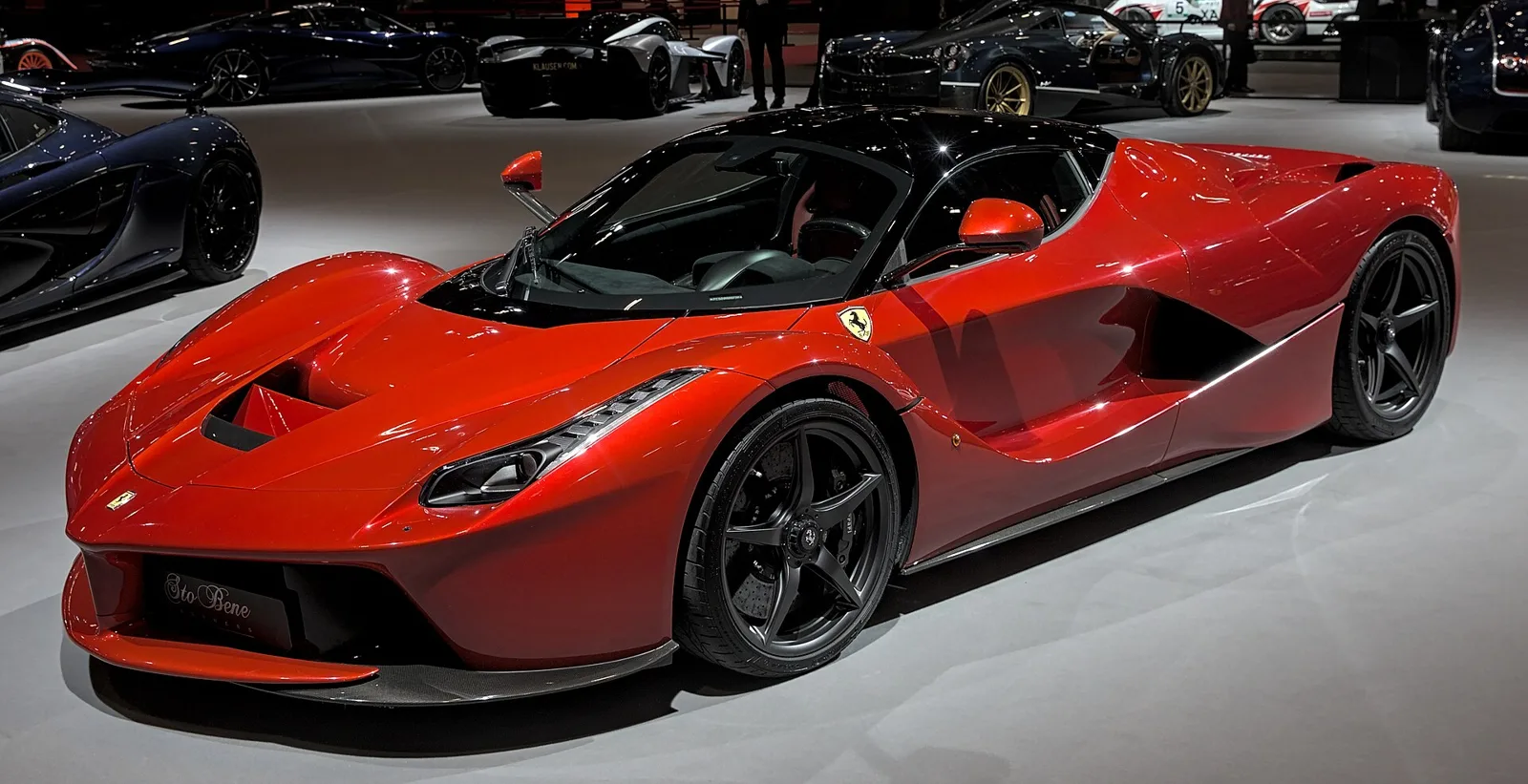
Built as Maranello's definitive statement, the LaFerrari paired a 789 hp V12 with a hybrid boost, and in doing so ended Ferrari's six-decade design partnership with Pininfarina.
The Ferrari LaFerrari is a limited-production, mid-engine hybrid hypercar built from 2013 to 2016, with 499 coupes made. It pairs an 800 PS V12 with a 163 PS electric motor for a combined 963 PS (950 hp), reaching 0-100 km/h in 2.6 seconds and over 350 km/h flat out.
LaFerrari means exactly what it says: The Ferrari, a hypercar built from 2013 as Maranello's definitive flagship, pairing an 800 PS (789 hp) V12 with an electric boost for a combined 963 PS (950 hp).
What is the Ferrari LaFerrari?
LaFerrari is a low-volume, mid-engine car running on a mild-hybrid system, built under the internal project name F150 and conceived from the outset as the clearest possible statement of what the Ferrari name stands for.
It was the first full hybrid road car Ferrari had ever built, combining a naturally aspirated V12 with a kinetic recovery system Ferrari calls HY-KERS. The company claimed the hybrid hardware cut fuel consumption by 40 per cent against an equivalent non-hybrid car while simultaneously producing more power than any other road-going Ferrari had managed up to that point, a combination that would have sounded contradictory from almost any other manufacturer.
The verified real-world figure turned out to be 21.99 seconds instead, still startlingly fast but a long way short of the factory's initial claim.
How was the LaFerrari designed?
Ferrari considered nine separate conceptual design studies for its V12 hybrid flagship in 2011, narrowing the field to five by that April: three from the in-house Centro Stile studio and two from Pininfarina.
Two of those five were built as full-size concepts, internally labelled Model 2 and Model 3 and nicknamed Manta and Tensostruttura respectively, and both were put on public display, one at the Ferrari Museum in Maranello and the other at Ferrari World in Abu Dhabi. The production car that eventually reached customers tracks closely to the Manta concept, while the rejected Tensostruttura design did not simply disappear; its visual language resurfaced years later in newer Centro Stile cars, most visibly the SF90 Stradale.
Why does the LaFerrari not wear a Pininfarina body?
The LaFerrari was the first Ferrari without any Pininfarina design input since the Bertone-styled 1973 Dino 308 GT4, breaking a partnership between the two companies that had run continuously since 1951.
At the time, Ferrari publicly insisted it had no plans to end the relationship with Pininfarina, even as the LaFerrari's own styling pointed firmly toward an all in-house future. Shortly after that statement, the two long-time partners split anyway, and every production Ferrari since the LaFerrari has come entirely from Centro Stile Ferrari. It was a quiet but decisive end to one of the longest-running design partnerships in the entire car industry, and the LaFerrari happened to be the car sitting at the hinge point.
Why did people expect the LaFerrari to weigh under 1,000 kg?
Development drew on testing from the FXX prototype and on research carried out under the University of Modena's Millechili Project, a connection that fuelled speculation during development that the finished car might weigh under 1,000 kg (2,205 lb). The real dry weight landed higher, at roughly 1,255 kg (2,767 lb).
That gap between early rumour and final reality did nothing to dim public interest once the finished car was finally shown to the world. After its Geneva debut, Ferrari toured it widely: to Auto Shanghai the same year, that year's Tour Auto Optic 2000 road rally, a Supercar Chronicle showing, and an appearance arranged through the Italian Chamber of Commerce in Japan, each stop adding to the mythology building around a car almost nobody outside Ferrari's own client list would ever get the chance to buy.
What powers the LaFerrari?
At the heart of the car sits a longitudinally mounted, rear mid-mounted Ferrari F140 V12, a direct-injection 65-degree unit displacing 6,262 cc (6.3 litres) and producing 800 PS (588 kW; 789 hp) on its own at 9,000 rpm, with 700 N.m (516 lb-ft) of torque arriving at 6,750 rpm.
Layered on top of that is the HY-KERS hybrid system, contributing a further 163 PS (120 kW; 161 hp) in short, targeted bursts rather than constant assistance. Combined, engine and electric motor produce 963 PS (708 kW; 950 hp) and 900 N.m (664 lb-ft) of torque, routed through a seven-speed dual-clutch transmission. The V12 itself is a tightly engineered thing even before the hybrid system is considered, with a bore and stroke of 94 mm by 75.2 mm (3.70 in by 2.96 in), a 13.5:1 compression ratio and a specific output of 94 kW (128 PS) per litre, figures that would be remarkable for a purely naturally aspirated road-car engine on their own.
LaFerrari specifications at a glance
Set out on a single page, the LaFerrari's numbers explain why it was treated as a genuine step change rather than simply another flagship update.
| Specification | Figure |
|---|---|
| Engine | 6,262 cc (6.3 L) F140 65-degree V12 plus HY-KERS |
| V12 output | 800 PS (588 kW; 789 hp) at 9,000 rpm |
| Combined output | 963 PS (708 kW; 950 hp) |
| Combined torque | 900 N.m (664 lb-ft) |
| 0-100 km/h (0-62 mph) | 2.6 seconds |
| 0-200 km/h (0-124 mph) | under 6.9 seconds |
| Top speed | over 350 km/h (220 mph) |
| Dry weight | around 1,255 kg (2,767 lb) |
| Claimed CO2 | 330 g/km |
Brakes and tyres match the ambition of the powertrain: carbon-ceramic Brembo discs measuring 398 mm at the front and 380 mm at the rear, wrapped in Pirelli P Zero Corsa rubber sized 265/30 R19 up front and 345/30 R20 behind. Underneath sits a carbon-fibre monocoque designed by former F1 technical director Rory Byrne, claimed to add 27 per cent to torsional rigidity and a further 22 per cent to beam stiffness over the car it replaced, running double wishbone suspension at the front and a multi-link layout at the rear. Keeping all of that cooperating are 21 separate onboard computers, running an active-aerodynamics system alongside a dedicated body computer platform supplied by Magneti Marelli Automotive Lighting, quietly doing all of the unglamorous work that lets a car this complex still feel, from the driver's seat, like one coherent machine.
How fast is the LaFerrari?
Ferrari's own figures put 0-100 km/h (0-62 mph) at 2.6 seconds and 0-200 km/h (0-124 mph) at under 6.9 seconds, with a claimed Fiorano test circuit lap of 1 minute 19.70 seconds.
The 0-300 km/h (0-186 mph) figure proved more controversial. Ferrari originally announced a time of 15 seconds, a number independent testers later debunked as unachievable; the verified real-world figure turned out to be 21.99 seconds instead, still startlingly fast but a long way short of the factory's initial claim. That gap between official marketing figures and verified testing became one of the more talked-about footnotes in the car's reception, a reminder that even a manufacturer as storied as Ferrari is not immune to an optimistic press release.
What is the LaFerrari Aperta?
Aperta is the open-top LaFerrari, unveiled at the 2016 Paris Motor Show with a removable carbon-fibre hardtop and a separate removable canvas soft top, continuing Ferrari's long habit of using the Aperta name for roofless variants.
Beyond the open roof, Ferrari re-angled the radiators so cooling air now exits underneath the car instead of washing across the bonnet, fitted a longer front air dam for extra downforce, and added an L-shaped flap at each windscreen pillar specifically to reduce buffeting in the cabin with no fixed roof overhead. The doors changed too, opening at different angles with reshaped wheel arches and a new carbon-fibre insert to allow the new rotation. Only 200 units were built, every single one pre-sold to invited customers rather than offered to the open market, with a further nine reserved specifically for Ferrari's own 70th Anniversary celebrations and one additional car sold later at auction.
What are the FXX-K and FXX-K Evo?
The FXX-K is Ferrari's track-only research vehicle built on the LaFerrari's bones, its name taking the K from the kinetic energy recovery system at its core, built not to race but to deliver an uncompromising experience with no road-legality constraints at all.
Ferrari unveiled it at the Yas Marina circuit in Abu Dhabi during late 2014, and only 40 units of this track-only machine were ever built in total. Total output reaches 1,050 PS (772 kW; 1,036 hp), well above 900 N.m (664 lb-ft) of torque, with the V12 contributing 860 PS (633 kW; 848 hp) and the electric motor adding another 190 PS (140 kW; 187 hp) on top. Weighing in dry at 1,165 kg (2,568 lb), the car generates 540 kg (1,190 lb) of downforce once it reaches 200 km/h (124 mph), and will run on to 350 km/h (217 mph) flat out, with a choice of four driving modes: Qualify, Long Run, Fast Charge and Manual Boost. Owners join Ferrari's Client Test Driver programme, the same scheme used for the earlier FXX and 599XX, feeding data back into future Ferrari road and race cars. An aerodynamic upgrade called the FXX-K Evo followed a few years later, shown to the public on 28 October 2017 during Ferrari's Finali Mondiali event in Florence. It lifts downforce 23 per cent above a standard FXX-K and 75 per cent above the road-going LaFerrari, alongside an estimated 90 kg (198 lb) saved in weight.
Were there any LaFerrari recalls?
Yes, three separate issues surfaced. Ferrari offered a replacement fuel tank over possible incorrect paint adhesion that risked a fire, recalled eighty-five coupes from the 2014-2015 model years over Lear L32 headrests that failed to absorb enough energy, and issued a further fix in 2015 for a driver's side airbag assembly fault.
The same 2014-2015 recall batch also addressed a tyre-pressure monitoring system that displayed the wrong message after a puncture, a relatively minor software issue compared with the headrest and fuel tank concerns but one Ferrari chose to correct in the same visit. None of the recalls appear to have dented demand; all 499 coupes and 200 Aperta units had already found owners through Ferrari's invitation-only allocation process.
The LaFerrari's lasting legacy
Beyond the showroom, the LaFerrari became a genuine charity fundraising tool. The 500th coupe, announced on 31 August 2016, was earmarked from the start for a benefit auction, sold by RM Sotheby's on 3 December 2016 during that year's Ferrari Finali Mondiali gathering, held at the Daytona International Speedway.
That single sale raised US$7 million, which was channelled into earthquake recovery work run through the National Italian American Foundation, specifically to help those directly affected by the central Italy earthquake of August 2016. The following year, the final LaFerrari Aperta built was auctioned for charity too, fetching US$10 million. Even Swiss watchmaking got drawn in: Hublot built 60 MP-05 'LaFerrari' tourbillon wristwatches inspired by the coupe, each holding 50 days of power reserve across 11 separate barrels. Few modern hypercars have left quite so wide a footprint, stretching from a broken design partnership and a disputed acceleration figure to a watch on a collector's wrist and millions raised for earthquake relief. Even the FXX-K track programme, strictly closed to public roads and competition alike, fed back into that same story, treating every lap its Client Test Driver owners completed as one more data point for whatever road or race car Ferrari builds next.