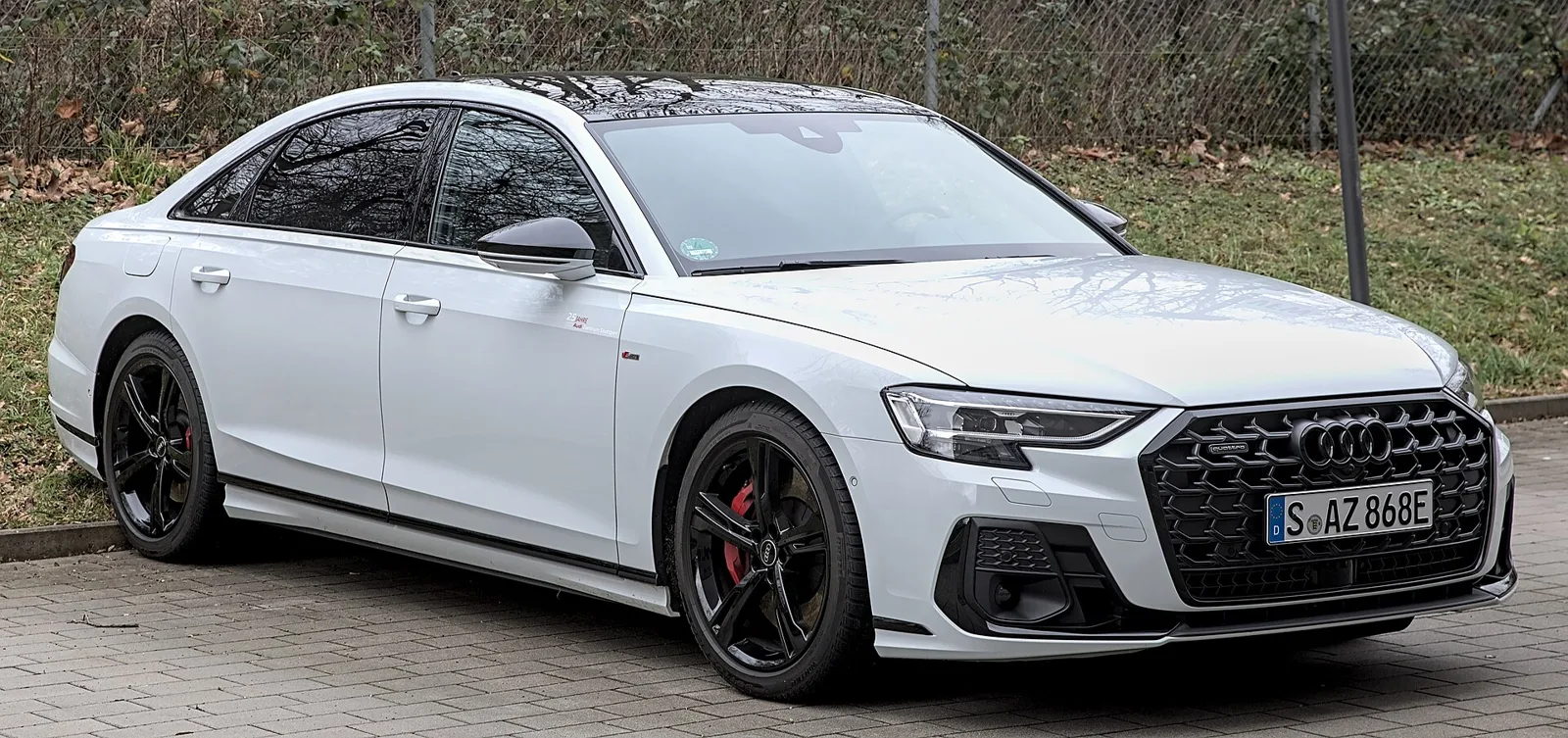
From the 1994 launch to the 2026 order halt in Germany, the A8 and its S8 performance line in one guide.
Launched in 1994, the A8 is Audi's large luxury saloon, sold in short and long wheelbase forms. Four generations have used an aluminium structure, while S8 versions added high-output performance. German orders were reported halted in February 2026, pending a successor.
Audi's full-size flagship has been sold since 1994 in short and long wheelbase forms, and every version has rested on an aluminium body structure. Front-wheel drive and quattro all-wheel drive have both been offered over the years. This guide walks through the four generations, the high-output S8 line and the 2026 order halt reported in Germany.
Where did the Audi A8 come from?
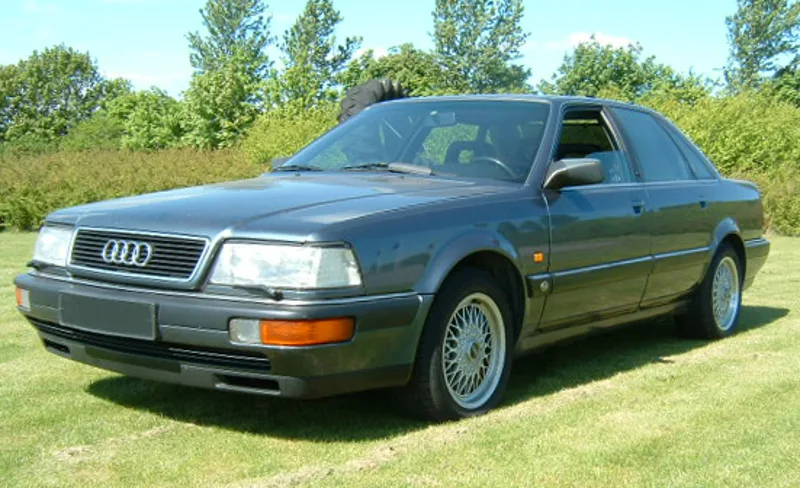
The A8 was created to take over from the Audi V8 as Audi's flagship. A 1982 agreement with Alcoa set the direction for a much lighter car, the final design was chosen by 1990, and the car was presented in February 1994 after pilot production began in December 1993.
The project grew out of a wish to build a luxury car that was far lighter than its competitors. Ferdinand Piech was the figure behind the agreement, and the engineers who followed had to find weight savings wherever they could.
The V8 it replaced sat on an existing steel platform. The new car used the Volkswagen Group D2 platform instead, an all-aluminium monocoque that was marketed as the Audi Space Frame. Development ended in early 1994 at a total cost of $700 million (GBP 418.1 million), and the Geneva show debut followed in March 1994.
Before the production car, a prototype called the Audi Space Frame Concept appeared at the 1993 Frankfurt show in polished aluminium. It signalled the construction method to the public well before launch, and pilot production started a few months later in December 1993.
The A8 was pitched against the Mercedes-Benz S-Class, the BMW 7 Series, the Jaguar XJ and the Lexus LS. Chris Bird and Dirk van Braeckel produced the design chosen for series production, and the body was frozen for manufacture in mid-1991.
An aluminium flagship that has carried one structural idea through four generations.
What is the Audi Space Frame?
The Audi Space Frame is an all-aluminium construction that forms the core of the A8. It was developed with Alcoa, and the car is noted as the first mass-market car with an aluminium chassis. Every A8 since has been built with the method.
Aluminium monocoques were rare in mass production when the A8 arrived. The Space Frame combined body and chassis into one structure that kept rigidity high while removing weight, and that combination was the reason Audi pursued the technique so seriously.
Standard all-wheel drive added weight compared with rear-drive rivals, so saving mass in the body became a central goal. The aluminium structure was the answer, and it stayed at the heart of the car through every later generation.
Audi marketed the construction under the Space Frame name from the start. The weight advantage was one reason the company kept the method, even as the platforms underneath the car changed from the D2 to the D5 generation.
For buyers today, the body is often the first thing that separates the A8 from steel-bodied rivals. Its structure is a reminder of how much effort went into the car's engineering before the first customer took delivery.
How did the second and third generations change the A8?
The second generation, the D3, was unveiled in July 2002 and reached European showrooms in November 2002. It added the Multi Media Interface, a six-speed Tiptronic automatic and adaptive air suspension. The third generation, launched in 2009 on the Volkswagen Group MLB platform, kept the aluminium body.
The D3 was previewed as the Audi Avantissimo concept at the 2001 Frankfurt show, and it carried much of the technology that the production car later used. It was longer than the first generation and offered room for four or five adults, depending on the rear seat layout.
The Multi Media Interface was a world premiere on the D3. It was an in-car control system similar in idea to BMW's iDrive, linked to a high-speed optical fibre network, and it was supported by bi-xenon headlights and adaptive front lighting.
The second-generation quattro system used a Torsen centre differential. Its default split was 50:50 between the front and rear axles, and the mechanical unit could shift power quickly to whichever axle had grip.
A compact 6.0-litre W12 was added to the range, made by joining two VR6 engines at the crankshaft. Audi said this layout allowed a twelve-cylinder engine in a car with all-wheel drive, which a conventional V12 could not manage.
The third generation was unveiled at Design Miami on 30 November 2009. It moved to the Volkswagen Group MLB platform while retaining the aluminium Space Frame, and an eight-speed ZF 8HP automatic replaced the older gearbox.
Its quattro layout sent 40 percent of torque to the front and 60 percent to the rear by default. Audi also promoted the car as the lightest all-wheel drive vehicle in the full-size luxury segment, which kept the aluminium construction central to its pitch.
Which S8 models were built?
The S8 is the high-performance version of the A8. The first S8 appeared in 1996 as a 4.2 quattro, a V10 model followed from 2006, and a 4.0 TFSI V8 arrived in 2012. The S8 Plus raised output to 605 hp (451 kW) for the 2016 and 2017 model years.
The first S8 was sold in Europe from 1996 and was set apart from the regular car by solid aluminium mirror housings, chrome-effect beltline trim and polished twin exhaust pipes. Subtle S8 badging completed the look without shouting about the performance underneath.
European-market S8s came with a six-speed manual as standard, while most other markets received only the sports-tuned automatic. That split meant the gearbox a buyer could choose depended largely on where the car was sold.
A late-1999 upgrade raised the first S8 to 265 kW (355 hp) and 430 Nm (317 lb ft). The engine moved from four valves per cylinder to five, which lifted output from the same basic 4.2-litre V8.
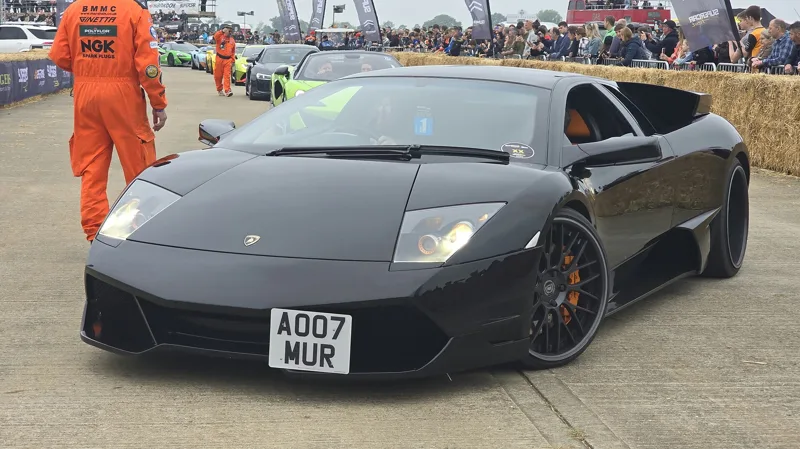
The second-generation S8 used a 5.2-litre V10 that Audi designed itself. The engine is often mistaken for a Lamborghini unit, but it was built on Audi's own 4.2-litre V8 architecture. Lamborghini later used a version of the same engine in its own cars.
That V10 reached 100 km/h in 5.1 seconds, and its top speed was electronically limited to 250 km/h (155 mph). The sports suspension used firmer springs, larger wheels and ceramic brakes that could be specified as an option.
The 2012 S8 4.0 TFSI used a biturbo V8 rated at 382 kW (512 hp) and reached 100 km/h in 4.2 seconds. Cylinder deactivation allowed the engine to run on four cylinders at light load, which helped economy on the motorway.
The S8 Plus of 2016 was built by Audi Sport, the former quattro GmbH, and was pushed to 605 hp (451 kW) by remapping turbo boost and fuel delivery. Its options list largely matched the earlier S8, with extra carbon-fibre trim for the mirror caps, spoiler and diffuser.
How did the A8 compare with its rivals?
The A8 was built to compete with the Mercedes-Benz S-Class and the BMW 7 Series, and it also faced the Jaguar XJ and Lexus LS. The S8 and the top W12 models were pitched against the rivals' sportiest and most powerful cars, which made the choice between them a matter of priorities.
Direct competitors for the 2012 S8 included the BMW Alpina B7 and the Mercedes-Benz S63 AMG, both of which also used biturbo V8 engines. That put the A8 in a crowded field of high-output luxury saloons.
Against the long-wheelbase W12, the S8 offered sportier mechanical features, including a firmer suspension, larger wheels and ceramic brakes. The W12 was more expensive, had more torque and rode on a longer wheelbase, so it trailed the S8 in agility.
Buyers therefore faced a clear split between outright character and comfort. The shorter S8 was usually the sharper driver's car, while the long-wheelbase W12 offered a more relaxed and spacious experience for rear-seat passengers.
Why are A8 orders stopping in Germany?
Reports from March 2026 said Audi had stopped taking new A8 orders in Germany from 18 February 2026. The company has confirmed that a successor is in development, and other markets were reported to depend on remaining stock. The move was linked to a wider change in Audi's focus.
The fourth generation was unveiled in Barcelona on 11 July 2017 and shown at the Frankfurt show the same year. Its styling drew on the Audi Prologue concept, and the long-wheelbase A8 L followed later in the cycle.
Audi was reported to be shifting its strategic focus toward SUVs and electric vehicles. A large petrol saloon is a difficult product to keep in the line-up under those conditions, which is why the current car is winding down rather than being replaced immediately.
The fourth generation also introduced the Traffic Jam Pilot, a Level 3 system that handles heavy motorway traffic at speeds up to 60 km/h (37 mph) without driver input. Audi cancelled the feature for the United States in 2019 because the legal rules were complicated.
For anyone considering an A8 now, the practical question is stock and support. Availability depends on the market and on dealer supplies, so checking with an authorised Audi dealer is the sensible first step.
What are the Audi A8 specifications?
The table below lists the main figures for each generation and the performance variants. Values follow the launch figures quoted at the time, so each model keeps its own line rather than being merged into one car. Figures for the first and second generations appear before the later cars, so the table reads in order of launch.
The first-generation figures show how quickly the platform developed. Later models lifted power, added a long-wheelbase option and then moved to a more modern eight-speed automatic. Readers comparing models should note that performance versions often sit on separate lines.
| Specification | Detail |
|---|---|
| Launch | February 1994, Geneva debut March 1994 |
| Construction | Audi Space Frame aluminium |
| Drive | Front-wheel or quattro all-wheel drive |
| First-generation quattro V8 | 4.2 litre, 221 kW (300 PS; 296 bhp) |
| First-generation front-drive V8 | 3.7 litre, 169 kW (230 PS; 227 bhp) |
| First-generation front-drive V6 | 2.8 litre, 142 kW (193 PS; 190 bhp) |
| S8 after late-1999 upgrade | 265 kW (355 hp), 430 Nm (317 lb ft) |
| Second-generation S8 V10 | 5.2 litre, 0-100 km/h in 5.1 seconds, 250 km/h (155 mph) limit |
| Third-generation transmission | Eight-speed ZF 8HP automatic |
| Third-generation quattro split | 40 percent front, 60 percent rear by default |
| 2012 S8 4.0 TFSI | 382 kW (512 hp), 0-100 km/h in 4.2 seconds |
| S8 Plus (2016 and 2017) | 605 hp (451 kW) |
| First generation ended | 4 August 2002, number 105,092 |
Frequently asked questions
How quick was the second-generation S8?
The second-generation S8 reached 100 km/h in 5.1 seconds, with its top speed electronically limited to 250 km/h (155 mph). These are factory claims quoted at launch, so real-world times will vary with conditions, tyres and load.
Is the A8 still on sale?
Orders in Germany were reported stopped from 18 February 2026, and a successor is in the works. Other markets may only receive cars from the remaining stock while the fourth generation winds down.
Did the A8 ever get a W12 engine?
Yes. The compact 6.0-litre W12 arrived in 2001 and was built from two VR6 engines joined at the crankshaft. Only 750 first-generation W12 models were produced between 2001 and 2003, so they are uncommon today.
Was a manual gearbox ever offered?
Yes, on early S8 models. Cars sold in Europe had a six-speed manual fitted at launch in 1996, whereas most other markets offered only the sports-tuned automatic. Later A8 models used automatic transmissions alone.
_1X7A1787.jpg)