From a Tucson rental franchisor to a coin-operated car tower, and from a Mexico City start-up to a company that buys 150,000 cars a year at auction.
Carvana sells used cars online and through car vending machines, DriveTime finances buyers in its own dealerships, and Kavak runs a buying, selling and credit platform across Latin America. DriveTime funded Carvana in 2012 and owned most of it from 2013, while Kavak, founded in 2016, took a separate route.
Carvana, the online used-car retailer that reached the Fortune 500 in 2021, was funded by DriveTime, a lender and dealer group that began in 1977 as a rent-a-car business in Tucson called Ugly Duckling. Alongside Mexico's Kavak, they represent three different ways to sell a used car.
How did DriveTime grow out of a Tucson rental business?
Thomas S. Duck Sr. started Ugly Duckling Rent-A-Car in Tucson in 1977. After the company's 1989 bankruptcy, Ernest Garcia II formed Duck Ventures in 1990 and bought its assets, and the business was renamed DriveTime on 1 September 2002.
The rental firm had once been a real force. By 1985 it ranked fifth in the United States, with 600 franchises. Garcia turned the remains toward used cars, and by 1992 the company ran two dealers, in Phoenix and Tucson. It bought three more, built four new ones and gave them the look of an ordinary dealer rather than the shabby appearance of most subprime lots. In 1994 it bought Champion Financial Services, which gave it income from purchasing instalment contracts written by other dealers.
The financing was inventive. Ugly Duckling prepared customers' tax returns and let them put expected refunds toward a down payment. It helped buyers get Visa cards through a deposit, refunded the down payment, usually 10 to 15 percent of the price, to those who paid on time, and, unlike most dealers, accepted cash instalments. When the company listed on the NASDAQ in 1996 under the ticker UGLY, it raised $170 million. The Washington Post that November called it a bank posing as a car lot.
The rental side faded out. A hundred franchises had closed by August 1996, and the other 40 were gone over the following ten years as their contracts ran out. Meanwhile a $100 million credit line from GE Capital paid for a buying spree: Seminole Capital's five Tampa dealers along with $25 million of its finance contracts, and assets of E-Z Plan of San Antonio for $26.3 million. By August 1997 there were 24 dealers across five states plus 64 branch offices spread over 17, and headcount had grown from 652 to 1776 in nine months. Yet by 1999 it was out of the financing business, with Garcia buying one finance subsidiary and the other, Champion, closing.
Garcia owned 65 percent of the company by January 2002 and, with chief executive Gregory Sullivan, bought out the rest that year. The private DriveTime then ran 76 dealerships in eight states. In November 2004 it outlined a plan to grow from 75 to 100 locations in two years, when it employed 2,100 people and revenue stood at $729 million. The 100th dealership opened in Concord, North Carolina, in 2007. By 2015 the group owned more than 130 dealerships, and by 2018 it had 145. In 2017 it changed tack to concentrate on newer cars with lower mileage.
One started as a rental franchisor, one as a vending-machine start-up, one as a Mexico City platform: three different routes to the used-car market.
How does DriveTime sell and inspect its cars?
DriveTime buys 150,000 cars a year at auctions and puts each through a 14-day inspection at one of 24 centres. Roughly 8 percent fail and never reach a dealership.
Repairs happen before the cars go to the lots, and customers are financed in-house using a proprietary credit scoring model that includes subprime lending. Ownership rests with chairman Ernest Garcia II and Ray Fidel, a former president and chief executive. Both men were known beforehand for their role in the Lincoln Savings and Loan affair: Garcia admitted a fraud charge in 1990 and Fidel securities fraud in 1991, and each received three years of probation, with judges crediting their help in convicting Charles Keating.
The business has faced scrutiny. CarMax sued in federal court, alleging that DriveTime paid kickbacks to CarMax salespeople for each customer referred, a claim DriveTime's general counsel denied. In November 2014 the Consumer Financial Protection Bureau imposed an $8 million civil penalty over debt collection, alleging abusive tactics such as repeated calls, some to workplaces, and wrong information given to credit bureaus. No buy here, pay here business had been targeted by the agency before. It agreed to pay, to change its collection process and to accept five years of close supervision.
What did DriveTime spin off?
Its leaders encouraged employees to start companies, and four came out of it: GO Financial, SilverRock Group, Bridgecrest Acceptance Corporation and Carvana.
GO Financial began in 2011 as a division offering subprime retail financing and became separate in 2013. It serves 2,800 dealerships in 46 states, and it stopped writing new loans in May 2016. SilverRock, spun off in June 2015, sells insurance, service contracts and extended warranties and has about 185 employees. Bridgecrest was launched in April 2016 to service instalment contracts and took over more than 220,000 customers previously handled by DriveTime Acceptance Corp.
How did Carvana start, and what is a car vending machine?
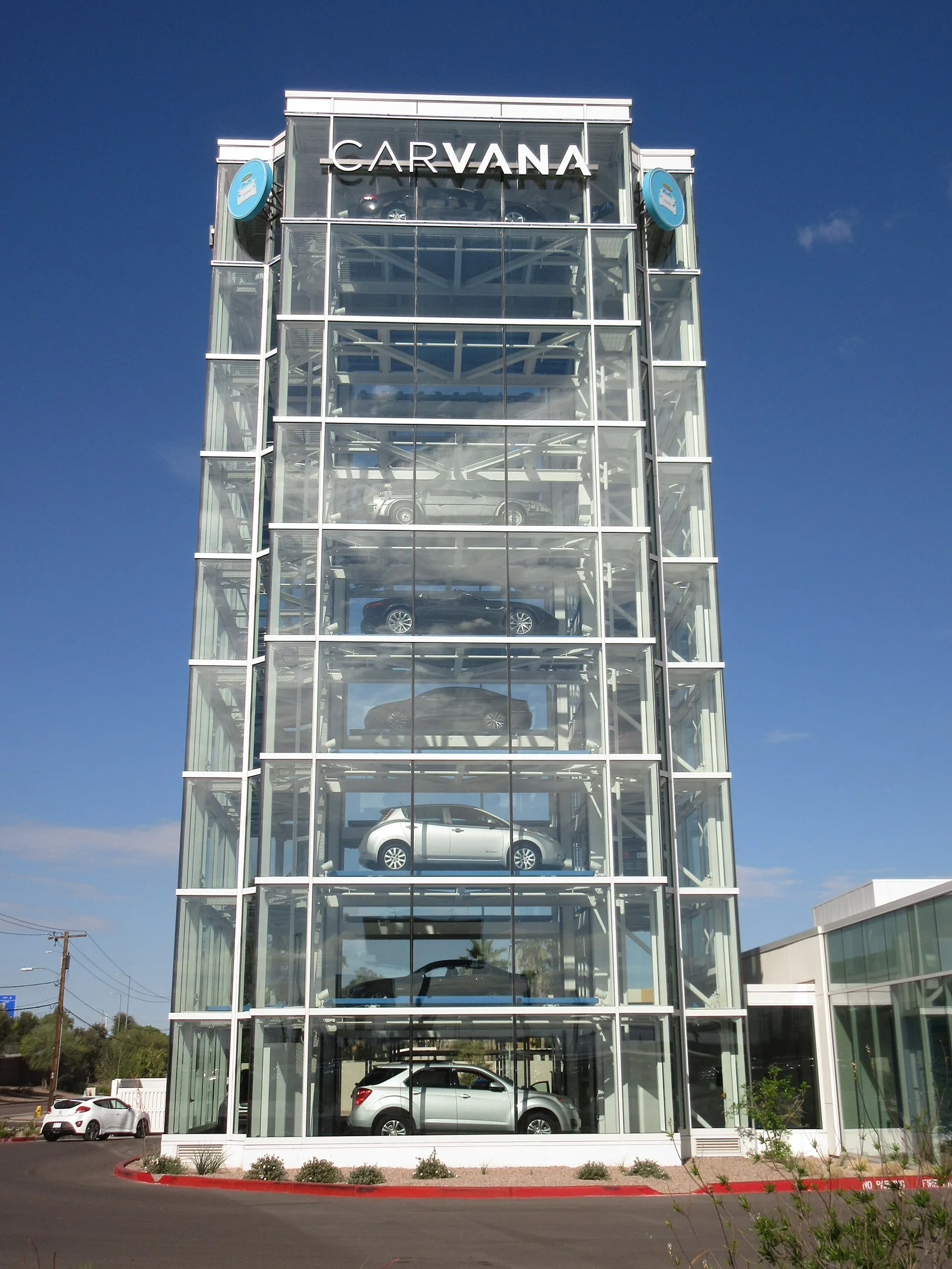
Carvana was founded in 2012 by Ben Huston, Ryan Keeton and Ernest Garcia III, with DriveTime providing the first funding round. A year later it opened its first car vending machine, a way for buyers to collect cars ordered online.
DriveTime became majority owner in 2013, the year Carvana launched nationwide in November, though the two firms were operated completely separately. Shoppers browse stock, seek finance and set up collection or delivery on the website, and the start-up could draw on DriveTime's service facilities. When DriveTime moved to a new Tempe headquarters in November 2015, Carvana took over its old Phoenix premises. A coin-operated version of the signature machine opened in Nashville, Tennessee, in 2015, and Carvana now operates more than 30 of them.
The company went public on the New York Stock Exchange in April 2017 under the symbol CVNA. It bought a rival start-up, Calypso, that year and paid $22 million in 2018 for Car360, a smartphone photography system that uses 3D computer vision plus machine learning and augmented reality. In 2022 it bought ADESA, the second-largest wholesale auto auction chain in the country, for $2.2 billion to enlarge its real estate footprint.
The pandemic helped. Carvana introduced touchless delivery and pickup in March 2020, and second-quarter vehicle sales rose 25 percent as physical dealerships closed. Revenue for April to June reached $1.12 billion, up 13 percent. Over that year 244,111 vehicles went out the door, for annual revenue of $5.587 billion, which made it the number two online used-car seller in the country. By November 2023 as-soon-as-next-day delivery covered more than 300 markets, and since August 2023 it has offered same-day delivery in places including Central Florida, Dallas-Fort Worth, Georgia, North Carolina, Indiana, Arizona and Alabama. In 2025 it moved into the new car market.
What went wrong at Carvana?
In 2022 growth stalled and regulators stepped in. The Wall Street Journal reported in May 2022 that Carvana laid off 12 percent of its staff, or 2,500 people, after missing growth expectations.
Its share price fell to 90 percent below its 52-week high, and on 4 November 2022 it dropped about 40 percent after poor third-quarter results, when used vehicle sales declined 8 percent to 102,570. Analysts blamed higher borrowing costs and inflated used-car prices. In February 2024 CNBC reported that the company had spent 18 months restructuring operations and debt amid bankruptcy concerns. It cut headcount by more than 4,000 and removed $1.1 billion of annualised expenses. It also introduced software called Carli to handle reconditioning and other formerly manual work, built logistics tools for routing and driver schedules, and brought in generative AI for some tasks.
Several states took action over paperwork. Regulators in North Carolina temporarily banned the Raleigh vending machine in August 2021 over inspections and titles, and it resumed in January 2022. Illinois suspended Carvana's business licence from 10 to 25 May 2022, saying titles had not reached buyers within 20 days and that temporary registrations from other states had been issued unlawfully. The suspension was lifted on 26 May, reimposed on 18 July after the state said conduct continued, and then blocked by a temporary injunction won by Carvana on 29 July. A Carvana vice president, Paul Breaux, was charged with misdemeanour and petty offences over the Illinois issues. In Pennsylvania, a class action alleges the company failed to transfer ownership properly, and Carvana denies liability. Michigan suspended the Novi dealership on 7 October 2022 after earlier probation, although the site kept operating the following week.
In January 2025 the short seller Hindenburg Research published a report alleging that Carvana's turnaround rested on accounting manipulation and weak loan underwriting, and focusing on its dealings with DriveTime, owned by Ernest Garcia II, father of Carvana's chief executive. A securities fraud class action in the District of Arizona has been allowed to proceed to discovery as of February 2025. These are allegations in a report and a lawsuit, not findings.
How did Kavak build a used-car platform in Mexico?
Carlos Garcia Ottati founded Kavak in 2016 in Mexico City. Its first round, a MXN$3 million seed investment through the Mountain Nazca fund, was then the biggest seed-stage deal ever completed in Mexico.
Between 2016 and 2020 the company raised nearly MXN$400 million in three rounds, led by Kaszek Ventures, Mountain Nazca and SoftBank. That took its valuation to US$1 billion by the end of 2020, making it the first Mexican unicorn. Expansion followed quickly: Argentina in 2020 after merging with a local start-up, Checkars; Brazil at the start of 2021; and a Series E round of US$700 million that valued the company at $8.7 billion and made it Latin America's second most valuable company.
The map then grew and shrank. Kavak announced plans in July 2022 to enter Chile, Colombia and Peru, and began in Turkey that May under the name Carvak. In October 2022 it announced a start-up in Saudi Arabia, Oman and the United Arab Emirates, planning its own operation in Saudi Arabia with two operational centres in Riyadh, while the Emirates and Oman operations followed a tie-up with an Omani platform, Carzaty. In November 2023 it said it would suspend operations in Colombia and Peru indefinitely from 1 January 2024, citing the economic climate. In 2025 it sold Carvak to Borusan Next, and Turkey's Competition Authority approved the deal on 18 September 2025.
How does Kavak price, recondition and finance cars?
It leans on data. An algorithm gathers public automotive-industry information and the company's own figures to work out prices it considers fair to buyers and sellers, and it has learned to project market trends and judge a user's ability to pay.
That lets Kavak tailor financing and vehicle offers. A reconditioning facility in the State of Mexico can process more than 3,500 vehicles a month, with technical check-ups, repairs and quality certification. The finance side grew from Kavak Capital into two newer brands, Kuna and Kavak Credito, the latter launched in November 2025. By January 2025 Kavak reported about 1.2 percent of the Mexican used-car market.
Its backers include D1, Ribbit Capital, Spruce House, General Catalyst, Tiger Global, Founders Fund, SoftBank and Sea, plus the athlete Manu Ginobili. Football links run through the Mexican and Argentine federations, the CONCACAF Champions Cup from February 2024 and a commercial partnership with the NFL announced in December 2025, and Kavak has a self-financing arrangement with Uber. In 2023 it climbed 93 places in a ranking of Mexico's 500 most important companies, to 322 from 415.
How the three companies compare
| Company | Founded | Base | Main route to the buyer | Scale marker |
|---|---|---|---|---|
| Carvana | 2012 | Tempe, Arizona | Website with delivery, pickup or a car vending machine | 244,111 vehicles sold in 2020 |
| Kavak | 2016 | Mexico City | Platform for buying, selling, financing and managing cars | About 1.2 percent of the Mexican used-car market in January 2025 |
| DriveTime | 1977, as Ugly Duckling | Tempe, Arizona | Company dealerships with in-house financing | 145 dealerships by 2018 |
What does the difference mean for a used-car buyer?
The route matters more than the badge. At Carvana a shopper browses stock, applies for finance and chooses pickup or delivery on the same site, or collects from a vending machine. DriveTime sells through dealerships and arranges credit itself, with a scoring model that includes buyers with weak credit.
Preparation differs too. DriveTime's cars pass a 14-day inspection and about 8 percent of auction buys are rejected, while Kavak says its Mexican workshop adds technical check-ups, repair and certification before sale. The regulatory record at Carvana, from title delays to licence suspensions, is a reminder that paperwork is part of the product, and that the company has denied liability in at least one lawsuit.
What is next for Carvana and Kavak?
Carvana's securities fraud case is moving into discovery, and the company has entered the new car market in 2025. It has also extended its sponsorship list, with a deal in November 2025 that made it official auto retailer of Stanford Athletics.
In February 2026 Kavak closed a Series F worth US$300 million; Andreessen Horowitz led it with US$200 million of its own, and WCM Investment Management co-led. Its credit platform, Kavak Credito, launched in Mexico in November 2025.