Twenty thousand copies a year, none for sale, and a photographic record that mirrors sixty years of change, alongside the tyres on every Formula One grid since 2011.
The Pirelli calendar is an annual publication produced by Pirelli's UK subsidiary since 1964. About 20,000 copies are printed each year and given away rather than sold, and its photography has shifted from glamour towards portraits of achievement, while Pirelli itself is now purely a tyre maker.
Every year Pirelli prints 20,000 copies of a calendar and sells not one of them. That oddity, repeated since 1964, is a large part of how the Milan tyre maker is known, from a calendar whose photography has kept changing with the times to a company founded on rubber whose name reaches well past the tyre shop.
What is the Pirelli calendar, and who actually gets one?
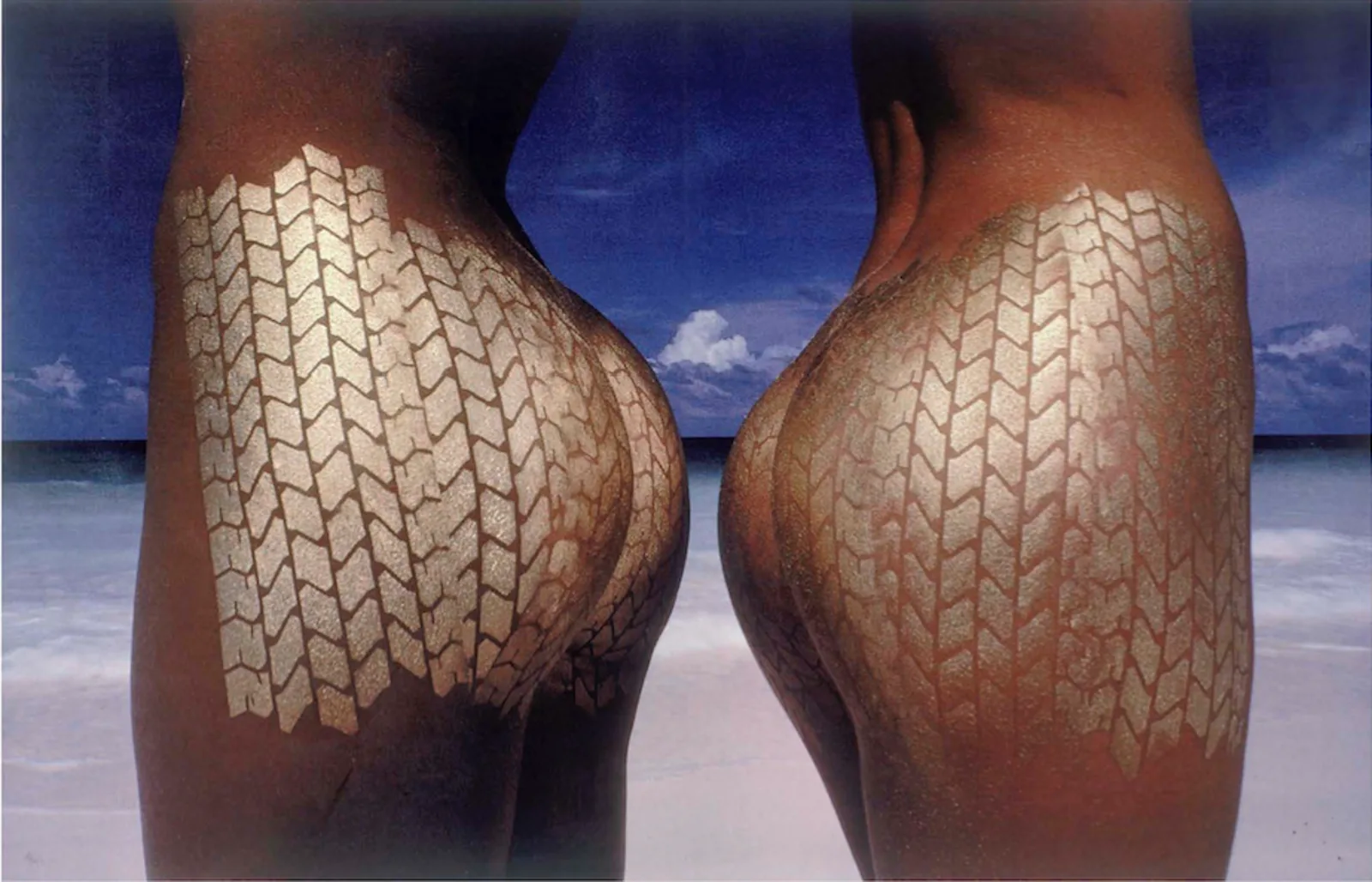
The Pirelli Calendar, which carries the trade mark The Cal, is a yearly corporate calendar issued by the British subsidiary of the Italian tyre group. Only 20,000 are printed. They never reach a shop shelf: copies are handed out as corporate gifts to celebrities and chosen Pirelli customers.
Putting it together is not cheap. In 2017 the bill for producing it came to about US$2 million. Under Marco Tronchetti Provera, who ran Pirelli from 1992 to 2022, the point, in his words, was to mark the passing of time by capturing the spirit of the moment. A freebie that costs that much and cannot be bought turns into an invitation, and appearing in it, whether as model or photographer, has become a mark of distinction in its own right.
About 20,000 copies a year, none for sale, at a production cost of around US$2 million.
How did the Pirelli calendar begin?
A British art director, Derek Forsyth, created it. A mock-up that never saw print dates from 1962, and the first real edition followed in 1964. Some early issues gave Pirelli tyres a prominent place, though the product pitch was dropped later. For roughly the first ten years the pictures showed women fully clothed.
In 1972 Sarah Moon became the first woman to photograph it. Two years later the run stopped. The 1974 issue was the last for a decade, an economy measure after the 1973 oil crisis pushed the world into recession. It came back ten years on and has appeared every year since, with a single gap: the 2021 edition was cancelled because of the coronavirus pandemic. The 2022 calendar, titled On The Road, returned with musicians as its subjects.
Why did the Pirelli calendar change so often?
During the 1980s the emphasis shifted towards nudity. The 1987 edition, shot by Terence Donovan, was the first to use only black models, set against savannah-like scenery with tribal-inspired styling. Eroticised imagery then dominated until the middle of the 2010s, and editors sometimes judged what their photographers delivered to be too risque to print. In 2014 Pirelli finally released an unpublished 1986 calendar shot by Helmut Newton.
The turn came in stages. Patrick Demarchelier took the 2008 edition to Shanghai and cast a number of Asian models, and Terry Richardson's 2010 calendar echoed the look of the 1960s. Then came the sharper break. Annie Leibovitz's 2016 edition set out to celebrate women for what they had achieved. Her sitters included Serena Williams, Patti Smith, Yoko Ono, Mellody Hobson and Fran Lebowitz, chosen to represent different ages, in almost entirely clothed portraits.
Peter Lindbergh followed in 2017 with fully dressed subjects in minimal make-up, and it was the first calendar whose pictures were not retouched. Julianne Moore, Nicole Kidman and Helen Mirren sat for him. Tim Walker's 2018 edition used only black models, among them RuPaul, Whoopi Goldberg, Adwoa Aboah, Duckie Thot and Thando Hopa. The 2019 calendar, by Albert Watson, showed Laetitia Casta in lingerie without any teasing nudity, in the trend of the MeToo movement and the Weinstein effect. For the 60th anniversary in 2024, Prince Gyasi was the first black photographer handed an edition.
Who has shot the Pirelli calendar?
The photographer list reads like a gallery directory. Peter Lindbergh made three editions, for 1996, 2002 and 2017. Demarchelier made two, for 2005 and 2008, and the pair worked together on the 50th anniversary calendar of 2014. Richard Avedon, Herb Ritts, Bruce Weber and Leibovitz each shot two, and so did Terence Donovan, Clive Arrowsmith, Harry Peccinotti, Francis Giacobetti and Brian Duffy.
The cast is just as long. Isabeli Fontana appeared eight times. Naomi Campbell and Natalia Vodianova each appeared five times, and Kate Moss, Adriana Lima and Lara Stone three times apiece. Actresses range from Sophia Loren to Uma Thurman and Kate Winslet. Beyond fashion models and film stars the calendar has also featured an athlete, Serena Williams, a dancer, Misty Copeland, and a singer, Patti Smith. Between 1997 and 2015 the casting director Jennifer Starr helped steer the look of each edition.
Because the object itself is hard to get, the images travel by other routes. Mondadori published a book covering 1964 to 2007, Taschen followed with a 50th anniversary volume in 2015, and Emmanuel Le Ber made a film, The Pirelli Calendar Saga, in 2010. Exhibitions have run at Palazzo Reale in Milan in 2014, at Skylight at Moynihan Station during New York Fashion Week in 2016, and in several Russian museums in 2018.
Pirelli history, from rubber works to pure tyre company
Giovanni Battista Pirelli founded the firm in Milan in 1872, and it began with rubber and the processes built around it. Its history includes some surprises. In World War II it supplied diving gear to Italian frogmen, namely rebreathers and dry suits. Tyres and cables became the main business, and Alberto Pirelli had the Pirelli Tower built in the 1950s, in the Milan district that had held the first factory.
The company then spent decades pulling in and shedding unrelated businesses. It bought the Armstrong Rubber Company of New Haven, Connecticut, for $190 million in 1988. In 2000 it sold its fibre optic cable operation to Cisco and its optical components to Corning, a deal worth 5 billion euro, and through the Olimpia vehicle it became the majority shareholder of Telecom Italia in 2001, a position it kept until 2007. A Pirelli-branded range of clothing, watches and eyewear arrived in 2002. In 2005 the cable, energy and telecommunications assets went to Goldman Sachs, which renamed the group Prysmian.
By 2010 the transformation was complete. Pirelli sold its broadband business, spun off the real estate arm Pirelli Re, and set up Fondazione Pirelli to safeguard the company's past. It is now solely a tyre manufacturer, ranked fifth-largest in the world, with 18 manufacturing sites across 12 countries, around 14,600 distributors and retailers, and sales in more than 160 countries.
Ownership has moved around too. Shareholders accepted a 7.1 billion euro bid from ChemChina, Camfin and LTI in March 2015, and the company left the stock market that November. It came back to the Milan exchange on 4 October 2017, having separated its industrial tyre business to focus on consumer products. Silk Road Fund began selling its entire stake on 29 May 2024, and in April 2025 the board determined that Sinochem's control had ended. The company's market capitalisation stood at $6.69 billion in May 2024.
Pirelli tyres and the wide radial
The technical story starts with a problem from rallying. In 1974 the Lancia team asked Pirelli for a tyre that could cope with everything the new Lancia Stratos could deliver. The options of the day were poor. Slicks were cross-ply tyres, very wide with a short sidewall, and they proved too stiff for the car. Radials were too narrow, gave too little grip, and were destroyed within 10 km.
Pirelli's answer, ready in 1975, kept the slick's width and low sidewall but gave the tyre a radial structure. Think of it as taking the wide footprint of a racing slick and the strength of a radial and refusing to choose between them. Porsche then began fitting the same tyres to the 911 Turbo, which is how a rally request ended up under a road-going 911.
The Pirelli range and the Cinturato name
Today the passenger car line is organised by purpose, and several family names double as racing brands.
| Family | Built for | Racing link |
|---|---|---|
| P Zero | Ultra-high-performance cars | Dry-weather Formula One and other racing tyres |
| Cinturato | High-end cars | Wet-weather F1 tyres |
| Sottozero | Cold-weather tyres for high-end cars | World Rally Championship tyres |
| Scorpion | SUVs and crossovers | None listed |
| Carrier | Vans | None listed |
| Ice | Extremely low temperatures | None listed |
The Cinturato name dates back to the 1950s. The company also makes motorcycle tyres under the Diablo, Angel and Scorpion names, and bicycle tyres: P Zero Velo for road racing, Cycl-e for urban and electric bikes, a Scorpion for mountain bikes and a Cinturato for gravel. Pirelli announced its return to cycling in May 2017 and the mountain bike range in March 2019.
Pirelli F1 and the tyres everyone can read
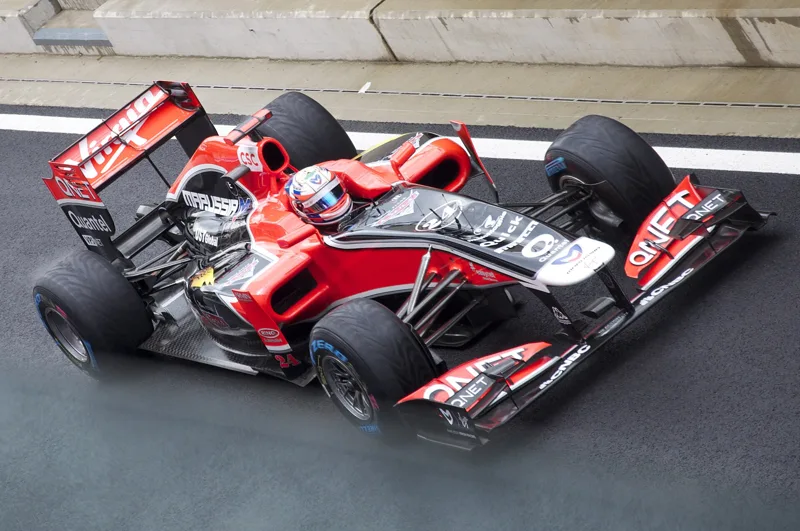
Pirelli has been the only tyre supplier in Formula One since 2011, taking over when Bridgestone left at the end of 2010. It had been in the sport before, from 1950 to 1958, from 1981 to 1986 and from 1989 to 1991. It also supplies Formula 2, Formula 3 and F1 Academy, the feeder series, and the 2025 Dutch Grand Prix was its 500th Grand Prix entry.
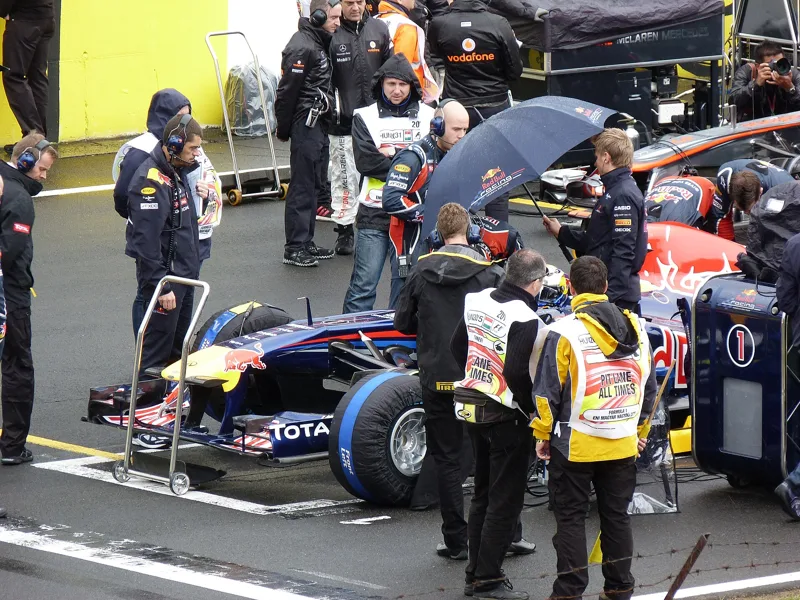
The company brought in a colour code to help viewers follow strategy. Since 2019 the dry-weather P Zero tyres have been marked white when hard, yellow when medium and red when soft. The two wet-weather grooved tyres are Cinturato, with green marking the intermediate and blue the full wet.
The brief given to Pirelli at the start was unusual. In 2011 it was asked to build tyres that wore out quickly, so that races would have more pit stops and more overtaking. The organisers' demands then shifted as the cars changed with the turbo hybrid era from 2014. Trouble came along the way. The 2013 British Grand Prix saw several tyre failures, and Pirelli responded by moving to Kevlar belts. In Belgium in 2015, Sebastian Vettel's Ferrari suffered a blowout at 320 km/h (200 mph); Pirelli first blamed excessive wear, then said after further analysis that a cut was responsible.
For 2017 the tyres grew 25 per cent wider, with fronts going from 245 mm to 305 mm and rears from 325 mm to 405 mm, while the rim stayed at the traditional 13 inches. Faster cornering put far more load through them, so Pirelli had to deliver tyres that wore less and resisted overheating for the fastest cars the sport had seen. It introduced 18-inch tyres in 2021 for the aerodynamic and technical changes due in 2022. Pirelli has also been the exclusive supplier to the FIM World Superbike Championship since 2004.
Pirelli in rallying and endurance racing
Pirelli's first World Rally Championship involvement dates to 1973. Since then it has won 181 events and supplied 25 drivers' champions, among them Colin McRae in 1995, Petter Solberg in 2003 and Sebastien Loeb from 2008 to 2010. It was the sole supplier from 2008 to 2010, left to concentrate on Formula One, and came back in 2014 with a handful of private teams while Michelin was the main supplier. It then took over the Junior WRC, where champions receive a Ford Fiesta R5 plus tyres, fuel and entry for the following season's WRC-2, and returned full time from 2021 to 2024.
Elsewhere it has supplied the American GT World Challenge since 2011 and the European Endurance Cup round of that series since 2013. It backed the Hoonigan Racing Division of the late Ken Block from 2010, and put its own name on the Pirelli World Challenge between 2011 and 2018.
From Inter Milan to the America's Cup
The racing programme is only one strand of a sponsorship habit that goes back to 1907. In football, Pirelli was the main shirt sponsor of Inter Milan between 1995 and 2021, and in 1998 it ran a commercial in which the Brazilian striker Ronaldo, in an Inter shirt, took the place of the figure on the Christ the Redeemer statue; the Catholic Church objected. South American clubs including Palmeiras, Penarol and Velez Sarsfield have carried the name, Burton Albion's ground in Burton-upon-Trent is the Pirelli Stadium because it sits beside a Pirelli factory, and in 2009 it took the title sponsorship of China's top flight.
Further afield it backed Emirates Team New Zealand in the 2017 America's Cup, the Alpine World Ski Championships and the ice hockey world championship from 2017 to 2021, and the Los Angeles Dodgers from 2014 to 2020. Its long-running slogan was Power is nothing without control.
What the Pirelli name means for drivers
Someone shopping for tyres meets the same naming logic that runs through the racing programme. A P Zero on a road car carries the name used for dry-weather Formula One rubber, a Cinturato shares its name with the wet-weather F1 tyre, and Sottozero winter tyres share theirs with rally tyres. Meanwhile the sponsorships and the calendar keep the name in front of people who may never buy a set.
Where this goes next
Pirelli's Formula One arrangement is due to end after the 2027 World Championship. On ownership, the board concluded in April 2025 that Sinochem's control had ended, after Silk Road Fund sold its holding in May 2024 and the Camfin vehicle of Tronchetti Provera increased its stake alongside other Italian investors.