From Lydden Circuit in Kent to electric World Championship cars, the story of the sport built to fit a TV schedule.
Rallycross began on 4 February 1967 at Lydden Circuit in Kent as a television show combining autocross and rallying. Up to eight cars race together on mixed asphalt and gravel, and the FIA World Rallycross Championship ran from 2014 until it was cancelled in 2025.
A week of rally driving over 3,000 miles, squeezed into seven minutes on a single mile of track. That was the pitch of a television producer named Robert Reed, who had spent November 1966 trying and failing to make the RAC Rally of Great Britain gripping for mass audiences. His answer became rallycross, and by April 1971 the idea had given the world a circuit built purely for the sport.
How did rallycross begin?
Rallycross was created for television, and it was first shown on 4 February 1967. Reed, a producer for ABC Weekend TV and a director on ITV's World of Sport, wanted the excitement of autocross married to the hardship of rallying. In his own words, the plan was to cut seven days and 3,000 miles down to seven minutes and one mile.
He brought in Bud Smith and the Tunbridge Wells Centre of the 750 Motor Club to stage an event and write the rules. Professional rally drivers of note were asked to come to Lydden Circuit in Kent, a track with a history of grass racing that had added short stretches of chalk and tarmac. Because it lay in a natural bowl, with changing gradients and mixed surfaces, four cameras could follow every car throughout.
The first race went to Vic Elford, later a Formula One driver and a winner of the Monte Carlo Rally, in an original Porsche 911. Brian Melia was second, driving a Ford Lotus Cortina, and Tony Fall third in a BMC Mini Cooper S.
From one-off broadcast to championship
Two more televised rallycrosses at Lydden followed, on 11 March and 29 July 1967. Then the World of Sport Rallycross Championship began, with round one on 23 September and round two on 7 October, the latter watched by up to 1.2m viewers. The series ran to six rounds, split evenly between Lydden and Croft in Yorkshire, and Tony Chappell in a Ford Escort Twin Cam became the first rallycross champion by winning the last round at Lydden on 6 April 1968.
The first international rallycross was televised live from Lydden on 25 November 1967, timed to coincide with the RAC Rally. The plan was a match between Britain and a rest-of-the-world team drawn from visiting rally stars such as Timo Makinen, Simo Lampinen and Rauno Aaltonen. Then the rally itself was cancelled on the evening of 17 November because of an outbreak of foot-and-mouth disease, and many of the visitors flew home. Only British drivers took part, and Andrew Cowan won in a works Hillman Imp.
The following day, the Thames Estuary Automobile Club ran a clubman's event that let up to 100 amateurs compete. That mattered: it showed rallycross could be a sport people took part in, not just a show to watch. The Royal Automobile Club's Motor Sport Division promptly claimed authority over the discipline and added it to the 1968 Motor Sport Year Book, with a definition that required a permanent circuit mixing sealed and unsealed surfaces.
After about eighteen months, the BBC took rallycross for its Grandstand programme and ITV let it go after the British Rallycross Winter Series of 1968/69. Cadwell Park in Lincolnshire joined Lydden and Croft in 1969, though it later dropped the sport. By then nearly ten million Britons were watching some of the events.
Seven days and 3,000 miles became seven minutes and one mile.
How rallycross spread around the world
The Netherlands came next. Rob Herzet of AVRO, the Dutch counterpart to Reed, saw rallycross on a visit to Britain in 1968 and believed it would work on television. Gerard van Lennep, a racing and rally driver and journalist, agreed to help and found a military testing ground near Venlo, close to the German border.
On Saturday 7 June 1969 the first rallycross on the European continent took place there. The circuit mixed a stretch of concrete runway with loose heathland and a hollow some 40 metres long and 10 metres deep, ordinarily used to test tanks. Soft heath soil and a muddy hollow slowed most of the cars, but it made for good television. Hans Kok won in an NSU 1200 TT, and he took the first Dutch title on 16 August. The Dutch Rallycross Association was founded on 1 November 1969, and in 1971 the sport moved to the Eurocircuit at Valkenswaard near Eindhoven. Opened on 17 April with a win for Jan de Rooy in a DAF 555 Coupe 4WD, it was the first track anywhere designed and built purely for rallycross.
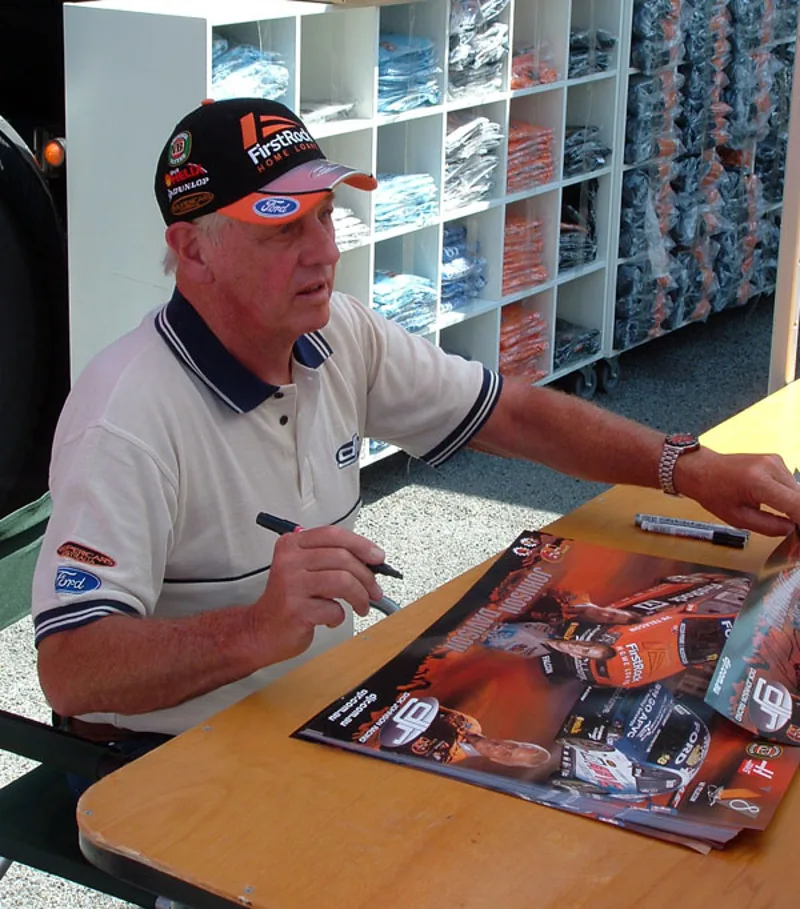
Australia saw a single meeting at Leppington, New South Wales, in 1969. Events then ran at Calder Park in Melbourne until the mid-1970s and at Catalina Park, Katoomba, from 1972 until the early 1980s, with Peter Brock doing well in a supercharged Holden Torana GTR for the Holden Dealer Team. Within a dozen or so years the sport had faded. The only Australian Rallycross Championship was held at Tailem Bend on 24 June 1979 and won by Larry Perkins in a 2.0-litre Volkswagen Beetle. A fresh national series, the Extreme Rallycross Championship, was planned for 2015 and 2016 but was cancelled after one event for lack of entries.
Estonia is thought to have staged the Soviet Union's first rallycross, in 1978.
Rallycross in the United States
In October 2009, Rally America announced it would sanction European-style rallycross in the United States. The 2010 RallyCar Rallycross Championship held four events, all at New Jersey Motorsports Park. The X Games added a closed-circuit rallycross that year under the name SuperRally, with heavily modified production cars: turbocharged engines at 600 hp, all-wheel drive, sequential gearboxes and suspension set up for long jumps.
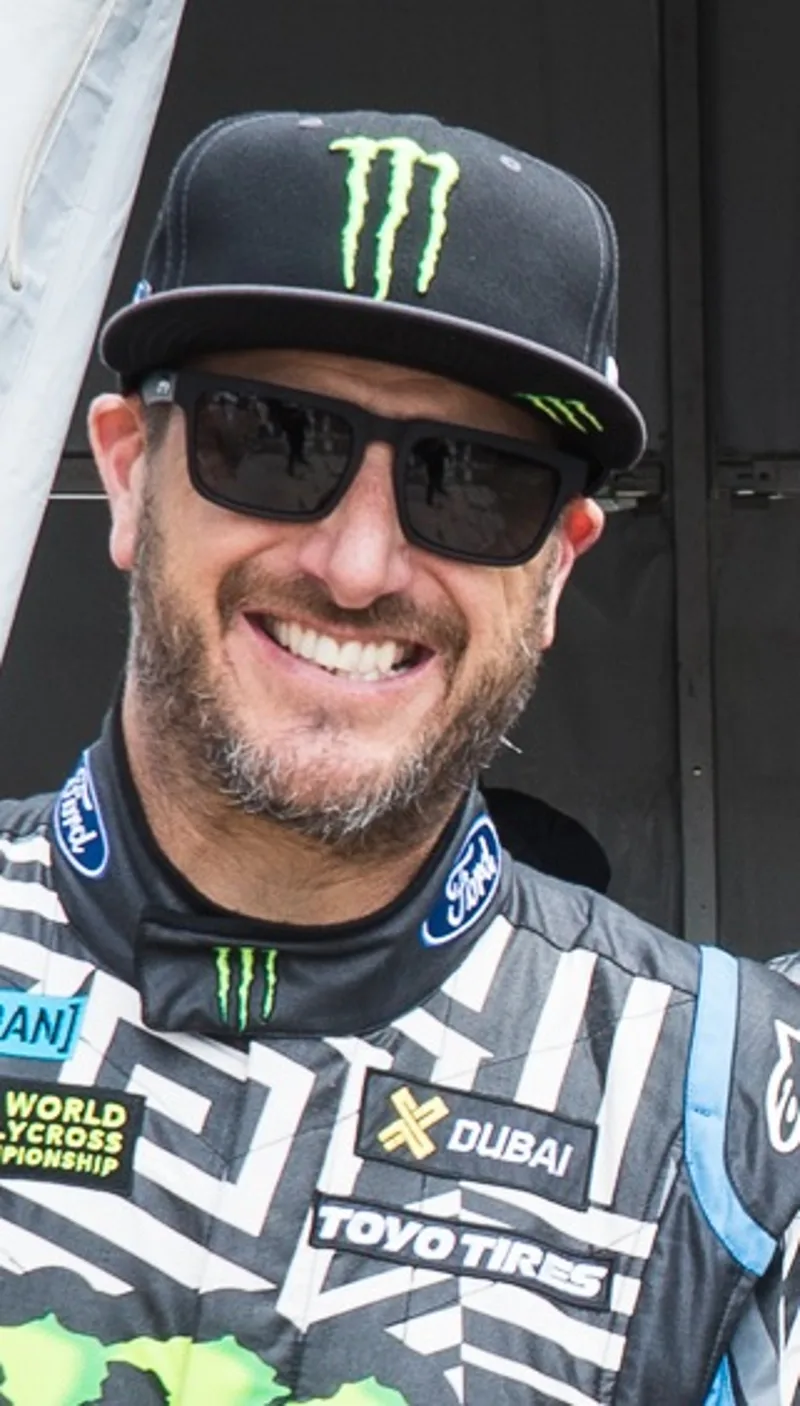
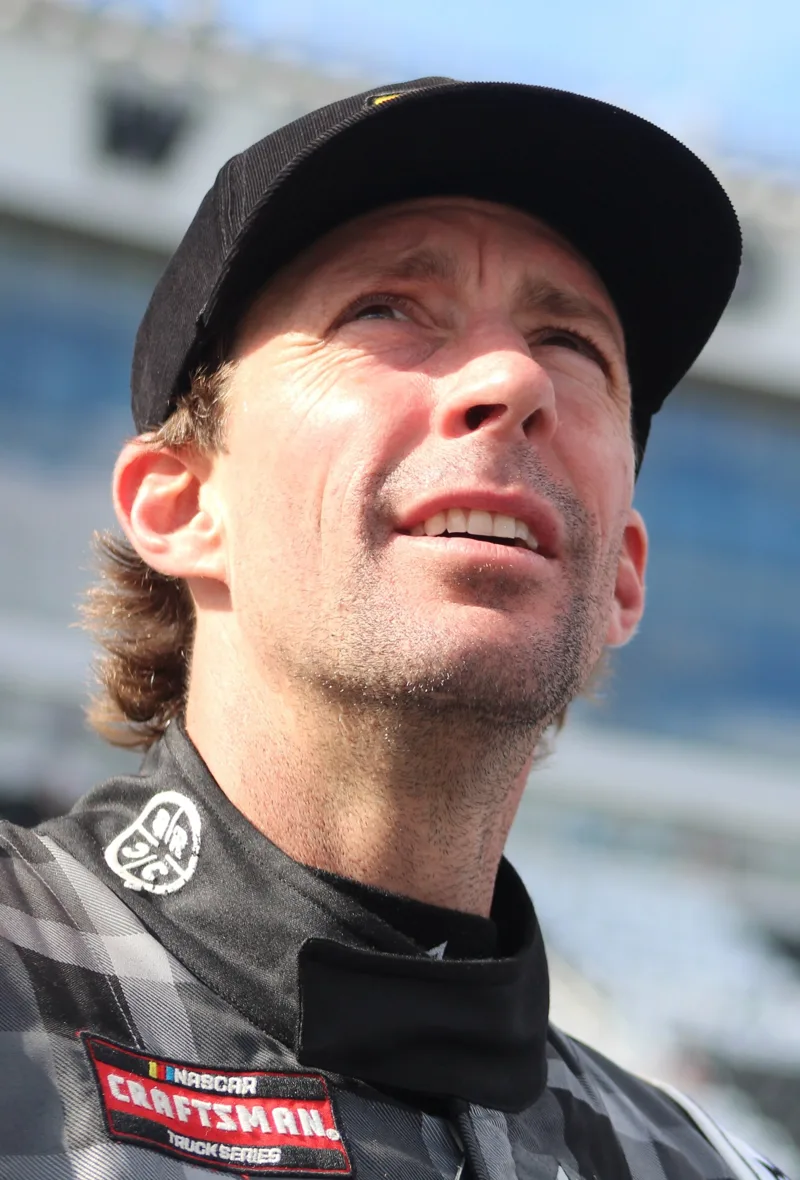
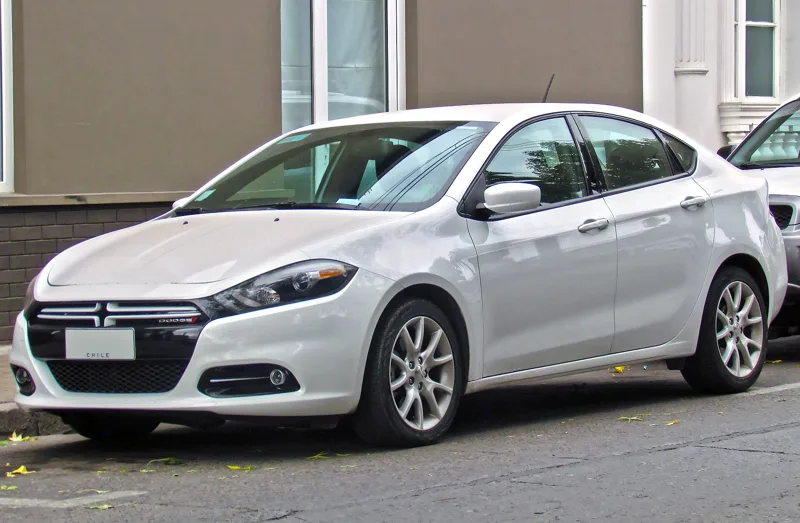
Red Bull sponsored the Global RallyCross Championship, which began in 2011 with five rounds and attracted drivers including Tanner Foust, Ken Block and Travis Pastrana, plus Marcus Gronholm and Rhys Millen. ESPN televised it, and in 2012 it grew to seven events, with factory or importer efforts from Ford, Hyundai, Subaru and Dodge. In 2013, at the age of 16, Mitchell deJong became the youngest to win an X Games silver medal on his first attempt, and in 2014 he became the youngest gold medallist at the Circuit of the Americas.
Not everything survived. The Americas Rallycross Championship began in 2018 but was cancelled after 2019 for lack of sponsors. Pastrana launched Nitrocross in 2021, and in October 2024 all its planned events were cancelled and the series paused indefinitely.
Rallycross vs rally: how a race works
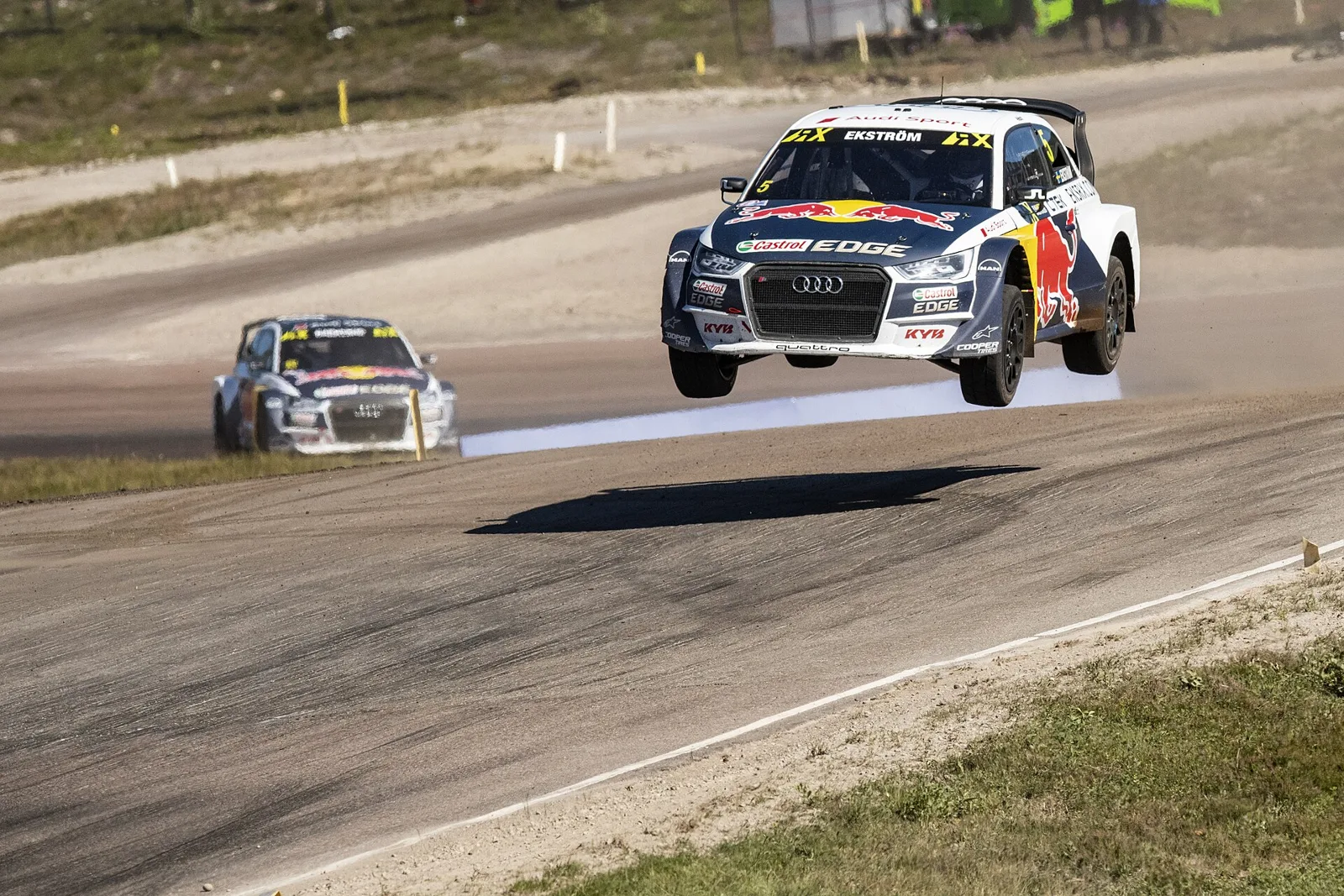
The difference starts with distance. A rally sends cars one at a time against the clock over many miles of road. Rallycross puts up to eight cars on the grid together, side by side, on a short circuit that mixes sealed asphalt with unsealed gravel or mud. Races last about three minutes, so there are few laps.
Events consist of heats whose total times form a classification. When there are many entrants, the results decide who advances to knock-out rounds and a final.
In many series, including the FIA World Rallycross Championship, every driver must complete a joker lap at least once. This is an extended section of the circuit, and it can separate or regroup the cars. It adds tactics: a driver with clear track ahead may drive faster instead of overtaking, but the point where they rejoin carries a risk of contact or a good scrap for position.
The sprint format changes how drivers think. There is little time to settle in or hold back to protect a lead, and no need to save tyres or engines, since there is usually time between heats for repairs and maintenance.
World Rallycross Championship: from 2014 to cancellation
The first FIA World Rallycross Championship, known as World RX or WRX, took place on 4 and 5 May 2014 alongside the FIA European Rallycross Championship. Petter Solberg, a former World Rally champion, became its first winner. The 2014 season had 12 events for the Supercar category, and the World RX name distinguished the series from the European Championship, which dates from 1976 and took its present name in March 2013.
The cars are heavily modified production bodyshells, either approved for Group A and Group N or listed by the FIA as permitted. Two classes ran in 2014: Supercar, later RX1, and RX Lites, later RX2, where every team raced identical cars from OlsbergsMSE.
The event format
A World RX meeting was a two-day event on a closed mixed-surface circuit, mostly asphalt and gravel. It began with four qualifying heats of three to five cars, each run over four laps including one joker lap. Points from those heats decided which 12 drivers reached the next round. Two semi-finals followed, with six cars over six laps (again including a joker lap), and the top three in each moved into the final. The final is also six cars over six laps, and its winner takes the event, though not necessarily the most championship points from the weekend.
Going electric
An electric class was originally planned for 2020 but delayed until 2021 to give manufacturers more time to join after the rules change. In its place, Projekt E ran in 2020 as a parallel series with a spec racer, unveiled in September 2019 in Latvia, at the Riga Motor Museum. It used electric powertrain kits from STARD and a Ford Fiesta bodyshell: the STARD ElectRX had three motors, all-wheel drive and a combined output of 450 kW (600 hp).
In August 2020 the FIA announced that RX2e would take over from RX2 for 2021. Olsbergs MSE and QEV Technologies jointly developed the car, which has a 250 kW powertrain. The top class, RX1e, was RX1 cars retrofitted with two 250 kW electric motors (equal to 680 horsepower) and a 52kWh performance battery from Kreisel Electric. In August 2022 the top series switched to electric RX1e cars, making World RX all-electric. Then in 2024 combustion-engined cars returned to the top level to race alongside the electric RX1e machines. RX2e itself ended after 2024.
The related Nitro Rallycross series, meanwhile, made the FC1-X electric car its premier class for 2022-23, after the car's debut at the 2022 Race of Champions.
Rallycross cars compared
| Class | Engine or motors | Power | Drive | Weight | 0-60 mph (0-97 km/h) |
|---|---|---|---|---|---|
| RX1 Supercar | 2.0 L turbocharged four-cylinder | 570-600 hp (430-450 kW) | Four-wheel drive | About 1,300 kg (2,900 lb) | Under 2 seconds |
| RX2 Supercar Lites | 2.4 L naturally aspirated Ford Duratec four | 310-320 hp (230-240 kW) | Four-wheel drive | Minimum 1,100 kg (2,400 lb) | - |
| RX3 (formerly Super 1600) | 1.6 L naturally aspirated four | 220-250 hp (160-190 kW) | Front-wheel drive | 920-1,000 kg (2,030-2,200 lb) | Just under 4.5 seconds |
| RX1e | Two electric motors | 680 hp (510 kW) | Four-wheel drive | 1,300-1,330 kg (2,870-2,930 lb) | 1.8 seconds |
What is inside an RX1 car?
The top-level combustion car runs a 2.0-litre turbocharged four-cylinder with a 45 mm (1.8 in) intake restrictor and 50 psi (3.4 bar) of boost. Torque is 620-680 lb ft (840-920 N m). Take the restrictor away and such engines could make about 1,000 hp (750 kW). Power goes through a Sadev 6-speed sequential gearbox, and launch control gets the car from 0 to 60 mph (0 to 97 km/h) in under 2 seconds, which is quicker than a Formula One car.
The RX1e uses two motors that each make 340 hp (250 kW) and 440 N m of torque, for a total of 680 hp and 880 N m of instant torque. Its 0-60 mph time of 1.8 seconds is a shade quicker than the combustion car's.
Where this goes next
The FIA World Rallycross Championship has ended. The series was cancelled in 2025 and replaced by the European Rallycross Championship for the 2026 season. Its promoters changed along the way: IMG Motorsport from 2014 to 2020, then Rallycross Promoter GmbH, a company Red Bull had set up with KW25, until it pulled out at the end of 2024. A tender for a new promoter followed, and in March 2025 the FIA confirmed it would promote the series itself. In 2025 there was one World Championship, for electric RX1e and combustion RX1 cars, plus two European championships, Euro RX1 and Euro RX3.
At national level, Motorsport UK runs the British Rallycross Championship, whose calendar takes in Lydden Hill, Pembrey, Mondello Park in Ireland and Loheac in France. RallyX, set up in 2014, has classes for supercars of both four-wheel and two-wheel drive as well as crosscars, and visits Montalegre in Portugal and Estering in Germany.
What rallycross means if you want to watch or race
Rallycross is built for spectators. The sprints are short, the cars are close, and the venues are compact enough that everything is in view. In Britain, Lydden Hill and Croft are still in use for rallycross more than half a century after the first broadcast. A joker lap makes the order on track different from the order on the clock, so it is worth following the timing as well as the cars.
For drivers, the figures show how the classes are stacked. The RX3 class, front-wheel drive with a 1.6-litre engine, makes 220-250 hp and reaches 0-60 mph in just under 4.5 seconds, while weighing between 920 kg and 1,000 kg. It sits well below the RX1 cars in power and traction, but it races on the same mix of asphalt and gravel.