An independent Le Mans winner in Gulf colours, Matra's Le Mans hat-trick and a 2-litre Chevron that kept racing into the 1980s.
The Mirage was a Gulf-sponsored British sports prototype family that won Le Mans in 1975. The Matra-Simca MS670 won the Le Mans 24 Hours in 1972, 1973 and 1974 before Matra quit racing. The Chevron B31 was a 2-litre sports prototype raced mostly by privateers from 1975.
The Mirage cars built by John Wyer Automotive Engineering never finished outside the top ten at Le Mans from 1974 to 1978, taking one win, two second places, a third, a fourth, a fifth and a tenth. With Rondeau, Mirage is one of only two independent marques to have won the 24 Hours outright since 1949. The Matra-Simca MS670 won Le Mans three years running from 1972, and the Chevron B31 spent most of a decade in the hands of private teams.
What was the Gulf Mirage?
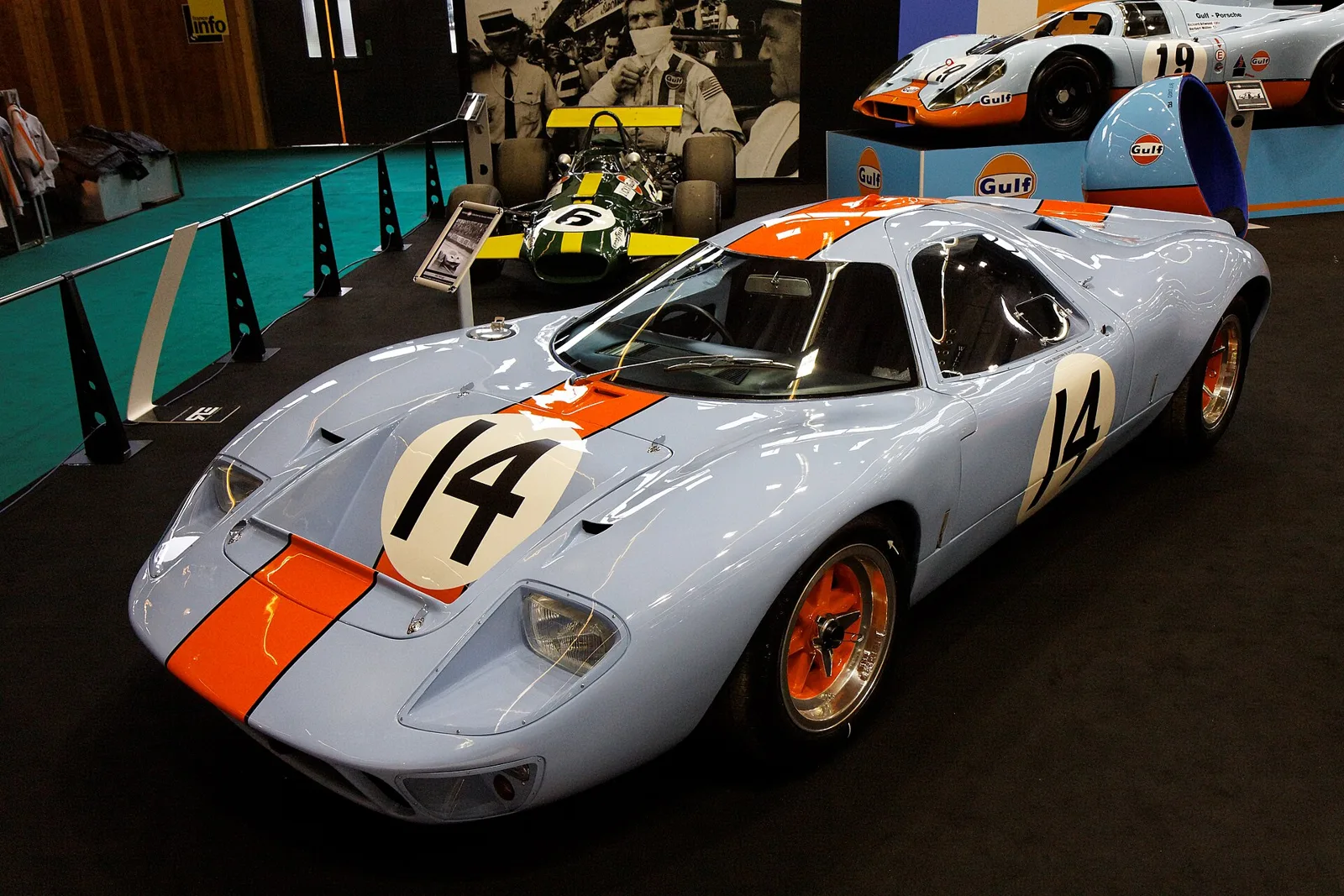
The Mirage was a family of race cars built by John Wyer Automotive Engineering, known as JWAE, at Slough in England. It was created to race in international sports car events in the colours of the Gulf Oil Corporation. Mirages were the first cars to wear Gulf's powder blue and marigold livery, the first to win races for Gulf, and the last to win Le Mans overall for the company.
The Mirage M1 of 1967
The project started in the spring of 1967, after Ford decided to stop developing the GT40. John Wyer bought an old Len Bailey project that aimed to improve the aerodynamics, weight and suspension of the Mk I, and the M1 first ran on 21 March 1967. At the preliminary tests for Le Mans, two cars that looked like GT40s in Gulf colours turned up. They were M1s. In the tests they did better than the GT40s, but both retired in the race.
The team felt the Mk I GT40 was reliable but too heavy and underpowered to take on the Ford and Ferrari battle and Jim Hall's Chaparrals, so JWAE reshaped the car. It kept a standard Mk I chassis but squared off the front bulkhead and fitted a sleeker body, mixing carbon fibre with fibreglass panels, a first in all of automotive racing. The engine began as a 289 V8, and by Le Mans it had been fitted in sizes up to 5.7 litres. The car was not ready for the first two rounds of the 1967 World Sportscar Championship, so Grady Davis's own GT40 was used instead, finishing 6th overall at Daytona and retiring at Sebring. When the Mirage did appear, its livery was powder blue and marigold, replacing the deep metallic blue.
The high point was the victory by Jacky Ickx and Dick Thompson in the rain-soaked 1967 Spa-Francorchamps 1000 km. There were other wins in Sweden, Paris and at Kyalami. After the 1967 season the FIA banned Group 6 cars of over 5 litres built in fewer than 50 production models, an attempt to stem soaring speeds and costs, and JWAE failed to persuade officials that the Mirage was really a modified GT40 eligible for Group 4. The M1 never raced in the championship again.
Three M1s were built. Chassis M10001 retired from every championship race in 1967 but won the Stockholm race at Skarpnack, a local event run largely as marketing for Gulf's Swedish arm, and the Kyalami 9 hours. It repeated the Kyalami win in 1968, then went to Malcolm Guthrie, who raced it with great success into the 1970s. It is the only M1 that survives in original form. M10002 was 32nd fastest at the Le Mans test days, took 9th at the Monza 1000 km, and was written off in practice at the Nurburgring after a crash into a stationary Ginetta. M10003 won at Spa, Karlskoga and Montlhery, the first victories for JWAE and the Mirage name. For 1968 it became a lightweight GT40, chassis P1074, which won at Monza that year and later carried cameras for the film Le Mans. Some claimed that M10002 was rebuilt as P1075, the car that won Le Mans in 1968 and 1969, but P1075 turned out to be a new chassis that received some parts from M10002.
Mirage M2 to M6
The M2 of 1968 was built for the new 3-litre Group 6 prototype class with a BRM V12, and it raced rarely and without success. The roofless M3 of 1969 used a Ford Cosworth DFV V8 and saw little use either, because JWAE was concentrating on the GT40. The M4 was a roadster combining an M3 chassis with a 5-litre Ford GT40 engine, abandoned when JWAE agreed to run the Porsche 917 in 1970. The M5 was a Formula Ford single-seater raced in the 1970 British season under the Willment banner.
After two seasons with the 917, JWAE returned in 1972 with the M6, a Ford Cosworth-powered Group 5 sports car for the World Championship for Makes. Big 5-litre cars like the 917 and Ferrari 512 had been banned at the end of 1971, leaving the field to 3-litre prototypes. Len Bailey designed it with a steel-reinforced riveted aluminium chassis, open fibreglass bodywork with a large rear wing, and a detuned 3-litre Cosworth DFV used as a stressed member. The first chassis was finished in March 1972 and raced at the Sebring 12 Hours.
The third chassis was used to test a Weslake V12, heavier, but it promised smoother running and more power than the Cosworth, which shook hard enough to cause many failures. The only M6 victory came at the 1973 Spa 1000 km. Most of the team's resources went into the Weslake engine, which proved no better, and the programme ended with four of the five chassis rebuilt as GR7s. A closed M6 Coupe with a 2995 cc Ford-Weslake V12 was planned for the 1973 Le Mans but was 16 seconds a lap slower than the Cosworth car, which ended the project.
Gulf GR7 and the Le Mans-winning GR8
The car was renamed the Gulf GR7 for 1974, reflecting the sponsorship Gulf had provided since 1967, and the "Gulf Ford" finished second in the 1974 World Championship for Makes.
In 1975 the GR8, driven by Jacky Ickx and Derek Bell, won the 24 Hours of Le Mans. The other car, with Vern Schuppan and Jean-Pierre Jaussaud, was third. The CSI later excluded that race from the World Championship for Makes because of new fuel consumption rules introduced after the oil crisis. Gulf and John Wyer then decided to withdraw from competition.
Mirage under Harley Cluxton: M8 to M12
The American entrepreneur and former driver Harley Cluxton III took over the team after Gulf stopped sponsoring international sports car racing in late 1975. Backed by JCB Excavators, Elf Lubricants and Renault Sport, with John Horsman still managing and Wyer advising, he ran two Mirage M8s at Le Mans. They finished second overall in 1976 with a Cosworth engine and in 1977 with a Renault engine, in each case behind Porsche's factory Martini 936s. Jean-Louis Lafosse and Francois Migault were second in 1976, and Vern Schuppan and Jean-Pierre Jarier second in 1977, when the 3-litre (180 cu in) Cosworth V8 gave way to a 2-litre (120 cu in) Renault turbo V6.
The M9 of 1978 had a new open long-tail body and a turbocharged 2.1-litre six-cylinder Renault engine. Two started at Le Mans, and one finished tenth. The 1979 M10 used an updated M8 chassis with a 3-litre Ford Cosworth DFV, and two were entered at Le Mans as Ford M10s. Neither finished.
The last Mirage was the M12, a Group C prototype with an aluminium honeycomb monocoque and a 3.9-litre Cosworth DFL engine, designed by John Horsman and built by Tiga. Mario Andretti and his son Michael were to drive it together for the first time at the 1982 Le Mans, but it was disqualified 20 minutes before the start for a technical infringement involving the position of an oil cooler. The ACO's decision caused much controversy, with many pointing to organisational politics. The M12 showed potential in Group C and IMSA GTP, but the programme was dropped after Le Mans. Two chassis were built, and one raced in IMSA GTP with modest results.
| Model | Year | Engine | Notable result |
|---|---|---|---|
| M1 | 1967 | 289 V8, up to 5.7 litres | Won the Spa 1000 km |
| M2 | 1968 | BRM V12 | Rarely raced |
| M3 | 1969 | Ford Cosworth DFV V8 | Little used |
| M6 | 1972 | Detuned 3-litre Cosworth DFV | Won the 1973 Spa 1000 km |
| GR7 | 1974 | Cosworth | Second in the Makes championship |
| GR8 | 1975 | Cosworth DFV V8 | Won Le Mans |
| M8 | 1976 | Cosworth, then Renault turbo V6 | Second at Le Mans in 1976 and 1977 |
| M9 | 1978 | 2.1-litre Renault turbo six | Tenth at Le Mans |
| M10 | 1979 | 3-litre Ford Cosworth DFV | Both cars retired at Le Mans |
| M12 | 1982 | 3.9-litre Cosworth DFL | Disqualified before the Le Mans start |
The Mirage IndyCar project
In the summer of 1982 Cluxton, then president of Grand Touring Cars, began talks with Renault about a Renault engine to race in CART and at the Indianapolis 500, a development of the two-litre turbo six that the GTC-Mirage had used in the GR8 Renault and M9. The target was the 1983 season, and candidates for the drive included Mario Andretti, Rick Mears, Tom Sneva and Geoff Brabham. The team reckoned the American regulations would make it a match for the Cosworth DFX, an eight-cylinder unit fitted to almost every car in the series. Reworked to the 2.65-litre limit, the French V6 was expected to deliver around 800 hp, in a lighter and smaller package and with better reliability.
Renault approved the project and provided engines, money and technical support from 1983 to 1985. It cut the funding at the end of 1985, when it left the American market by selling Renault USA and the AMC brand to Chrysler. The engine went into a Lola T900 from the Doug Shierson team, which Al Unser Jr. tested at Rattlesnake Raceway near Midland in West Texas, the private track of Chaparral Cars. The car ended up with a private collector.
Mirage is one of only two independent marques to win Le Mans overall since 1949; the other is Rondeau.
What was the Matra-Simca MS670?
Matra's MS670, introduced in 1972, was a Group 5 prototype built for the World Championship for Makes. It took over from the MS660C.
Matra MS670 at Le Mans in 1972
The MS670's only start in 1972 was at Le Mans, where Matra fielded four cars: Jean-Pierre Beltoise and Chris Amon in the older MS660C, Francois Cevert and Howden Ganley, Henri Pescarolo and Graham Hill, and Jean-Pierre Jabouille and David Hobbs. Hill and Pescarolo won by a lap from Cevert and Ganley. Beltoise and Amon retired with engine failure and Jabouille and Hobbs with a broken gearbox. Matra scored 20 points in the championship that year, seventh place.
The 1973 Matra MS670B season
The 1973 season began with a retirement for Cevert, Beltoise and Pescarolo at the Daytona 24 Hours, where an engine failed. The new MS670B then won the Vallelunga 6 Hours with Cevert, Pescarolo and Gerard Larrousse. Pescarolo and Larrousse won the Dijon 1000 km, with Cevert and Beltoise third. At Monza Pescarolo and Larrousse were third, and at Spa Pescarolo, Amon and Larrousse finished third. Matra skipped the Targa Florio, and both cars at the Nurburgring 1000 km retired with engine failure.
At Le Mans, Matra entered four cars again. Pescarolo and Larrousse won, Jabouille and Jaussaud were third, Cevert and Beltoise crashed after a puncture, and Patrick Depailler and Bob Wollek stopped with a failed oil pump and a failed engine. Pescarolo and Larrousse then won the Zeltweg 1000 km and the Watkins Glen 6 Hours. Matra scored one hundred and twenty-four points and finished first in the championship.
The 1974 season and Matra's withdrawal
For 1974 the new MS670C started with a Monza double retirement. Jarier and Ickx won at Spa, Beltoise and Jarier at the Nurburgring, and Pescarolo and Larrousse at Imola. Pescarolo and Larrousse won Le Mans again, with Jabouille and Migault third, while Beltoise and Jarier retired from the race in the new MS680. Later in the season Beltoise and Jarier won at Watkins Glen, Le Castellet and Brands Hatch, and Pescarolo and Larrousse won at Zeltweg and Kyalami. Matra scored one hundred and forty points and was first in the championship for the second year running, but at the end of the year the company pulled out of motor racing.
What was the Chevron B31?
Chevron Cars Ltd built the B31 in 1975 as a sports prototype for the European 2-Litre Championship, developing it from the Chevron B26. Its first engine was the 2-litre Hart 420R straight-four, rated at 294.0 PS (216.3 kW; 290 hp), though others were fitted over the years, including a 3-litre Cosworth DFV V8, 2-litre Cosworth FVD and BDG fours and the 2-litre BMW M12.
Chevron B31 design
Chevron's founder, Derek Bennett, designed the B31 in 1975, and six cars were built. It had subtle changes, notably slightly redesigned fibreglass bodywork, but the aluminium monocoque was the same as the B26's. The Hart 420R was a naturally aspirated, fuel-injected, 16-valve twin-cam four making 290 hp at 9500 rpm, driving the rear wheels through a Hewland five-speed manual gearbox.
At the front the car had double wishbones, coil springs over dampers and an anti-roll bar. The rear used single top links, twin lower links and twin trailing arms with coil springs, dampers and an anti-roll bar. Ventilated discs were fitted all round, and the steering was rack and pinion. Weighing 580 kg (1,279 lb), it produced exactly 0.5 hp per kilogram.
Chevron B31 racing history, 1975 to 1977
The B31's first race was the 1975 Mugello 1000 km, a World Championship for Makes round, where KVG Racing fielded John Hine and Ian Grob, and Team Italiano Chevron entered Eris Tondelli and Mauro Nesti with a 1.3-litre Cosworth engine in place of the Hart. The 1300 retired, but KVG won the Sports 2000 class and finished fifth overall. At the Dijon 800 km, KVG's was the only B31, and it took third overall and the class win. In Europe's 2-Litre Championship, Hine won the first heat at Brands Hatch, and at Hockenheim Martin Raymond of Team Fisons won the second heat and the event outright. Nothing bigger followed that season.
Nothing finished in the 1976 World Sportscar Championship. Engine failures, crashes, a gearbox and a halfshaft ended the B31s' races, and several cars entered did not even attend. Even so, B31s took a non-championship race and an Interserie race, both at Zolder, plus the Thruxton round of the British Sports Car Championship.
The 1977 season began the same way. A B31 finally finished a championship race again at the Monza 500 km, where Claudio Francisci and Giuseppe Fiaccadori were eighth overall and Ian Bracey and Tony Charnell won the Sports 1800 class. At Vallelunga Francisci was fourth overall and took the Sports 1600 honours. The 1977 Le Mans saw the first B31 at the race, a 2-litre Cosworth FVD car driven by Charnell, Bracey and Robin Smith, which retired after 21 laps with a fuel pump failure. At the Le Castellet 500 km, Jean-Pierre Jaussaud and Jacques Henry took a Chrysler-Simca-engined car to third overall and a class win.
Chevron B31 in the late 1970s and early 1980s
By 1978 the World Sportscar Championship had folded and the European Sportscar Championship replaced it. Raymond finished ninth at the Nurburgring 300 km, second in his class. At Le Mans, Charnell, Smith, Frederic Alliot and Richard Jones struggled and the 181 laps they completed were not enough to be classified. Their sixth place at the Pergusa Coppa Florio was the car's best result of the season in any championship.
In 1979, when the World Championship for Makes replaced the European series, the B31's best result was second place for Rolf Gotz's BMW M12-engined car in an Interserie round at the Nurburgring. Secondo Ridolfi and Roberto Marazzi won the Sports 1600 category at Monza's Italian Group 6 round. In 1980 Gotz and John Blanckley won the Sports 2000 category at the Nurburgring 1000 km, 15th overall. In 1981 the B31 was used less and less, and its best finish was Gotz's seventh overall in the Interserie at the Nurburgring. By 1982 it ran only in the Interserie, with all but one entry from Gotz.
How do the three sports prototypes compare?
| Mirage | Matra-Simca MS670 | Chevron B31 | |
|---|---|---|---|
| Builder | John Wyer Automotive Engineering | Matra | Chevron Cars Ltd |
| Class | Prototypes and sports cars, 1967 to 1982 | Group 5 prototype, 1972 to 1974 | 2-litre sports prototype, from 1975 |
| Le Mans | Won in 1975 with the GR8 | Won in 1972, 1973 and 1974 | Did not finish in 1977; unclassified in 1978 |
| Championship | Second in 1974 Makes | First in 1973 and 1974 | Class wins in Sports 2000 and Sports 1600 |
How did the Mirage, Matra and Chevron programmes end?
All three stories end in the early 1980s or sooner. Matra pulled out of motor racing at the end of 1974. The Mirage programme was aborted after Le Mans in 1982, and that same year the B31 raced only in the Interserie championship, almost always in the hands of Rolf Gotz.