Porsche's only Formula One win came from a flat-eight it never sold in a road car; here is how that engine, monobloc castings and exhaust-recovery turbines work.
A flat-eight has eight cylinders in two opposed banks of four. A monobloc engine casts major parts such as the head, block or crankcase as one unit. A turbo-compound engine uses an exhaust turbine to return power to the crankshaft, as in the Wright R-3350 and some modern truck diesels.
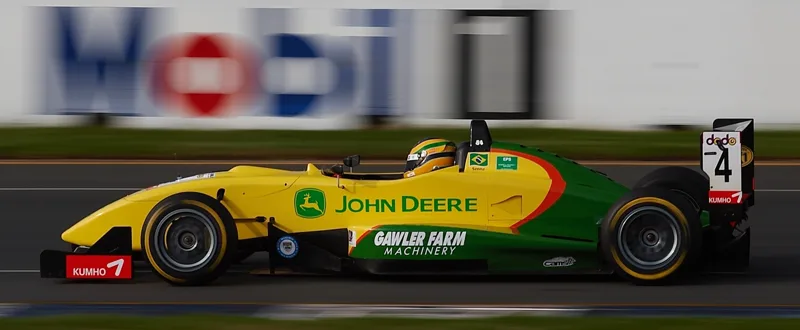
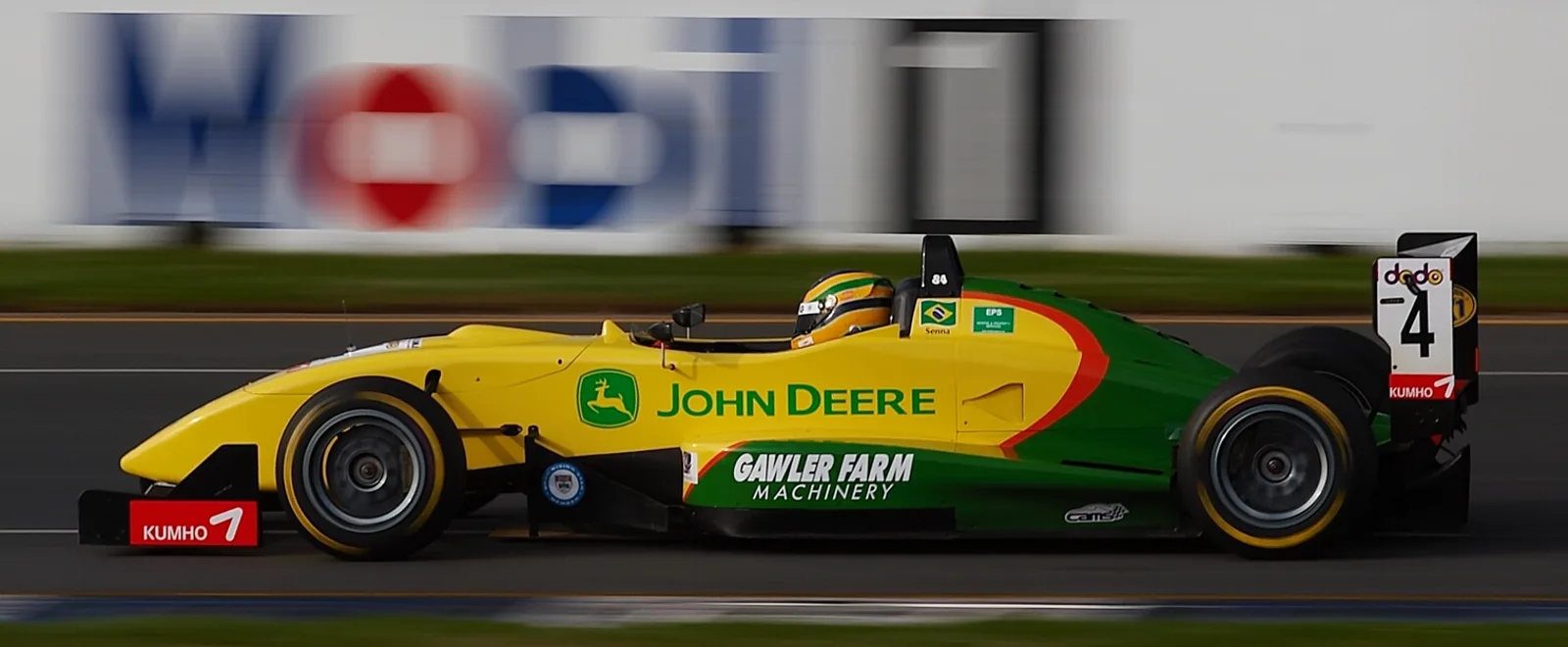
Porsche won a Formula One grand prix in 1962 with a flat-eight engine, in a car driven by Dan Gurney, and it remains the company's only win as a constructor. Porsche then never put a flat-eight into a road car. It is one of three engine designs, with turbo-compounding and monobloc construction, that most drivers will never meet, yet each one is still shaping engines somewhere today.
Flat-eight engine: how it works and why it is rare
A flat-eight engine, also called a horizontally opposed eight, has eight cylinders in two banks of four, with a bank either side of the central crankshaft and 180 degrees between them. It is short and sits low, but it is wide, which is why it is hard to package in most cars.
There are two ways to build one. In a plain flat-eight, a piston from each bank can share a crankshaft journal. In a boxer-eight, every piston rod gets its own journal, so each facing pair travels in towards the crank, or out away from it, together, rather like two hands clapping. Give a boxer-eight nine main bearings and it can be pictured as two boxer-fours laid end to end with the crankshafts a quarter turn out of step, 90 degrees apart. The shared-journal type is sometimes labelled a 180 degree V, and uses either a two-plane crankshaft or a single-plane crank with the end crankpins in one position and the two central ones in the opposite position.
The attractions are length and height: a flat-eight is minimal in length and has a low centre of mass. The drawback is width compared with a V8 or a straight-eight. Both primary and secondary balance can be perfect, which means very little vibration.
Porsche won a grand prix with a flat-eight in 1962, then never sold one in a road car.
Porsche flat-eight engine: Type 753, 771 and 908
Porsche raced flat-eights across the 1960s. The first was the Type 753, started in 1960 after a 1.5 L (92 cu in) capacity limit was announced for the 1961 Formula One season. Hans Mezger and Hans Honich gave it double overhead camshafts driven by shafts, a magnesium crankcase cast in two pieces, eight separate finned barrels, a one-piece crankshaft carried on nine main bearings and Lucas electronic ignition. The version that made its debut at the 1962 Dutch Grand Prix produced 138 kW (185 hp), and at the French Grand Prix that year it took Gurney's win in the 804. The 753 also influenced the flat-six of the first-generation 911.
A 2.0 L (122 cu in) version, the Type 771, was built alongside for sports car and endurance racing. It powered the Porsche 718 W-RS, 904/8, 906, 907, 909 and 910 between 1962 and 1968, and a 2.2 L (134 cu in) enlargement became the Type 771/1.
The Type 908 of 1968, in the Porsche 908 of Group 6, was a fresh design. It was not based on the 771 but on the Type 916 flat-six racing engine with two extra cylinders. Porsche also put 908 engines in two 914/8 mid-engined road cars. The head of the racing department built the first as a concept study, and the second was a present for the company chairman's 60th birthday.
The nearest Porsche came to a production flat-eight was a prototype from the late 1960s and early 1970s. Volkswagen had asked Porsche to develop Project EA266, a Beetle replacement driven by a water-cooled four-cylinder in-line engine that sat lengthways under the rear seat with its cylinders lying flat. Porsche explored using that chassis as the basis of a mid-engined 911 replacement, the Typ 1966, and built a water-cooled flat-eight prototype for it. Volkswagen then cancelled EA266, and every record of the Typ 1966 was destroyed, the prototype engine included.
Other flat-eights, from 1904 to the Runge Hetzer
One of the earliest flat-eights was in the 1904 Buffum Model G Greyhound, an American racing car with an engine made by joining two existing Buffum flat-fours. It followed the Winton Bullet No. 2, which used a straight-eight, by a year, and at about that time the first V8s were beginning to appear in Europe.
Racing specials have often taken two inline-fours and given them a custom crankshaft. Scotland's Anderson Specials Number 2 of 1928, built from two Humber 9/20 engines, now sits in Glasgow's Kelvingrove Art Gallery and Museum. In 1977 Bruce Crower raced an Eagle 72 chassis in the United States, using cylinder heads taken from a pair of Chevrolet Cosworth Vega engines. In 1969 a one-off was made for Emerson Fittipaldi to use in the Thousand Miles of Guanabara endurance race, bolting two 1.3 L Volkswagen flat-four crankcases together with a rubbery elastomeric gasket between them and coupling the crankshafts. Similar engines followed for his racing cars in the early 1970s.
The latest is the Runge Hetzer, an air-cooled 5.3 L flat-eight announced by Runge Cars in 2025. It was designed for the ultra-lightweight, mid-engined Runge R3 supercar, and also fits directly into air-cooled Porsche 911 platforms.
Monobloc engine: casting more of the engine in one piece
A monobloc engine has major parts, the cylinder head, cylinder block or crankcase, cast as a single unit rather than bolted together later. Doing so makes the structure stiffer and the seals between the parts more reliable. The technique dates back to the earliest internal combustion engines, and the word has meant different things at different times, always aimed at the most pressing mechanical problem of the day.
Four distinct uses have been recorded: the cylinder head cast with the cylinder, the cylinder block, the block with the crankcase, and a combined crankcase, cylinder and head. Where a monobloc approach later became normal, the specific name fell out of use. Monobloc cylinders and crankcases are now routine, while a monobloc head on a water-cooled inline engine would be thought peculiar and obsolescent.
The monobloc cylinder head
No seal in an engine works harder while standing still than the head gasket, and in the early years it caused plenty of trouble. A monobloc head makes the cylinder and head one piece, so no seal is needed. It also helped with another weak spot of early petrol engines, the exhaust valve, which tended to burn out from overheating. With no gasket joint, the water jacket could run unbroken around head and cylinder.
The catch was access. Reaching the inside of the combustion chamber is awkward, and the regular job of de-coking and regrinding the valve seats meant a mechanic had to pull the pistons, connecting rods and crankshaft out from below instead of lifting the head off. Side-valve engines solved part of it with a screwed plug above each valve, with tapered threads for a tight seal, but the plug was hard to cool. Some makers put the spark plug inside the plug, which kept the space in use but moved the spark away from the combustion chamber, producing a long flame path and slower ignition.
After the First World War the monobloc head became less common. The Leyland Eight of 1920 kept it, and Bentley and Bugatti were among the racing marques that stayed loyal throughout the 1920s and on into the 1930s. The American Offenhauser straight-four racing engines of the 1930s used them too. Aircraft engines turned to high supercharging pressures that stressed head gaskets, so Rolls-Royce gave the Buzzard monobloc heads to keep it dependable. The last widespread users were large air-cooled radial aircraft engines such as the Wasp Major. Once gaskets could handle higher heat and pressure, the monobloc head went out of use, though a Japanese maker of model engines, Saito Seisakusho, adopted it, and monobloc cylinders still appear on small two-stroke garden tools.
Cylinder block, crankcase and the Honda uniblock
Early foundries could cast either big castings or intricate ones with the complicated cores that water jackets need, but not both at once. Engines with more than four cylinders were therefore usually cast as pairs or triplets and bolted to one crankcase. As techniques improved, a single block holding four, six or even eight cylinders became possible. That was simpler and cheaper, and a shared water jacket let the cylinders sit closer together. It also made the engine stiffer against bending and against the twisting that matters more as an engine gets longer.
V engines largely stayed with one block per bank, because the inlet ducting between the banks was too complicated to cast any other way. Pierce-Arrow's V12 used identical castings for left and right to save money, and a few rare designs, among them the narrow-angle Lancia V12 of 1919, put both banks in one block.
Cadillac's 1936 Series 60 brought the idea to a mid-priced car. Its 322 cu in (5.3 L) monobloc had cylinders and crankcase in one casting and hydraulic valve lifters for durability. It was designed as the company's next-generation engine at lower cost than the 353 and the Cadillac V16, and it allowed the mid-priced Series 60 line to exist. Casting the cylinders and crankcase together also stiffened the engine, cut vibration and allowed higher speeds, and most engines now combine crankcase and block, except some V engines.
The extreme case is Honda's GC family of light-duty engines. Honda calls its design a uniblock: the head, the block and half the crankcase share one casting, which lowers the engine height and the cost. It works because the engine is air-cooled and has no hollow spaces for liquid cooling, and the valves stand vertical so that the engine can be assembled in the cramped space. Even simple repairs take so long that the engine is effectively a throwaway. Honda's commercial GX family has a more traditional cylinder-and-crankcase casting topped by a separate head.
Turbo-compound engine: getting power back from the exhaust
A turbo-compound engine is a piston engine in which a turbine takes energy from the exhaust gas and feeds it back to the crankshaft as mechanical power. A turbocharger uses exhaust energy only to push air into the engine. Turbo-compounding adds the recovered energy to the engine's own output, which increases power or lowers fuel use for the same power.
Think of a waterwheel placed in the outflow from a mill. The mill has already done its job, but the water leaving it still carries energy, and the wheel puts some of that to work.
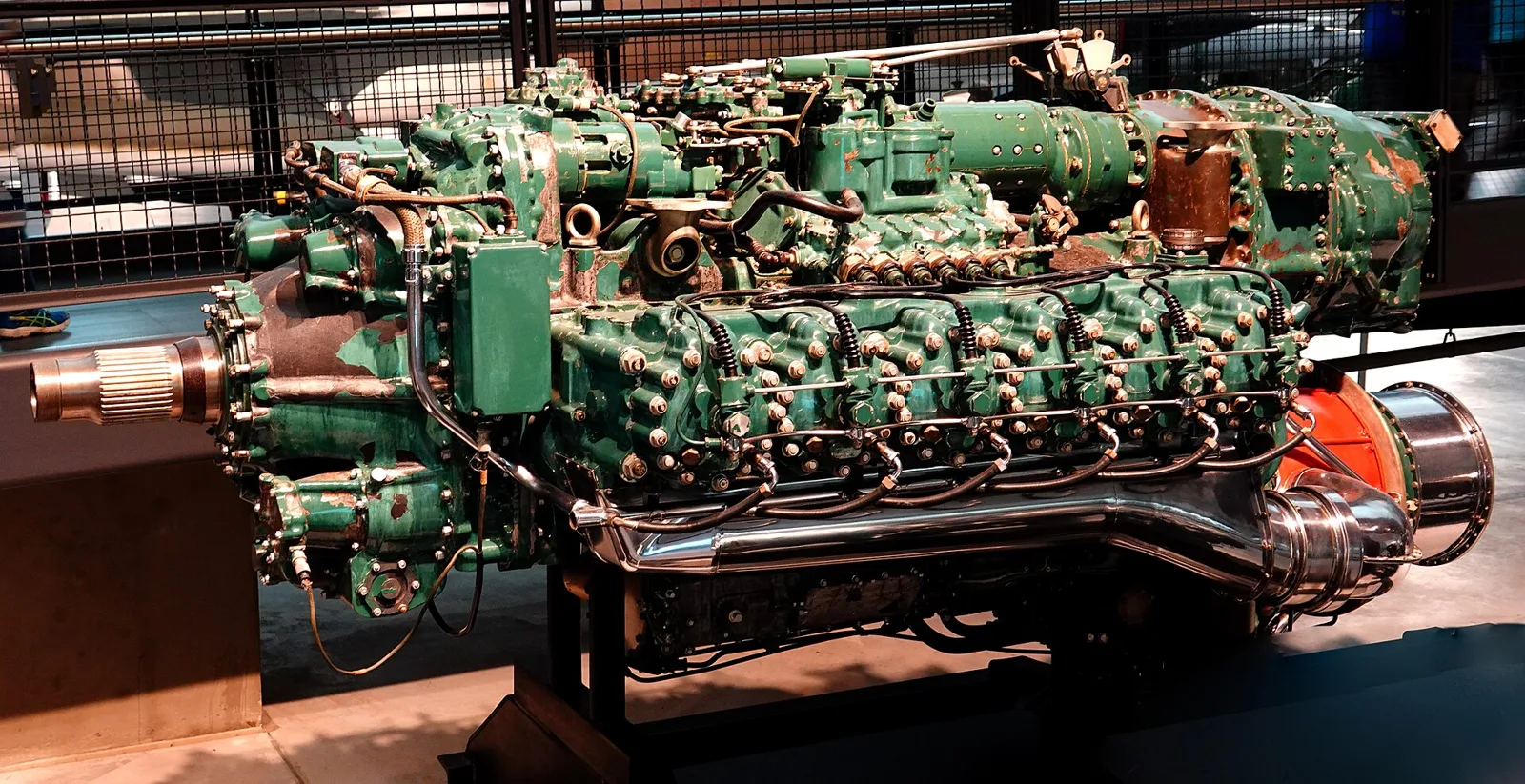
The best-known examples are aircraft engines. Wright's R-3350 Duplex-Cyclone used three blowdown turbines, each driven by the exhaust of six cylinders, which sent power to the crankshaft using shafts, bevel gearing and fluid couplings. Against a similar R-3350 without compounding, the system added about 240 hp (180 kW) in cruising settings and about 550 hp (410 kW) at take-off. On the Napier Nomad the exhaust spun a three-stage turbine at the back of the engine, linked to the compressor and, by a fluid coupling of variable speed, to the crankshaft: at low power the crank drove the compressor, and at higher power the turbine fed surplus power back. The turbo-compound R-3350 was the sole turbo-compound aero engine ever built in quantity, and it powered airliners such as the Douglas DC-7 and the Lockheed L-1049 Super Constellation and L-1649 Starliner. Rolls-Royce investigated the idea on its Crecy engine, projecting a fuel-economy advantage of 15 to 35 percent over the Merlin. Later turboprop and turbojet engines replaced all of them.
Turbo-compounding in lorries and Formula One
The idea survives on the road in heavy trucks. Examples include the Volvo D13TC, the Detroit Diesel DD15 and Scania's 11 L DTC1101 as used in the R113.400.
Formula One has an electrical version. Since 2014 the cars have used 1.6 L turbocharged V6 hybrid power units, and these include an MGU-H, which the FIA defines as an electrical machine connected to the exhaust turbine in the pressure-charging system. It takes energy from the turbocharger that exhaust gas drives and turns it into electricity, which can be stored, used to power the MGU-K that is linked to the drivetrain, or used to manage turbocharger speed and cut turbo lag. Examples are the Ferrari 059/3 in the F14 T, the Renault Energy F1-2014, the Mercedes-Benz PU106A Hybrid and the Honda RA615H in the McLaren Honda MP4-30.
| Design | Core idea | Best-known users | Status |
|---|---|---|---|
| Flat-eight | Two banks of four cylinders, 180 degrees apart | Porsche Type 753, 771 and 908; Buffum Model G Greyhound | Racing and special builds; Runge Hetzer announced in 2025 |
| Monobloc | Major parts cast as a single unit | Leyland Eight, Offenhauser, 1936 Series 60, Honda GC | Block and crankcase now standard; monobloc head rare |
| Turbo-compound | Turbine returns exhaust energy to the crankshaft | Wright R-3350, Napier Nomad, Volvo D13TC, Scania DTC1101 | Used in heavy trucks; electric form in F1 power units |
What these designs mean if you drive or buy
You will not find a flat-eight in a showroom. Porsche never sold one, and the Runge Hetzer is the only recent one announced, as a bolt-in for air-cooled 911 platforms. The monobloc you do meet is the cast block and crankcase in nearly every modern engine, plus the Honda GC uniblock, where basic repairs are slow enough that the engine is practically disposable. And turbo-compounding is something you can find in a modern heavy truck engine such as the Volvo D13TC or Scania DTC1101.
Where these designs stand now
Few of the early experiments went beyond the prototype. The Napier Deltic, Rolls-Royce Crecy and Allison V-1710 all had compound versions built, none of which got beyond the prototype stage, and a turbo-compound Rolls-Royce Griffon stayed a paper project. The flat-eight has one new entry, in Runge Cars' 2025 announcement of the Hetzer for its R3 supercar. The monobloc head, once the answer to a leaking head gasket, is almost unknown today.