A plastic engine that raced, a disc that wobbles, two cylinders sharing one chamber: four ideas that never reached the mainstream.
The plastic automotive engine, nutating disc engine, split-single engine and axial engine are unconventional designs built for lightness, compactness or simplicity. Each ran in prototypes or limited production, but cost, weight, funding or competing engines kept all four away from the mainstream.
The first plastic pistons Matti Holtzberg put into an Austin Mini engine in 1969 lasted 20 minutes before they failed. By 1985 a race car with a largely plastic engine was finishing third in its class at Lime Rock. The same engineer took a polymer engine from a failed piston to a class podium and then to the edge of a revival that never happened.
That arc, a promising design that works in a prototype or a race and then fails to reach the road, describes the four unconventional engines covered below: the plastic automotive engine, the nutating disc engine, the split-single engine and the axial engine. None became the engine in your car.
The plastic automotive engine
The plastic automotive engine grew out of research in the late 1970s by Matthew (Matti) Holtzberg of Polimotor Research. After those 1969 pistons failed, Holtzberg fitted aluminium crowns to polymer pistons and sold them to racing builders in the early 1970s. In 1979 he founded Polimotor Research in Fair Lawn, New Jersey, which went on to build and race engines made largely of polymers in the 1980s.
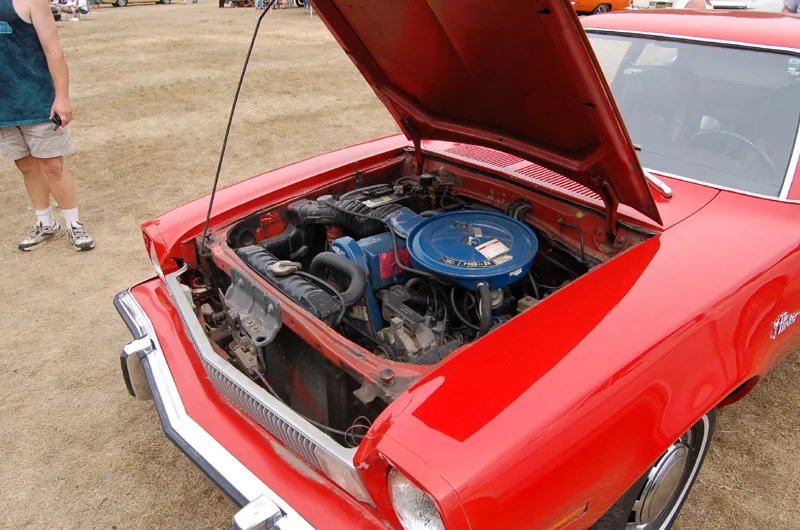
Version one started from Ford's 2.3-litre Pinto engine. It weighed 69 kg (152 pounds), against 188 kg (415 pounds) for the cast iron original, and was designed to make 237 kW (318 hp) at 9,200 rpm. The cylinder sleeves, combustion chamber tops, piston crowns, bearings, valves and crankshaft stayed metal. Nearly everything else, including the block, rods and piston skirts, was glass-reinforced polyamide-imide resin from Amoco Chemicals. The engine was never fitted to a vehicle. Reports said Ford was a partner, but Holtzberg later said the company was not involved at all.
Version two, reportedly based on the Cosworth BDA and YB engines, weighed 76 kg (168 pounds), half the weight of the metal equivalent. Its plastic parts included the block, cam cover, intake trumpets, valve stems, piston skirts, connecting rods and timing gears. It was raced in a Lola T616 in the IMSA Camel GT Championship's Camel Lights class in 1984 and 1985, and it took a class third in the 1985 Lime Rock two-hour race.
A plastic engine raced in 1984 and 1985, a disc engine wobbled and a split-single shared one chamber, yet none reached the mainstream.
Plastic engine patents and later projects
Between 1983 and 1988 Holtzberg was awarded 10 patents covering composite engine components. Most covered polyamide-imide components, with graphite, glass or titanium reinforcement possible. They are claimed to be stiffer for their weight, up to 70% lighter than the parts they replace, and cheaper to finish because they are injection moulded. The process is to mould the part, cool it, then post-cure it by solid-state polymerisation in an inert atmosphere, which also raises its heat deflection temperature.
Composite Castings, which Holtzberg founded in 1990, is based in West Palm Beach, Florida, and had developed by 2011 a V4 engine block in carbon-reinforced epoxy, using material from Toho Tenax. Holtzberg claims it is up to 50% lighter than an aluminium equivalent and that tooling and production costs are 50% below those of die casting. In April 2015 the Fraunhofer group and Sumitomo Bakelite announced a single-cylinder research engine with an injection-moulded casing in glass-fibre-reinforced phenolic resin, about 20% lighter than aluminium, with metal inserts at points of high heat and stress. It was shown at the 2015 Hannover Messe.
That May, Belgian chemical company Solvay was reported to be interested in reviving Polimotor with Holtzberg's help. The new engine was planned to weigh under 67 kg (148 pounds), make over 310 kW (420 hp) and be turbocharged. It was to go in a Norma M-20 chassis for Lime Rock in 2016 and possibly Le Mans in 2017. That did not happen.
The nutating disc engine
A nutating disc engine has fundamentally one moving part and drives the crankshaft directly. The disc does not spin; it wobbles, or nutates, on a Z-shaped shaft, with its edge tracing part of a sphere. One part of the disc handles intake and compression, another seals against the casing, and the rest handles expansion and exhaust. Compressed air passes to an external accumulator and then to an external combustion chamber before reaching the power side of the disc. That arrangement lets small versions burn diesel fuel, which is why unmanned aircraft are an attractive application. The power strokes overlap, and power goes straight to the shaft with none of the linkage a piston engine needs to turn straight-line motion into rotation. Because the disc does not rotate, seal speeds are lower than in a piston engine, though the total seal length is long enough to cancel out some of that advantage.
US patent number 5,251,594, awarded in 1993 to Leonard Meyer of Illinois, covers a nutating internal combustion disc engine said to run on petrol, heavy fuels and hydrogen. A single prototype has managed a short run on its own power, matching the power-to-weight ratio of a typical four-stroke. The developers' technical evaluation said a production version for unmanned aircraft might reach 2.7 kW/kg (1.6 hp/lb), slightly better than current car engines. A separate company, McMaster Motor, was working on a nutating motor burning hydrogen and oxygen that it said would deliver 200 hp at one-tenth the weight of a conventional engine. It said it had spent at least $10 million, and planned a coffee-can-sized version for wheel hubs.
The history of the nutating disc engine
The concept is far older than the 1993 patent, which cited no reference to the original. Two Derbyshire mill owners, Edward and James Dakeyne of Darley Dale, designed a water engine in the 1820s, nicknamed The Romping Lion, to exploit the pressurised water by their mill. Its patent came in 1830, it weighed 7 tons and it produced 35 horsepower from a head of 96 feet of water. A later writer remarked that those who tried to describe it produced accounts of monumental incomprehensibility.
George Davies and Henry Taylor patented a steam version in 1836, and in 1839 the rights passed to the Birmingham Patent Disc Engine company. By February 1841 it had completed 26 engines, with more totalling 260 horsepower in progress and 500 horsepower on order, in sizes from 5 to 30 horsepower. A 12 hp example raised a 1-ton load 180 feet in a minute at a Dudley mine. Prices ran from 96 pounds for 8 hp to 300 pounds for 30 hp. Disc engines also drove canal craft. In 1843 Davies built an iron tug with a 16 hp engine, and the Birmingham and Liverpool Junction Canal ordered six, but nobody had planned how a train of barges would pass the locks, and the tugs were pulled from service in 1845. The company collapsed in 1844. During later legal proceedings it was said the disc engine had never made a profit.
George Daniell Bishopp, a former locomotive engineer, had his first engine built in 1840 and patented a design in 1845. A Bishopp engine ran the printing presses of the Times and was shown at the Great Exhibition of 1851, and another powered HMS Minx. In 1855 The Mechanics' Magazine listed the disc engine's advantages: perhaps half the weight of a conventional steam engine, up to 18% better fuel economy and the ability to run at high speed without gearing. Disc engines still fell out of use, because modern high-speed steam engines were small, light and could be compounded, and did not need the same manufacturing precision. The same geometry lives on in the nutating disc water meter, likely the most common flowmeter anywhere; it is claimed to be in more than half the domestic water meters in the US and Europe.
The split-single engine
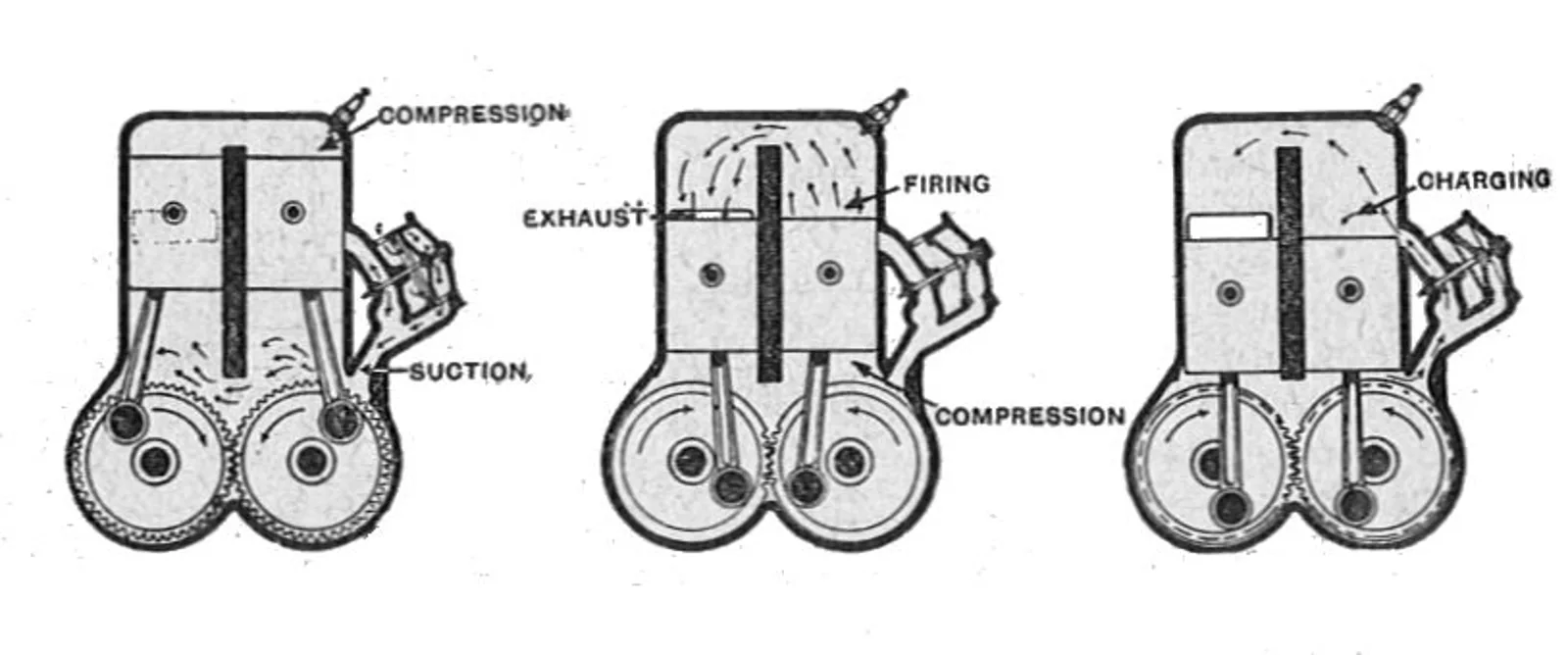
A split-single, called a twingle in American English, is a two-stroke engine in which two cylinders share one combustion chamber. The first was the Lucas, built in Britain in 1905, with two geared crankshafts that gave perfect primary balance. The first production engine appeared in 1908, and the layout appeared in motorcycles and cars through the mid-1950s, while Puch kept building it until 1970.
The benefit is better scavenging of exhaust with less loss of fresh mixture, which brings better economy and smoother running at small throttle openings. The cost is size, weight and price. For only a marginal gain over a single cylinder, a split-single is bigger and dearer, and a conventional two-cylinder engine costs about the same and uses space more efficiently.
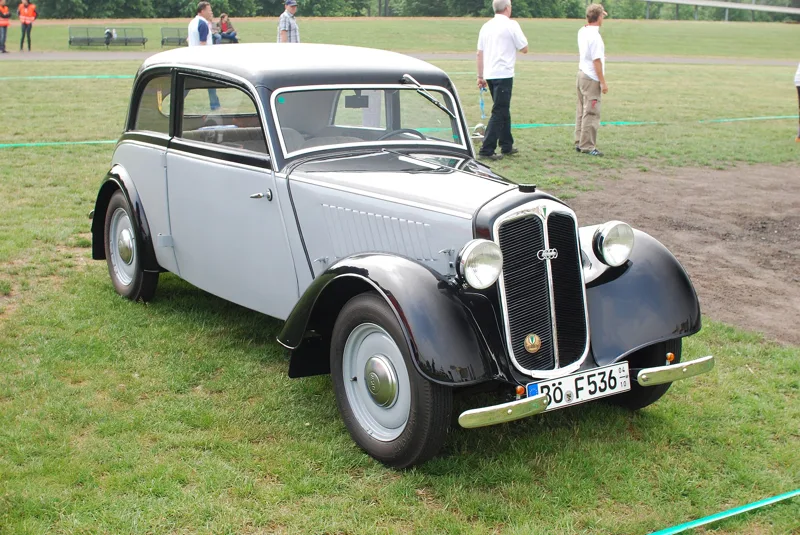
Adalberto Garelli patented one in 1911 to 1914 and built a 350 cc (21 cubic inch) motorcycle engine from 1918 to 1926. The Trojan car, from 1913, used an independently invented unit that would now be called a split-single; UK tax horsepower rules gave it a lower road tax than a conventional engine of similar size. Puch's version debuted in the 1923 Puch LM, and a supercharged split-single won the 1931 German Grand Prix. DKW split-single racing motorcycles dominated the Lightweight and Junior classes from 1931 to 1939. Leon Duray entered cars with a 16-cylinder split-cylinder engine at the 1931 and 1932 Indianapolis 500, and the 1935 Monaco-Trossi Grand Prix car had a 16-cylinder radial built the same way.
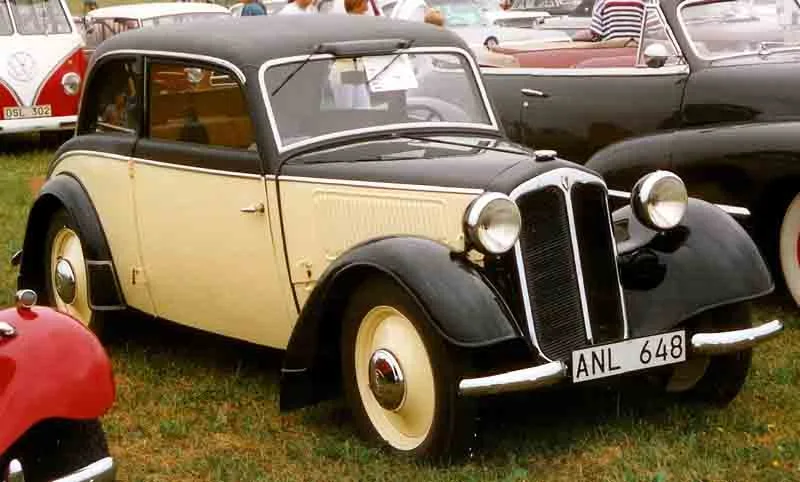
After the war, improved mechanisms tamed the old problems of oil and plug fouling. The Puch 250 SGS, built from 1953 and which Sears sold in America as the Allstate 250 and the Twingle, put the carburettor in front of the barrel. In all 38,584 were made by 1970. Iso fitted a 236 cc split-single to its Isetta bubble car from 1953 to 1956. Triumph-Werke Nurnberg built them until all motorcycle production ended in 1957, and a four-piston Duplex shown in 1953 never entered production.
The axial engine
An axial engine, sometimes called a barrel or Z-crank engine, arranges its pistons round the output shaft with their axes parallel to it. A swashplate or wobble plate converts piston motion to rotation, and the Rand cam engine uses a sinusoidal cam instead. The attraction is compactness. The cylinders sit parallel to the shaft rather than at right angles as in radial and inline engines, the compression ratio can in principle vary while running, and piston side-forces that cause wear can almost be eliminated. The small-end bearing, a troublesome part of a traditional engine, disappears. Making one work at normal engine speeds is hard. Some cam engines tested have been the size of a 150 mm cube yet produced about 40 horsepower at around 7,000 rpm.
In 1911 the Macomber company marketed one of the first axial engines, a seven-cylinder air-cooled unit that reportedly produced 50 hp at 1,000 rpm and weighed 100 kg (230 pounds). Pioneer aviator Charles Francis Walsh flew a Macomber-powered aircraft that May. Swiss firm Statax introduced a swashplate design in 1913, but only a single prototype survives at the Science Museum, London. Anthony Michell obtained patents in 1917 and set up the Crankless Engines Company in Fitzroy, Australia, building prototype pumps, compressors, car engines and aero engines. His largest, the XB-4070, was a diesel aircraft engine with 18 pistons rated at 2,000 horsepower.
John O. Almen's water-cooled 18-cylinder A-4 passed United States Army Air Corps acceptance tests in the mid-1920s, rated at 317 kW (425 hp) and weighing just 340 kg (749 pounds). It never entered production, reportedly because of limited funds and the Air Corps' growing preference for air-cooled radials. Charles Redrup's Bristol Axial Engine, from the mid-1930s, was a 7-litre nine-cylinder wobble-plate unit conceived for buses, where its compact shape could sit beneath the floor. The RR4 version produced 145 hp at 2,900 rpm, but development stopped in 1936 after a change of management. John Wooler's six-cylinder engine of 1947, with 12 opposed pistons and two wobble plates, survives as a single example at the Science Museum.
The four unusual engines compared
| Engine | Defining feature | Best-known example | Outcome |
|---|---|---|---|
| Plastic | Block, rods and skirts made of polymers | Polimotor version two | Raced in 1984 and 1985; best class result third at Lime Rock |
| Nutating disc | Wobbling disc, one moving part | Meyer engine, US patent 5,251,594 | One prototype ran briefly |
| Split-single | Two cylinders, one combustion chamber | Puch 250 SGS | 38,584 built from 1953 to 1970 |
| Axial | Pistons parallel to the shaft | Dyna-Cam | Flew about 700 hours; about 40 prototypes from one group and 25 from another |
Why these unusual engine designs stayed rare
The split-single cost more and weighed more than a conventional twin for a small gain. Steam disc engines lost ground to faster, lighter conventional steam engines that were easier to build. The Almen A-4 reportedly fell to limited funds and a shift towards radials, the Bristol engine to a change of management, and the Polimotor revivals did not get past the planning stage. A canal tug that could not get through locks sank the disc engine's best commercial order. Where there was a real market, as with the water meter, the design thrived.
Axial engines today
The Dyna-Cam engine traces to the Blazer brothers, who worked for Studebaker in 1916, and to Karl Herrmann, who took out a US patent in 1941. It has six double-ended pistons in six cylinders, firing 12 combustion chambers each revolution, and is driven by a sine-shaped cam. Edward Palmer bought the rights in 1961. A Dyna-Cam flew in a Piper Arrow for about 700 hours from 1987 to 1991, the longest-lived engine ran almost 4,000 hours before overhaul, and one powered a 6.1 m (20 ft) ski boat for over four years. The Herrmann Group built about 40 prototypes and the Dyna-Cam Group 25 more. In 2003 Aero-Marine bought the assets and became Axial Vector Engine Corporation, which redesigned the engine with piezoelectric valves and ceramic cylinder liners.
New Zealand's Duke Engines, started in 1993, put a five-cylinder 3-litre four-stroke axial engine into a car in 1999. It has a valveless design and is claimed to be 30% lighter than a conventional unit. The UK's Covaxe, known as FairDiesel until 2017, is working on barrel engines of the two-stroke diesel opposed-piston type, from two to 32 cylinders. Spain's INNengine described two versions in 2023: a car-sized liquid-cooled prototype and an air-cooled 125 cc four-cylinder unit of 22 HP and 4.5 kg, aimed at drones, in pre-production. The Cylindrical Energy Module, designed by Eddie Paul, was planned for the unrealised Duesenberg Torpedo Coupe project in 2005.