A chairman's list of ten demands, a glass factory in Dresden and a loss per car, then a four-door coupe and a liftback that took up the same ambition.
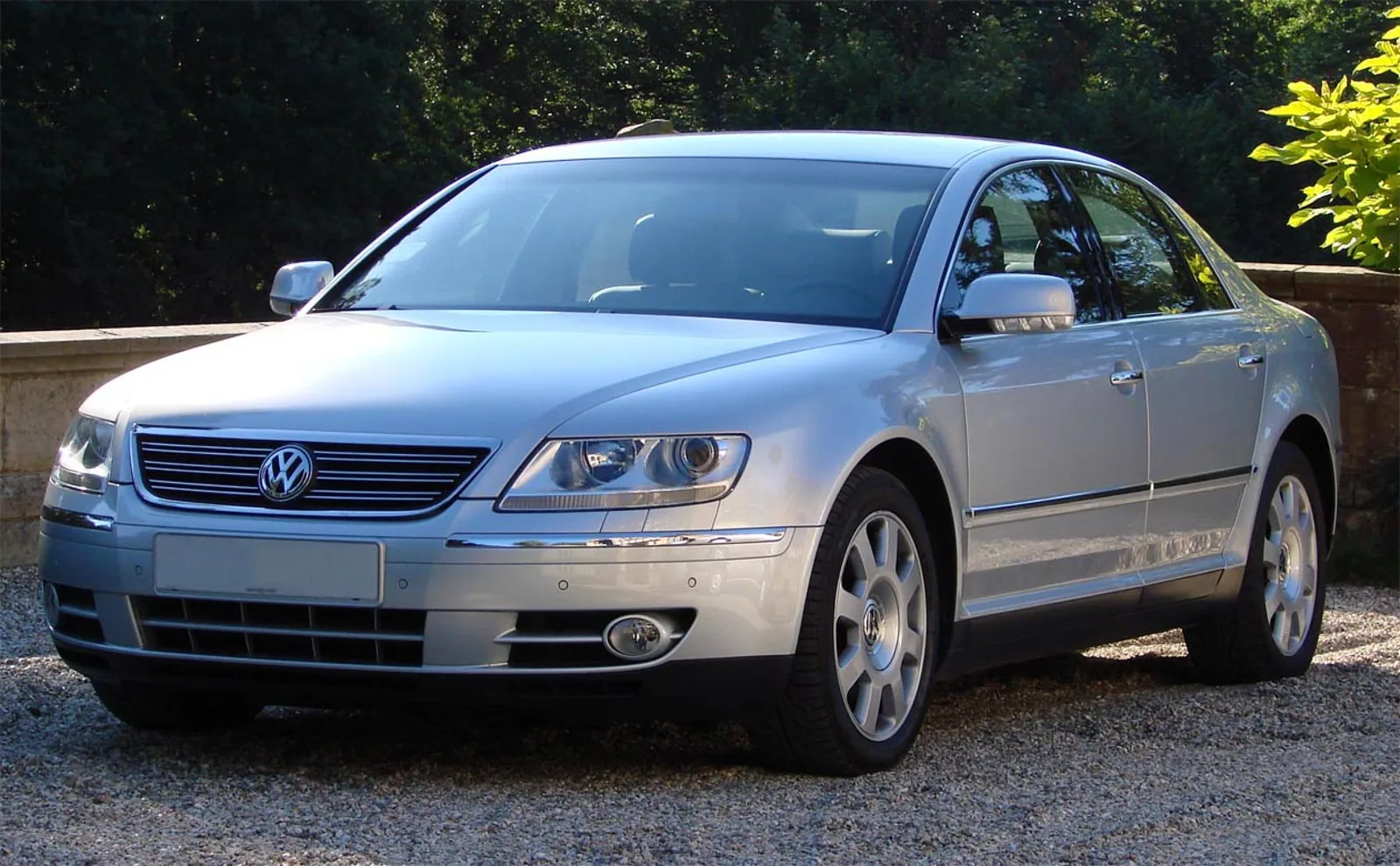
The Volkswagen Phaeton was a premium full-size saloon conceived by Ferdinand Piech to challenge Mercedes-Benz and BMW. It sold far below target, and 84,253 were built by 2016. The CC and Arteon later tried to move Volkswagen upmarket with coupe-style bodies on Passat and MQB underpinnings.
Over fifteen years, Volkswagen built 84,253 Phaetons, a car its chairman wanted to surpass the best from Mercedes-Benz and BMW. According to a 2013 estimate from Bernstein Research, the company lost 28,101 euros on every one it sold between 2002 and 2012. Two later cars, the CC and the Arteon, went after the same upmarket ground with a very different recipe.
Taken together the three tell one story: a flagship that tried to out-engineer the establishment, a four-door coupe that borrowed a Passat to get a more stylish shape, and a liftback aimed higher than the coupe it replaced. Each had its own idea of what a Volkswagen could be, and each fell short of the sales its makers wanted.
VW Phaeton history: why Volkswagen built it
The Phaeton was the idea of Ferdinand Piech, then chairman of Volkswagen Group. Mercedes-Benz and BMW had just introduced the A-Class and the 3 Series Compact and were competing directly with Volkswagen in Europe, and Piech wanted a car that would surpass them in the prestige market. It was officially revealed at the 2002 Geneva show.
The group already owned a big luxury saloon in the Audi A8. The Phaeton was meant to be different, a comfort-first limousine in the mould of the Mercedes S-Class and Lexus LS, while the A8 and the BMW 7 Series leaned towards performance. Piech also wanted a flagship that would lift the whole VW brand upmarket.
A concept called Concept D, shown at the 1999 International Motor Show Germany, previewed it with a four-door hatchback body, V10 TDI engine, air suspension and all-wheel drive.
Ten demands from the chairman
Development under the code VW611 began with Piech handing his engineers a list of ten parameters. Most stayed private, but a few reached the press. The car had to be able to run all day at 300 km/h (186 mph) in 50 degrees C (122 F) outside while the cabin stayed at 22 degrees C (72 F), even though the top speed was electronically limited to 250 km/h (155 mph). If it then braked hard from a long top-speed run, the oil pressure warning light must stay dark.
Stiffness was another demand. Piech asked for a torsional rigidity of 37,000 N m per degree, against 27,500 for the Mercedes S-Class of the time. Put simply, the body was to resist twisting far better than its rival, like a thick steel tube beside a thinner one. The electric motors that move seats, mirrors and windows had to be hidden for a cleaner look.
Climate control was a personal hobby of his. The cabin had to be completely free of draughts, with four temperature zones, and a cold-morning car had to defrost quickly without anyone wearing a jacket. The answer was a programmable auxiliary heater with its own fuel pump that warmed the car before the passengers arrived. Klaus Zyciora, then head of interior design, said the interior mockup was the most expensive in the company's history.
Volkswagen wanted a Phaeton that beat Mercedes and BMW, and settled for building 84,253 of them.
How the Phaeton was built
The Phaeton used a special version of the group's D platform, called D1. Bentley's Continental GT and Flying Spur shared it. What set it apart from the Audi A8 was all-steel construction, whereas the A8 kept its aluminium Audi Space Frame. Some systems, including the automatic gearbox and certain engines, were common to both.
The steel cost weight. Against an Audi A8L 4.2 FSI quattro, the Phaeton was 247 kg (545 lb) heavier, though more power (335 hp against 330) and a shorter final-drive ratio of 3.65:1 against 3.32 kept it competitive in most driving tests. Even so, the extra mass gave it noticeably slower acceleration and worse economy than the lighter car. It had the longest wheelbase of any Volkswagen passenger car, and its development produced over one hundred patents.
Standard equipment included Torsen-based 4motion four-wheel drive (optional on the 3.2-litre VR6), the four-zone climate system, double-glazed windows with UV protection and an automatic anti-fogging system. Front-wheel drive was offered with the 3.2-litre engine in 2003 and 2004 only. The front seats were heated and adjustable in 12 ways with memory, and an optional 18-way driver and 16-way passenger set, standard on the W12, added ventilation and massage. Buyers could swap the rear bench for two individual seats, and an optional sunroof carried solar cells that could run the ventilation with the car switched off.
Front and rear Adaptive Air Suspension with Continuous Damping Control gave the ride its softness. The same system, with firmer settings, reached the Audi A8 in November 2002. The Phaeton was also the first Volkswagen with radar adaptive cruise control, and its 5.0-litre V10 TDI was the first V10 ever fitted to a production sedan.
The VW Phaeton W12 and the engine range
The Phaeton line-up covered a 3.2-litre VR6, the V10 TDI, a later 3.0-litre V6 TDI, and the W12 at the top. Most engines came from the VW, Porsche and Audi plant in Gyor, Hungary; the W12 was the exception. In 2008 the V6 TDI rose from 165 to 171 kW (224 to 232 PS), and a new FSI V6 petrol with 206 kW (280 PS) met Euro 5 limits. After the 2011 model year the W12 was dropped everywhere except China, which kept it until production ended in 2016.
The W12 also lent itself to showpieces. The 2005 Phaeton Lounge, shown at the Middle East International Motor Show, stretched the car and turned the rear into a lounge for four, with two pairs of seats facing one another, wine coolers front and rear, a minibar, a cigar humidor, two 17-inch monitors and a computer with a broadband connection.
A glass factory in Dresden
Phaetons were assembled by hand in the Transparent Factory in Dresden, a glass-walled building with capacity for 20,000 cars a year and plans to expand to 35,000. Bentley Flying Spurs for Europe were assembled there too until October 2006, when that work moved to Crewe. Bodies were made and painted at Zwickau and carried about 100 km by special road transport to Dresden.
Why the VW Phaeton failed to meet its sales targets
The Phaeton's sales fell far short of expectations. Its biggest market turned out to be China, followed by South Korea. Volkswagen had given the Dresden plant a capacity of 20,000 a year in 2002; by September 2006 a four-year total of 25,000 had been built, running at about 6,000 a year. Germany took 19,314 by January 2009. Output dropped to 10,190 in 2012 and 5,812 in 2013.
North America was weaker still. Canada took 93 in 2004 and only 21 in the first eight months of 2005. In the United States, 1,433 were sold in 2004 and 820 in 2005, which led Volkswagen to say sales there would end after the 2006 model year. A further 235 were delivered in 2006 and 17 leftover cars in 2007.
Prices matched those of comparable cars from Mercedes-Benz, BMW, Lexus and the Audi A8, which shared the Phaeton's powertrain. Motor Trend said the Volkswagen badge might not say premium to many shoppers, while admitting it was impressed by how the car drove. Used W12 cars have depreciated to a small fraction of their original cost.
The public verdicts were harsh. In autumn 2013 The Economist included the Phaeton in a report on Europe's biggest loss-making cars, and in October 2014 Top Gear magazine put it on a list of the worst cars you could buy. Chancellor Gerhard Schroder did choose it as his official state car for his second term, from 2002 to 2005.
| Phaeton market | Sales figure |
|---|---|
| Germany, to January 2009 | 19,314 |
| United States, 2004 | 1,433 |
| United States, 2005 | 820 |
| United States, 2006 | 235 |
| Canada, 2004 | 93 |
| All markets, 2002 to 2016 production | 84,253 |
Updates through the years
Volkswagen kept refining the car. The first update, in 2008, added chrome fog light covers, red rear lights and a DVD navigation system. The third series, unveiled at Geneva in 2007, brought LED daytime running lights and a freshened centre console, and the 2009 changes added carbon-ceramic front brakes on the W12, a rear-view camera and Side Assist blind-spot warning. A new front end like the Golf Mk VI arrived in 2011 and a minor facelift in 2014 added a removable touch screen remote for rear passengers, together with stop-and-go cruise control, Front Assist collision avoidance, traffic sign recognition and 3G internet.
Volkswagen CC: a Passat in a coupe's clothes
The CC debuted in January 2008 at the Detroit show, first sold as the Passat CC. Volkswagen said the letters stood for Comfort Coupe. It was a Passat variant that gave up headroom and boot space for a low roofline, with the same wheelbase of 2,710 mm (106.7 in) but 27 mm (1.06 in) more length, 36 mm (1.42 in) more width and 50 mm (1.97 in) less height.
Volkswagen forecast 300,000 sales over seven years at launch, 60% of them from the United States, about 26,000 cars a year. China received the CC from FAW-Volkswagen on July 15, 2010, with 1.8 TSI and 2.0 TSI engines.
The engine range was broad. Europe had a 1.4-litre E85 TFSI in Finland and Sweden, 1.8 and 2.0-litre petrols, 2.0 TDI diesels and a 3.6-litre VR6 of 220 kW (299 PS; 295 hp) with 4motion all-wheel drive and a six-speed DSG. North America had only a 2.0T of 200 hp (149 kW) and 207 lb ft (281 Nm) and a VR6 of 206 kW (276 hp) and 265 lb ft (359 Nm), and a manual gearbox came only with the 2.0T. The 140 PS diesel had a manual box; the 170 PS version had DSG; and a BlueTDI of 143 PS used AdBlue.
Facelift, reviews and a short racing career
A facelift shown at the Los Angeles show went into production in January 2012. Only the front and rear changed to match the then-current VW look; the midsection did not. Equipment grew to include adaptive chassis control, bi-xenon headlights, a fatigue detector, city emergency braking, Lane Assist and Park Assist. Diesel power rose twice, to 177 PS in January 2013 and then 184 PS in 2015 with the Euro 6 EA288 engine.
Edmunds judged the 2013 car an attractive and higher-quality alternative to other mid-size saloons, though it warned that the back seat and boot were small and the suspension firm. A specially prepared CC raced in the 2013 British Touring Car Championship and in later events, driven by Warren Scott, Tom Onslow-Cole and Aiden Moffat.
By 2015 only 3,900 CCs were sold, one of the lowest totals in the range. Volkswagen announced in November 2016 that the Arteon would replace it. Production is given as 2008 to 2016, while the model itself was discontinued after the 2017 model year. China carried on with the CC name from August 2018, for the 2019 model year.
Volkswagen Arteon: aiming higher than the CC
The Arteon was unveiled at Geneva on 6 March 2017, and at the Chicago show for North America. It is the direct successor to the CC, though Volkswagen said it sits more upmarket. It rides on the modular MQB platform, sits above the Passat in Europe and follows a 2015 concept car closely. It came as a five-door liftback and, later, an estate.
The launch was staggered. The United States saw it at the 2018 Chicago show, but unspecified emissions testing issues delayed sales until April 2019. Canada followed in the spring of 2019 and Malaysia only in August 2020, after several delays. Production is in Emden, Germany, with a Chinese CC built at Changchun and further assembly at Pekan in Malaysia.
European buyers could choose a 2.0-litre TSI of 280 PS and diesels of 150 and 240 PS at launch, with a TSI Evo petrol of 150 PS and petrol and diesel units of 190 PS added soon after. American cars in 2019 came in SE, SEL and Premium trim with a single 2.0-litre turbo four of 268 hp and 258 lb ft, an eight-speed automatic and a choice of front or all-wheel drive. For 2022 power went to 300 hp, with a seven-speed DSG.
The 2020 facelift: Shooting Brake, R and eHybrid
The 2020 update added a Shooting Brake estate, a plug-in hybrid and a performance R. All gained a 260 mm (10.25 in) digital instrument panel and a touch screen of 200 mm (8.0 in) or 230 mm (9.2 in). The Arteon R used the 2.0-litre TSI at 236 kW; 320 PS (316 bhp) with 420 Nm (310 lb ft), driving all four wheels through a seven-speed DSG and a Magna rear torque-splitting differential. Volkswagen put its 0-100 km/h time at around five seconds, and the R was not sold in the United States.
The eHybrid paired a 1.4-litre petrol engine with an electric motor for a combined 160 kW (215 bhp) and an electric-only range of 61 km (38 mi).
An optional Emergency Assist 2.0 system watched for a driver who had stopped touching the pedals or wheel. It would warn with sounds, visual cues and a brake tap and, if there was no response, switch on the hazard lights and steer itself to a safe lane. The Arteon won the 2017 Golden Steering Wheel in the midsize and premium class and was overall winner of the 2019 Tow Car Awards.
| Model | Debut | Platform and body | Positioning | End of the line |
|---|---|---|---|---|
| Phaeton | 2002 Geneva | D1, all-steel full-size saloon | Comfort limousine to rival the S-Class | Production ended March 2016 |
| CC | January 2008, Detroit | Passat-based four-door coupe | Comfort Coupe, more stylish than the Passat | Replaced by the Arteon; China continued under the CC name |
| Arteon | March 2017, Geneva | MQB liftback, later a Shooting Brake | More upmarket than the CC | Saloon ended 2023, wagon ended end of 2024 |
The end of the Arteon, and what came after the Phaeton
Poor sales led Volkswagen to drop the Arteon in Canada after the 2021 model year, and Volkswagen later announced that 2023 would be the last model year as it shifted focus to high-volume models. The saloon ended in 2023. The Shooting Brake wagon, planned to run until 2026, was discontinued early at the end of 2024.
The Phaeton's production ended in March 2016, with an all-electric second generation slated to follow. In April 2017 the Dresden factory began building the e-Golf instead. Development of the second generation had already begun before the Phaeton was discontinued, and a near-production prototype was completed, which Volkswagen revealed in 2022.
What it means for a used buyer
For anyone shopping for these cars today, the facts point in a few clear directions. The W12 Phaeton has lost most of its original value. The CC offers a firm ride and a small rear seat in return for its looks. The Arteon, built until 2023, is the newest of the three, and the Arteon R was never sold in the United States.