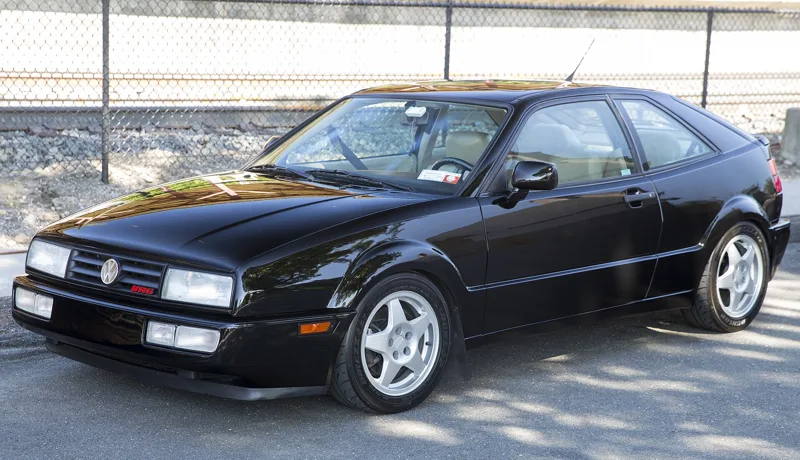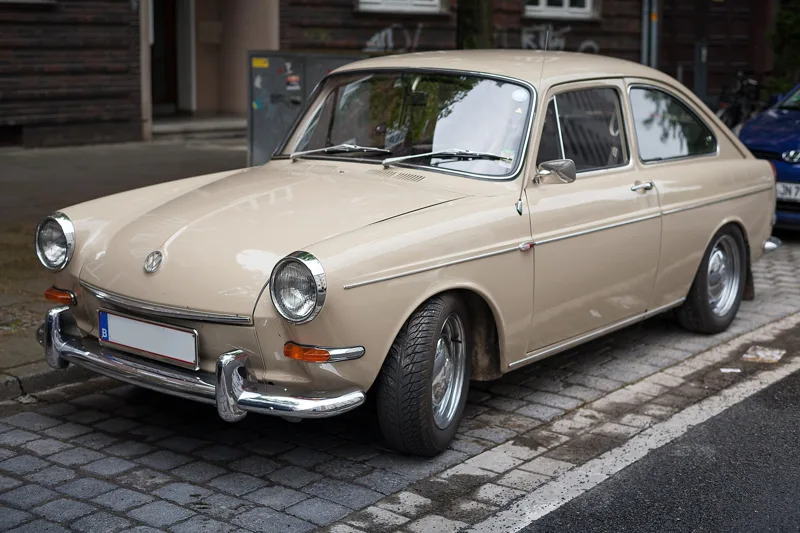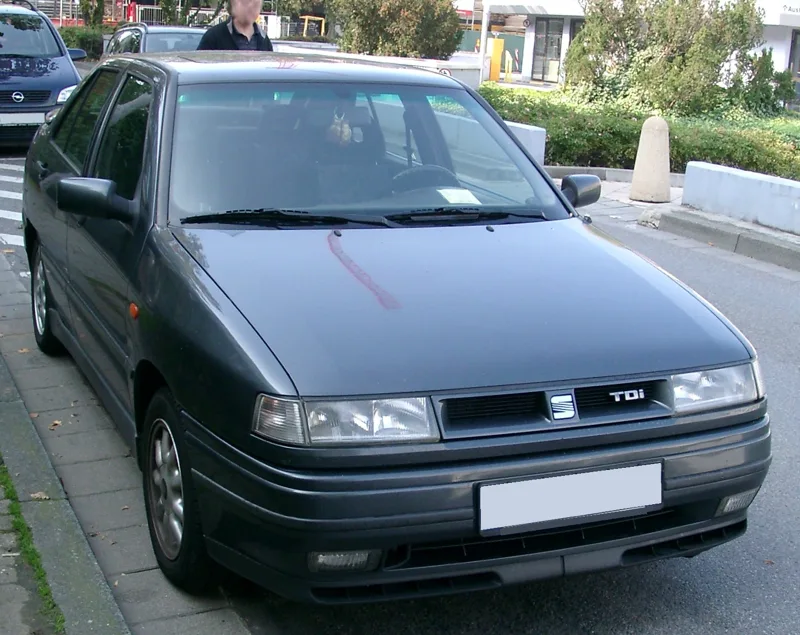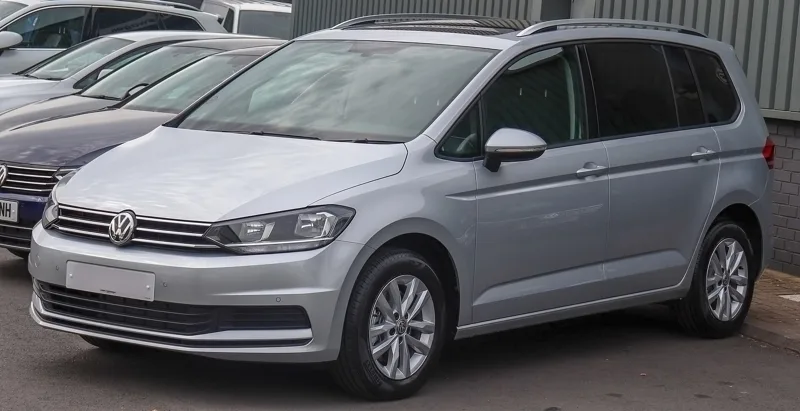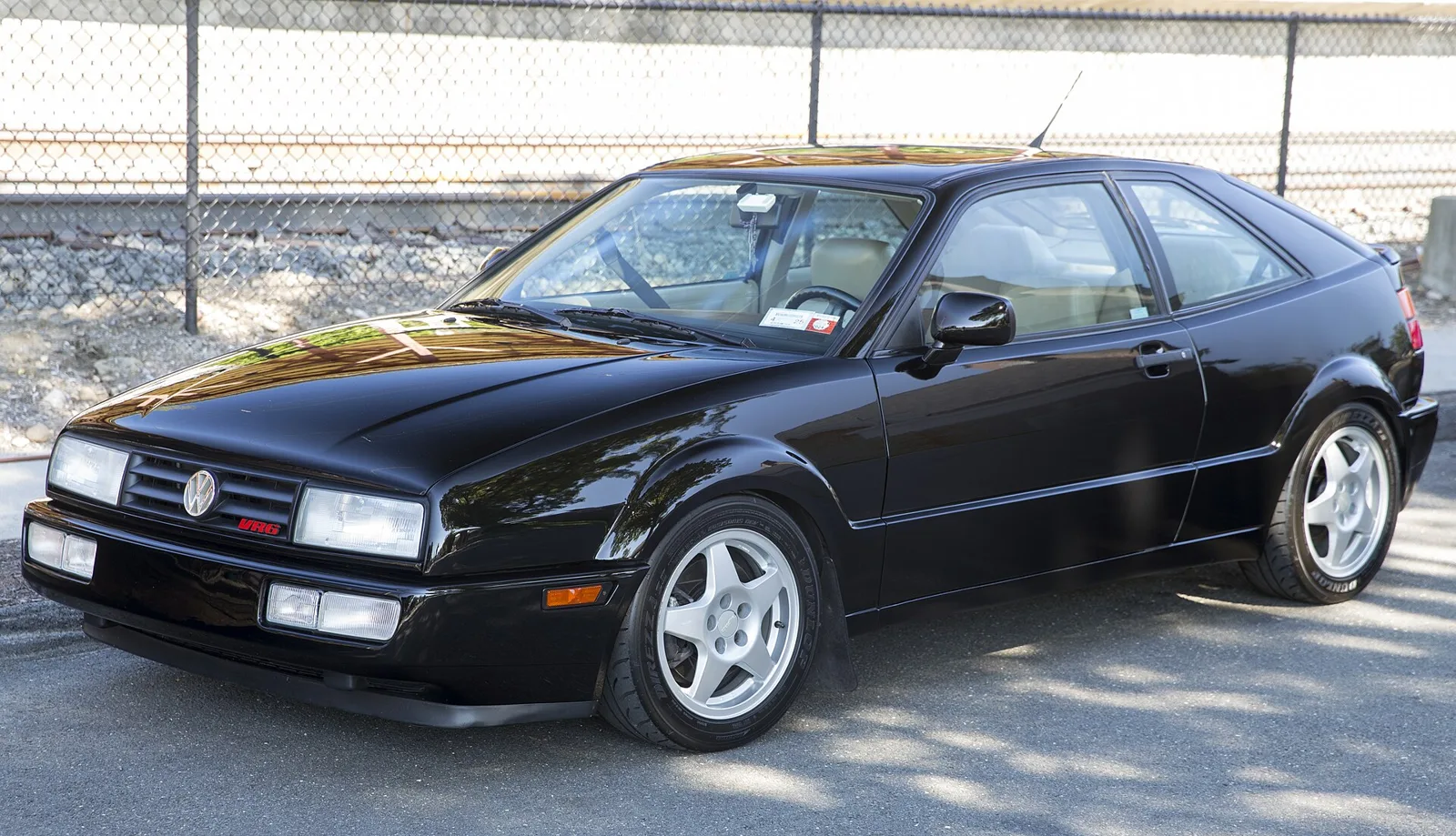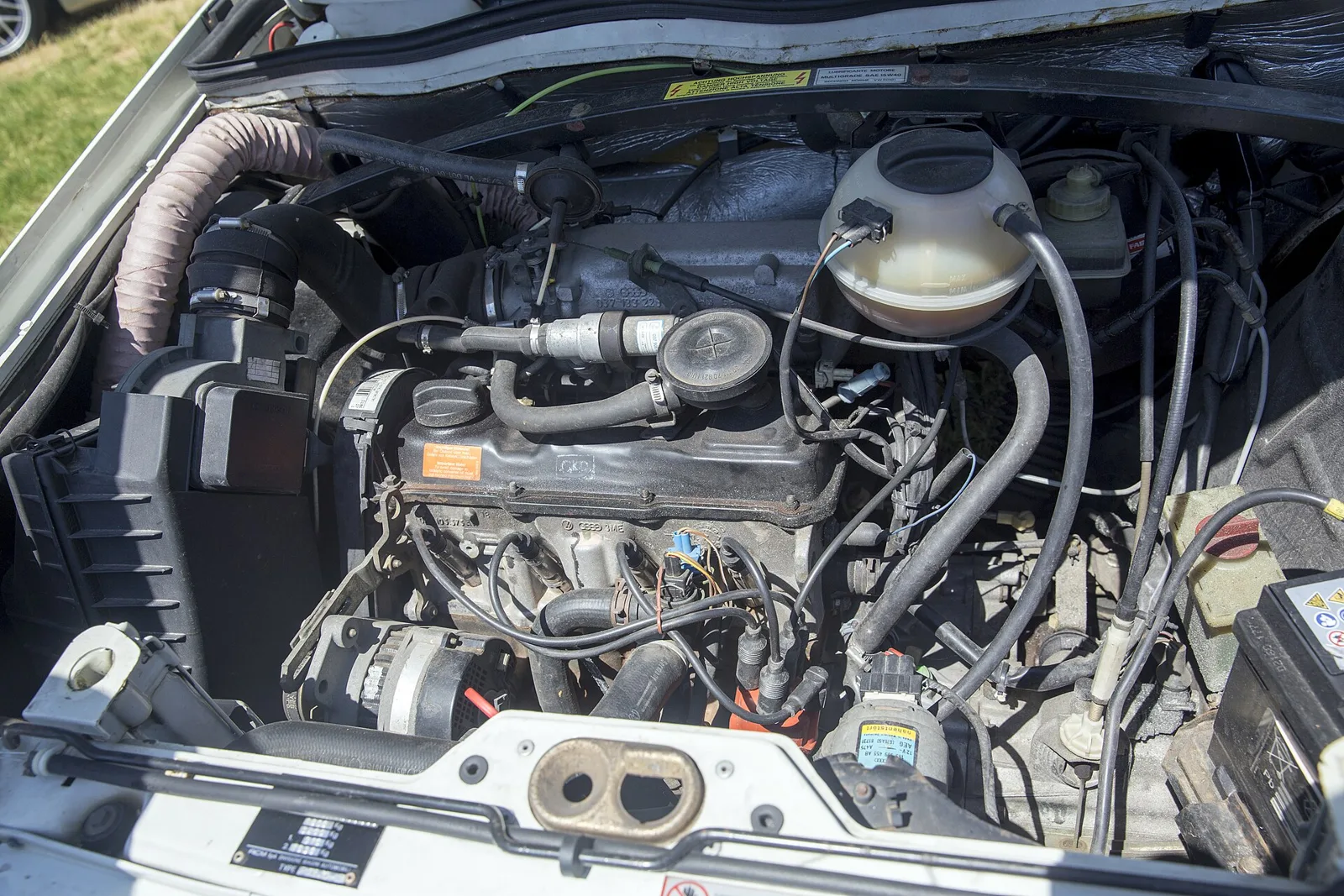
A flat-four that lasted from 1936 to 2006, a water-cooled family that began in an Audi 80, and a six with its cylinders only 15 degrees apart.
The VR6 packs six cylinders at a 10.5 to 15 degree angle under one head, the EA827 is an Audi-developed water-cooled family introduced in 1972, and the air-cooled flat-four ran from 1936 to 2006. Together they show Volkswagen choosing compact, adaptable and shared designs.
Volkswagen built its air-cooled flat-four from 1936 until 2006, and its narrow-angle VR6 from 1991 until late 2024. Between them sits the EA827, a water-cooled petrol family that Audi developed and that powered everything from an Audi 80 to a Golf GTI. Together they trace a flat-four kept for decades, an adaptable family shared across a group, and a six squeezed into the space of a four.
The Volkswagen air-cooled engine
The VW air-cooled engine is a petrol boxer with four horizontally opposed cylinders. The cylinders are cast iron, the heads and pistons are aluminium alloy, the crankcase is magnesium alloy and the crankshaft and connecting rods are forged steel. It was produced at Volkswagen plants around the world from 1936 until 2006, and it went into the Type 1 Beetle, the Type 2 Transporter, the Type 3 and the Type 4, as well as industrial, light aircraft and kit car applications.
Two families dominate. The Type 1 engine takes its name from the Beetle, and the Type 4 is a separate family. The Type 3 engine is a Type 1 variation with a low-profile cooling arrangement.
Type 1: from 985 cc to the Mexican Beetle
The Type 1 grew from the original 985 cc unit in the 1939 KdF-Wagen to a 1600 cc dual-port, fuel-injected engine fitted to the 2003 Mexican Beetle. The final Type 1 of all went into a Type 2c built in Brazil in 2006. Upright shrouds and belt-driven fans were the norm. If the fan sat on the crankshaft instead, the engine was called a Type 3, and these came only in 1500 cc and 1600 cc sizes in Type 3 vehicles. A universal engine case fits all three uses, and the bore spacing is 112 mm.
Sizes changed along the way. The first Volkswagen Transporters used a 1.1 litre engine rated at 18 kW (24 PS), with a 22 kW (29 PS) version standard from 1955. The 1.2 litre Type 122 displaces 1,192 cc, and in the Beetle it made 41 PS at 3900 rpm and 88 N.m of torque at 2400 rpm. A 1285 cc single-port engine appeared on the 1966 Beetle and with higher compression made 50 bhp, but it proved problematic and was used in North America only in Type 2 vehicles for the 1966 model year.
Type 4: a bigger redesign
For 1968 Volkswagen redesigned the engine for the Type 4. The new engine was bigger and stronger, and beyond a similar general layout it had almost no parts in common with the Type 1. The Type 4 was produced from 1968 to 1983 in 1.7, 1.8 and 2.0 litre versions.
Beyond the car
The engine's afterlife was long. Volkswagen offered air-cooled boxers for industrial use from 1950, in outputs from 18 to 46 kW and sizes from 1.2 to 1.8 litres, officially discontinued in 1991. Since 1970 Limbach has turned out over 6,000 aircraft engines derived from the Beetle unit, and Sauer has built certified engines for small airplanes and motorgliders since 1987. Hobbyists even sawed Type 1 blocks in half to make two-cylinder aircraft engines of 30 to 38 hp (22 to 28 kW).
A flat-four built from 1936 until 2006, and a six with just one cylinder head.
The Volkswagen EA827 engine
Audi started the EA827 petrol family under Ludwig Kraus, and it debuted in 1972 with the B1-series Audi 80. It spread across the Volkswagen Group and had descendants still being built into the 2010s. It is a water-cooled configuration for four to eight cylinders, and a robust one. In Brazil it was sold under the name AP, for Alta Performance.
One defining trait was an intermediate shaft that drove all the auxiliaries off the timing belt, because longer rubber belts were not considered reliable when the engine was designed. Diesel versions shared the same 88 mm (3.46 in) cylinder spacing as the petrol engines. The EA113 evolution arrived in 1995 and slowly replaced it, dropping the intermediate shaft, adding a toothed-belt water pump and distributorless ignition, and using a crossflow head.
Sizes and states of tune
The 1,297 cc four, with a 75.0 mm by 73.4 mm bore and stroke and a carburettor, made 44 kW (60 PS) in the Audi 80 and Passat B2. The 1.5 gave 51 to 63 kW in the Golf, Scirocco and Jetta. The 1588 cc 1.6 in the Golf GTI and Scirocco GTI made 81 kW (110 PS) with K-Jetronic fuel injection.
Four valves per cylinder arrived with the 1.8 16V, a DOHC head on the same grey cast iron block with K/KE-Jetronic injection. It made 94 kW (128 PS) in the SEAT Toledo of 1992 to 1995 and 102 kW (139 PS) in the Golf, Jetta and Corrado.
A 1,715 cc 1.7 originally from the German Volkswagen Iltis went into American Sciroccos, Rabbits and Jettas and the Audi 4000, and from 1978 to 1983 into the Dodge Omni and Plymouth Horizon, at 63 to 75 hp (47 to 56 kW). Audi's first petrol five-cylinder, the 2.1-litre EA828, was in effect this 1.7 plus a cylinder, minus the intermediate shaft.
Later sizes include the 1.9, whose cylinder walls are only 5.5 mm (0.22 in) thick, and the 2.0 of 1,984 cc, which has an 82.5 mm bore and a 92.8 mm stroke. Its commonest rating was 85 kW (115 PS), and it appeared in an enormous list of cars from the Ibiza and Octavia to the Golf Mk3 and Mk4, the New Beetle and the Passat B3 to B5. The 2.0 16V made 100 kW (136 PS) to 110 kW (150 PS), the latter in the Golf III GTI 16V.
The strangest member is the 1.8 G60, with a belt-driven G-Charger supercharger and intercooler. It made 118 kW (160 PS) in the Golf Mk2 G60, Passat G60 and Corrado G60, and a DOHC 16V version reached 154 kW (210 PS) in the Golf Limited.
The VR6 engine
The VR6 is a six-cylinder configuration Volkswagen developed for transverse engines in front-wheel-drive cars. VR comes from the German Verkurzt and Reihenmotor, meaning shortened inline engine. Instead of the 45 to 90 degrees between banks in a conventional V6, the VR6 has just 10.5 to 15 degrees between adjacent cylinders. The result is very compact, and it needs only one cylinder head for all six cylinders, as an inline-six does, which makes it cheaper to build.
VR6 versus a conventional V6
The narrow bank angle of 15 degrees cuts the width of the engine compared with a traditional V6, so the VR6 fits more easily into an engine bay originally designed for a four-cylinder. Two camshafts do the job whether the head carries two valves per cylinder or four, which also keeps costs down.
How a VR6 is put together
Because the cylinders are not on the centreline of the shared head, the intake and exhaust ports are different lengths on each bank. Left alone, that would make the two banks produce different power at the same revs, so engineers compensate with manifold runner lengths and camshaft overlap and lift.
The crankshaft runs in seven main bearings with its journals offset 22 degrees from one another, which accommodates the staggered cylinders and still gives a 120 degree firing interval. The firing order is 1, 5, 3, 6, 2, 4. The bank angle is 15 degrees in the early engines and the compression ratio 10:1. Because both rows share one head and one head gasket, the piston crowns are tilted. Valves measure 39.0 mm on the intake side and 34.3 mm on the exhaust, and the engine management is Bosch Motronic.
Early engines had two valves per cylinder and a single camshaft for each bank, working without rockers. The 24-valve version, introduced in 1999, moved to a layout closer to a double overhead camshaft design: one cam operates the intake valves of both banks and the other the exhaust valves, reaching the far bank through rockers.
VR6 history: from the Passat to the Cayenne
The Lancia V4 and V8 of the 1920s were the first narrow-angle V engines in a motor vehicle. Volkswagen's version appeared in 1991 in the Passat B3 and the Corrado. The AAA 2.8 L (171 cu in) made 128 kW (172 hp) in most Passats and the North American Corrado, and the 2.9 L ABV made 140 kW (188 hp) in the Passat Syncro and the European Corrado. The Golf Mk3 2.8 VR6 and the Vento and Jetta followed in 1992, and the 2.8 litre also powered the Mercedes-Benz Vito van from 1996 to 2003.
A 24-valve AQP/AUE 2.8 L making 150 kW (201 hp) followed in 2000. The 3.2 L EA390 arrived in 2001 in the New Beetle RSi and later powered the 2002 to 2004 Golf Mk4 R32 and the Audi TT and A3, with outputs from 165 kW (221 hp) to 184 kW (247 hp). In 2005 a 3.6 L version with direct injection appeared in the Passat B6, using a narrower 10.6 degree bank angle to make 206 kW (276 hp), and in 2008 the BWS version reached 220 kW (295 hp) in the Passat R36. Porsche used the 3.2 L engine in the base Cayenne from 2003 to 2006 and the 3.6 L from 2008 to 2018.
The VR5 arrived in 1997 as a five-cylinder derivative.
Family trees: from VR6 to W16
Volkswagen also paired VR engines on a shared crankshaft to make W engines. The W12, in production since 2001, is effectively two VR6s at 72 degrees. A W8 ran from 2001 to 2004. The biggest is the W16, introduced on the Bugatti Veyron in 2005, effectively two VR8s at 90 degrees with four turbochargers.
The VR6 also earned a cult following in the tuning world for its throaty exhaust note and compact size, which make it a popular engine swap. Fans nicknamed it Chewbacca after the Star Wars character, and an annual gathering of VR6 cars is called Wookies in the Woods.
Three engines compared
| Engine | Years | Layout | Typical uses |
|---|---|---|---|
| Air-cooled engine | 1936 to 2006 | Four horizontally opposed cylinders | Beetle, Transporter, Type 3, Type 4, industrial and light aircraft |
| EA827 | 1972 into the 2010s | Water-cooled, four to eight cylinders | Audi 80, Golf, Passat, Scirocco, Ibiza |
| VR6 | 1991 to late 2024 | Six cylinders, narrow bank angle, one head | Passat, Corrado, Golf, Beetle RSi, Cayenne, Atlas |
Where this goes next
Volkswagen started retiring its VR engines in favour of smaller turbocharged fours. The VR6 left the Passat NMS by 2019, which made the Atlas the only model with it, and the Atlas dropped it from 2023. Production lasted until late 2024. Even so, the company designed a fresh VR6, still coded EA390, for China alone: a 2.5 litre turbocharged 24-valve engine with 220 kW (295 hp) and 500 N.m for the Teramont SUV and Talagon MPV. Buyers have been able to order it since the Teramont's 2017 debut, and the engines are made in Germany and exported to suit Chinese tax and emissions rules.