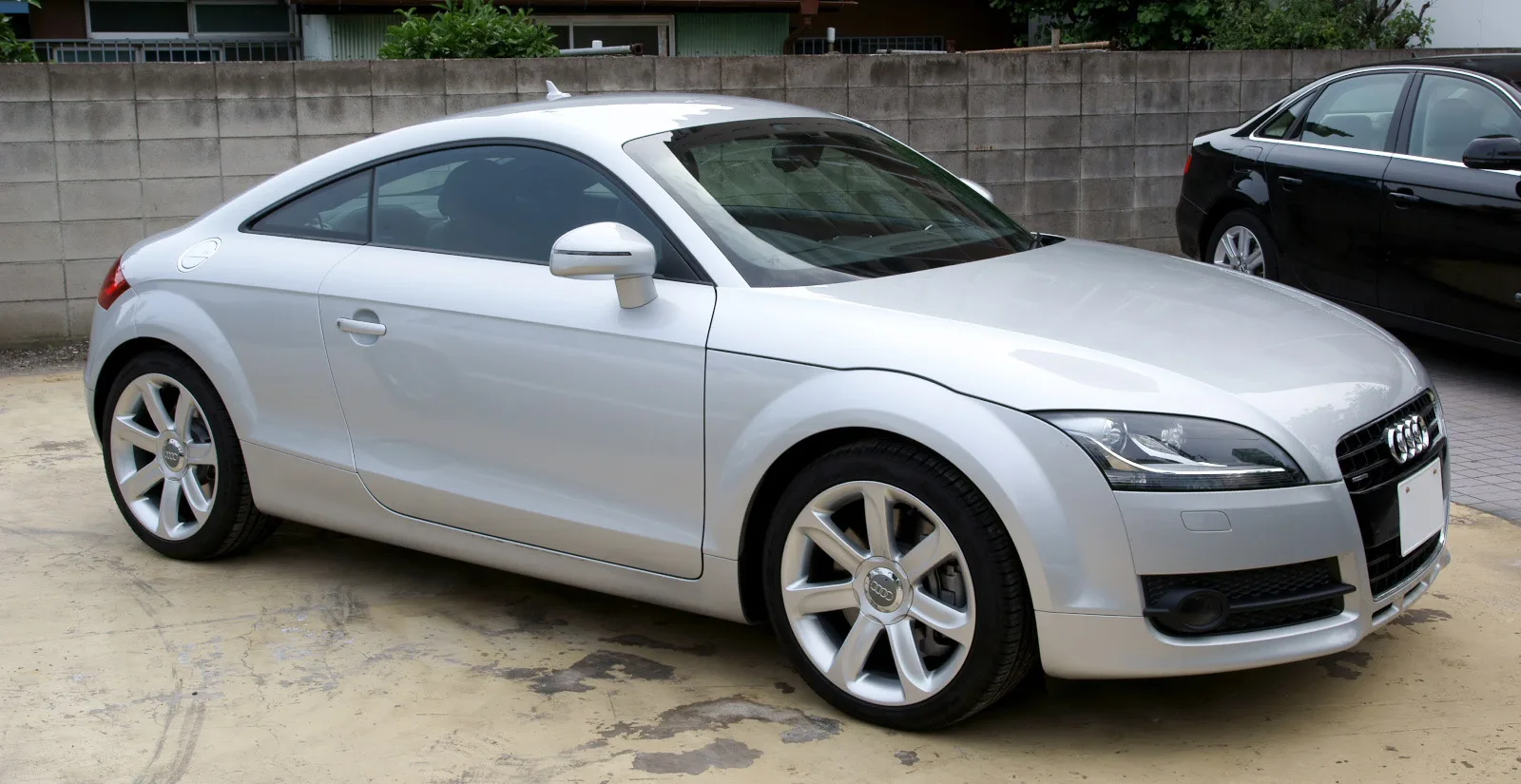
A Bauhaus-styled coupe and roadster built from 1998 to 2023, with quattro grip, RS and S models and a long run of limited editions.
Built from 1998 to 2023, the Audi TT came in three generations and two body styles, a 2+2 coupe and a roadster. The Hungarian-built car used front-wheel or quattro drive, and 662,762 were produced before the last car in November 2023.
The Audi TT was built across three generations between 1998 and 2023. It was sold as a 2+2 coupe and a two-seater roadster, and its bodies were built in Ingolstadt before assembly in Hungary. Each generation sat on a Volkswagen Group platform shared with other models.
Where did the Audi TT get its name?
The name comes from the Isle of Man TT, a motorcycle race where NSU, a predecessor of Audi, enjoyed success. NSU's TT models of the 1960s also took their names from the race, and the nameplate has also been linked to the phrase Technology and Tradition.
NSU first competed at the Isle of Man TT in 1907, DKW and NSU later combined to form the company that is now Audi. That history tied the car's name to motorcycle racing rather than to any car event.
Styling began in spring 1994 at the Volkswagen Group Design Center in California. The TT was previewed as a concept at the 1995 Frankfurt Motor Show, and the design is credited to J Mays and Freeman Thomas.
The interior received contributions from several designers, including Hartmut Warkuss, Peter Schreyer, Martin Smith and Romulus Rost. Their work gave the car a cabin that matched the exterior's clean, rounded theme.
A sports car named after a motorcycle race, with curves borrowed from Bauhaus and a quarter-century run.
How was the first-generation TT built?
The Mk1, internally Type 8N, went on sale as a coupe in September 1998 and was followed by a roadster in August 1999. It was built on the Volkswagen Group A4 (PQ34) platform, which also underpinned the Golf Mk4 and the original Audi A3.
Early engines were 1.8-litre turbos rated at 180 PS (132 kW; 178 hp) and 225 PS (165 kW; 222 hp). The 3.2-litre VR6 with 250 PS (247 bhp; 184 kW) arrived in early 2003, and the six-speed DSG followed in July 2003.
Early TTs were linked to a number of fatalities at speeds above 112 mph (180 km/h). The coupe and roadster were both recalled in late 1999 and early 2000 to improve high-speed handling, and the fix added ESP or ASR, a rear spoiler and suspension changes.
Audi also introduced a laser beam welding technique to achieve the smooth seams that the design called for. That process delayed the car's launch, which shows how much the look depended on the manufacturing details.
What changed in the second-generation TT?
The Mk2, Type 8J, debuted on 6 April 2006 with aluminium front bodypanels and steel rear panels. It was five inches longer and three inches wider than the first car, and production began in August 2006 with a choice of front-wheel drive or quattro.
Engines included a 2.0 TDI diesel with 125 kW (170 PS; 168 bhp), and quattro came standard on V6 models. The rear spoiler rises automatically at 125 km/h (78 mph) to add downforce.
Audi Magnetic Ride, based on BWI Group's MagneRide, was optional and adjusted the damping to suit road conditions and the way the car was driven. It made the Mk2 feel more composed on uneven surfaces.
The Mk2 also won a string of prizes, including the inaugural Drive Car of the Year award. Its styling was widely praised, and that reputation helped the model hold its place in the market for years.
What did the TTS and TT RS add?
The TTS arrived in 2008 with a revised 2.0 TFSI rated at 200 kW (272 PS; 268 hp) and quattro as standard. The TT RS followed in 2009 with a five-cylinder turbo producing 250 kW (340 PS; 335 bhp). Both were positioned as Audi's performance models.
The TTS sat lower than the standard car, with Magnetic Ride included as standard. The TT RS brought a new turbo engine to the family and kept the TT's core layout.
A later TT RS plus used an uprated engine with 355 hp (265 kW; 360 PS) at 5500 rpm, which put it at the top of the second-generation range. The upgrade was popular with buyers who wanted the extra pace without changing the body.
Quattro all-wheel drive was used on the performance models, with the Haldex Traction clutch providing the grip. That system allowed the TTS and TT RS to deliver power to all four wheels when conditions demanded it.
What did the third-generation TT bring?
The Mk3, Type FV/8S, was unveiled at the 2014 Geneva Motor Show on the Volkswagen Group MQB platform. It came with TFSI and TDI engines, and in 2019 Audi added the TT 40 and TT 45 models while the TT RS carried on with 294 kW (400 PS; 394 hp).
The TT RS produced 480 Nm (354 lb ft) and used quattro all-wheel drive with a seven-speed S-tronic automatic. It was the most powerful TT yet built, and its figures reflected a shift toward turbocharged power across the range.
Audi later said the current generation would be the last, and the car was discontinued at the end of its lifecycle. The third generation kept the TT's compact dimensions while refining the cabin.
The 20th Anniversary Edition, which marked 20 years of the TT, was limited to 999 units. It was a homage to the original 8N car, offered as a coupe or roadster with a moccasin brown leather interior.
Which special editions were built?
Several limited editions were produced. The 2005 Quattro Sport was limited to 1,165 cars, the 20th Anniversary Edition to 999 units, the TT RS Iconic Edition to 100 and the TT RS Heritage Edition to 50. The final TT/TTS Edition of 2023 was sold only in the United Kingdom.
The Quattro Sport was built by quattro GmbH and split 800 right-hand steering and 365 left-hand steering cars. Only 900 went to the UK, not the 1,000 originally planned, and the car used a lighter specification than the standard TT.
The Heritage Edition came in five colours, each tied to a Ur-Quattro rally champion. This edition was sold exclusively in Europe, with 11 of the 100 cars left-hand drive, and it wore Nardo Grey paint with Audi Sport Performance Parts.
Audi Sport Performance Parts were offered through European dealers as add-ons. Only 15 factory-built cars were made with the full package, and they were distributed to shows around the world.
How did the TT race?
The TT competed in several series. Abt Sportsline ran a TT in DTM, and Laurent Aiello won the title in 2002. Istook's Motorsports raced a TT RS in Grand Am GS from 2012 to 2014, and a TT RS served as the safety car at the 2009 24 Hours of Le Mans.
Istook's also received the first US TT-RS in July 2011, and it raced TTs in SCCA's World Challenge series. A Revo Technik-sponsored TT competed in the Grand-Am KONI Sports Car Challenge Street Tuner class.
The 2008 TT Clubsport quattro concept, shown on the Worthersee Tour, was an open speedster with roll bars and humped covers in place of a soft top. It stayed a show car, although Audi did not rule out a small production run.
The TT's competition record was therefore spread across a few series and one-off events rather than a single championship programme.
What are the Audi TT specifications?
The table lists the main figures for each generation and for the performance variants. Each model keeps its own row, so the Quattro Sport, TT RS and TTS values are not mixed with the standard coupe. Figures are the factory claims quoted when each model launched.
The generation rows show how the platform changed across three decades. Early cars relied on turbocharged fours and a VR6, while later models moved to S-tronic gearboxes and more powerful RS engines.
| Specification | Detail |
|---|---|
| Generations | Three: Type 8N (1998), Type 8J (2006), Type FV/8S (2014) |
| Bodystyles | Coupe (2+2) and roadster |
| Total built | 662,762 |
| Final car | Built November 2023 |
| Drive | Transverse engine, front-wheel or quattro |
| Quattro Sport | 240 PS (177 kW; 237 hp), 320 Nm, 1,390 kg (3,064 lb) |
| Quattro Sport 0-62 mph | 5.9 seconds |
| Mk2 TTS 0-100 km/h | 5.2 seconds |
| Mk2 TT RS 0-100 km/h | 4.5 seconds |
| TT RS plus | 355 hp (265 kW; 360 PS) at 5500 rpm |
| Mk3 TT RS | 294 kW (400 PS; 394 hp), 480 Nm (354 lb ft) |
| TTS 2021 to 2023 | 235 kW (320 PS; 315 hp), 400 Nm |
| TTS 2008 top speed | Limited to 250 km/h (155 mph) |
How did the TT's aerodynamics develop?
The original TT was shaped with aerodynamics in mind. Its drag coefficient of 0.35 was similar to that of rivals such as the BMW Z4 and the Mazda MX-5, which showed the car was competitive for its time. Stability at speed became a design priority after early accidents.
Audi's head of design, Marc Lichte, linked the rounded body to Bauhaus ideas, and the curved outline was unusual when the car arrived. The shape had a clear design logic that set it apart from more angular rivals.
High-speed accidents involving early examples led Audi to add a rear spoiler, firmer shock absorbers and modified control arms. The lesson carried into later cars, and the second-generation spoiler was made to rise automatically at speed.
The Mk2 used aluminium front bodypanels with steel at the rear, a mix chosen to keep weight balanced from front to back. Its spoiler deploys at 125 km/h (78 mph) and can be operated manually from a switch on the centre console.
Why did the Mk2 TT use aluminium?
The second-generation TT used aluminium for its front bodypanels and steel at the rear. The mix kept weight low at the nose and gave a balanced split of weight from front to rear, which helped the handling. Those choices show how the second generation was built around balance rather than sheer size.
Aluminium is lighter than steel, so using it at the front helped offset the weight of the engine and gearbox sitting over the front axle. The steel rear kept costs and rigidity in check.
That combination suited a car built for fast road driving, and the optional Magnetic Ride damping supported the same aim by adapting to the surface and the driver's style.
The TT's name, borrowed from a motorcycle race, remains part of its story, and the car's run from 1998 to 2023 is one of the longer sports car careers of its era.
Frequently asked questions
Did the TT RS come to the United States?
Yes. An internet petition with more than 11,000 signatures helped persuade Audi, and the TT-RS arrived in the third quarter of 2011 as a 2012 model.
What made the Quattro Sport lighter?
Engineers removed the spare wheel, rear seats and standard air conditioning, and moved the main battery to the rear to keep the weight balance. Lightweight Recaro bucket seats completed the package.
How long do TTs last?
A 2019 iSeeCars study placed the TT at the top of its list of sports cars likely to pass 150,000 miles. That reputation for durability has helped used examples hold their appeal.
Was there a TT SUV?
Audi showed a TT Offroad Concept at the 2014 Auto China show, a hybrid SUV version with electric motors on both axles. It remained a concept and did not join the production line.