Over 40% of scrapped US tyres are burned as fuel, a quarter become ground rubber, and the stockpiles that remain can smoulder for years.
In the United States in 2017, 43% of scrapped tyres were burned as fuel, mostly in cement kilns, 25% became ground rubber and 17% went to landfill. Stockpiles are a fire risk because tyre blazes are hard to extinguish and can smoulder for months or years.
A fire in a pile of about 10 million tyres at Heyope, in Wales, in 1989 was still smouldering 15 years later. Tyre fires come in two forms, a fast blaze and a slow burn called pyrolysis that can carry on for more than a decade, and both are hard to put out.
Many scrap tyres avoid that fate. They go to cement kilns, road surfaces, football pitches and recycling plants, and the routes they take say a lot about what a tyre is made of and why it refuses to disappear.
Why are old tyres such a problem?
A tyre that is worn out or irreparably damaged becomes an awkward kind of waste: it is produced in huge volumes, it is built to last, and some of its components are ecologically troublesome. Tyres are durable and do not biodegrade, so they eat up landfill space, and poorly managed ones can cause rubber pollution.
Landfill operators do not want them. A pile of tyres is large and about 75% void space, and tyres can trap methane, which makes them buoyant and sends them bubbling to the surface. That movement can damage the liners that protect local water sources from contaminants. Under the EU Landfill Directive, used tyres may not be sent to landfill at all.
Progress has been real. In 1990 an estimated 1 billion scrap tyres sat in stockpiles in the United States; by 2015 only 67 million remained. Between 1994 and 2010 the European Union lifted the recycled share of annual discards from 25% to nearly 95%, with roughly half of end-of-life tyres used for energy, mostly in cement manufacturing.
Tyres rarely catch fire on their own, but once they do, they can burn for years.
Where do old tyres end up?
Tyres taken off vehicles in the United States in 2017 had several fates. Some 13% were sold into the used tyre market. Among those scrapped, the largest share was burned as tyre-derived fuel, with cement manufacturing the biggest customer.
| Destination of scrapped US tyres, 2017 | Share |
|---|---|
| Burned as tyre-derived fuel | 43% |
| Made into ground rubber | 25% |
| Landfill | 17% |
| Civil engineering projects | 8% |
| Other uses | 8% |
An earlier 2003 report cited by the US Environmental Protection Agency counted markets, for recycling and beneficial use, for 80.4% of scrap tyres, about 233 million a year, weighing roughly 2.62 million tonnes at 22.5 pounds (10.2 kg) a tyre. It expected 130 million of them to be used as fuel, 56 million in civil engineering, 18 million as ground rubber in moulded products and 12 million in rubber-modified asphalt, with 9 million exported, 6.5 million cut, stamped or punched into goods and 3 million going to agricultural and miscellaneous uses.
How do cement kilns burn whole tyres?
Old tyres are an alternative fuel in the making of Portland cement, a key ingredient of concrete. Whole tyres are fed in at the top end of a preheater kiln by rolling them, or dropped through a slot partway along a long wet kiln. Gas temperatures of 1000 to 1200 degrees Celsius burn the tyre almost instantly, completely and without smoke. Another route is to chop tyres into chips of 5 to 10 mm and inject them into a precalciner combustion chamber.
The steel is not wasted. Cement making needs some iron, so the belts in a steel-belted tyre help the process.
What is crumb rubber and what is it used for?
Crumb rubber is granular recycled rubber made from car and truck scrap tyres. During processing the steel and the textile cord, known as fluff, are removed, and then a granulator or cracker mill, sometimes helped by cryogenics, reduces the particles further. They are sorted by size through screens of a certain opening or mesh count, and by colour, black only or black and white. Grades run from clean buffings from retreading to unclassified, unseparated granules.
Freezing is one way to get there. Tyres chilled with cryogens, super-cold fluids, shatter into crumb for road-bed asphalt, farm hoses and liners for truck beds.
The list of uses is long: athletic surfaces, agricultural mats and equestrian footing, playground and safety surfaces, landscaping and trails, moulded and extruded products, rubber and plastic blends, vibration damping, concrete and rubber-modified asphalt and sealants. Rubberised asphalt is the largest market in the United States, taking an estimated 100 kt (220 million pounds) of crumb, or about 12 million tyres, each year.
Why put rubber in the road?
Asphalt overlays can suffer reflection cracks that telegraph an unwanted pattern from below. Rubber-modified asphalt contains stress-absorbing membranes, and their elasticity cuts that cracking. Fewer cracks mean fewer repairs, so maintenance costs fall, and the rubber keeps ordinary asphalt from losing elasticity as it ages, extending the life of the pavement.
How did tyres end up under football boots?
The first synthetic grass was laid over concrete in 1964 and called Chem Grass. It became AstroTurf when installed in the Houston Astrodome in 1966. Athletes disliked it, since the hard surface raised the risk of injury. In the early 2000s a new system arrived, with black crumbs of styrene-butadiene rubber, ground from old vehicle tyres, poured between the blades. The cushioning reduced major injuries compared with AstroTurf.
The Synthetic Turf Council says about 13,000 fields use crumb rubber, with about 1,500 new installations a year. An average football field takes 20,000 to 40,000 scrap tyres to fill. In 2007 this use kept roughly 300 million pounds of rubber out of landfills. The catch comes at the end: a synthetic field lasts about 10 years, and replacements create up to 330 million pounds of waste annually, because crumb is hard to reuse again and is largely landfilled.
Is crumb rubber safe?
The question has been studied heavily. Government bodies and independent researchers have produced nearly 100 studies and reports. Connecticut's Department of Public Health published three peer-reviewed studies and found no scientific support for elevated cancer risk from inhaling or ingesting chemicals from recycled tyres on artificial turf, though it suggested ventilation at indoor fields and noted that it had not tested new fields in hot weather. Massachusetts reached a similar view in 2015. The European Chemicals Agency judged the risks extremely low compared with the benefits of health and exercise, although later scrutiny has put further chemicals under review, and some of them, including benzene, appear on a candidate list of substances of very high concern.
Not everyone is reassured. Amy Griffin, a soccer coach at the University of Washington, counted 38 American players with cancer in a 2014 survey; 34 of them were goalkeepers, the position most likely to take a fall onto the surface. Lymphoma and leukaemia predominated. A study by Brian Pavilonis and colleagues found exposure generally negligible, with a possible exception for lead on some fields. FIFA's chief medical officer has said the research does not support the idea that cancer could result from the granules.
The environmental side is also disputed. A 2022 study found high levels of PAHs and zinc in crumb that could pose a risk to aquatic organisms, and the material is regarded as a significant source of microplastics. Connecticut's environmental department found in 2010 that run-off passing over crumb rubber routinely topped the acute aquatic toxicity level for zinc, with copper, barium, manganese and aluminium also elevated, though most were below levels regulated in waterways.
Policy has moved. Montgomery County in Maryland banned publicly funded crumb rubber fields in 2015, Washington, DC set a moratorium on installing them in 2017, and Westport, Connecticut barred synthetic infill on town playing fields in 2018. A European Commission draft proposal in September 2022 would restrict or ban the sale of granular infill for synthetic sports surfaces.
How does tyre pyrolysis work?
Whole or shredded tyres are heated in a reactor with no oxygen. The rubber softens and its polymers break into smaller molecules that vaporise and leave the vessel. The vapours can be burned for power or condensed into an oily liquid, generally used as fuel, while molecules too small to condense stay as gas that can be burned as well. Heat can come from direct firing, electrical induction or microwaves, and a catalyst may speed the breakdown.
The sticking point is the solid residue. About 40% of the output is mineral matter plus char, the remains of the carbon black that gave the tyre its strength and abrasion resistance. Magnets pull out the steel, but the char has had little or no value beyond low-grade fuel, and the low-grade carbon black from pyrolysis cannot be used in tyre manufacture. A method to produce activated carbon and high-grade carbon black has been suggested. Done properly, the process is clean, but concern about air pollution from incomplete combustion has been documented.
Putting recycled material back into new tyres is limited. Tyres may contain no more than 5% recycled material by weight, and those that do are inferior, with reduced tread life and lower traction.
The odd afterlives
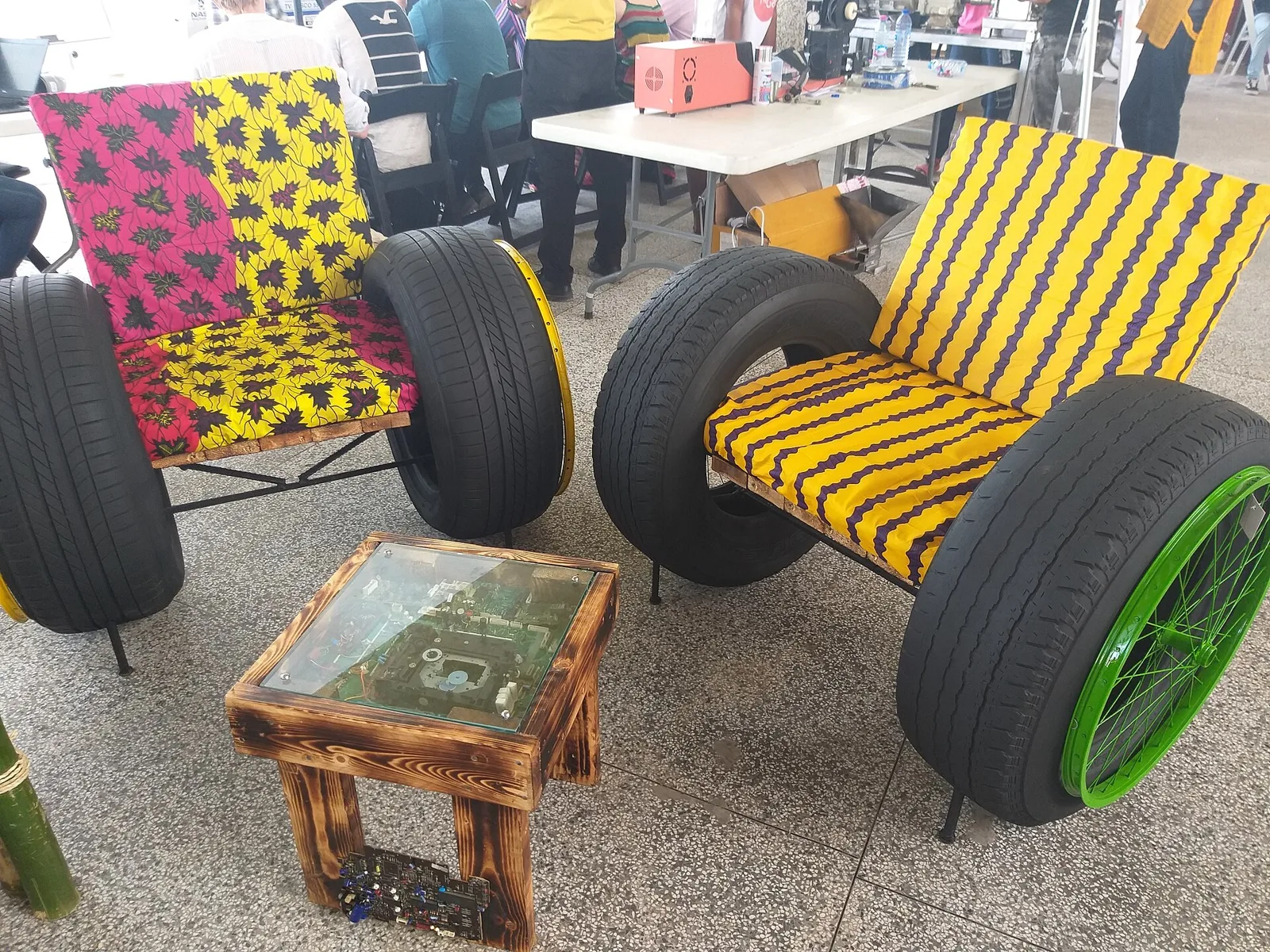
Beyond industry, tyres turn up everywhere. Stacks line racing circuits to spread the energy of a crash over a longer time than a concrete wall would. Whole tyres filled with earth and covered in concrete form the walls of earthships. Farmers set tractor tyres over springs as water troughs for cattle, athletes run through them in a drill that forces the feet up, and old ones hang as swings. Artificial reefs built from bonded tyres have not all worked: the Osborne Reef Project has turned into an environmental headache needing millions of dollars to put right.
Why are tyre fires so hard to put out?
Tyres are not prone to spontaneous combustion. Lighting a tyre calls for at least 400 degrees Celsius (750 degrees Fahrenheit) held for several minutes. That is why fires usually start with arson or carelessness around open flame. The real danger comes after. When a pile gets wet, water reaches the carcasses, the steel rusts, and the oxidation gives off heat. Rubber is a good insulator, so temperatures keep rising. At about 60 degrees Celsius rotting rubber releases methane and later cyclic hydrocarbons such as toluol and xylol, highly flammable fumes that keep the process going. The temperature at which those fumes burn is more consequential than the tyre's own.
Steel adds to the trouble. The hot wires act like the glowing spiral in a storm lighter, relighting the fire when it is blown out. The smoke is dark and rich, carrying cyanide, carbon monoxide, sulfur dioxide and the products of butadiene and styrene. Hot tyres conduct heat poorly, so they are hard to cool, they often burn inside after being extinguished outside, and they reignite easily. One remedy is to blanket a fire in sand, which cuts the oxygen supply and the smoke. Cooling can take several days, after which toxic chemicals can be neutralised.
Notable tyre fires
- 1983, Winchester, Virginia: arsonists ignited seven million tyres that burned for nine months and polluted the area with lead and arsenic; clean-up as a Superfund project ran until 2002.
- 1990, Hagersville, Ontario: a pile of 12 to 14 million tyres burned for 17 days and 4,000 people were evacuated.
- 1993, Inwood, West Virginia: a fire in a 10-acre pile, brought under control after 3 days, became the textbook response for fighting tyre fires.
- 1998, Tracy, California: seven million tyres at an unlicensed disposal site burned until, after 26 months, water and foam put them out.
- 1999, Sycamore, Ohio: arsonists lit an estimated 25 million tyres on 0.45 square km (110 acres); more than 250 firefighters and the National Guard fought it and dirt helped extinguish it.
- 2012, Sulaibiya, Kuwait: five million tyres burned; in 2020 about a million more burned at the same graveyard.
- 2016, Lockport, New York: more than 8 million pounds of crumb rubber went up, four buildings were destroyed and over 400 families had to leave.
- 2020, Bradford, England: 600,000 tyres at a former go-karting site burned for about a week before the fire was declared out.
Protesters also burn tyres, which are readily available and give off dense smoke; in 2012 burning tyres cut off main roads across Lebanon. In popular culture the phrase now means an appalling, seemingly endless mess, and The Simpsons gave its cartoon town of Springfield a permanent one.
What is changing in tyre recycling?
Effort is aimed at processing rather than burning. Pyrolysis and devulcanisation could make recycling easier, a proposed pyrolysis route would yield activated carbon and premium carbon black, and the problem of the solid residue remains a source of innovation. On the regulatory side, the European Commission's September 2022 draft would restrict or prohibit sales of granular infill for synthetic sports surfaces, and the review of chemicals on the candidate list continues.