A fixed camshaft has to be right for idling and for flat-out running, and it cannot be both. VVT and VTEC are the engineering answers.
Variable valve timing alters when an engine's valves open and close so one engine can run well at both low and high revs. Honda's VTEC, released in 1989, goes further by switching to a second cam profile at high rpm, changing valve lift and duration as well as timing.
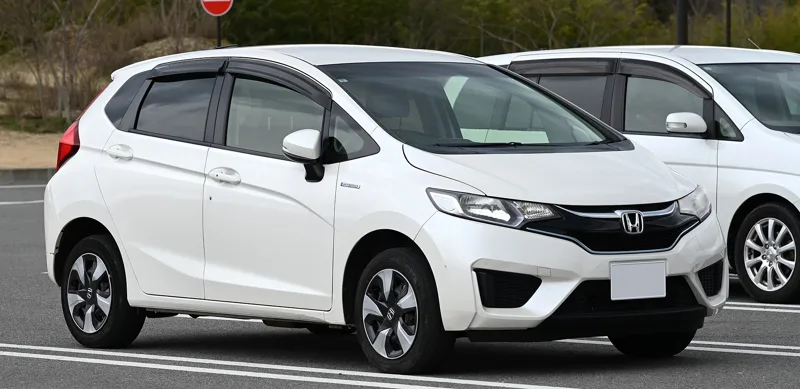
The first car to use variable valve timing was a 1903 Cadillac, built decades before Honda's engineers put VTEC into a hatchback. What Honda did in 1989 was different: it made an engine change its camshaft profile, not just the moment its valves opened, and then it let owners feel that change happen at a precise point on the rev counter.
Why does a fixed camshaft compromise an engine?
An engine breathes through valves, and the camshaft decides how they behave. As it turns, each lobe presses a valve open, and a spring closes the valve again once the lobe has passed. Three things matter. Timing is when the valve opens and closes relative to the position of the crankshaft. Duration is how long it stays open. Lift is how far it opens. The camshaft is driven from the crankshaft by a belt, gears or a chain, and in a four-stroke engine it turns at half the crankshaft's speed.
A fixed camshaft has one answer for all of those, whatever the engine happens to be doing. That is the problem. An engine at high speed needs a great deal of air, and if the intake valves close before enough has entered the cylinder, performance suffers. Leave the valves open longer, as a racing cam does, and the trouble moves to low speed. The intake valve then opens while the exhaust valve is still open, a period known as overlap, and unburnt fuel can leave the engine, which costs performance and adds to emissions. The engineer David Vizard describes the mechanism in his book Building Horsepower: with both valves open, the much higher exhaust pressure pushes the intake charge back out of the cylinder and fouls the intake manifold with exhaust.
Longer duration therefore tends to raise power at high revs and cost torque at low revs, and overlap hurts idle quality most, since the intake charge blows straight through to the exhaust at low rpm. Lift has its own limits: open a valve too far and the piston may strike it, and at high rpm the spring may fail to keep the valve following the cam, a fault called valve float that loses power and can bend a valve.
Timing alone gives a milder version of the trade. Advancing the camshaft, shifting it ahead of the crankshaft's timing, increases low-rpm torque. Retarding it increases high-rpm power. The changes involved are small, often in the order of 5 degrees, yet they move the whole power band.
Settings that are ideal at low speed fill the cylinder poorly at high speed and limit power. Settings that are ideal at high speed make low-speed running very rough and idling difficult. The ideal engine would vary timing, lift and duration freely, so the valves always open at the right moment, lift high enough and stay open exactly as long as the speed and load demand.
VTEC lets the engine start in comfortable shoes and lace up the spikes only when it is asked to sprint.
What is VVT and how does variable valve timing work?
Variable valve timing, or VVT, means shifting when a valve is lifted while the engine runs. Makers use it to improve performance, fuel economy or emissions, and tightening emissions rules are pushing more of them towards it. Hardware ranges from simple mechanical devices through electro-hydraulic units to camless designs. An engine with a variable system is freed from the fixed-camshaft constraint, so performance can improve across the operating range.
The simplest form is cam phasing. The camshaft is turned a little ahead of or behind its normal position against the crankshaft, which moves every opening and closing earlier or later. What phasing cannot do is change lift or duration. For variable duration the engineering gets complicated, with multiple cam profiles or oscillating cams.
Early systems worked in steps, with one timing below 3500 rpm and another above. Later ones adjust continuously, matching the timing to every speed and condition.
Moving the timing in different directions produces different benefits.
- Late intake valve closing holds the intake valve open a little longer, emulating the Atkinson cycle. It has been shown to cut pumping losses by 40% at partial load and nitric oxide emissions by 24%, with peak torque down by only 1% and hydrocarbon emissions unchanged.
- Early intake valve closing shuts the valve midway through the intake stroke. Studies found pumping losses fell by 40% and fuel economy rose by 7%, with a 24% cut in nitric oxide at partial load. The possible downside is a cooler combustion chamber, which can raise hydrocarbon emissions. Miller cycle engines with forced induction use it too.
- Early intake valve opening lets some inert exhaust gas flow back into the intake manifold, where it cools briefly before refilling the cylinder. That helps control cylinder temperature and nitric oxide emissions and improves volumetric efficiency.
- Early exhaust valve closing leaves more exhaust gas in the cylinder and raises efficiency, much as an EGR valve does. In some engines it replaces EGR altogether. Holding the exhaust valve open slightly longer instead empties the cylinder further for a bigger fresh charge.
Who built variable valve timing first?
Steam engineers got there long before the motor industry. Their term was variable cut-off, and the Stephenson valve gear on early steam locomotives supported it. The Serpollet steam cars used a patented sliding camshaft that varied the inlet cut-off and also let the engine reverse.
In cars, the 1903 Cadillac Runabout and Tonneau carried the first variable valve gear, under a patent filed by Alanson Partridge Brush. Vauxhall's chief designer Lawrence Pomeroy drew up a 4.4 L engine before 1919 whose single overhead camshaft was meant to slide so that different lobes could be engaged. The need became more pressing in the 1920s, when permitted engine speeds started to rise and idle and operating speeds were no longer close together. Porsche applied for a patent in 1958 using an oscillating cam, though no working prototype is known.
Fiat was the first to patent a functional system that included variable lift. Giovanni Torazza developed it in the late 1960s, moving the pivot of the cam followers with hydraulic pressure, giving a typical opening variation of 37%. Alfa Romeo then became the first manufacturer to put a variable system into production cars: the fuel-injected 1980 Spider 2000 had a mechanical system engineered by Giampaolo Garcea, and every Spider from 1983 used an electronic one.
Then came Honda. In 1989 the company released VTEC, and it broke with what had gone before. Nissan's earlier NVCS shifts the camshaft's phasing. VTEC instead hands over to a separate cam profile once the revs climb, for more peak power. Three years later, in 1992, Porsche introduced VarioCam on the 968, the first system to offer continuous adjustment, although it worked on the intake valves only.
What is VTEC?
VTEC stands for Variable Valve Timing and Lift Electronic Control. Honda developed it to improve volumetric efficiency, so that the engine makes more power when revved hard and burns less fuel when it is not. It uses two camshaft profiles, or occasionally three, and selects between them hydraulically. The system was invented by a Honda engineer, Ikuo Kajitani.
The distinction from ordinary VVT matters. Standard VVT changes only the valve timing. VTEC changes the camshaft profile and so the valve lift as well. Its roots reach back to a Honda system called REV, introduced on the CBR400 in 1983.
Japan taxes cars by engine displacement, so Japanese makers have concentrated on squeezing performance from small engines. Forced induction was one route, with the turbocharged Toyota Supra and Nissan 300ZX and the supercharged Toyota MR2. The Mazda RX-7 and RX-8 took a rotary route. Changing the cam timing profile was a third, and Honda's was the first production engine to switch between cams, varying timing and lift together.
What happens when VTEC kicks in?
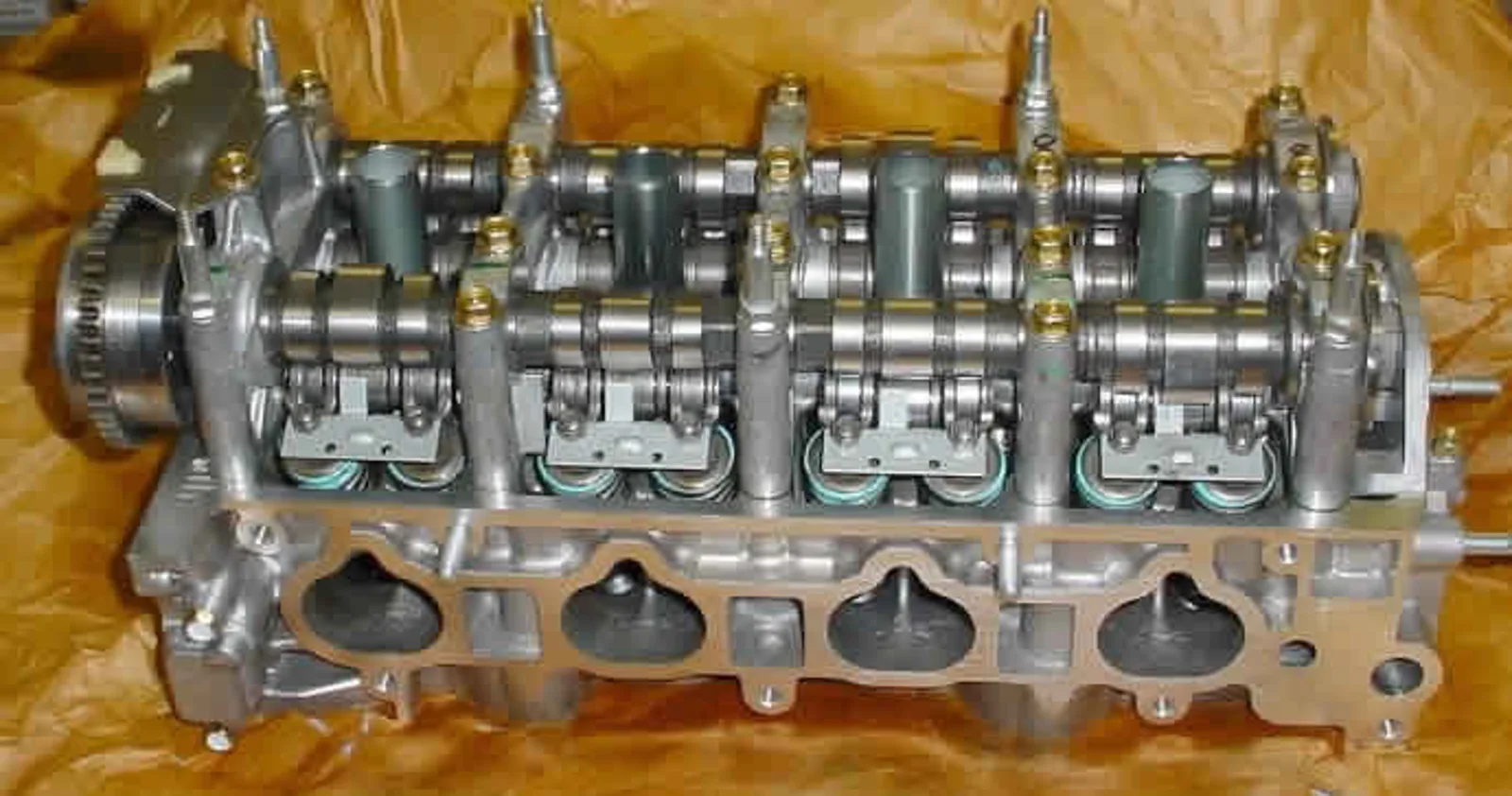
A conventional engine gives each valve a single cam lobe and follower. A VTEC engine swaps that for a multi-part rocker arm that can lock together, plus two cam profiles. One is tuned for stability and fuel efficiency at low rpm. The other is designed to maximise power at high rpm.
Picture two pairs of shoes: comfortable ones for walking round town and spiked ones for running. VTEC starts the engine in the comfortable pair and laces up the spikes only when it is asked to sprint, and oil does the lacing.
The engine computer decides when. It looks at oil pressure, engine and road speed, temperature and how far the throttle is open. When the programmed conditions are met, a solenoid opens and oil pressure from a spool valve pushes a locking pin across, locking the high-rpm rocker arm to its low-rpm neighbours. From that moment the valves follow the high-lift profile, which opens them further and for longer. The switch point is not fixed. It moves between a minimum and a maximum according to engine load.
The return trip is set for a lower engine speed than the upward switch. That gap, a hysteresis cycle, keeps the engine from dithering between profiles when it sits right at the changeover.
The benefit is what an older camshaft could not offer. A cam shaped for low-speed operation suits the way most street cars spend most of their time, but it pays with lost power and efficiency at higher revs. VTEC tries to keep the low-rpm stability and economy and still deliver high-rpm performance.
How did VTEC change Honda's cars?
The first VTEC engine Honda built was the B16A, fitted to the Integra, CRX and Civic hatchback sold in Japan and Europe. In Japan it arrived in the 1989 Integra XSi as a dual overhead camshaft system with 160 bhp (120 kW). The same year the Civic and CRX 1.6i-VT brought a 150 bhp (110 kW) B16A1 variant to Europe. The American market had to wait until the 1991 Acura NSX, which used a 3-litre C30A V6 with 270 bhp (200 kW).
More followed: the 1992 Acura Integra GS-R, with 160 bhp from its B17A1, the 1993 Prelude VTEC with 195 bhp (145 kW) from the H22A, and the del Sol VTEC. The Japanese-market Integra Type R, built from 1995 to 2000, produced 197 bhp (147 kW; 200 PS) from a 1.8-litre B18C engine. That gave it more horsepower per litre than most supercars of its day.
What are VTEC-E, three-stage VTEC and i-VTEC?
| Variant | What it does | Figures |
|---|---|---|
| DOHC VTEC | Switches between two cam profiles on both camshafts | B16A 160 bhp (120 kW), from 1989 |
| SOHC VTEC | Switches profile on the intake valves only | D-series and J-series engines |
| VTEC-E | One intake valve barely opens at low rpm to create swirl | Engages from 2500 rpm in later versions |
| Three-stage VTEC | Three intake cam profiles, selected by rpm | Stages at 2500-3000, 3000-5400 and 5500-7000 rpm |
| i-VTEC | VTEC plus continuous intake cam phasing (VTC) | 25 to 50 degrees of advance; K-series from 2001 |
On single overhead camshaft engines like the D-series and J-series, only the intake valves got VTEC. VTEC needs an extra centre rocker arm and cam lobe on each side, and in those engines the spark plugs sit between the two exhaust rocker arms, so there is no room. The centre lobe on a shared camshaft also cannot serve intake and exhaust together. The limit was lifted with the J37A2, a 3.7L V6 in the 2009-2012 Acura RL SH-AWD, which gave each cylinder six lobes and six rockers so that VTEC could work on both intake and exhaust. Its secondary intake rocker arms are shaped like a Y so that each one can contact two intake valves at once.
VTEC-E pursues economy. At low rpm one of the two intake valves opens only a tiny amount, which forces most of the charge through the other valve and sets it swirling. The swirl improves the mixing of air and fuel and permits a leaner mixture. When speed and load rise, a solenoid sends oil to a sliding pin that ties the two followers together and both valves follow the normal lobe. Later versions replaced that normal lobe with an aggressive one, identical to the original VTEC high-speed profile, so the fuel and low-speed torque benefits were combined with high performance. The lowest rpm for activation is 2500, or higher if the load is light.
Three-stage VTEC goes further. From idle to 2500-3000 rpm, depending on load, one intake valve opens fully and the other only slightly, which is why it is called 12-valve mode. At 3000-5400 rpm one solenoid engages and the second valve locks to the first valve's lobe, in a mode called 16-valve mode that resembles a normal engine. At 5500-7000 rpm the second solenoid engages and both valves use a third lobe tuned for peak power. The newer version in the Honda CR-Z moves between low-end and standard modes from 1000 to 2250 rpm, then takes the high cam above that.
i-VTEC, short for intelligent VTEC, adds Honda's VTC, which continuously varies the phasing of the intake cam on DOHC VTEC engines. It first appeared on the K-series four-cylinder family in 2001, and by the 2002 model year most Honda and Acura four-cylinders sold in the United States used it, the 2002 Accord being the exception. The valve lift and duration are still limited to the two distinct profiles, but the intake camshaft can advance between 25 and 50 degrees depending on the engine, through an adjustable cam sprocket that is driven by oil under computer control. At idle the intake phase is fully retarded; at full throttle and low rpm it moves somewhat forward, which sharpens torque at low and middle revs. Confusingly, Honda's J-series SOHC engines carry the same i-VTEC name for a completely different system.
Where this goes next
Valve timing control has spread well beyond petrol cars. Variable systems have reached marine engines, with a cam phaser on a Volvo Penta engine, and diesels: Caterpillar's C13 and C15 Acert engines used it in 2007 to cut NOx emissions, and Mitsubishi's 1.8 L 4N13 became the first passenger-car diesel with a variable system when it entered mass production in 2010. Motorcycles were slower: as late as 2004 the weight penalty made it a showpiece, but later bikes such as the Kawasaki 1400GTR, Ducati Multistrada 1200 and BMW R1250GS adopted it.
The camless route removes the camshaft altogether. Electromagnetic and pneumatic actuators control the valves precisely, yet they are still hard to make at a price mass-market cars can bear. Koenigsegg's Freevalve system was offered in the Gemera when it was announced in 2020. The camless three-cylinder option was cancelled ahead of 2024 production because few customers wanted it, and a V8 replaced it.