From the 1906 mirror to the 2018 camera mandate: what hides around a car, and the tools that now show it to the driver.
A blind spot is any area around a vehicle the driver cannot see. Mirrors cover the sides and rear quarters, while the strip behind the bumper needs a camera. Backup cameras became compulsory on new US vehicles from May 2018, following the 2007 Gulbransen Act, with Canada mandating them at the same time.
The boot or rear deck of an ordinary car can hide as much as 3 to 5 metres (10 to 15 feet) of road behind it. A mirror cannot see that space, which is exactly where a small child can stand. That is the gap reversing cameras were built to close, and it is why, in the United States and Canada, they are now compulsory on new vehicles.
What is a vehicle blind spot?
A blind spot is any part of a vehicle's surroundings that the driver at the wheel cannot see directly. Driver visibility, the greatest distance at which you can identify prominent objects around the car, depends on weather and on design: the windscreen, the dashboard and the pillars all play a part. Blind spots turn up on aircraft, cars, buses, trucks, tractors, boats, trams and trains.
In a car there are several. Ahead, the A-pillar, the side mirror or the interior mirror can block part of the road. Behind, cargo, headrests and extra pillars take away visibility. Low areas near the front, back and sides are also out of sight, especially when the seating point is high. The best-known one sits at the rear quarters on both sides, where a car in the next lane can drop out of view in the mirrors. A driver can check it by turning their head, which risks a rear-end collision, or reduce it with mirrors of wider field of view.
Large trucks have what is called a no zone, a set of areas the driver cannot see, and collisions are frequent in them.
The area directly behind a vehicle is where backup collisions begin, and it has been called a killing zone.
How do mirrors cover the blind spot?
The rear-view mirror is usually a plane mirror fixed at the top of the windscreen on a double-swivel mount. The mount lets any driver adjust height and angle, and lets the mirror swing harmlessly aside if an occupant strikes it in a collision. One or more side mirrors supplement it, and on trucks, motorcycles and bicycles the side mirrors are the only rear-vision mirrors.
The idea is older than most people assume. A trade magazine noted in 1906 that mirrors showing what was behind were popular on closed-bodied cars and were likely to spread quickly, and a French warning mirror was patented the same year. The adjustable Argus Dash Mirror followed in 1908. Ray Harroun fitted what is the earliest known rearview mirror on a race car, his Marmon, at the first Indianapolis 500 in 1911, though he said it vibrated constantly on the brick surface and was largely useless. Elmer Berger, usually credited with inventing the mirror, was the first to patent it, in 1921, and to develop it for production cars. He sold it as the Cop-Spotter, a way of avoiding police when speeding.
Rear view mirror types: day, night and self-dimming
The prismatic mirror, often called day/night, is a wedge of glass whose front and rear surfaces are not parallel. In day position the silvered rear surface gives a strong reflection. Flip the tab to night and the rear surface tilts out of line, so the driver sees only the faint reflection from the front glass, and following headlights stop dazzling. Manual versions appeared in the 1930s and were standard fitment on most cars and trucks by the early 1970s.
Automatic dimming came from the American inventor Jacob Rabinow in the 1940s. Chrysler sold it as Mirror-Matic on nearly all its US models from 1959 to 1961 at $23.25 in the 1960 catalogue; a solenoid flipped the mirror when a rear-facing light sensor detected glare. It lasted only four years, and it is generally believed it sold poorly, though sales figures are unknown. Automakers revived the idea in 1983, and it caught on in the late 1980s. Current systems use photosensors and electrochromism to dim the mirror, and the same trick has reached side mirrors. Aftermarket secondary mirrors also exist, clipped to the main one so adults can watch children in the back seat.
Blind spot mirror setup: two views
Side mirrors can remove the side blind spots if they are set up carefully. The method points them well outboard, so that the side of your own car is barely visible when you lean in towards the centre, and it is said to be a lifesaver. It costs nothing, which is its appeal against expensive technology, but it is often skipped in driver education and takes some getting used to.
Not everyone agrees. One critic calls the method a driving mistake, even more dangerous than leaving mirrors alone, because it creates other blind spots right behind the vehicle, nine reasons being listed, which a shoulder check cannot remove.
The killing zone behind the car
None of that touches the area directly behind a vehicle. That zone is where backup collisions involving pedestrians, children and objects begin, and it has been called a killing zone. A rear deck can hide the road for 3 to 5 metres (10 to 15 feet) behind the car. In the US, the figure cited is as many as 50 small children killed by SUVs each year, with drivers unable to see them in the mirrors.
The technical answers, in rough order of complexity, run from the rear-view mirror and side-view mirror through the Fresnel lens, sonar and parking sensors to the backup camera. Cross-traffic alert systems deal with a related problem, the positions to the left and right of the rear bumper when backing out of a parking space.
On trucks and buses the problem is larger. The load often blocks the rear window, so drivers rely on side mirrors and are left with a big unviewable area behind that narrows with distance. Drivers compensate with a person guiding them through tight, crowded spaces, or by reversing in an arc. Convex spot mirrors, usually on at least the right side, give a distorted view of the whole side of the vehicle.
How does a backup camera work?
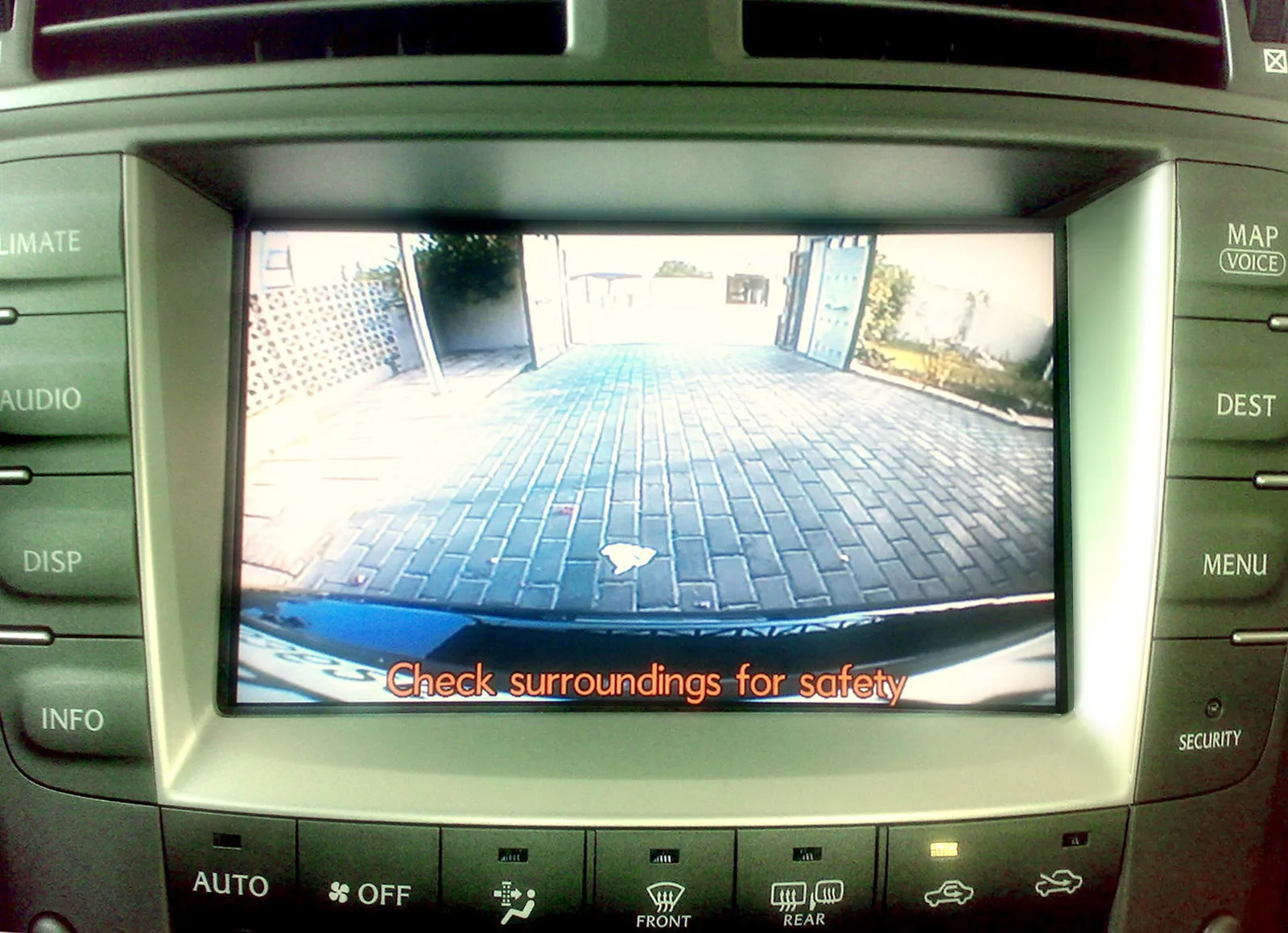
A backup camera is a small video camera at the back of a vehicle, wired to the head unit display, that shows the area behind you while you reverse. Several design choices set it apart from an ordinary camera.
- The image is flipped horizontally into a mirror image. The camera and the driver face opposite ways, so without the flip the camera's right would appear on the driver's left. The mirrored picture matches the physical mirrors.
- The lens is wide or fisheye, often exceeding a 160-degree horizontal field of view. That limits how well it sees distant objects, but it covers an uninterrupted strip from one rear corner to the other.
- It points downward to see low obstacles on the ground.
- Because fisheye lenses bend straight lines, electronic control units apply real-time dewarping algorithms and Inverse Perspective Mapping to give the driver a clear view. Some screens add a grid overlay as a distance guide.
- The display switches on automatically when the transmission is put into reverse.
Camera feeds do not always sit on the centre dashboard screen. In the late 2010s some vehicles began offering a backup display in the roof-mounted centre mirror, switchable by the driver, and some show the camera when the indicators are used at a standstill or going forward.
Types of reversing camera
Systems can be added to cars that lack them, in wired or wireless form. Wireless kits are easier and cheaper to install, because they pair a camera with a receiver and need no cable between them; some models sync with a phone app. Large vehicles such as motorhomes may carry cameras that the driver can pan and tilt remotely, and an audio intercom helps when a spotter is guiding a trailer or boat. Night vision cameras use infrared lights where white reverse lights are not enough. A licence-plate-frame version fits without permanent modification, and some designs combine a camera with a brake light.
Firsts in reversing cameras
| Year | Vehicle | What was new |
|---|---|---|
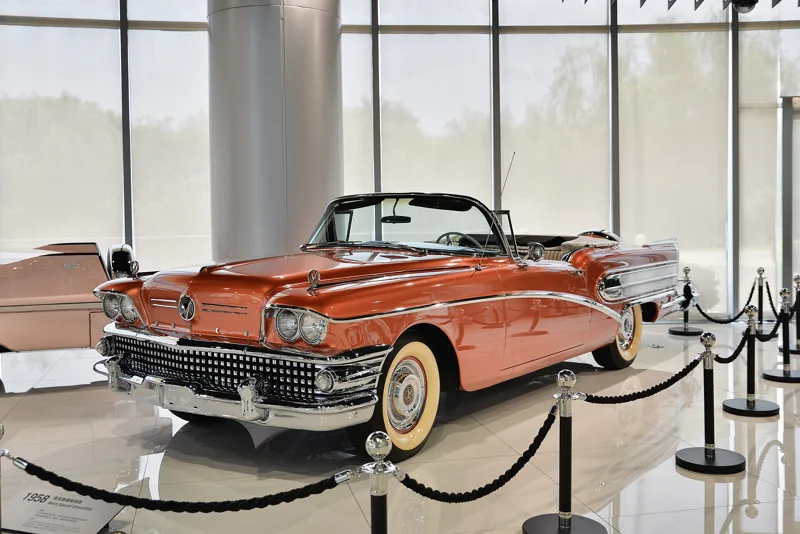
| 1956 | Buick Centurion concept | Rear television camera feeding a dashboard screen in place of the mirror |
| 1972 | Volvo Experimental Safety Car | Backup camera, though it did not reach the Volvo 240 |
| 1987 | Toyota Crown (Japan only) | First production car with a backup camera, using a colour screen and a spoiler-mounted CCD camera |
| 2002 | Infiniti Q45 | Rear View Monitor with a plate-mounted camera and 7-inch in-dash screen |
| 2008 | Infiniti EX35 | First surround-view cameras, marketed as Around View Monitor |
| 2018 | Lexus ES (Japan) | Cameras offered in place of side view mirrors |
Why did reversing cameras become mandatory?
The backup camera law began in the United States with the Cameron Gulbransen Kids Transportation Safety Act of 2007. It required the Department of Transportation to issue backup-collision regulations within three years and to demand full compliance within four years of the final rule. The deadline for the rule was February 2011, but the department repeatedly extended it to analyse costs and benefits.
In September 2013 Greg Gulbransen, whose child gave the law its name, joined a group of consumers and advocates in petitioning the Second Circuit Court of Appeals to demand regulations within 90 days. By then about half of model year 2012 cars carried a camera. On 31 March 2014, three years past the deadline, the National Highway Traffic Safety Administration announced that all vehicles sold in the US built from May 2018 must have one. Transport Canada issued a similar mandate on 31 October 2016, starting at the same time.
Since May 2018, a backup camera has been required on every new vehicle sold in the US, and Canada regulates them as well.
Surround-view and camera mirrors
Surround-view systems go further than one camera. Infiniti introduced the first on the 2008 EX35 with four cameras at the front, back and sides, and an image processing unit stitched the pictures into an artificial but positionally correct bird's-eye view. In most modern systems the detail is such that it is hard to believe the picture was not taken from above. Toyota sells a similar system as Bird's Eye View Camera and Chevrolet as Surround Vision.
Cameras can replace side mirrors too. The Japanese-market Lexus ES offered the option from October 2018, and it is also available on the Audi Q8 e-tron and Hyundai Ioniq 5. Alongside them, some blind spot monitors add Cross Traffic Alert, and side radar can warn when a fast vehicle closes on the blind spot.
Why car designers cannot just remove the pillars
Blind spots in front of the driver come from design as much as from equipment. Most cars have a diagonal A-pillar at about 40 degrees to the horizon, which is strong, aerodynamic and leaves a decent door opening. A panoramic windscreen allows vertical pillars and the best forward view, as on the Saab 900, school buses and almost all Cadillacs from 1954 to 1959. But an aerodynamic small car cannot have a vertical pillar: the more upright it is, the less room the door has, and the greater the frontal area and drag.
The opposite extreme is the Pontiac Firebird and Chevrolet Camaro of 1993 to 2002, with a windscreen at 68 degrees from the vertical, which is only 22 degrees from the horizon. A flat pillar lowers drag and strengthens the body in a frontal crash, and it helps pedestrians by sending them up and over rather than into the glass. The cost is a narrower 180-degree view for the driver, and practical irritations: others cannot see the driver through the reflection, the heater takes longer, snow does not slide off and the glass is hard to reach for cleaning.
Driver height changes the picture too. A split A-pillar with a small triangle of glass can trouble a short driver, while a rounded pillar or a B-pillar in a small four-door can trouble a tall one. Turning your head cuts or removes a blind spot and improves depth perception. Convertibles need thicker A-pillars, though once the roof is folded the B and C pillars disappear, which opens up the view behind. Other forces limit what designers can do: narrower pillars are harder to make strong, taller windscreens create drag and cost fuel economy, and fashion and cost can come first.
Where this goes next
Cameras are starting to replace side mirrors on a few models, as the Lexus ES, Audi Q8 e-tron and Hyundai Ioniq 5 show, and surround-view and side radar systems now sit beside them. The technology available to a driver has moved from a single piece of glass to a screen that stitches several views into one.
What it means for a buyer or a driver
If you drive a new car in the US or Canada, you already have a camera. If your car lacks one, aftermarket systems come wired or wireless, and some fit in a licence plate frame. Whatever you drive, the mirrors remain your first tool, and setting them well is free. And keep in mind what the camera does best: it covers the narrow strip right behind the bumper, while the sides still depend on mirrors, radar and a glance over your shoulder.