Oscar Montabone's clean-sheet design, the Sport Coupe and Spider, and the Soviet VAZ Zhiguli that made the platform one of the best-selling in history.
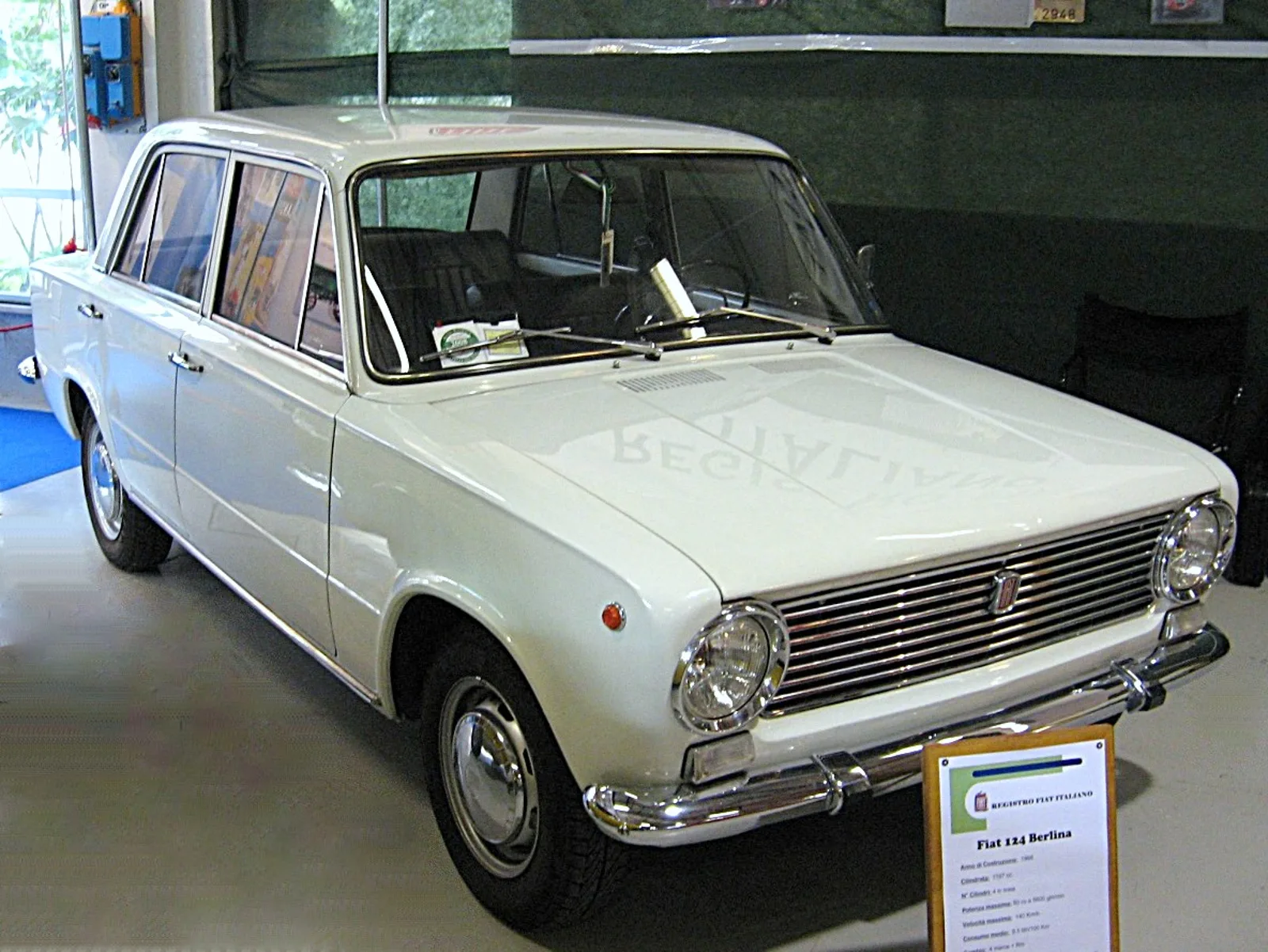
The Fiat 124 was a small family car built by the Italian maker from 1966 to 1974. It spawned estate, coupe and convertible variants and was licensed worldwide, most notably as the Soviet VAZ-2101 Zhiguli, which was sold as the Lada abroad.
Fiat launched the 124 in 1966 as a clean-sheet family saloon with a roomy interior and modern running gear. Its underpinnings spawned an estate, a sporting coupe and a convertible, and the design was built under licence around the world. On the all-time list of automotive platforms it sits fifth.
Where did the Fiat 124 come from?
The 124 was a clean-sheet design led by chief engineer Oscar Montabone. It replaced the Fiat 1300 in the saloon line and borrowed only its all-synchromesh gearbox from the Fiat 1500. The saloon arrived in 1966, and the estate and Sport Spider debuted at the 48th Turin Motor Show that November.
The specification included a spacious interior, coil spring rear suspension, disc brakes at every corner and lightweight construction. Fiat promoted the launch with a stunt in which a 124 was dropped by parachute from an aircraft. In 1967 the car collected the European Car of the Year award.
The design was aimed at mainstream family buyers, and the same underpinnings later supported a family of sporting and licensed derivatives. That breadth is the real story of the 124, more than any single model within the range.
A clean-sheet family saloon that became a Soviet bestseller under another name.
What were the Sport Coupe and Sport Spider?
The sporting variants used a 1.4-litre engine with two overhead camshafts. It was rated at 90 DIN PS, or 66 kW and 89 hp, at 6,500 rpm. The Sport Coupe completed the range at the Geneva Motor Show in March 1967, and the Sport Spider convertible ran from 1966 to 1982.
The Sport Coupe was a two-door, four-seat notchback, and its three generations ran from 1967 through 1975. It shared its twin cam engine with the Spider, and from late 1968 both sporting models adopted the improved five-link rear axle first seen on the Special.
Fiat also produced one-offs around the car. A Touring cabriolet was shown at Turin in 1966, but only one example was made. Moretti sold about 60 coupes through the Fiat network in Italy, giving buyers a rarer alternative to the standard Sport models.
How did the 124 Special change the car?
The 124 Special arrived in October 1968 as an upmarket, better-appointed and quicker version of the saloon. It used a 1,438 cc overhead valve engine, a new five-link rear axle and a rectangular grille with four inset round headlamps. Fiat claimed more than 150 km/h, or 93 mph, for the top speed.
The dashboard was reworked with an oval instrument binnacle holding two round dials, plus a radio console. Output was 70 DIN PS, equal to 51 kW or 69 hp, at 5,400 rpm, while torque peaked at 110 newton-metres at 3,300 rpm.
Beyond the engine and rear axle, the Special swapped the dynamo for an alternator, uprated its clutch, made radial tyres standard and added a vacuum servo to the disc brakes. Those were practical upgrades that moved the car further from the basic saloon.
What changed in the 1970 revisions?
At the Turin show in November 1970, Fiat updated the whole saloon and estate range with C-pillar air outlets and a split brake circuit. Features previously exclusive to the Special, such as servo-assisted brakes, a back-up light and an alternator, became standard across the range.
The new Special T used a 1,438 cc twin cam engine rated at 80 DIN PS, which is 59 kW or 79 hp, at 5,800 rpm. Fiat quoted a top speed of 160 km/h (99 mph). The T stood for twin cam, and the car was otherwise identical to the Special apart from its rear badging.
The third series arrived in 1972 with a standard 1.2 engine now giving 65 DIN PS (48 kW; 64 hp). It came with a matte black grille and flush door handles borrowed from the Special. The Special T could now be ordered with a 1600 twin cam from the Fiat 132 saloon, which produced 95 PS, or 70 kW and 94 hp, with a top speed of 170 km/h, equal to 106 mph.
Which engines did the 124 use?
The range covered the 1200 with 60 to 65 PS, the 1400 with 70 to 75 PS, the 1400 Special T twin cam with 80 PS and the 1600 Special T with 95 PS. The standard engine was a 1.2 litre (1,197 cc) overhead valve inline-four, while the Special T used a twin cam unit.
The Special T used a four-speed gearbox, with a five-speed available as an option. The twin cam unit shared its heritage with the Sport models, which tied the mainstream and sporting versions of the car together.
How did the 124 become the Lada?
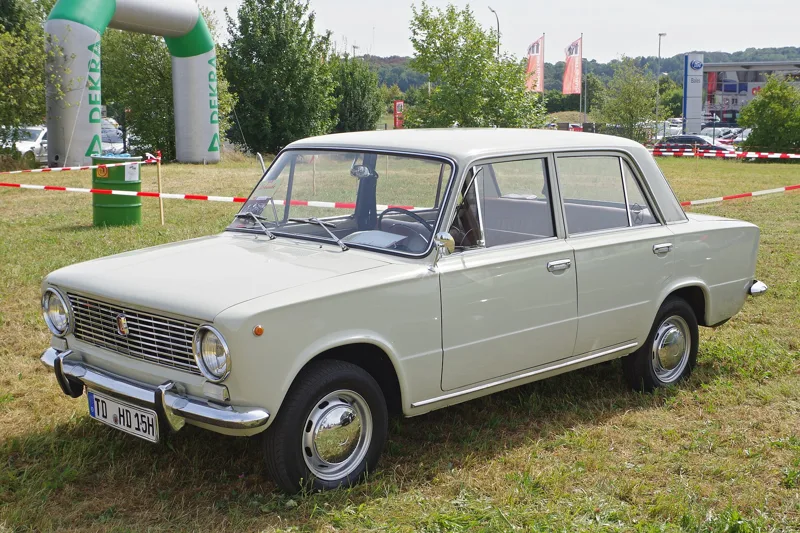
Fiat signed a collaborative agreement with the Soviet government in 1966 to build cars in the Samara region. The result was the VAZ-2101 Zhiguli, built at the new Togliatti plant and sold as the Lada 1200 and 1300 in export markets, with modifications made at more than 800 points.
Production of the Soviet line continued in heavily revised forms. The VAZ-2104, 2105 and 2107 were restyled and marketed in the UK as the Lada Riva. Output across the family reached 17,332,954 cars, a volume that ranks third among the largest production runs for a single car design.
Licensing spread well beyond Russia. SEAT produced the car in Spain from 1968 to 1975, Tofas built 134,867 Murat 124s in Turkey between 1971 and 1994, and Asia Motors assembled a Korean version from 1970 to 1975. Premier Automobiles also released an Indian model, the 118NE, in the autumn of 1985.
When did the Fiat 124 end?
The 124 was superseded in Italy by the Fiat 131, launched in 1974, which brought the original design to an end in its home market. Licensed production lasted far longer, with Lada-Egypt building at least 9,000 cars from 2002 to 2007.
Licensed variants outlived the Italian original by decades. Production in India ended in 2001, while the Soviet-built Rivas continued until September 2012, long after the Italian plants had moved on.
Why does the 124 still matter?
The 124 matters because its design travelled further than almost any other Fiat. Its platform was built in Russia, Spain, Turkey, India and South Korea, and the Soviet version alone ranks among the largest production runs in automotive history, which is what gives the car its place in the record books.
Its place on the all-time platform list reflects the reach of the licensed versions rather than the number of Fiats sold in Italy alone. The sporting Coupe and Spider gave the family a more exciting face, but only the saloon's underpinnings carried the design across so many markets.
Enthusiasts still seek out the sporting models, while the Lada derivatives remain a common sight in parts of the world that never saw the Italian original.
Which rare 124 variants existed?
Few 124 variants were ever built. The Touring cabriolet exists only as a single example shown at Turin in 1966, and Moretti produced about 60 coupes for sale in Italy. Fiat's own ESV 2500 safety experiment, built in 1972, used 124 mechanicals in a heavier five-door body.
The ESV 2500 was an experimental safety vehicle with an extra strong passenger cell. Its body weighed 43% more than the standard 124, a reminder that safety engineering added mass in the early 1970s.
What did the 124 interior look like?
The 1972 third series brought a more finished cabin, with a strip of wood veneer on the dashboard, dark dial backgrounds and a water temperature gauge. A spot for a radio was added too. A boucle carpet replaced the rubber floor mats, and the speedometer scale ran to 170 km/h (106 mph).
The 1970 update had already changed the cabin, adding imitation wood inserts to the dashboard and cloth upholstery. Together, those changes gave the 124 a more finished interior across its production life.
How did the SEAT 124 differ from the Fiat?
In Spain the car was built as the SEAT 124 from 1968 to 1975, under a licence agreement between Fiat and SEAT. A clone based on the 124 Special, with some elements of the Fiat 125, was also produced there from 1969 to 1975.
In 1975 Giorgetto Giugiaro reworked the SEAT 124 with rectangular headlamps and taillights integrated into the body. Renamed the SEAT 124D, it remained in production until 1980, and the sporting versions carried the FL codename.
How did assembly work in Malaysia and Bulgaria?
Malaysian production began at the Kilang Pembena Kereta-Kereta plant in Tampoi, Johor, in the latter half of 1967, using a 1.2-litre engine producing 60 hp. The 124 Special joined that line-up in late 1969, and the twin cam 124 Special T followed in late 1971.
In Bulgaria the car was assembled as the Pirin-Fiat in Lovech from complete knockdown kits between 1967 and 1971. In South Korea, Asia Motors built the Fiat-KIA 124 from 1970 to 1975, with 6775 units assembled, showing how far the design travelled by kit.
What were the Murat 124 and Serce?
Tofas, based in Bursa, Turkey, produced the Fiat 124 as the Murat 124 between 1971 and 1977. The car returned under the name Serce, meaning sparrow in Turkish, from 1984 to 1994. Its licence arrangement kept Fiat's design alive in Turkey long after production ended in Italy.
In total 134,867 Murat 124s were built between 1971 and 1994. Tofas also ran the Fiat 131 series alongside it as the Murat 131 from 1976 to 2002, and the company now builds current Fiat models.
How did the Soviet Lada differ from the Fiat?
The Soviet version was far from a straight copy. The VAZ-2101 Zhiguli used an entirely different overhead camshaft engine and a hydraulic clutch, and it kept drum brakes at the rear. Those changes made the Lada a distinct car rather than a simple copy of the Fiat design.
Early variants included the VAZ-2102 station wagon, the 2103 Lada 1500 and the 2106 Lada 1600, while the 21011 became the Lada 1300. The later restyled models, the 2104, 2105 and 2107, were the ones sold in the UK as the Lada Riva.
How should the 124 be remembered?
The 124 is best remembered as a platform rather than a single model. Its saloon, estate and sporting variants were only part of the story, and its licensed descendants carried the design far beyond Italy. Its legacy rests on breadth as much as on any single model in the range.
In Spain the SEAT version was sold in both four-door and estate forms, a reminder that the original design could stretch to suit different markets and different buyers.
Frequently asked questions
How fast was the 124 Special?
The 124 Special was advertised at over 150 km/h, and a 1972 Special T with the 1600 twin cam was quoted at 170 km/h, or 106 mph.
Who built the Lada?
The Lada name was used outside the Soviet Union for the VAZ-2101 Zhiguli, which was built at the VAZ plant in Togliatti under a 1966 agreement between Fiat and the Soviet government.
Was there a convertible 124?
Yes. The Sport Spider convertible was built from 1966 to 1982, and Pininfarina produced it from 1982 to 1985.
What replaced the 124 in Italy?
The Fiat 131 replaced the 124 in its home market in 1974.