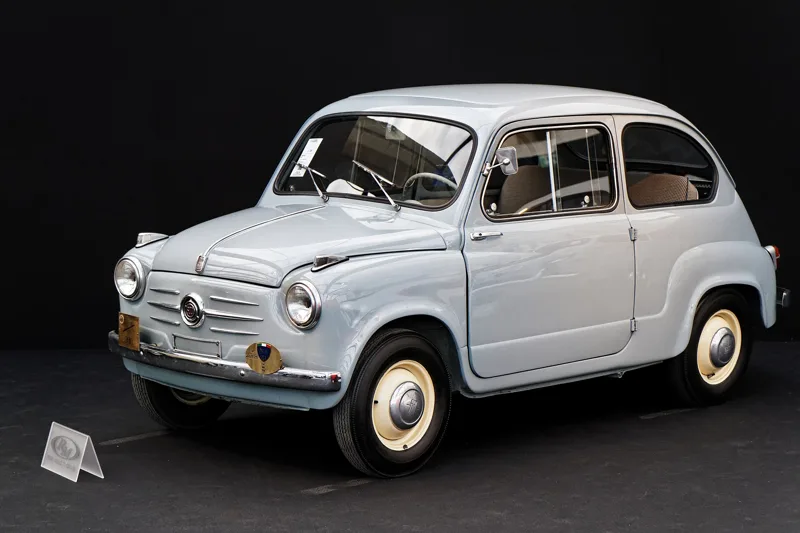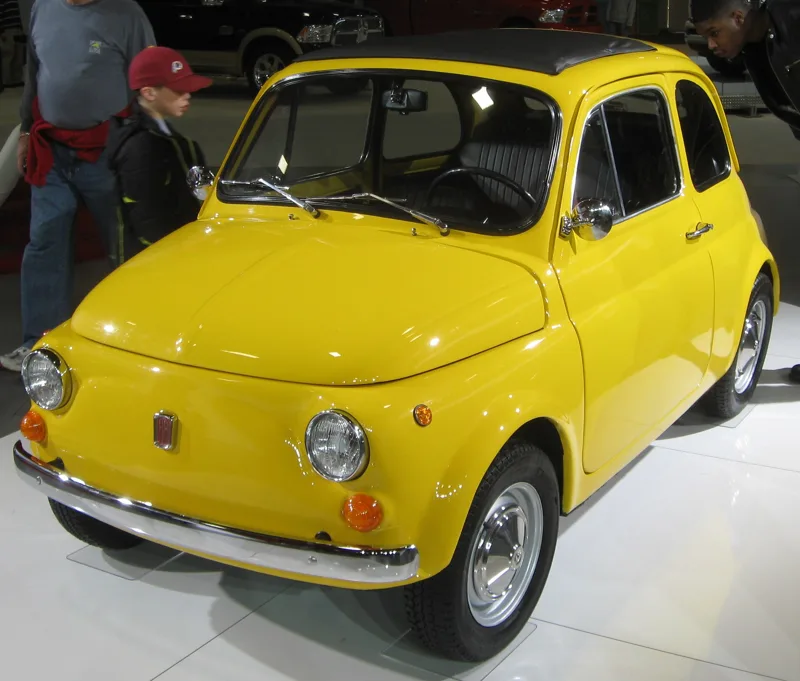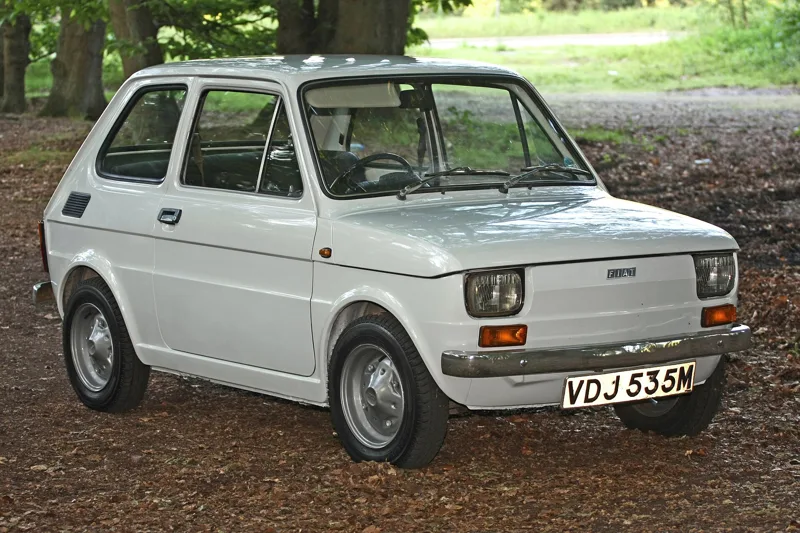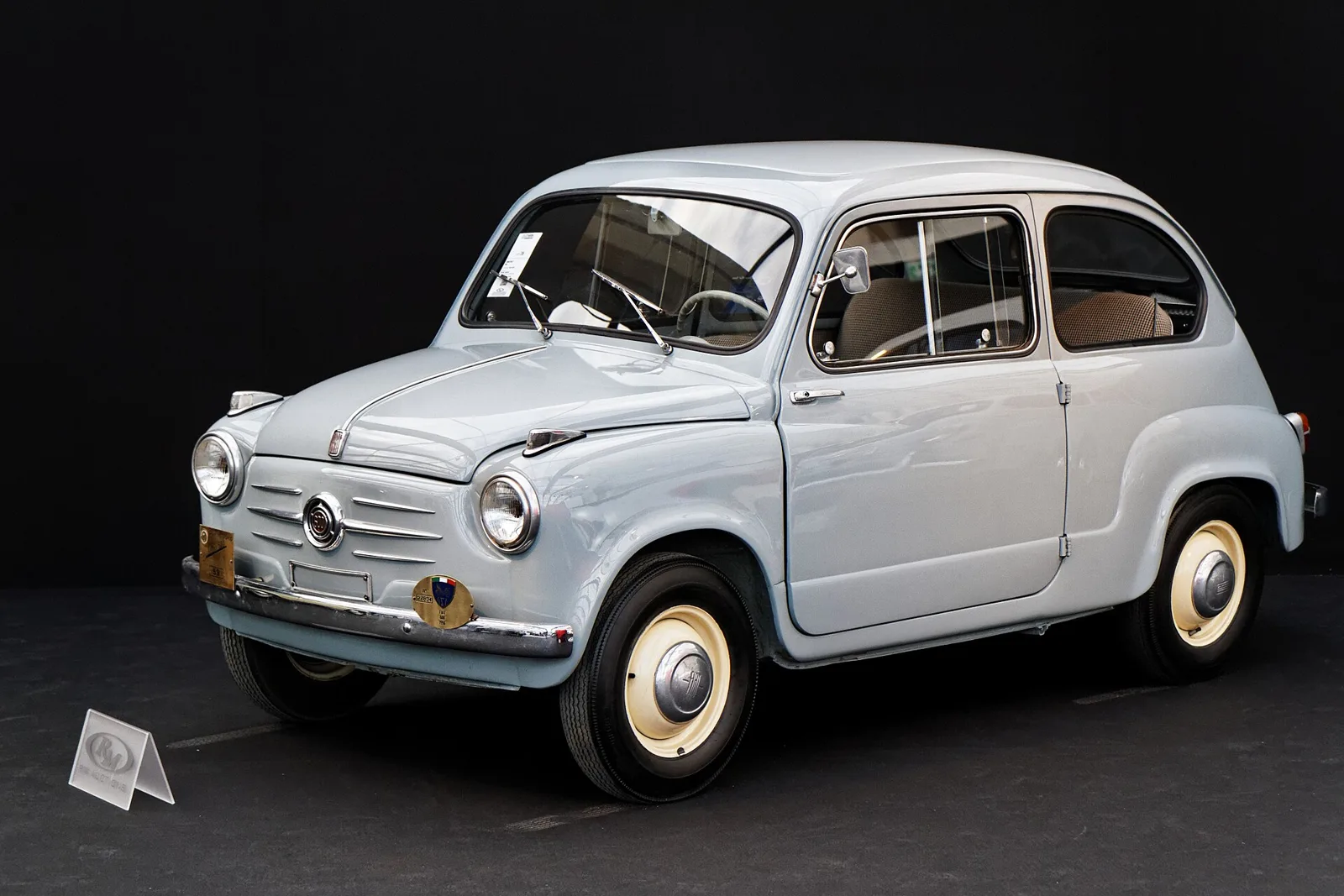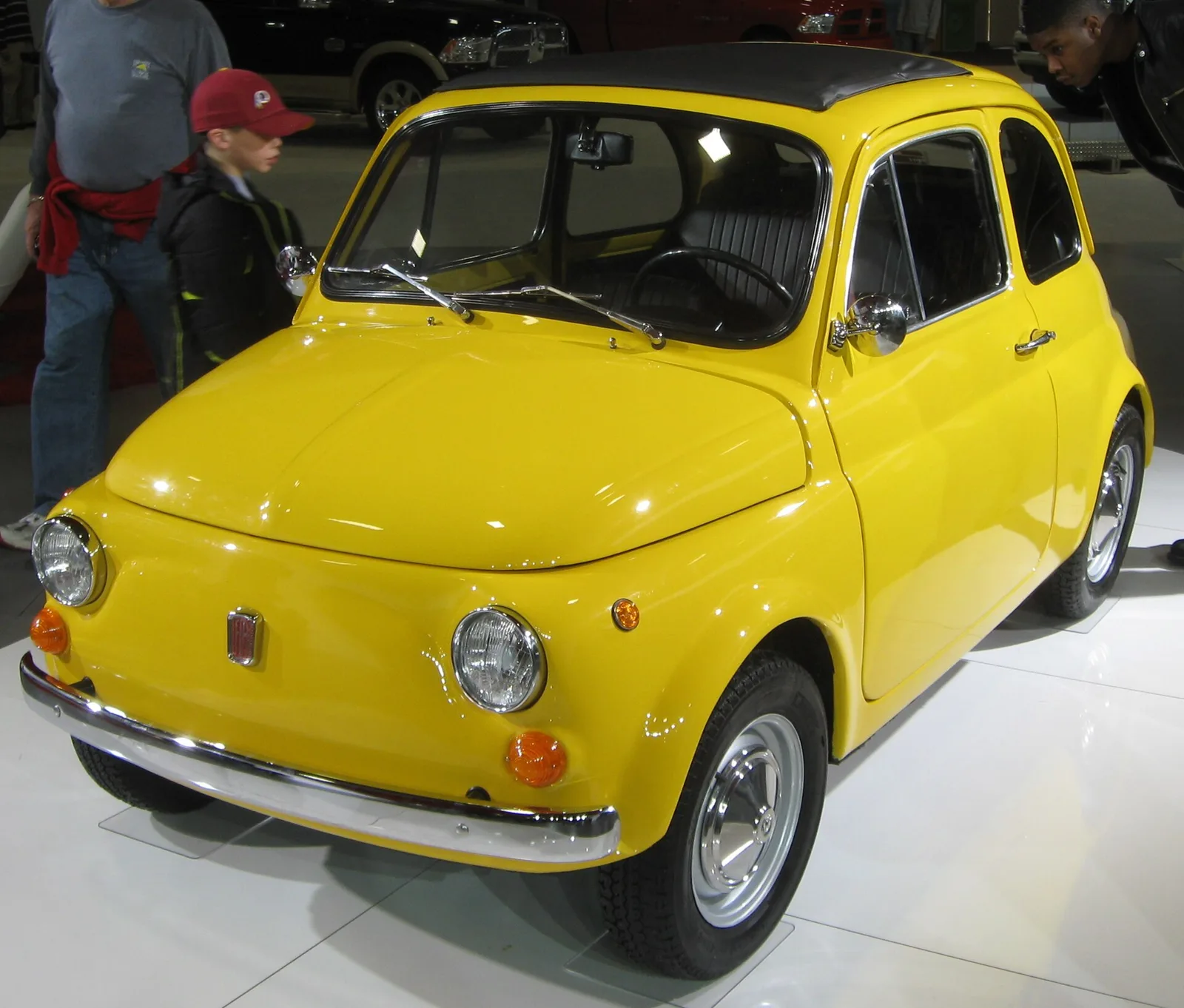
A 479 cc rear-engined two-door that spawned estate, van, Abarth and US-market versions before the line ended in 1975.
The Fiat 500 was a two-door economy car built from 1957 to 1975, launched as the Nuova 500 with a 479 cc rear-mounted engine. It was offered as a saloon, estate and van, and it inspired Abarth performance versions. A 2007 model later revived the name.
The Fiat 500 was an economy city car built by Fiat from 1957 to 1975. It came as a two-door saloon, an estate known as the Giardiniera and a three-door panel van. Launched as the Nuova 500 in July 1957, it became one of the first purpose-designed city cars and stayed on sale for nearly two decades.
Where did the Fiat 500 come from?
The Nuova 500 succeeded the 500 Topolino, a front-engined economy car of 1936. Launched in July 1957 with a rear-mounted 479 cc two-cylinder engine, it was smaller than the Fiat 600, which had replaced the 500C in 1955. Designer Dante Giacosa later won a major design prize for the car.
Before the rear-engined range arrived, Fiat had brought back its 500C after the war in 1949. That earlier car had a front engine and a two-door coupe body with a sunroof, and it was complemented by an estate version that offered useful rear seating.
The Nuova was 2,970 mm (9 ft 9 in) long and 245 mm (9.6 in) shorter than the Fiat 600. In 1959 Giacosa received a Compasso d'Oro industrial design prize, the first time such an award went to a car maker, which gave the little car a lasting place in design history.
The idea behind the new car was simple. A small, light machine with a rear engine could carry a family and luggage at low cost, and the Nuova 500 proved that a city car could be practical as well as cheap to run.
A small rear-engined car that showed a city car could be practical, cheap and a little bit sporting.
How did the Nuova 500 work?
The Nuova 500 used a 479 cc two-cylinder air-cooled engine mounted at the rear, producing 13 hp (10 kW). It had a fabric roof that folded to the rear and a drag coefficient of Cd=0.38, which was good for its time. It is one of three models with suicide doors.
The layout followed the pattern of the Volkswagen Beetle, with the engine behind the rear axle. Without a front engine, the body could stay short while still giving passengers a usable cabin.
Suicide doors are hinged at the rear edge, so each door opens from the back. The arrangement was seen on several small cars of the period and gave easy access to the seats.
Including the Sport model, 181,036 Nuova 500s were built from 1957 to 1960. That volume made it one of the most successful small cars in Europe at the time, and it set the template for the later 500 family.
What was the Nuova 500 Sport?
The Nuova 500 Sport arrived in 1958 with the engine bored to 499.5 cc, giving 21.5 PS (16 kW; 21 hp). It was finished in white with a red flank stripe and had an all-metal roof with three longitudinal grooves. Its top speed was over 105 km/h (65 mph).
Only the Sport wore that two-tone livery, which made it easy to pick out from the standard car on the street. A short open-roof version appeared later, giving buyers a lighter and more open alternative.
The bored-out engine kept the same basic block, so the extra output came from the bore and internal tuning rather than a larger design. For a small car of its generation, the Sport offered a noticeably livelier drive.
Which 500 versions followed the Nuova?
The 500 D replaced the Nuova in 1960 with a 499 cc engine, and the 500 F and L later brought front-hinged doors and richer trim. The Giardiniera estate ran from 1960 to 1968, and the 500 R closed the range from 1972 to 1975.
The D's engine produced 17 bhp (13 kW). Its standard roof did not fold as far back as the Nuova's, although a Transformable version kept the earlier design for buyers who wanted it.
The Giardiniera put its engine under the boot floor to create a flat load area, and its roof ran all the way to the rear. Production moved to Desio in 1966, where Autobianchi built it from 1968 to 1977.
The 500 F was the version most often misidentified, because it carried the same badging as the D in its early years. Its front-hinged doors were the clearest difference, and they were introduced in response to new safety rules for passenger cars.
The 500 L Lusso, introduced in 1968, added tubular guards to the bumpers and a trapezoidal instrument binnacle. Its interior was dressed in plastic rather than bare metal, and the car offered a more modern cabin than its predecessors.
The 500 R was launched in 1972 with a 594 cc engine shared with the Fiat 126. It was a stop-gap model, and sales of the older car dropped once the 126 arrived, although the 500 R stayed in production alongside it for three more years.
What was the Abarth 695 SS?
The Abarth 695 SS was the most serious performance version of the 500. Introduced in 1966 after a 1964 presentation, it used a 689.5 cc engine producing 38 PS (37 bhp; 28 kW) and reached around 140 km/h (87 mph). About 1,000 were built, and about 150 are believed to survive.
Abarth gave the 695 SS flared arches, a raised engine cover for stability and cooling, and 10-inch Campagnolo alloy wheels. It had a 9.8:1 compression ratio and developed 57 Nm (42 lbf ft) of torque, with its engine upgraded in the valve gear, springs and camshaft.
The rear-engined layout of the 500 was the foundation for the Abarth project. Its tuning focused on the cylinder head, valves and carburation, and the result was a car far quicker than the standard 500.
Abarth and Giannini both sold tuned 500s, and Giannini was regarded as Abarth's main competitor in that market. Each builder had its own look and specification, so the tuned 500 scene was varied and sometimes confusing for buyers.
What are the Fiat 500 specifications?
The table covers the original engine, the Abarth and the larger Lusso body, along with production totals for the Nuova and Giardiniera. Each version keeps its own figures, so the 1957 car and the later models are not mixed together.
The Nuova figures should be read against the broader 500 family. The Sport and Abarth changes sit well above the standard car, while the later Lusso adds length and trim rather than performance.
| Specification | Detail |
|---|---|
| Production | 1957 to 1975 |
| Original engine | 479 cc two-cylinder, air-cooled, rear-mounted |
| Nuova output | 13 hp (10 kW) |
| Sport engine | 499.5 cc, 21.5 PS (16 kW; 21 hp) |
| Abarth 695 SS engine | 689.5 cc, 38 PS (37 bhp; 28 kW) |
| Abarth 695 SS torque | 57 Nm (42 lbf ft) |
| Length (Nuova) | 2,970 mm (9 ft 9 in) |
| Length (500 L) | 3,025 mm (119 in) |
| Drag coefficient | Cd=0.38 |
| Nuova 500 total | 181,036 built, 1957 to 1960 |
| Giardiniera total | 327,000 built |
Which open-air and export versions were built?
Carrozzeria Ghia produced a Jolly version of the 500 that was open-air and doorless, with wicker seats and a removable fabric canopy. It belonged to the same family of simple, light vehicles as the Citroen Mehari, the BMC Mini Moke and the Volkswagen Type 181.
In Austria, Steyr-Daimler-Puch built a licence version from 1957 to 1973, powered by a boxer twin engine from Puch. A sports model followed on the same route, although it was a rarer car.
Germany also had a licensed car. From October 1961 a version was built in Heilbronn under a complicated arrangement involving NSU, and the German-built cars followed the Italian design closely.
In New Zealand the 500 D was assembled locally by Torino Motors and sold as the Fiat Bambina, a nickname that is still used to describe the car.
How did the 500 earn its place in popular culture?
The 500 became a fixture of popular culture well beyond Italy. Its shape and small size made it an easy subject for magazines, advertising and films, and it remains recognisable decades after production ended. Its appearances in print and on screen kept it in view long after the last cars were built.
The 500 F is closely linked to the Japanese franchise Lupin III, which has associated the car with the lead character since the 1971 television series. The link grew stronger after the 1979 film The Castle of Cagliostro.
Top Gear's sexiest-car vote in 2006 and the 2017 museum exhibit in New York both reflected that lasting appeal. Fiat used the car's anniversaries to mark its heritage.
The Fiat 126 that succeeded the 500 sold well in Eastern Bloc countries, where it was assembled and built in Poland as the Polski Fiat. That gave the small-car formula a second life beyond the Italian market.
Why did the Nuova 500 matter for city cars?
The Nuova 500 showed that a very small car could carry real families and luggage at low cost. Its 13 hp (10 kW) engine was modest even by 1957 standards, but the light body and rear engine kept the car easy to park and cheap to run.
Fiat's approach was to design the car around what buyers needed rather than around what the engineers preferred. The result was a car that suited congested towns and narrow streets, where a larger car would have been a burden.
With 181,036 Nuova 500s built from 1957 to 1960, the model proved that demand for a city car was real. That success shaped the later 500 family and made the name synonymous with compact practicality.
Later generations of city cars owe something to that early template, even though technology and safety standards have moved on greatly since the rear-engined era.
The 500 is still discussed as the reference point for city cars, and the company's decision to return to the name in 2007 showed how strong that heritage remained.
The Giardiniera's engine under the boot floor was a deliberate choice that kept the load area flat, which made the estate more practical than its size suggested. That layout was one of the reasons the estate lasted longer in production than the saloon.
Frequently asked questions
Was the Fiat 500 sold in the United States?
Only in small numbers. Fiat built a US-market version with a modest output, larger bumpers, prominent headlamps and an mph speedometer. About 300 were made between 1958 and 1960 before the car was discontinued.
What made the Giardiniera different?
The Giardiniera was the estate version, with a boot floor that sat flat over the engine, and it became the longest-running model. A total of 327,000 were built, and from 1968 it was sold only as an Autobianchi.
Was there a Fiat 500 after 1975?
Yes. A new car appeared in 2007 to mark the 50th anniversary of the original, styled after the 1957 car but with a front engine and front-wheel drive. Convertible versions arrived from 2009.
Did the 500 win any design honours?
Yes. In 2006 Top Gear voted it the sexiest car, and a 60th anniversary exhibit was held at the Museum of Modern Art in New York in 2017. Fiat also received a Corporate Art Award at the Quirinal Palace that year.