Built by GAZ from 1946 to 1958, the Pobeda grew from a troubled prototype into a taxi, export and collector's car, with a Polish licence build and a 4x4 spin-off.
The GAZ-M20 Pobeda was a Soviet passenger car built by GAZ from 1946 to 1958. Its 50 PS four-cylinder engine powered a car that became a taxi staple and an export success. Over 235,999 were built, and a Polish licence version ran until 1973.
The GAZ-M20 Pobeda, whose name means Victory, was a passenger car built by GAZ in the Soviet Union from 1946 until 1958. It was also licensed to a Polish plant and produced as the FSO Warszawa, and it became one of the defining cars of Soviet postwar life.
Where did the Pobeda come from?
Early sketches came from Valentin Brodsky in 1938 and Vladimir Aryamov in 1940, showing a growing interest in streamlined shapes. Aryamov's two-door coupe, the GAZ-11-80, looked very much like the later Pobeda. The German invasion of 1941 pushed the project aside, and the plant turned to military output.
Work restarted in 1943 at Gorky Avto Zavod, the Gorky car plant known as GAZ. Chief engineer Andrei A. Liphart led the team, and the styling was the work of Veniamin Samoilov. By then the outcome of the war seemed likely, so the car was planned as a model for post-war times.
The works was named after Vyacheslav Molotov, which is why the first designation was M-20, with the M standing for Molotovets. The name Pobeda was a backup for the original idea, Rodina, meaning Homeland, but Joseph Stalin preferred it. The name carried a message of national triumph, and it suited a car meant to show what the postwar economy could produce.
A Soviet car that began as a troubled prototype, reached the roads through a hard postwar build and became a symbol of its era.
What was the Pobeda's design?
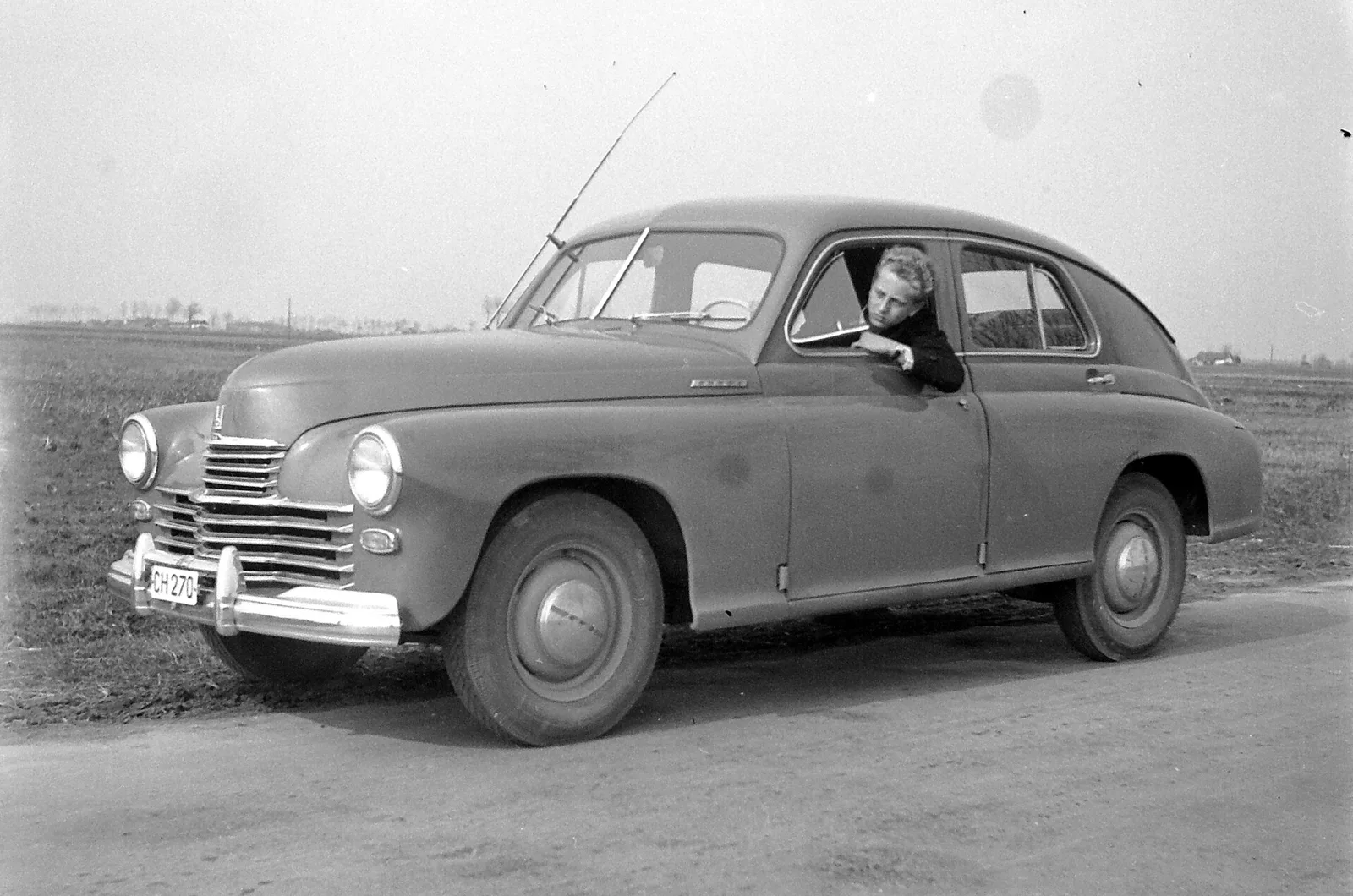
The Pobeda was one of the first Soviet cars with an original design and a clear break from the prewar look. It was an early example of ponton styling with slab sides, although it did not reach full production until 1949. Its body was the first Soviet design made entirely with domestic dies.
Some elements were borrowed from abroad. The front suspension and part of the unitised body echoed the 1938 Opel Kapitan, and the 1941 Chevrolet Fleetline also influenced the design. Opel's Russelsheim tooling had come to the Soviet side as war reparations, and that tooling also helped create the Moskvitch 400 and 420.
The body was built against wooden bucks, which warped and forced last-minute tuning by plant staff. The first prototype was ready on 6 November 1944, a date chosen to mark the anniversary of the October Revolution.
What engine did the Pobeda use?
Engineers weighed a 2,700 cc six-cylinder giving 62 PS (46 kW) against a 2,112 cc four giving 50 PS (37 kW). Stalin favoured the smaller four, and that choice was made. The same engine was later fitted to the ASU-57 light assault gun.
Engineers accepted the smaller engine because it was sufficient for the car's purpose and fitted the economic constraints of the time. The 2.1-litre sidevalve straight-four was derived from Chrysler's flathead six-cylinder design, and it gave the car a top speed of 105 km/h (65 mph). The Pobeda weighed 1,350 kg (2,976 lb), so its modest output was enough for the roads of the day rather than for speed.
In 1952 airflow improvements raised output from 50 PS to 52 PS. The M20V of 1955 went further, reaching 55 PS (40 kW) along with a new grille, upholstery, steering wheel, radio and radiator badge.
Why was the Pobeda's early build quality so poor?
Production began in 1946, only a year after the war ended, and it was difficult because of serious shortages. By the end of 1946 only 23 cars had been completed, almost entirely by hand. Mass production did not start until 28 April 1947, and only 700 cars were built before October 1948.
The Soviet Union lacked steel sheets large enough for body panels, so strips were welded together. That created countless leaks, used about 20 kg (44 lb) of solder in each body and added roughly 200 kg (440 lb) of weight. Steel quality was poor, and up to 60% of it had to be rejected.
The first cars were so faulty that production was halted by government order, and the head of the works was dismissed. A decree of 31 August 1948 required immediate quality improvements and detailed testing, with drivers' opinions taken into account. Testing included laboratory work as well as long on-road trials.
How did the Pobeda return to production?
After a reorganisation, the plant solved the build problems, made 346 improvements and added two thousand new tools. The Pobeda received a new carburettor, a different final drive ratio of 5.125:1 instead of 4.7:1, strengthened rear springs, a better heater and the ability to run on 66-octane fuel.
The rear bench was lowered by 5 cm (2.0 in), so officers in uniform could sit without taking off their caps. The improved car reached 50 km/h (31 mph) in 12 seconds, half the time of the earlier model, and it was no longer a risk to its owners. The improved car was tested on poor roads, where ruggedness mattered more than outright speed.
The improved Pobeda entered production on 1 November 1949, a date that marked a turning point for the works. The techniques used to develop it helped create the Soviet car industry as a whole, and a state commission noted the much better build quality and durability in its January 1949 report. Its findings also praised the car's good fuel consumption and on-road performance.
What versions of the Pobeda were made?
The stock range ran in three phases: early GAZ-M-20 cars from 1946 to 1948, improved and mass-produced cars from 1948 to 1954, and the GAZ-20V from 1955 to 1958 with the 52 PS engine and a radio. Heaters, water pumps and a mechanical clock were added in the middle phase.
A column-shift synchromesh gearbox replaced the old floor-shifted crash box in 1950. A cabriolet appeared in 1949 and survived until 1953, and a cheaper taxi version, the M-20A, became the first regular taxi model in Moscow.
Between 1949 and 1953, 14,222 GAZ-20B-31 four-door convertibles were built. Sales were poor, and the works never returned to mass-producing a convertible. The Soviet climate made an open car less practical, and the postwar limits on sheet metal production had driven the convertible idea in the first place.
Each version reflected the way the works was learning to build cars at scale, with small changes in trim and equipment appearing as production matured.
What was the GAZ-M72?
The GAZ-M72 arrived in 1955 as GAZ's first four-wheel-drive saloon since the 1941 GAZ-61. It is described as the first comfortable mass-produced monocoque four-wheel-drive vehicle, with its system adapted from the GAZ-69. Vitaly Grachev developed the concept as assistant to the GAZ-69's chief engineer.
The M72 used a standard Pobeda gearbox, a GAZ-69 front axle, leaf springs and a transfer case, along with a new rear axle that was used on no other vehicle. Fourteen panels were added to strengthen the floor, frame, doors and roof. Production ended in 1958 with 4,677 built.
A limited number of M20G cars were also built for the KGB, fitted with a 3,485 cc straight six from the GAZ M12 ZIM. That version was reportedly capable of 140 km/h (87 mph), and it cut the 0 to 97 km/h time to 16 seconds from the stock car's 34 seconds.
The heavier front end made handling a compromise, which shows the trade-offs of fitting a larger engine into an existing body.
How many Pobedas were built and where did they go?
Total production reached 235,999 cars, including 37,492 taxis and 14,222 cabriolets. Few of the government-owned cars survive in their original form, which makes surviving examples valuable to historians. Government organisations and state-owned corporations used many of them, and taxi fleets were a major user because the USSR had no private taxis.
Taxi fleets, depots and repair plants also built pickups and vans from worn-out Pobedas, producing a varied set of utility vehicles. At a price of 16,000 rubles against an average wage of 800 rubles, the Pobeda was out of reach for most ordinary citizens. By 1954 and 1955 demand exceeded production, and long queues formed. The car was also the first serious export success for the Soviet car industry.
In Poland the design was licensed to the FSO plant in Warsaw, which built the FSO Warszawa from 1951 until 1973. In Finland, where import controls limited Western cars, the Pobeda became the most popular taxi in the 1950s, and 5,644 were still registered there in 1963.
Why does the Pobeda still matter?
The Pobeda still matters because it marked the point where Soviet car design moved beyond prewar models. It was the first domestic design with a modern body, and the production lessons it taught shaped the wider industry as well as the car itself. Its importance is clearer when set beside the rest of the postwar Soviet car range.
Its use in taxi fleets and by government users meant that many Soviet citizens encountered it in daily life, even when they could not buy one. That presence helped turn the car into a shared memory of the postwar years. Its legacy also includes export deals and its popularity in Finland, which showed that Soviet cars could find buyers beyond the bloc.
Cars like the Pobeda are now studied for their engineering history as well as their looks. Surviving examples are prized by collectors who want a physical link to the postwar period and to the car's place in Soviet industry.
What are the GAZ-M20 Pobeda specifications?
The table covers the core figures for the standard car and the later variants. Each row names the version it applies to, so the stock car and the KGB and four-wheel-drive versions are not blended together. Metric figures come first, with imperial values in brackets where they are given.
| Specification | Detail |
|---|---|
| Production run | 1946 to 1958; 235,999 built |
| First production car | 21 June 1946 |
| Engine (standard) | 2.1 L sidevalve straight-four, 50 PS (37 kW) |
| Engine (1955 M20V) | 55 PS (40 kW), with radio and new trim |
| Weight | 1,350 kg (2,976 lb) |
| Top speed | 105 km/h (65 mph) |
| Improved car, 0 to 50 km/h | 12 seconds (31 mph in that test) |
| Final drive ratio | 5.125:1, up from 4.7:1 |
| KGB M20G engine | 3,485 cc straight six, about 140 km/h (87 mph) |
| GAZ-M72 production | 4,677 built by 1958 |
| Polish version | FSO Warszawa, 1951 to 1973 |
Frequently asked questions
What does Pobeda mean?
Pobeda is the Russian word for Victory. It was chosen over the original name Rodina, meaning Homeland, after Stalin expressed a preference for it.
Who built the Pobeda under licence?
The Polish maker FSO built the car as the FSO Warszawa from 1951 until 1973.
Why is the Pobeda a collector's car today?
Its place in Soviet history and its rarity on the road today make it popular with collectors. Its design also stands out as one of the first genuinely original postwar Soviet cars.
What replaced the Pobeda?
The GAZ M21 Volga replaced the Pobeda. The first Volga sedan went on sale in 1956, which made it the first GAZ sedan since the Pobeda's launch.