A clean-sheet Ford design for the US Army with a unitary body and independent suspension, plus a swing-axle rollover history that shaped its redesign.
Designed by Ford for the US Army as a replacement for the M38 and M38A1 jeeps, the M151 introduced a unitary body and independent suspension. Swing-axle handling problems cut its civilian appeal, and the M151A2 redesign of 1968 addressed them.
The Jeep M151 MUTT was the US Army's quarter-ton 4x4 utility truck, a clean-sheet Ford design that replaced the M38 and M38A1 jeeps of the Korean War era. It introduced a unitary body and independent suspension, but early swing-axle rollovers limited its civilian use and led to a redesign in the M151A2.
Built on a shared concept and nearly the same size and weight as its predecessors, the vehicle differed sharply underneath. Its many updates and variants stretched from field ambulances to weapons carriers, and the series outlasted the Willys MB and its successors in total years of service.
Where did the M151 come from?
Ford Motor Company won the 1951 contract for a quarter-ton four-wheel-drive truck meant to succeed the M38 and M38A1. The Army's Ordnance Tank Automotive Command set the specifications, and design and testing ran through most of the 1950s. It was developed and initially produced by Ford.
Design started in 1951, and prototyping lasted through much of the decade. Production contracts for the M151A2 later went to Kaiser and to AM General, a subsidiary of AMC.
Testing and prototyping ran for most of the decade before the vehicle entered service in the early 1960s.
A quarter-ton jeep that broke with Willys design, then needed a redesign to tame the swing-axle rollovers it carried.
How did the M151 design differ from earlier jeeps?
The M151 used an integrated frame, fusing the box rails and the steel body panels into one unit. Its suspension was independent at each end with coil springs, which was a clear break from the rigid live axles of earlier military jeeps.
Earlier jeeps used a steel tub bolted to a separate frame. Removing that frame gave slightly more ground clearance and a lower centre of gravity, while the vehicle kept its light weight.
The 85-inch wheelbase was 4 in (10 cm) longer than the predecessor's, and the body and tracks were 2 in (5.1 cm) wider. The extra room made the M151 more comfortable than the jeeps it replaced.
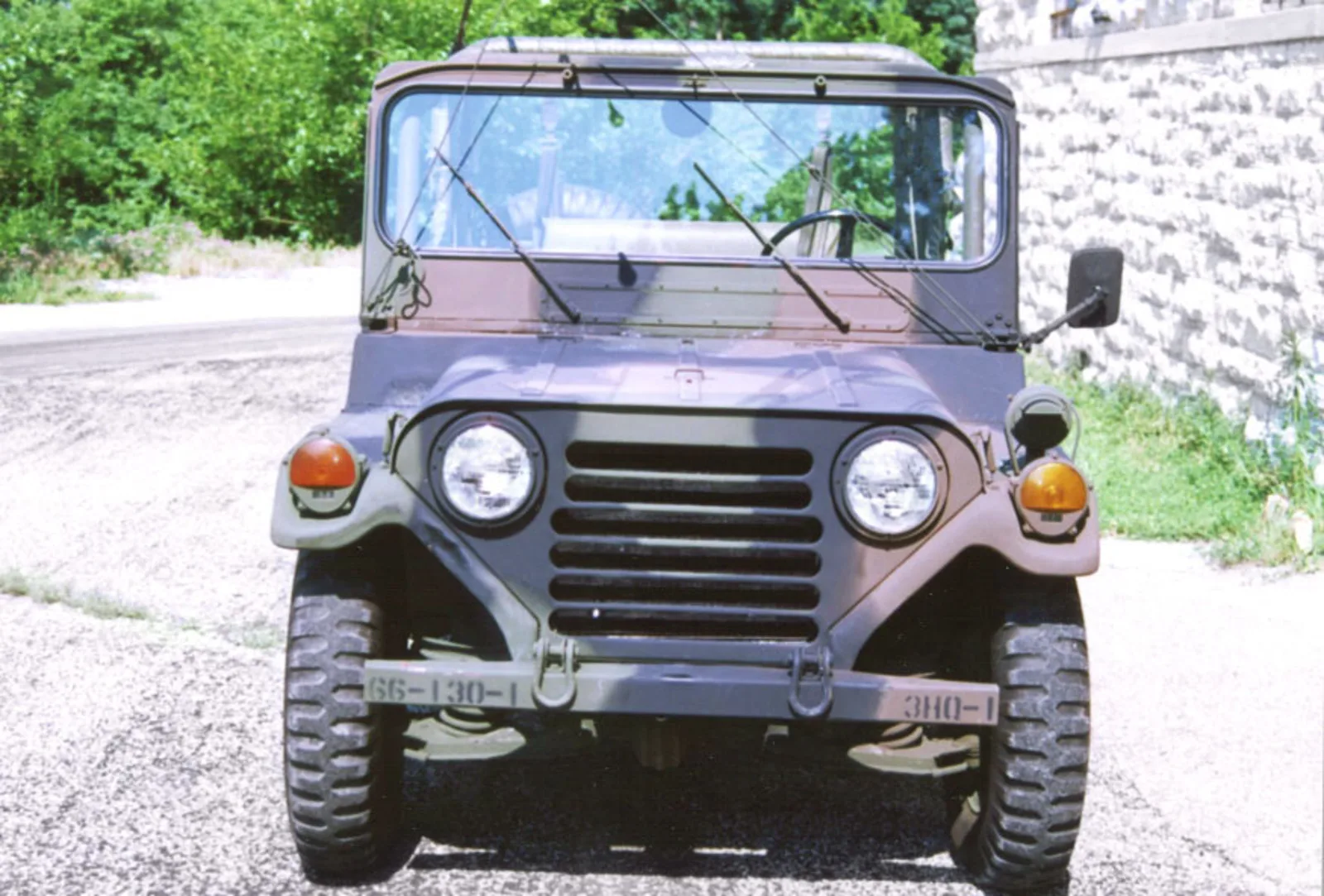
Copyright and trademark concerns stopped the use of Jeep's seven-slot grille, so the M151 carried a horizontal grille instead. The independent suspension also gave a smoother ride on rough ground than the old live axles.
The M151 kept the basic layout and general dimensions of its predecessors, even though nearly every component beneath the body was new.
Why did the M151 roll over so easily?
The M151A1 had a high-pivot swing axle at the rear, which changed the camber sharply in corners. On a hard turn the rear could lift and the inside wheel tuck under, a sequence that often ended in a rollover. Steering input during emergency avoidance made the problem worse.
Drivers often put a sand-filled ammunition box under the rear seat to add weight, which made the vehicle more stable. The box could be emptied or left behind once the extra weight was not needed.
Ford's engineers had been working on the M151A1 from 1951. By 1965 the dangers of swing axles were widely discussed, after Ralph Nader's book Unsafe at Any Speed had raised the subject.
A 1969 report from an engineer at the Human Engineering Laboratory, part of Aberdeen Proving Ground, found the M151A1's swing axle inherently unstable in corners. It also proposed retrofits that had worked on Corvairs, Volkswagens and Formula Vees, but the laboratory director rejected the report and Ford's engineers rejected the fixes as well.
Recoilless rifle carriers were the worst affected, because their stiffer rear springs raised the risk. They were kept under strict speed limits whenever the gun was not fitted.
How was the handling problem fixed?
The M151A2, introduced in 1968, replaced the swing axle with semi-trailing arms that greatly improved fast cornering. Even so, the Department of Defense judged all M151 models unsafe for public highway use, which limited their civilian life. Those handling issues were eventually resolved by that redesign.
Rollovers continued into the 1980s, so the army fitted many vehicles with a roll cage known as a roll-over protection structure. The cage shielded occupants in both the front and the back.
The A2 can be identified by its large combination turn signal and blackout lights on the front fenders. Those fenders were modified to take the bigger lights, while earlier A1 models had flat fenders.
Where was the M151 used in service?
The M151 entered service in the early 1960s and played an active part in US operations into the 1980s, when the HMMWV began to replace it. Various models served in 15 NATO countries, and the vehicle is used in over 100 countries today.
Buyers included Canada, Denmark and the United Kingdom, along with non-NATO countries such as Egypt, Lebanon, Israel, the Philippines and Pakistan. The range of export customers was wide for a vehicle that never found favour on civilian roads.
Its service history is long. The M151 was used in the Vietnam War, the Laotian and Cambodian civil wars, the Six-Day War, the Lebanese Civil War, the Iran-Iraq War, the US invasion of Grenada, the Persian Gulf War and the 2006 Lebanon War.
Further campaigns in the record include the Western Sahara War, the Thai-Laotian Border War and the Somali Civil War. The HMMWV kept independent suspension but used a separate aluminium body, the opposite of the 1984 Jeep Cherokee, which had a unitary body and still used rigid live axles.
What happened to surplus M151s after military service?
The vehicles began to leave service in the late 1980s, when about 1,000 were sold at government surplus auctions. Others went abroad through foreign military sales, and those not sold this way were cut into four pieces and scrapped. Individual buyers could also bid for them.
Some buyers welded the quartered vehicles back together and drove them again, so the story did not end with scrap. Other owners cut complete vehicles in half, welded them back and drove them as well.
From the late 1990s, surplus firms bought M151s from foreign governments and reconditioned them for resale. That trade kept the vehicle in circulation long after the army had moved on.
What were the main M151 variants?
The original M151 of 1960 was the standard version, and the M151A1 of 1964 added minor rear suspension changes and front turn signals. The A1 changes were mostly aimed at heavier loads. Variants included the M151A1C recoilless rifle carrier, the M151A1D nuclear variant and the M718 ambulance.
The M151A1C fitted a pedestal-mounted 106 mm recoilless gun, with room for six rounds and the weapon tools. The driver and one other crew member made up the team, and the vehicle had a cruising range of 442 km (275 miles).
The M151A1D was an M151A1C modified to carry the Davy Crockett Atomic Warhead Launcher, developed in parallel with a similar M38A1 and other tactical vehicles.
The M718 front-line ambulance had a longer rear body to carry litters, with taller bows and a longer canvas top. It kept the 85 in (2.16 m) wheelbase of the M151, unlike the M170 jeep ambulance, which had a 20 in (51 cm) wheelbase stretch.
The M718A1 was a further front-line ambulance with an extended rear body that carried litters.
The M825 carried an M40 106 mm recoilless rifle on the rear, with racks for four shells. The M1051 was a firefighting variant that saw exclusive use by the Marine Corps. The M151A2 TOW variant carried the wire-guided anti-tank missile system, and the MRC108 served as a forward air control vehicle with multi-band radios. The see-also list links the M151 to the FMC XR311, the Jeep J8, the Willys FAMAE Corvo, the Austin Champ and the UAZ-469.
What were the fast attack vehicles?
The fast attack vehicles, or FAVs, were M151 derivatives built for airborne, Marine and special operations units. They had roll bars, extra armour plate and heavy weapon mounts, and some were designed to fit inside a CH-53 helicopter. Each unit modified its vehicle differently.
The M151A2 FAV added a combined grille armour plate and spare wheel carrier, a radio bracket between the front seats, a roll cage and high-beam lights. It also carried a heavy weapon pedestal on the rear deck.
The Marine FAV Mk I, known as the Super Jeep, wore flat black paint with a cloth blackout panel over the gauges. The Mk II had woodland camouflage and a welded roll bar with two angled braces.
The Airborne FAV, also called the Ranger FAV, served the 82nd Airborne Division. It carried a forward-facing machine gun on the passenger side and a box for an AT-4 anti-tank rocket, while the Air Force version had a roll cage and a ring mount over the rear seat.
What are the M151 specifications?
The M151 was a quarter-ton 4x4 with an integrated body and independent suspension, built to be light and roomy. The table lists the core figures for the original vehicle and its main variants, drawn from the figures given for each model.
| Specification | Detail |
|---|---|
| Official designation | Truck, Utility, 1/4-Ton, 4x4 |
| Designer | Ford Motor Company, contract awarded 1951 |
| Wheelbase | 85 in (2.16 m), 4 in longer than the predecessor |
| Body and frame | Unitary body and frame, integrated frame design |
| Suspension | Independent with coil springs; swing axle until the M151A2 semi-trailing arms |
| Original model | M151 (1960), swing-axle rear |
| Second version | M151A1 (1964), minor rear changes |
| Revised model | M151A2 (1968), semi-trailing arms |
| Recoilless rifle carrier | M151A1C, 106 mm rifle, six rounds, 442 km (275 miles) range |
| Ambulance | M718, 85 in (2.16 m) wheelbase, like the M151 |
| Production partners | Ford; later Kaiser and AM General |
| Service dates | Early 1960s into the 1980s; replaced by the HMMWV from 1985 |
Frequently asked questions
Was the M151 sold to civilians?
Almost never. The vehicle fell short of federal highway safety rules for civilian use, and rollover accidents kept it out of the market. The Department of Defense later classed the series as unsafe for public use on highways.
What replaced the M151?
The AM General HMMWV replaced it from 1985 into the early 1990s. The HMMWV was much larger, heavier and more expensive, and it kept all-wheel independent suspension with geared hubs, but used an aluminium body on a steel chassis.
Did the M151 serve in Vietnam?
Yes. The vehicle's record includes the Vietnam War, plus the Dominican and Guatemalan civil wars.
What was the Airborne FAV?
The Airborne FAV, or Ranger FAV, was built for the 82nd Airborne Division. It carried an M60 or M240 machine gun on a mount welded to the dashboard, and it stored AT-4 and M72 LAW rockets.