A compact family hatchback designed in Europe for Europe, with a seven-year warranty, a hot hatch and a shooting brake on the side.
Kia's Cee'd is a family of compact hatchbacks first built in 2006 exclusively for Europe. The name came from European initials, and the line grew through three generations, a shooting brake and the XCeed crossover, and it remained a key European model for years.
The Kia Cee'd is a compact hatchback that Kia has built since 2006 for European buyers, and it was Kia's best-selling European model from 2007 to 2011. Kia designed it entirely in Europe, and its name grew out of European Economic Community initials.
Where does the name Cee'd come from?
Kia built the name from the initials of the European Economic Community, which spelled CEE in several languages, plus ED for European Design. Once the letters ran to CEEED, Kia swapped the final E for an apostrophe. The apostrophe was dropped in 2018, and the name now stands for Community of Europe with European Design.
The same spelling pattern carried over to the Pro_cee'd, Ex_cee'd and Eco_cee'd concepts, which Kia showed while the production car was still establishing itself in showrooms.
The first Kia designed entirely in Europe, launched with a seven-year warranty never offered on a European car before.
Who designed the first Cee'd?
Miklos Kovacs led the design team in Frankfurt, while Pontus Fontaeus designed the concept car. The first Cee'd shared its underpinnings with the Hyundai i30 and came with four engines, two petrol and two diesel.
The car replaced the Cerato, which had struggled in Europe. Its debut came on 28 September 2006 at the Paris Motor Show, and a station wagon named the Cee'd sw followed in mid-2007.
What did the first generation offer?
The first generation was offered in LX, EX and TX trims. Its warranty ran for seven years or 150,000 km on the drivetrain, and the rest of the vehicle had five years of cover, one of the strongest packages in Europe at launch.
The TX trim added semi-leather seats, 17-inch alloy wheels on Michelin 225/45 tyres and rear parking sensors. All versions had six airbags as standard, plus active front headrests, and roughly 646,300 first-generation cars were produced.
How did the body variants differ?
The three-door Pro_cee'd was the sports version, with a new rear end and a body about 5 cm lower and 5 cm longer than the five-door. The Sportswagon estate was the only version with the 2.0-litre CRDi diesel, and its boot held 534 litres, rising to 1,664 litres with the rear seats folded.
The Pro_cee'd concept appeared at the 2007 Frankfurt show, and production followed in January 2008. The second-generation Pro_cee'd, unveiled in 2013, shared no body panels with the five-door and sat 40 mm lower.
How did the second generation change?
The second-generation Cee'd, codenamed JD, made its debut at the 2012 Geneva Motor Show. It was more sophisticated and better equipped than the first car, but it cost significantly more, moving the model away from the budget segment. Independent reviewers such as Honest John noted the shift.
Roughly 647,700 second-generation cars were built. The model also brought Kia's first hot hatch, the Pro_Cee'd GT, which arrived in July 2013, and a five-door Cee'd GT followed in January 2014.
What made the Pro_Cee'd GT special?
The Pro_Cee'd GT was Kia's first performance car and the first hot hatch of European style built by a South Korean firm. It reached 60 mph in 7.4 seconds, which was 0.4 seconds quicker than a Veloster Turbo using the same engine with a lower tune.
Torque rose to 265 Nm (195 lb ft), with full torque available from 1,750 to 4,600 rpm. The car also had a body kit with a splitter and twin exhausts, 18-inch alloy wheels in place of 17-inch ones, LED daytime running lights and Recaro sports seats.
What did the third generation bring?
The third generation first appeared as an announcement in February 2018, with a reveal before that year's Geneva show, where the estate was also unveiled. Hatchback production began in May 2018, and the car went on sale in June, with estate production following in the summer.
A 48-volt mild-hybrid version of the 1.6 Smartstream diesel, called EcoDynamics+, joined the range across the line-up in 2020.
What are the Proceed and XCeed?
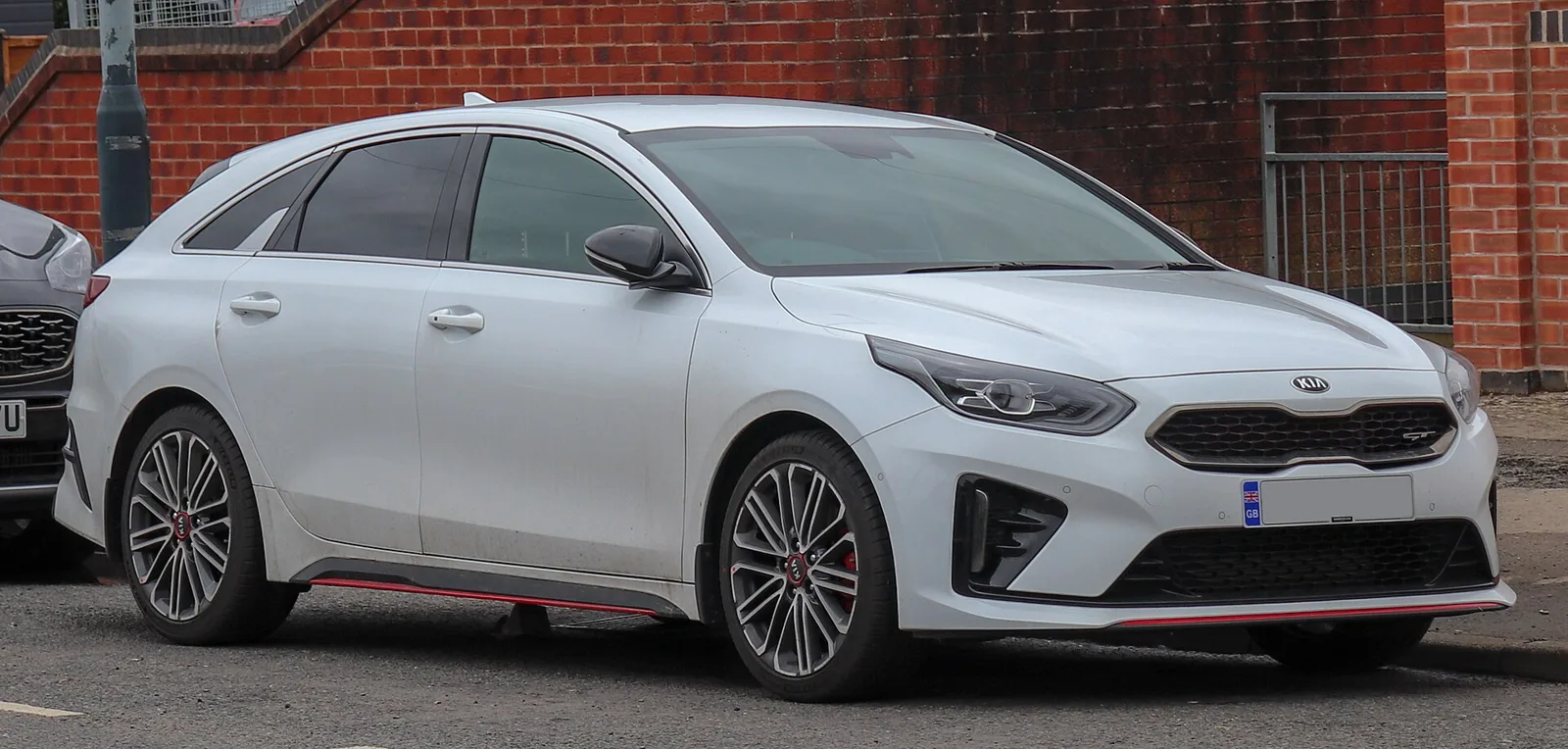
The Proceed, a shooting brake take on the Ceed, went on sale in early 2019 aimed at European buyers. The XCeed is a crossover SUV built on the third-generation car, unveiled in 2019, and it received facelifts on 18 July 2022 and 4 May 2026.
The Proceed was being gradually discontinued as of 2025. From January 2026 the Ceed hatchback, Sportswagon and Proceed were replaced by the K4 hatchback and sportswagon, while the XCeed continues in production.
How well did the Cee'd sell?
From 2007 to 2011 the Cee'd was Kia's top-selling car in Europe, before the Sportage overtook it. Sales ran between 90,000 and 150,000 units a year, and in 2008 the car made up 44 percent of Kia's European volumes.
Sales benefited from the seven-year warranty, which was the first of its kind on any vehicle marketed in Europe.
Which concept cars came before production?
Kia showed several concepts before production. The Pro_cee'd show car appeared at the 2007 Frankfurt Motor Show, and the Ex_cee'd cabriolet premiered at the 2007 Geneva show with an electric folding fabric roof.
The Eco_cee'd concept added ISG idle stop and regenerative braking to diesel engines, and a hybrid Cee'd previewed at the 2008 Paris Motor Show used an electric motor and a high-voltage battery behind the rear seats.
How did Top Gear feature the Cee'd?
On 27 June 2010 the Cee'd was picked for the reasonably priced car slot on the UK show Top Gear, where presenter Jeremy Clarkson persistently mispronounced its name. The test car weighed upwards of 1,263 kg and cost GBP 13,930 at the time.
The car was replaced in Series 20 by a Vauxhall Astra, and Top Gear dented several Cee'ds during a game of car rugby in 2013. The programme had named the Cee'd runner-up in its 2009 car of the year award, broadcast on 3 January 2010.
Did the Cee'd race?
Yes, in a limited way. The model was homologated for TCR touring car specification, and the Austrian company STARD builds the racing version. Kia fielded a works-backed squad in the Scandinavian Touring Car Championship in 2017. Its racing role was limited, but it carried the Cee'd name onto the track.
The Pro Cee'd also acted as safety car for Poland's Kia Lotos Race, a series created by Kia Motors Polska and Grupa Lotos.
Where was the Cee'd sold outside Europe?
The Cee'd was first sold only in Europe, Israel and South Africa. Russia and Kazakhstan sold the first two generations alongside the Kia Forte, and Kia started selling Cee'd models in Morocco in 2010, a market where the model still sold alongside the Cerato in 2020.
The Pro_Cee'd GT went on sale in Israel, Australia and New Zealand in 2014. Kia Australia said in 2015 that the car would be dropped in 2016, after registering just 746 units over two years on sale.
What awards did the Cee'd win?
Auto Express gave the Cee'd a New Car Honours award for its seven-year warranty, and Autocar named the warranty its Idea of the Year. What Diesel Car also picked it as Hatchback of the Year, and a German magazine rated it above the Toyota Auris and Volkswagen Golf.
Danish magazine Motor gave the Cee'd the first 6-out-of-6 rating it had awarded, while Swedish magazine Vi Bilagare found it kept the highest second-hand value of any car it had tested over a long run. Driver Power ranked it first in the compact family class, and L'Automobile Magazine named it best in its 2009 quality and reliability survey.
How did the first Cee'd score in crash tests?
The pre-2009 Cee'd earned a five-star adult rating from Euro NCAP. Its six airbags, including curtain airbags, came as standard even in markets such as Ukraine, where safety equipment was often stripped out of cars.
Euro NCAP's results also showed that the dashboard could pose a threat to the knees of the driver and passenger in a frontal collision, despite the six airbags. The car scored the maximum points in both the side impact and pole tests.
The 2009 facelift, unveiled at the Frankfurt Motor Show, gave the five-door and estate new front and rear styling, while the three-door kept its original exterior.
What was the Pro_Cee'd GT's cabin like?
The Pro_Cee'd GT's interior added red accents, an overstitched GT badge on the bottom of the steering wheel, and leather and suede Recaro sports racing bucket seats. The TFT dial offered a choice of display styles for the driver's data.
Why did Top Gear pick the Cee'd as its reasonably priced car?
Top Gear chose the Cee'd as its reasonably priced car in a slot that the show kept from series 15 to series 20, and the car earned that place by offering a lot for its money. The role was built on its price, and the programme kept the car in that slot until Series 20.
How did the warranty shape the Cee'd's reputation?
The warranty was among the most extensive in Europe when the car launched, and it was the first such cover on any vehicle sold there. Its length meant the powertrain was covered for seven years or 150,000 km, while the rest of the car had five years of cover.
The warranty became part of the model's identity across its first generation, alongside the awards it collected.
How did the Pro_cee'd's suspension differ?
The second-generation Pro_cee'd sat 40 mm lower than the five-door, and its suspension and steering were tuned for comfort rather than sporty handling. Reviewers made that point about the car, which excelled at refinement but did not feel sharp on a winding road.
What did the second generation's engines include?
The second-generation Cee'd's engine line-up included the Pro_Cee'd GT's T-GDi petrol, which was the first turbocharged petrol Kia sold in the UK. The GT's engine was a variant of the T-GDi Gamma unit, altered slightly so that its full torque band ran a little higher than in the standard engine.
What made the Cee'd a family car in Europe?
The Cee'd was built for European families, with a compact footprint, five doors and an estate option that widened its practical role. Kia designed it in Europe so that the car would suit the expectations of local buyers.
The estate gave the range its most practical body, and the family-focused layout suited the car's European design brief.
The car's place in the Kia range was clear by the second generation, with the Pro_Cee'd GT adding a performance halo above the core hatchbacks. The family then grew to include estate, shooting brake and crossover versions, each built on the same European foundation.
What were the Cee'd's main milestones?
The table lists each generation with its internal code, launch point and one headline figure. The Proceed shooting brake sits outside the numbered line-up, so its entry shows only its launch and later phase-out.
| Generation | Code | Launch | Headline figure |
|---|---|---|---|
| First | ED | Paris show, 28 September 2006 | About 646,300 built |
| Second | JD | Geneva, 2012 | About 647,700 built |
| Third | CD | Geneva, 2018 | 48V mild hybrid from 2020 |
| Proceed (shooting brake) | n/a | Early 2019 | Gradually discontinued as of 2025 |