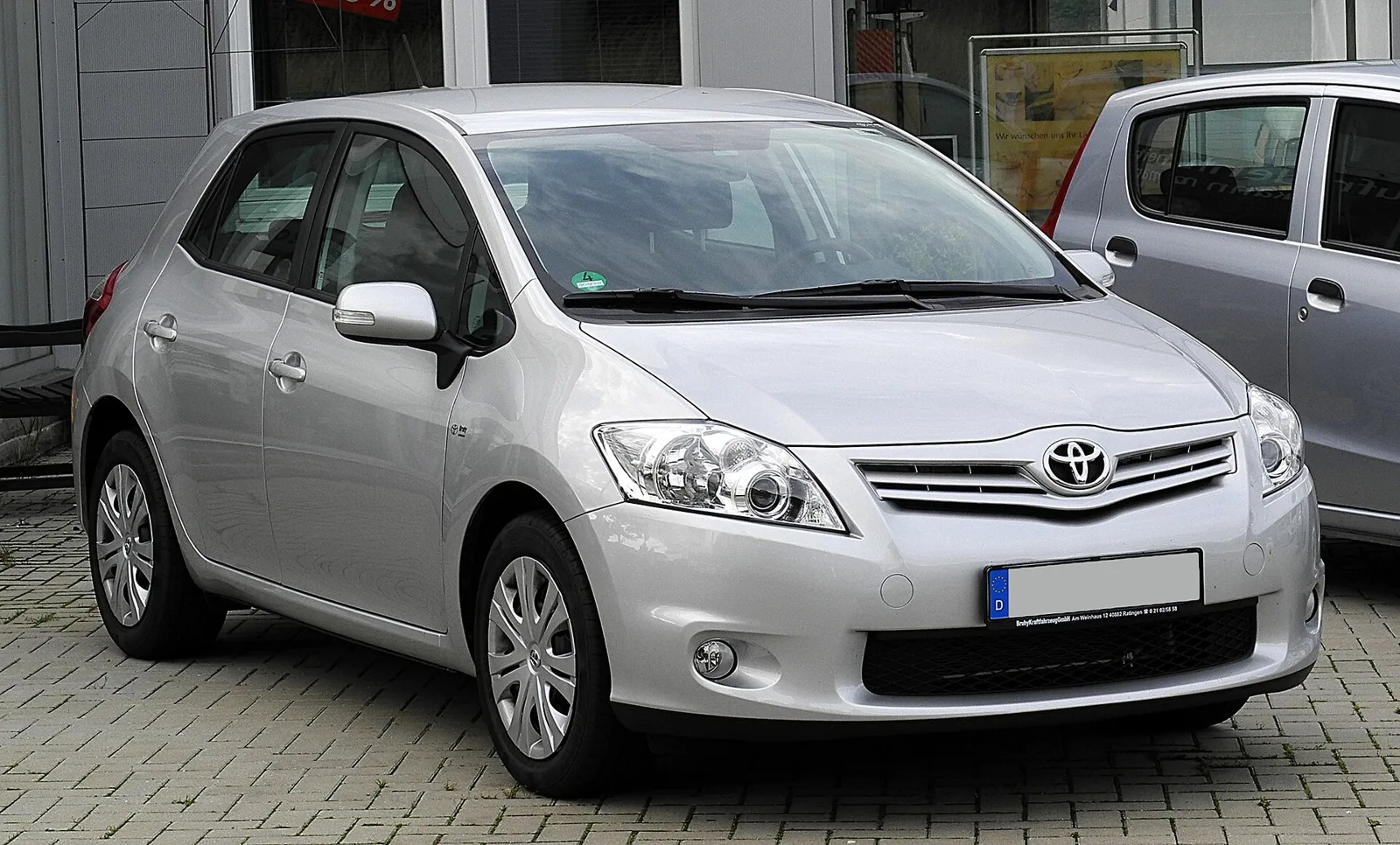
A compact hatchback built on the Corolla platform, the Auris became the first mass-produced hybrid made in Europe before the nameplate was retired.
The Toyota Auris was a compact hatchback built from the Corolla from 2006 and sold in three generations. It became the first mass-produced hybrid in Europe, and it spawned the Touring Sports estate before the Corolla name took over in Europe in 2019.
The Toyota Auris is a compact car derived from the Corolla, which Toyota made and sold from 2006 onward. Its first generation shared the platform of the E150 Corolla, and later versions moved to newer architectures. The Auris became Europe's first mass-produced hybrid, although the name was later dropped in favour of Corolla.
Where did the Auris name come from?
The name is based on the Latin word for gold, aurum, which gave the car a slightly upmarket ring. Toyota positioned the Auris in Europe as the replacement for the Corolla hatchback, while the saloon version of the car kept the Corolla nameplate.
The Auris succeeded the Allex in Japan and took over from the Corolla RunX. Japan also sold a more luxurious sibling, the Blade, but only in the first generation.
A Corolla-based hatchback that became Europe's first mass-produced hybrid, then gave way to the Corolla name.
How did the first-generation Auris launch?
Japanese buyers could find the car at Netz showrooms from 23 October 2006, and European sales followed in early 2007. In the UK the Auris went on sale on 1 February 2007, replacing the E120 series Corolla hatchback.
The car was unveiled at the October 2006 Paris Motor Show, with exterior styling by ED2, Toyota's European design base in southern France. The design concept carried Toyota's Vibrant Clarity philosophy, with a panoramic glass roof and 19-inch alloy wheels on the concept car.
Which engines did the Auris use?
Australian Auris models used a 1.8 litre 2ZR-FE engine with a six-speed manual or four-speed automatic. European buyers had a different range, starting with the 1.33 litre 1NR-FE Dual VVT-i, which carried Toyota's first Stop and Start system sold in Europe.
Diesel engines were also offered. The 2.0 D-4D added a diesel particulate filter, and a 1.6 Valvematic replaced the earlier 1.6 Dual VVT-i. Toyota invested 100 million pounds in its Deeside plant in February 2007 to build a petrol engine for the Auris. Diesel buyers in Europe also had the 2.0 D-4D, so the range covered both fuels.
Why was the Auris Hybrid so important?
The Auris Hybrid was announced at the 2009 Frankfurt Motor Show as a concept, with Hybrid Synergy Drive technology, a solar panel roof and blue leather upholstery. Production was confirmed for Toyota Manufacturing UK, which began building it in May 2010 at the Burnaston plant.
The production car became the first mass-produced hybrid built in Europe. It shares its powertrain and batteries with the Prius, and its combined fuel economy of 74.3 mpg-imp (3.80 L/100 km; 61.9 mpg-US) and 89 g/km CO2 gave it an advantage in tax and charging incentives.
How well did the Auris Hybrid sell?
The Auris Hybrid went on sale in the UK on 1 July 2010, at a price starting at 18,950 pounds, which was 550 pounds less than the Prius. Toyota sold 15,237 Auris Hybrids in Europe in 2010, and the number rose to 32,725 in 2011. Those figures show the hybrid quickly became a volume product in Europe.
The car's green credentials were recognised by the press. In July 2010 it was selected as WhatGreenCar Car of the Year 2010 by What Car?, which reflected how the hybrid stood out in its class.
What changed in the second generation?
The second-generation car was unveiled on 20 August 2012, with Japanese showroom sales starting that same day. It had a wider, lower stance and a more luxurious interior, and its dashboard was later used on the E170 Corolla saloon. The European car was first shown at the 2012 Paris Motor Show, with sales starting in early 2013.
The range offered a 1.33 litre Dual VVT-i, a 1.6 Valvematic and a 1.4 litre D-4D diesel. The 1.6 Valvematic had first replaced the Dual VVT-i unit in the earlier car, so the second generation carried that engine forward. The hybrid joined the Touring Sports estate, which was 285 mm longer than the five-door hatchback and used the same 2600 mm wheelbase.
What was the Touring Sports estate?
Toyota revealed the Touring Sports estate at the 2012 Paris Motor Show. It was the first estate in its segment with a full hybrid powertrain, which paired a 1.8 litre VVT-i petrol engine with an electric motor for a maximum output of 136 HP (100 kW).
The hybrid estate reached 0 to 62 mph in 10.9 seconds, with a top speed of 180 km/h (112 mph). Its sill was 80 mm lower than the hatchback, and the rear bumper and tailgate had different styling.
How did the Auris sell in Australia and Japan?
In Australia the Auris was sold as the Corolla hatchback, with the Seca emblem on the hatch door. The grades were Ascent, Conquest, Levin SX and Levin ZR, and all were powered by the 1.8 litre 2ZR-FE engine. A facelift in late 2009 gave the car a sportier look.
In Japan the Auris was sold through Netz and later Toyopet Store dealerships. The Japanese car was discontinued at Toyopet Store on 20 March 2018, after the hybrid had moved to the Toyota badge.
The first-generation trims in Japan were 150X, 180G and RS, and from 2007 a G-BOOK subscription telematics service was an option on Japanese models.
Did the Auris compete in motorsport?
The Auris-based Corolla hatchback won the Australian Rally Championship in 2008 and 2009. The Corolla S2000 used a 2.0 litre naturally aspirated 3S-GE engine from the Celica SS-III, the all-wheel drive system from the Celica GT-Four and a six-speed sequential gearbox.
Two drivers, Neal Bates with co-driver Coral Taylor, took the 2008 title, while Simon and Sue Evans won in 2009. Those results gave the hatchback a useful competition record away from the showroom.
Why did the Auris name disappear?
The third-generation car, the E210, was based on the Toyota New Global Architecture platform and was unveiled as a pre-production model at the Geneva Motor Show in March 2018. The Auris nameplate ended in Europe when the E210 Corolla arrived in January 2019. That closed a chapter that had begun in Europe in early 2007. The Corolla name carried the car forward in that market.
In Taiwan the Auris kept its name from September 2018 until July 2020, when it was renamed Corolla Sport. That Taiwanese car used a 2.0 litre M20A-FKS engine with a simulated 10-speed continuously variable transmission.
What did the Scion iM and Corolla iM offer in North America?
Toyota previewed the Scion iM as a concept at the November 2014 Los Angeles Auto Show, and the production version followed at the New York International Auto Show in April 2015. It was based on the Auris five-door hatchback but used body kits, lowered suspension and 19-inch alloy wheels.
Only the 1.8 litre engine was offered, paired with a six-speed manual or a continuously variable transmission. The Scion iM sold 5,097 units in the United States in 2015, and after the Scion brand was discontinued in early 2016 it was rebadged as the Corolla iM for the 2017 model year.
The Corolla iM partly filled the void left by the Scion xB, although Toyota said it was not a direct replacement. It remained on sale until the E210 Corolla hatchback arrived in March 2018 for the 2019 model year.
Which special editions did the Auris receive?
Japan saw several limited editions. The 2007 S package TUMI version was a run of 1000 units with model-specific seat cloth, floor mats and illuminated scuff plates. The 2008 Grayge selection added a grey interior and dual zone climate control, and it arrived with a choice of trims that suited buyers who wanted more comfort.
Toyota's Auris GT concept appeared at the Tokyo Auto Salon in January 2011, based on the 1.8 litre car with TRD graphics along its lower flanks. In August 2013 an advertising campaign featured Char Aznable from the Mobile Suit Gundam series, and Toyota unveiled a one-off MS-186H-CA Auris to match it.
Performance tastes were served by the Blade Master, an upgraded version of the Blade released in August 2007 with a 280 PS 3.5 litre V6. In Australia the limited Corolla RZ followed in 2014, a special edition of the Ascent hatchback with black alloys and an upgraded interior.
How did hybrid tax and congestion rules affect the Auris Hybrid?
Carbon dioxide emissions of 89 g/km allowed the Auris Hybrid to be exempt from Vehicle Excise Duty for cars registered before 1 April 2017. The same figure also kept it exempt from the London congestion charge, which made it a strong choice for urban drivers in the capital.
Those advantages gave the Auris Hybrid a clear edge in the city. Its 74.3 mpg-imp combined figure, shared with the Prius, meant that running costs were a selling point as well as the badge.
Where was the Auris built?
Japanese models were built by the Iwate Plant and by Kanto Auto Works. Kanto Auto Works produced the Auris and the Blade from October 2006 to November 2011, which made the factory central to the car's first years.
European cars came from the Burnaston plant in the UK, where the hybrid began production in May 2010, while engines came from the Deeside plant. In Ireland a five-door van version was offered, closely related to the hatchback, with a flat floor pan in place of the rear seat and a divider between the front seats and the load area.
What are the Auris specifications?
The table lists the main figures for the Auris family, from the 2006 launch and the hybrid to the third generation. Each row names the generation or version it applies to, so the hybrid economy does not blur with the petrol cars.
| Specification | Detail |
|---|---|
| Launch | 23 October 2006 in Japan; early 2007 in Europe |
| First-generation platform | E150 Corolla platform |
| Second generation | E180, revealed 20 August 2012 |
| Third generation | E210, TNGA platform, 2018 |
| Hybrid economy | 74.3 mpg-imp (3.80 L/100 km; 61.9 mpg-US) |
| Hybrid CO2 | 89 g/km |
| Hybrid price, UK | From 18,950 pounds on sale 1 July 2010 |
| Touring Sports length | 285 mm longer than the hatchback |
| European hybrid sales | 15,237 in 2010; 32,725 in 2011 |
Frequently asked questions
What does Auris mean?
The name comes from the Latin for gold. Most markets kept it until Europe moved the car to the Corolla name.
Where was the Auris Hybrid built?
Yes, at the Burnaston plant of Toyota Manufacturing UK, which started building it in May 2010.
When did the Auris name end in Europe?
The name ended with the arrival of the E210 Corolla in January 2019. Taiwan kept the Auris name until July 2020.
Did the Auris race?
Yes. A rally version of the Auris-derived hatchback took the Australian crown in 2008 and 2009, built around the Corolla S2000 specification.
What was the Touring Sports?
The Touring Sports was the estate version of the second-generation Auris, 285 mm longer than the hatchback, and its hybrid version was among the first full hybrids in the class.
_%E2%80%93_Frontansicht,_21._Juni_2011,_Ratingen.jpg)