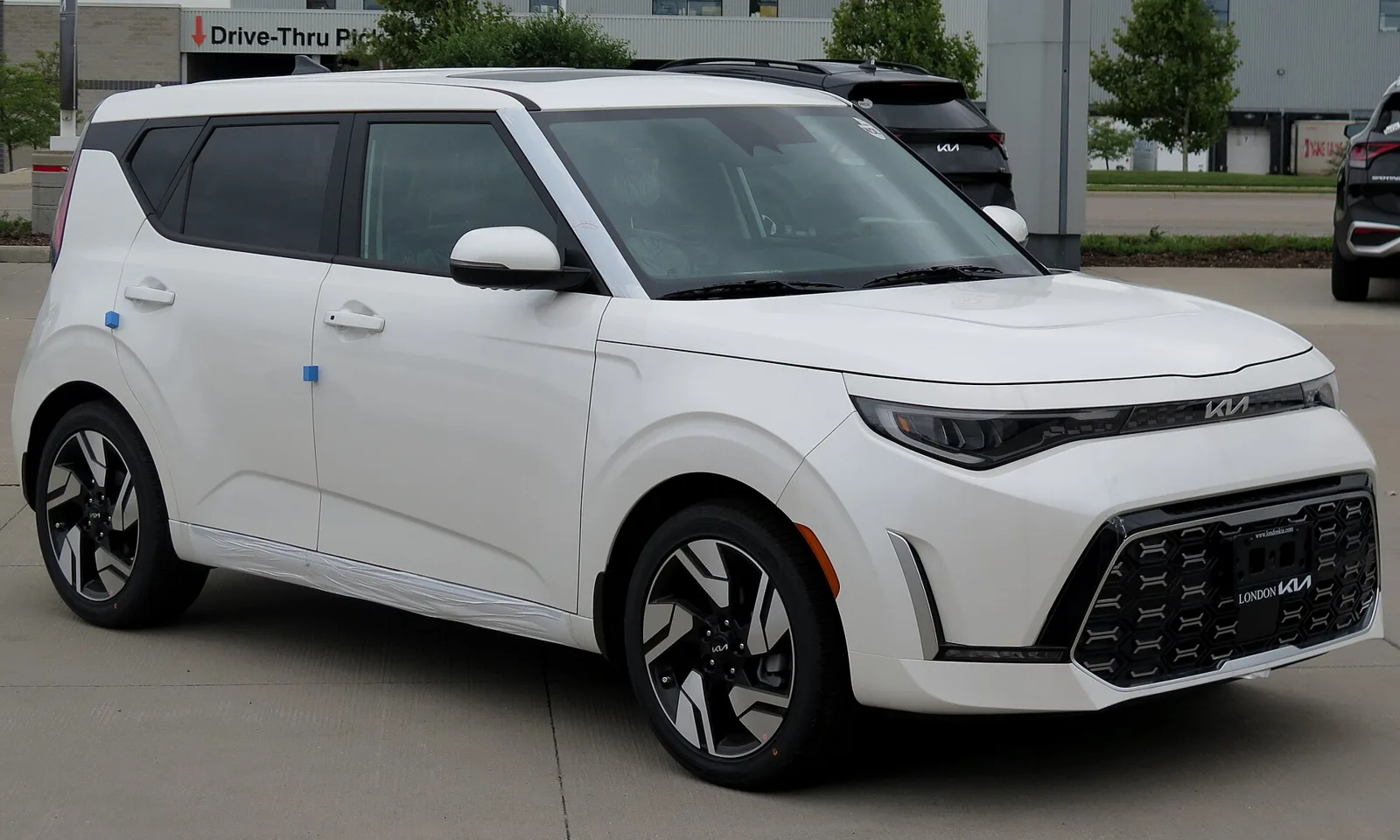
A boar-inspired, hamster-advertised subcompact from Kia's California studio, built from 2008 until production ended in 2025.
The Kia Soul was a subcompact crossover hatchback that Kia built from 2008 until 2025 across three generations. It was boxy, five-door and front-wheel drive only, aimed at buyers aged 18 to 35. Kia also sold an electric Soul EV from 2014 until 2024.
Few small cars have been as easy to recognise as the Kia Soul. Its tall, square silhouette stood out in showrooms for 17 years, and the name doubled as a homophone of Seoul, the city where Kia is headquartered. The car went through three generations before its production ended in 2025.
Where did the Soul idea come from?
The Soul began as a concept styled at Kia's California design centre in 2005 under Peter Schreyer, Kia's global design chief. Its designer, Michael Torpey, drew inspiration from a wild boar that he saw in a documentary on Korean wildlife, and he sketched the animal carrying outdoor gear. The concept was shown at the 2006 North American International Auto Show in Detroit.
Torpey had worked with General Motors before joining Kia's Irvine team. He was later sent to Kia's Namyang Design Center in Korea to help brainstorm a new vehicle. The New York Times reported that the boar's strength was the image he wanted for a model aimed at hip urban youth.
Patent drawings for the design were filed in the United States in 2004, and they credit a different designer, Yongpil Jang. The production model followed at the 2008 Paris Motor Show, aimed at buyers in the 18-35 age range.
A boxy hatchback styled around a wild boar that became a 17-year fixture of Kia's small-car range.
What was the first-generation Soul like?
The first generation, codenamed AM, arrived for 2008 as a five-door, five-passenger hatchback with boxy proportions and a tall roof. Its shape prioritised interior space, and the rear bench folded flat to carry either passengers or cargo. Early criticism focused on interior plastics and a harsh ride, and Kia upgraded both during the first year.
Standard equipment included a six-speaker audio system, a CD player, a USB port and Sirius satellite radio. Options ranged from 18-inch alloy wheels and cruise control to racing stripes, dragon and houndstooth graphics and LED turn indicators. The car was sold with front-wheel drive only, even though its crossover styling suggested otherwise.
For 2011 the Soul gained more conventional pull-out door handles, a switchblade-style integrated key and a leather shift boot. A Smart Key was optional on the Exclaim trim.
Which special editions did the first generation get?
Kia offered four special editions in 2010: Denim, Ignition, Dragon and Ghost, which were mostly visual upgrades. The Denim was limited to 1200 units, and the Dragon edition was limited to about 1,900 units. Each one brought a different look, from blue paint with white racing stripes to matte-black dragon graphics on the bonnet.
The Soul Flex, shown at the 2010 Sao Paulo show, was the first Korean flexible-fuel vehicle. It could run on any blend from E20-E25 gasoline up to E100 neat ethanol. Kia claimed a 44% improvement in fuel efficiency over the gasoline model, along with stronger power and torque.
The White Tiger edition appeared at the 2010 SEMA show and reached production as a 2011 model. It came with black 18-inch alloy wheels, heated front seats and a sport rear spoiler, which gave it a much more aggressive stance than the standard car.
How did the Soul's engines change?
The early Soul used a 1.6-liter Gamma four with 122 bhp (91 kW) and a 2.0-liter engine with 142 bhp (106 kW). In 2012 the range moved to a direct-injection 1.6-liter making 138 hp (103 kW) and a 2.0-liter Nu making 164 hp (122 kW).
Torque rose with the new engines to 123 lb-ft (167 N-m) for the smaller unit and 148 lb-ft (201 N-m) for the larger one. European buyers received a 1.6-liter diesel with 126 PS (93 kW; 124 hp) and 260 N-m (192 lb-ft), and the diesel's fuel use was rated at 4.90 L/100 km.
A six-speed manual and a six-speed automatic replaced the older gearboxes in 2012. The Gamma 1.6 gained dual variable valve timing and produced 128 hp (95 kW) in its updated form, with direct injection in some countries.
What did the second generation change?
The second-generation Soul, codenamed PS, was unveiled at the 2013 New York and Frankfurt shows and went on sale in North America as a 2014 model. Its wheelbase grew to 2,570 mm (101.2 in), its width reached 1,800 mm (70.9 in), and torsional rigidity rose by 28.7 percent. The height stayed at 1,600 mm (63.0 in).
The platform was shared with the cee'd hatchback, and 66 percent of the chassis used high-strength steels. The front subframe gained four bushings, and the rear torsion beam axle was mounted with vertical shock absorbers for more suspension travel.
North American buyers could choose base, Plus or Exclaim trims at launch, and early models came with either the 1.6-liter Gamma GDi or the 2.0-liter Nu GDi. The European car arrived in early 2014, with a UK launch that spring and three roof colours to choose from.
What was the Soul EV?
The Soul EV was an electric version of the second-generation car, announced in November 2013 and sold from 2014. It used a 27 kWh lithium-ion polymer pack with a target range of over 190 km (120 mi), and it could fast charge at 100 kW DC through a CHAdeMO connection.
The motor produced 109 bhp (81 kW; 111 PS) and 285 N-m (210 lb-ft). Kia first offered the car in California, Oregon, New York, New Jersey and Maryland, where the largest electric vehicle markets and charging networks were located.
Later, the third generation brought a second-generation Soul EV with a 64-kWh battery shared with the Niro. Kia planned to drop the electric model in Canada in late 2023 and phased it out in Europe by mid-2024, replacing it with the EV3, although stock sales continued until 2025.
What did the third generation look like?
Kia unveiled the third-generation Soul at the 2018 Los Angeles Auto Show, with thin headlights and the large grille retained. It shared a platform with the Hyundai Kona and was offered with a 1.6-liter turbo engine or a naturally aspirated 2.0-liter unit.
An X-Line trim became an option. The third generation also offered an electric version on the same platform as the gasoline models.
Kia discontinued the Soul in South Korea in 2021 because of poor sales and competition from the similarly sized Seltos. In the United States the 6-speed manual was dropped for the 2022 model year, which had been offered only on the base LX.
What changed with the 2023 facelift?
For 2023 Kia revised the headlights, taillights, front bumper and rear fascia, and it added new two-tone colour combinations and wheel designs. The X-Line trim was discontinued, and the turbo version went with it in the US.
That left the 2.0-liter Nu MPi naturally aspirated engine with a CVT as the only powertrain available in the United States. The facelift kept the car's boxy profile intact while refreshing its face and details.
What awards did the Soul win?
The Soul won a Red Dot design award in 2009, and it later received iF Design Awards in 2014 and 2016. Popular Mechanics placed it ahead of the Nissan Cube and the Scion xB in one comparison, and Kelley Blue Book included it on its 5 Great Deals list.
U.S. News ranked the Soul tied for No. 1 on its 2022 list of Best Subcompact SUVs, with a score of 8.4 out of 10. The Soul's residual values also stood out, with Automotive Lease Guide reporting 56 percent of the original value remaining after three years.
How was the Soul marketed?
Kia's advertising used animated hamsters on exercise wheels, created by a Los Angeles agency, under the campaign called A new way to roll. The commercials won Automotive Ad of the Year at the Nielsen Automotive Advertising Awards.
In October 2011 the Soul hamsters were inducted into the Madison Avenue Walk of Fame, and Kia was the only car maker to receive that honour at the time. Golfer Michelle Wie fronted Soul commercials from 2010 to 2012, and later the K-pop group ITZY appeared in a music video tied to the Soul Booster models.
How did sales and the end of production play out?
Kia sold more than 100,000 Soul units a year in the United States from 2011 to 2018, which made it the best-selling subcompact car ahead of the Nissan Versa. Kia has produced over a million Soul units since 2015 across its global markets.
Kia announced the Soul's demise on 6 October 2025, after 17 years of production since 2008. Korean production ended later that month, closing the run of a boxy subcompact as Kia shifted toward larger crossovers and SUVs.
What concept cars came before the production Soul?
Kia showed several concepts around the first Soul. The Soul Hybrid was shown at the 2008 Paris Motor Show, while the Burner, Diva and Searcher were unveiled at the 2008 Geneva Motor Show, all created by Kia's European design team.
The Soul Hybrid used a Gamma 1.6-litre gasoline engine and a 15 kW (20 PS; 20 hp) electric motor, with a continuously variable transmission and idle stop-and-go. Its motor delivered 105 N-m (77 lb-ft) of torque, which was modest but useful for a concept of that era.
The Soul'ster concept of 2009 was a two-door, four-seat cabriolet SUV with an open roof over the rear seats. It was shown at the Detroit show that year and went on to win the 2009 Concept Truck of the Year award.
Did the Soul face safety scrutiny in the United States?
Yes. In 2018 reports linked a large number of fires to the Soul, and the Center for Auto Safety asked Kia to recall all Soul vehicles from 2010 through 2015. Kia's voluntary fire-risk recall on 11 January 2019 did not include the Soul.
Those reports came at a time when the Soul was one of the best-selling subcompacts in the United States, which made the scrutiny more prominent. The contrast with the car's European reputation was notable, because the first generation was rated five stars by Euro NCAP in 2009.
What changed with the Soul's 2017 facelift?
For model year 2017 Kia made minor body trim changes, added new paint colours and offered new headlight options. The biggest change came at the top trim, where the 2.0-litre Nu engine was replaced by a 1.6-litre turbo gasoline unit.
The 1.6-litre turbo added 40 hp (30 kW) and 61 N-m (45 lb-ft) over the outgoing engine. It was mated to a 7-speed dual-clutch transmission in place of the 6-speed automatic, and the change made the car one of the quicker machines in its class.
Kia Soul specifications at a glance
| Specification | Detail |
|---|---|
| Body and drive | Five-door subcompact crossover hatchback, front-wheel drive |
| Second generation wheelbase | 2,570 mm (101.2 in) |
| Second generation width and height | 1,800 mm (70.9 in) wide, 1,600 mm (63.0 in) high |
| 2012 base engine | 1.6-liter Gamma, 138 hp (103 kW), 123 lb-ft (167 N-m) |
| 2012 top engine | 2.0-liter Nu, 164 hp (122 kW), 148 lb-ft (201 N-m) |
| Soul EV battery | 27 kWh, over 190 km (120 mi) target range |
| Soul EV motor | 109 bhp (81 kW; 111 PS), 285 N-m (210 lb-ft) |
| US sales pace | Over 100,000 units a year, 2011 to 2018 |
| End of production | Announced 6 October 2025 |
Frequently asked questions
Was the Soul ever sold with all-wheel drive?
No. The Soul was exclusively offered with front-wheel drive, so the crossover look was never matched by four-wheel traction. Buyers who needed more grip had to look at other models in Kia's range.
How safe was the Soul?
The first generation earned a maximum five-star rating from Euro NCAP. ANCAP gave the New Zealand version five stars, while Australian cars received four. Safety results varied by market, so buyers should check the rating for the exact version they plan to buy.
Is an electric Soul still on sale?
No. Sales of the Soul EV ended in Europe in mid-2024, while stock sold on until 2025. The EV3 replaced it on the global market.
What replaced the Soul?
Kia has focused on larger crossovers and SUVs, including the Seltos, which serves as the entry-level crossover at a higher price. The Soul's end marked the close of a long-running boxy hatchback in the Kia range.