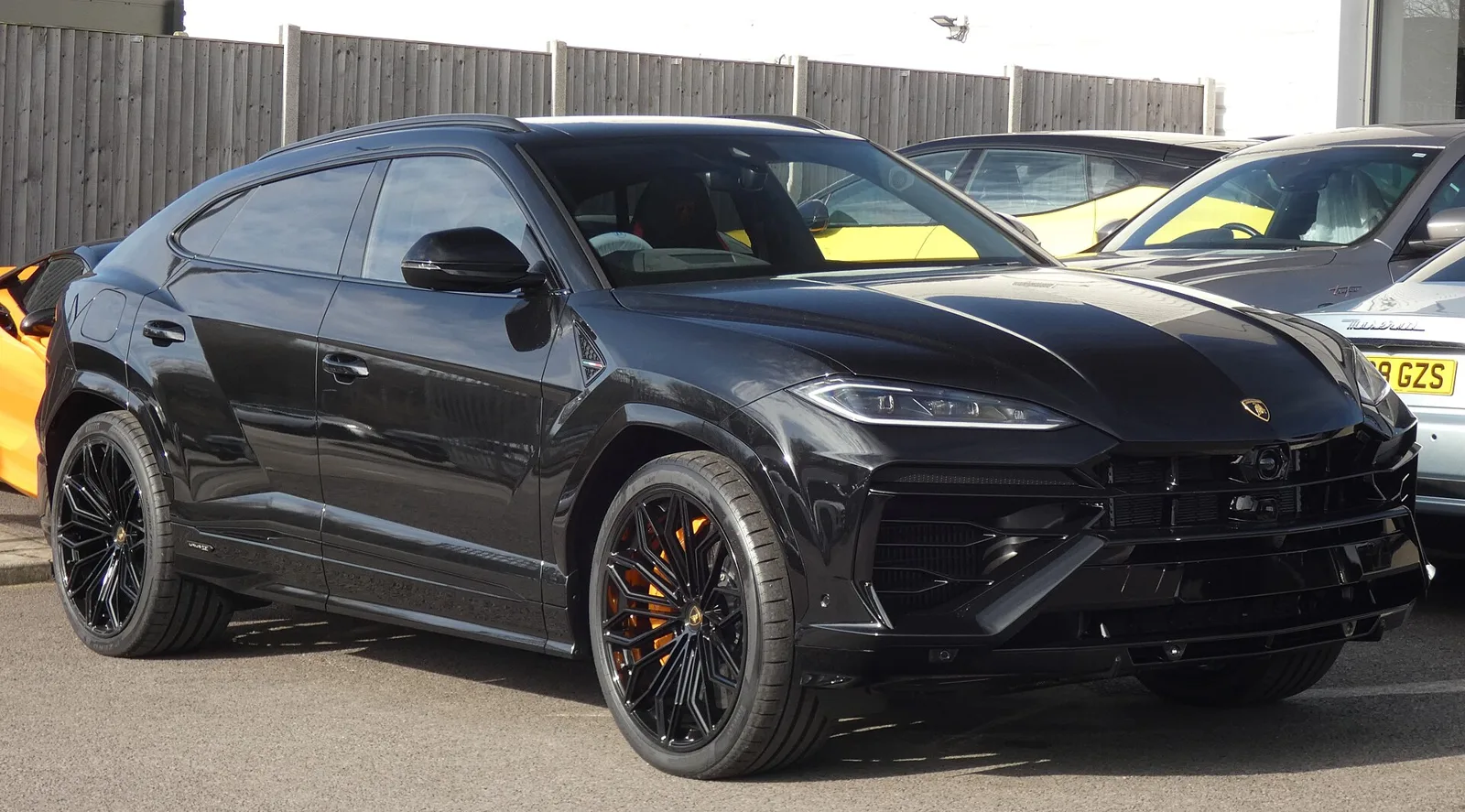
Lamborghini's first SUV since the LM002, a carbon-trimmed performance machine with a twin-turbo V8, plug-in hybrid and racing spin-offs.
The Lamborghini Urus is a luxury SUV with a 4.0-litre twin-turbo V8 that went on sale from 2018. It reaches 100 km/h in 3.6 seconds, and it became Lamborghini's best-selling model after 20,000 units by 2022. Variants range from the Performante to a plug-in hybrid SE.
The Lamborghini Urus is a high-performance luxury SUV that Lamborghini introduced in December 2017, its first SUV since the LM002. Built on a Volkswagen Group platform, it went on to become the brand's best-selling model, passing 20,000 units by 2022.
This profile covers where the Urus came from, how it performs, what is under the bonnet, the special variants, the sales story and the recalls. Metric figures come first, with imperial values in brackets.
Where did the Urus come from?
The Urus was previewed as a concept at the 2012 Beijing Auto Show, then unveiled for production on 4 December 2017 at Lamborghini's Sant'Agata Bolognese headquarters. It was the first Lamborghini SUV under Volkswagen ownership and the brand's first SUV since the LM002. It was also the first five-door vehicle the brand had produced under that ownership, which marked a clear change in direction.
The name points back to the aurochs, the wild ancestor of today's domestic cattle. The Latin term for a wild ox appears from the time of the Gallic Wars onwards, and the Urus name had been trademarked before the Estoque appeared at the 2008 Paris Motor Show.
Automotive blogs Jalopnik and Autoblog expected the name to be applied to the Estoque, which was later confirmed as the car that carried it.
The concept used a 5.2-litre V10 shared with the Gallardo, rated at 600 PS (592 hp; 441 kW) and paired with all-wheel drive. Its sharp-lined body took heavy cues from the Aventador flagship, but the production car dropped the V10 for a twin-turbo V8.
Production began at the refreshed Sant'Agata facility ahead of first deliveries in early 2018. Lamborghini had targeted around 3,500 cars a year, but demand was higher, and the factory had to be expanded to meet it.
A carbon-trimmed luxury SUV that gave Lamborghini its best-selling model and a plug-in hybrid flagship.
How fast is the Lamborghini Urus?
The standard Urus reaches 100 km/h (62 mph) in 3.6 seconds and 200 km/h (124 mph) in 12.8 seconds. Its top speed is 305 km/h (190 mph), while the Urus SE reaches 312 km/h (194 mph), which made it the fastest production SUV in the world at launch.
The car is lighter than many of its rivals. The maker quotes less than 2,200 kg (4,850 lb), mainly because of extensive use of carbon fibre reinforced polymer, even though the platform is shared with the Audi Q7, Bentley Bentayga, Porsche Cayenne and Volkswagen Touareg.
The brakes are carbon ceramic discs measuring 440 mm (17.32 in) at the front and 370 mm (14.57 in) at the rear. Lamborghini said these were the largest set of its kind it had developed at the time, and the front calipers use ten pistons.
What is under the bonnet of the Urus?
The Urus uses a twin-turbocharged V8 derived from an Audi engine of the same size, and it is rated at 478 kW (641 hp; 650 PS) at 6,000 rpm. Torque is 850 N m (627 lb ft) from 2,250 to 4,500 rpm, and the engine is assembled at a Volkswagen plant in Hungary.
Lamborghini's hallmark naturally aspirated V10 and V12 engines were absent from the production car. The V8 was heavily reworked, with new cylinder heads, and it produced 100 PS (74 kW; 99 hp) more than the unit in the Cayenne Turbo.
In normal driving the all-wheel drive system sends 40% of torque to the front and 60% to the rear. Torque vectoring can push up to 70% forward or 87% rearward when needed, and rear-wheel steering helps the car turn in tight spaces.
The air suspension can raise ground clearance to a maximum of 250 mm (9.8 in) for off-road use. An optional off-road package adds revised bumpers that suit rougher terrain.
The EPA figures show the car's thirst. It is rated at 14 mpg-US (16.8 L/100 km) combined, 12 mpg-US (19.6 L/100 km) in the city and 17 mpg-US (13.8 L/100 km) on the highway, which is typical for a large, powerful SUV of its type.
What does the standard Urus come with?
The standard Urus comes with an eight-speed ZF 8HP automatic, 21-inch wheels, carbon ceramic brakes, rear-axle torque vectoring and four-wheel steering. The front seats offer 12-way power adjustment, and a 12.3-inch digital instrument panel sits in front of the driver.
The rear seats can be set up as a three-person bench or as two sport seats, and four-zone automatic climate control is standard. Inside there is a simulated suede headliner with leather seating surfaces.
The Urus, like Lamborghini's other current models, offers several driving modes. Strada, Sport and Corsa are joined by Terra, Sabbia and Neve, with the last three possibly limited to cars fitted with the off-road package. Each mode adjusts the suspension behaviour to suit the surface, from relaxed road driving to a track session.
Which special variants did Lamborghini build?
Lamborghini built several variants, from the Pearl Capsule with its colour options to the ST-X racing car and the Performante. Each one changed the Urus's character in a different way, from styling to outright performance.
The Pearl Capsule let buyers choose from three pearl paints, Verde Mantis, Arancio Borealis and Giallo Inti, with two-tone Alcantara seats and 23-inch Taigete wheels in Shiny Black. Power and torque remained the same as the standard car.
A Black Gloss finish covered the lower bumpers, rocker covers and roof, creating a two-tone effect that matched the colour accents each buyer chose.
The Urus ST-X was a non-street-legal racing variant built by the Squadra Corse division. It was unveiled at the Lamborghini World Finals in 2018 and carried a full roll cage, a fire suppression system and an FT3 fuel tank. It was about 25% lighter than the road car, and customer deliveries were scheduled for 2020. Designed to meet FIA regulations, the production ST-X had enlarged air intakes to aid heat exchange for its twin-turbo V8, hexagonal racing exhausts and Pirelli tyres on 21-inch alloys.
The Urus Performante arrived in August 2022 with 657 hp (666 PS; 490 kW). Its quoted sprint to 100 km/h takes 3.3 seconds, and it tops out at 306 km/h (190 mph). It dropped the height-adjustable air springs for fixed coil springs and lost the off-road drive modes, while being 47 kg (104 lb) lighter than the other variants.
In December 2023 Lamborghini delivered a Performante to the Italian State Police in Rome, with the prime minister and interior minister present for the handover.
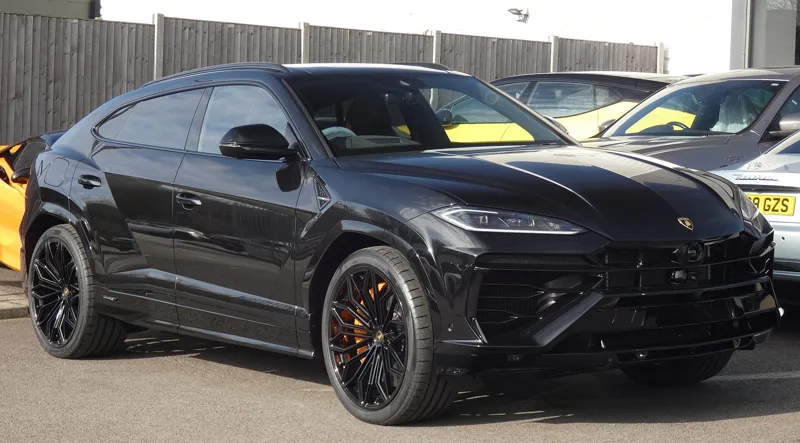
The SE, revealed in April 2024, added a plug-in hybrid system. On its own, the reworked 4.0-litre V8 makes 462 kW (620 hp; 628 PS), with 800 N m (590 lb ft) of torque. A permanent-magnet electric motor, integrated into the eight-speed automatic, adds 141 kW (189 hp; 192 PS) and a further 483 N m (356 lb ft).
Together the hybrid system is rated at 596 kW (799 hp; 810 PS), and its combined torque figure is 950 N m (701 lb ft). Its 25.9 kWh battery adds roughly 300 kg (661 lb) over the standard Urus S, yet the SE still reaches 100 km/h in 3.4 seconds. Lamborghini says the plug-in hybrid cuts regulated tailpipe emissions by up to 80%.
How well has the Urus sold?
Lamborghini announced its 10,000th Urus in July 2020, and by 2022 it had built 20,000. That pace made it the brand's top seller in record time, a notable result for a brand known for its naturally aspirated V10 and V12 flagships. The climb from the 2018 deliveries to the 20,000-unit milestone in 2022 was quick by any measure.
The figures show how far the SUV has moved the brand beyond its traditional sports cars, which are still the core of its identity.
How did the production Urus differ from the concept?
The production car received major exterior changes and a different powertrain from the 2012 concept. The concept's naturally aspirated V10 gave way to the twin-turbo V8, but the sharp-lined body language inherited from the Aventador was kept.
The production model was unveiled at Sant'Agata Bolognese, where the refreshed facility had been prepared for it. The concept had been shown at Pebble Beach later in the same year it debuted in Beijing, so the company used the show circuit to build interest well before the car reached buyers.
The production car also seats four or five people, with a luxury interior that the concept did not need to show. That layout gave the Urus a clear role as a daily performance SUV rather than a show car.
What are the Lamborghini Urus specifications?
The table below compares the standard V8, the Performante, the SE and the ST-X on power and key performance figures. Where a figure was not published for a version, the table says so, so the road car numbers are not overstated.
| Version | Power | 0-100 km/h (62 mph) | Top speed |
|---|---|---|---|
| Urus (V8) | 478 kW (641 hp; 650 PS) | 3.6 seconds | 305 km/h (190 mph) |
| Urus Performante | 657 hp (666 PS; 490 kW) | 3.3 seconds | 306 km/h (190 mph) |
| Urus SE | 596 kW (799 hp; 810 PS) | 3.4 seconds | 312 km/h (194 mph) |
| Urus ST-X | 641 hp (650 PS; 478 kW) | Not given | Not given |
The ST-X shares the standard car's power and torque, so the table lists its output and leaves the sprint and speed figures blank.
Has the Urus been recalled?
Yes, twice. In November 2020 the NHTSA recalled 2019 and 2020 models with the 4.0-litre V8 over a fire risk, and 2,831 cars were affected. A further recall in May 2024 covered 2,133 Performante and S cars over hood latch rivets. Both recalls involved V8 cars, but they covered different model years and different parts.
The 2020 recall centred on the fuel line quick connectors, which could soften under high engine compartment temperatures and lead to a fuel leak. The problem reached Lamborghini's attention after Porsche AG flagged it in 2019.
The 2024 hood problem appeared at speeds above 94 mph (151 km/h), when airflow could enter the gaps between the hood and the front bumper. The latch could then fail, and in some cases the hood could detach from the vehicle.
Frequently asked questions
Is the Urus a hybrid?
Yes, the SE is a plug-in hybrid with a 25.9 kWh battery. The standard Urus relies on its twin-turbo V8 alone, with no electric assistance.
Did the Urus ever have a V10?
No. The concept car's V10 was dropped for the production model, which uses the twin-turbo V8 instead.
Is the ST-X a road car?
No. The ST-X is a racing car, not a road car, so it could never be registered for public roads.
Is an off-road package available?
Yes, through an optional package. It brings different bumpers and unlocks some of the terrain-focused driving modes.
How many people can the Urus carry?
The Urus seats four or five people, depending on whether the rear is set up as a bench or as two sport seats.
_PHEV_-_Nero_Helene_-_02-2025,_Front.jpg)