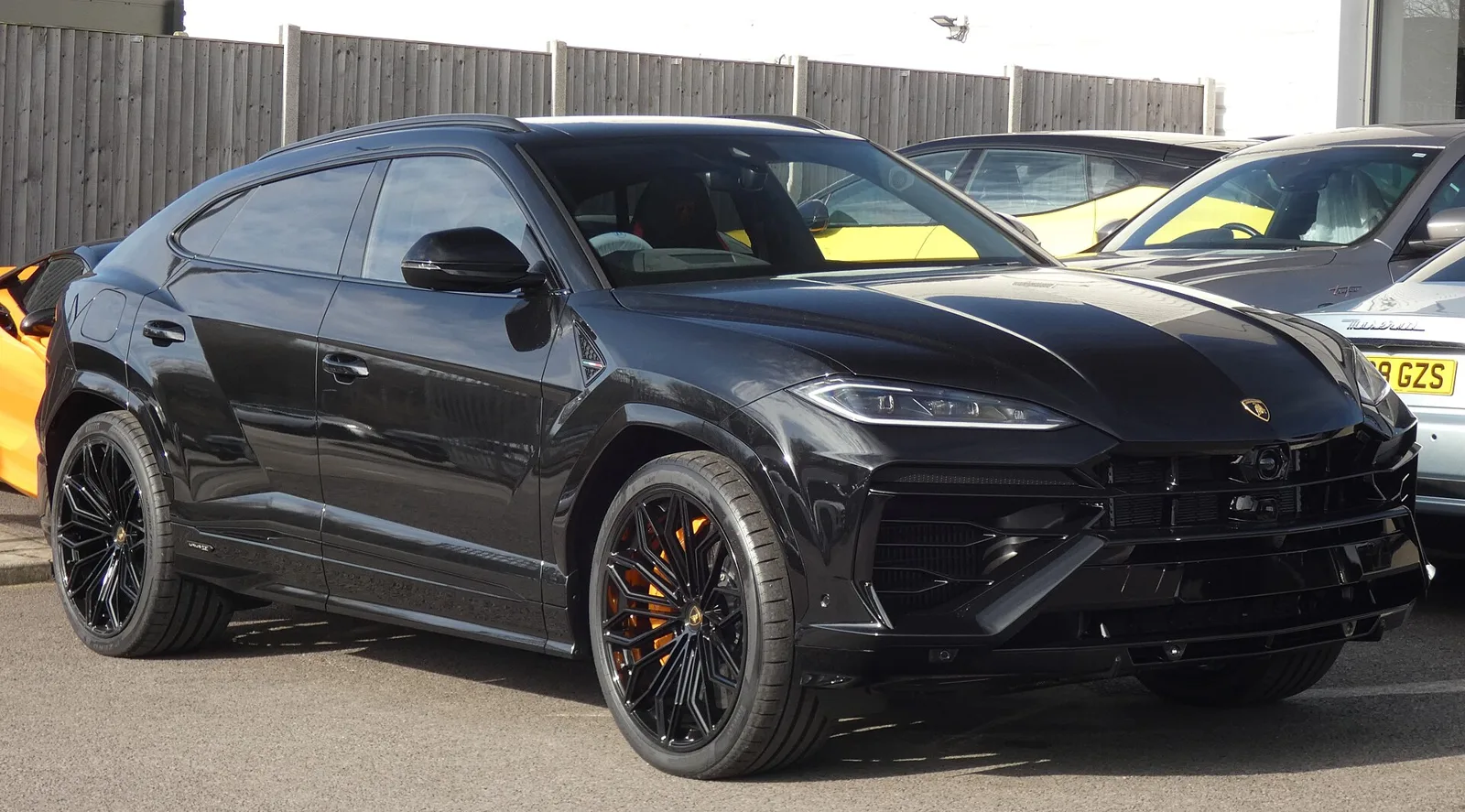
Two Volkswagen Group super-SUVs, two very different answers to the same question: how do you build a 300 km/h luxury machine that still seats four?
The Lamborghini Urus is the sharper, more extrovert machine, while the Bentley Bentayga leans on hand-finished luxury and a broader engine range. Both use Volkswagen Group MLB underpinnings, yet they deliver completely different experiences: Sant'Agata's SUV attacks the road, Crewe's cossets its occupants.
The Lamborghini Urus is the more focused performance SUV, while the Bentley Bentayga prioritises hand-built luxury and a wider choice of powertrains. Both arrived within two years of each other, share Volkswagen Group mechanical foundations, and cost roughly the same, yet they satisfy completely different appetites.
How did the Lamborghini Urus and Bentley Bentayga come to exist?
Bentley got there first, unveiling the EXP 9 F concept at the 2012 Geneva Motor Show and putting the production Bentayga on sale in late 2015. Lamborghini showed its Urus concept at the 2012 Beijing Auto Show in April, then waited until December 2017 to launch the road car as a 2018 model.
The two projects were born from the same corporate logic. Volkswagen Group wanted ultra-luxury SUVs to capture new money in the Middle East, China and North America, and both marques needed a volume model to fund their traditional flagships. For Bentley, the Bentayga was a genuine first: the company had never built an SUV, and the EXP 9 F show car was previewed with a 6.0-litre W12 making 600 hp. For Lamborghini, the Urus was a return rather than a debut. The LM002 had been a V12-engined military-derived brute built between 1986 and 1993, so the Urus became the marque's second SUV and its first five-door under Volkswagen ownership. The name itself was borrowed from the aurochs, the extinct wild ox that Latin writers called urus, a nod to raw strength rather than pastoral charm.
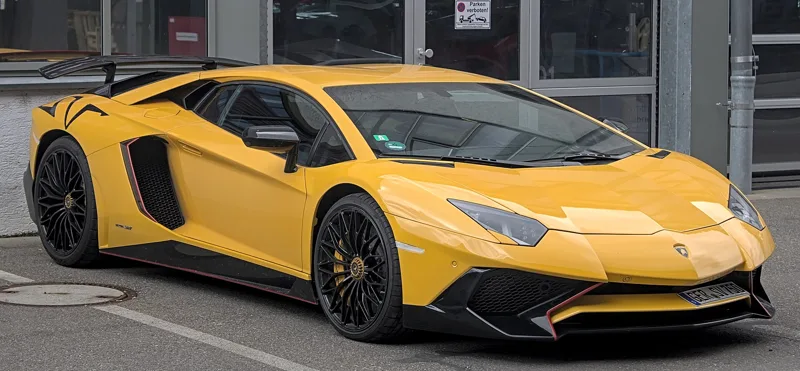
Drive them back to back and the philosophical split is obvious. The Urus feels like a supercar that happens to be tall: sharp-lined, Aventador-influenced.
What is the difference between the Urus and Bentayga platforms?
Both cars sit on Volkswagen Group's MLB Evo architecture, a unibody structure shared with the Audi Q7, Porsche Cayenne, Volkswagen Touareg and Audi Q8. Permanent all-wheel drive is standard on each, and both use a Torsen self-locking centre differential with an asymmetric 40/60 front-to-rear torque split in normal driving.
Beyond the shared mounting points, little else is common. Lamborghini's team started with the Cayenne Turbo's twin-turbo 4.0-litre V8 but altered it substantially, adding fresh cylinder heads and gaining 100 PS and 80 Nm in the process. Hungary is where a Volkswagen factory puts the engine together, after which it travels to Sant'Agata Bolognese to be joined with a ZF eight-speed automatic. Rear-wheel steering features on the Urus, as do air suspension offering as much as 250 mm of ground clearance and torque vectoring able to send up to 70 per cent of drive forwards or 87 per cent rearwards. When it arrived, its carbon ceramic brake discs were the biggest fitted to any production car: 440 mm at the front with ten-piston callipers, and 370 mm at the rear with single-piston callipers.
Bentley took a more conventional route. Although the Bentayga sits on the same MLB underpinnings, what defines it is the choice of powerplants offered over time: a 6.0-litre W12 featuring variable displacement, able to cut out six of its twelve cylinders; a diesel V8 sourced from a Volkswagen Group unit; a 4.0-litre twin-turbo petrol V8; and a plug-in hybrid that combines a 3.0-litre V6 turbo with an electric motor and a 17.3 kWh battery. On the Bentayga S, the chassis is made sharper through dampers 15 per cent stiffer than standard plus recalibrated torque vectoring, and the Extended Wheelbase variant brings in active anti-roll bars along with rear-wheel steering.
Which is faster, the Lamborghini Urus or the Bentley Bentayga?
In any like-for-like specification, the Urus comes out ahead. A 0-100 km/h time of 3.4 seconds and a 312 km/h (194 mph) maximum belong to the Urus SE, whereas the Bentayga Speed requires 3.9 seconds for the same sprint. The Urus Performante completes the benchmark even sooner, at 3.3 seconds.
Across the wider Urus line-up, the differences become clearer. In the Performante, output stands at 657 hp (666 PS; 490 kW) and top speed at 306 km/h. It also weighs 47 kg less than the other variants, a saving achieved through fixed-height coil springs in place of the air suspension, a centre differential biased further to the rear, greater downforce and revised suspension tuning. Lamborghini has removed the off-road driving modes from the Performante, a clear indication of the model's intended focus. The SE plug-in hybrid pairs a 462 kW (620 hp; 628 PS) V8 with a 141 kW (189 hp; 192 PS) electric motor, giving a combined 596 kW (799 hp; 810 PS) and 950 Nm (701 lb-ft). At its launch, that made it the quickest SUV ever put into series production, reaching 200 km/h from rest in 12.8 seconds. A 25.9 kWh lithium-ion battery is fitted, and Lamborghini states that the SE lowers tailpipe emissions by as much as 80 per cent relative to the purely combustion-engined versions. Weight is the trade-off: the SE is around 300 kg heavier than a standard Urus S.
Modesty was never part of the Bentayga story. At its debut, the W12 variant reached 60 mph in 4.0 seconds. The diesel V8 took 4.6 seconds for the same sprint, 4.8 seconds to reach 100 km/h, and topped out at 168 mph (270 km/h). A petrol V8 sat between them, needing 4.4 seconds to hit 60 mph and 4.5 seconds for 100 km/h, with a maximum of 180 mph (290 km/h). Output for the plug-in hybrid stands at 449 PS (330 kW; 443 hp) and 700 Nm. With the 2020 facelift came an entry V8 rated at 542 hp (404 kW; 550 PS), a figure also quoted for the Bentayga S and the Extended Wheelbase, whereas the revised Speed pushed output up to 626 hp (467 kW; 635 PS).
Specification comparison: Urus versus Bentayga
| Model | Power | Torque | 0-100 km/h | Top speed |
|---|---|---|---|---|
| Lamborghini Urus Performante | 657 hp (666 PS; 490 kW) | 850 Nm | 3.3 s | 306 km/h |
| Lamborghini Urus SE | 596 kW (799 hp; 810 PS) | 950 Nm (701 lb-ft) | 3.4 s | 312 km/h (194 mph) |
| Bentley Bentayga Speed (2020 facelift) | 626 hp (467 kW; 635 PS) | - | 3.9 s | - |
| Bentley Bentayga S / EWB | 542 hp (404 kW; 550 PS) | - | - | - |
| Bentley Bentayga PHEV | 449 PS (330 kW; 443 hp) | 700 Nm | - | - |
What is the Lamborghini Urus like inside?
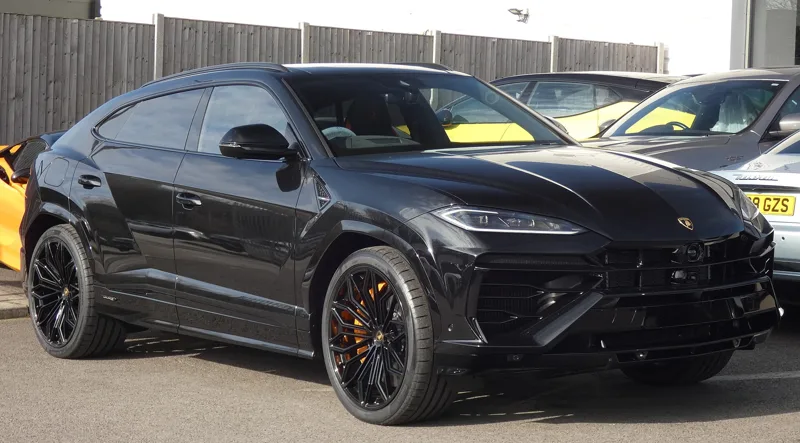
The Urus cabin is a deliberate exercise in aggression, with a simulated suede headliner, leather seating and a 12.3-inch digital instrument panel. Front occupants get 12-way power seats with memory and heating, four-zone automatic climate control is standard, and buyers choose between a three-person rear bench or two individual sport seats. Standard equipment includes 21-inch wheels, four-wheel steering and torque vectoring.
Two special versions take the drama up a level. With the Pearl Capsule come 23-inch Taigete alloys finished in Shiny Black, a choice of three pearl hues - Verde Mantis, Arancio Borealis and Giallo Inti - gloss black lower bumpers, rocker panels and roof, and two-tone Alcantara seats, while output and twist stay as they are on the regular car. Squadra Corse's ST-X sheds a quarter of the mass, gains 21-inch wheels on Pirelli rubber, hexagonal racing exhausts, a complete roll cage, fire suppression and an FT3 fuel tank, yet retains the road model's 641 hp and 850 Nm. It appeared as a concept in 2018 during the Lamborghini World Finals, engineered for FIA compliance, and buyers were to receive cars from 2020. In 2023, a Urus Performante Polizia was handed over to the Italian State Police in Rome.
What is the Bentley Bentayga like inside?
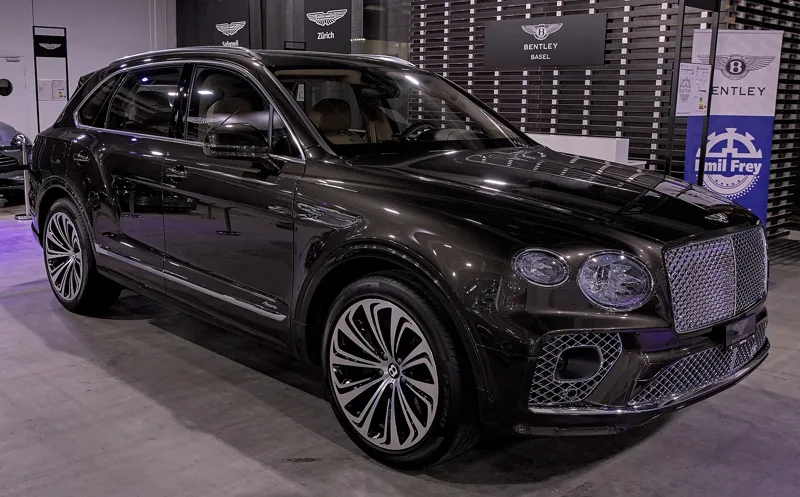
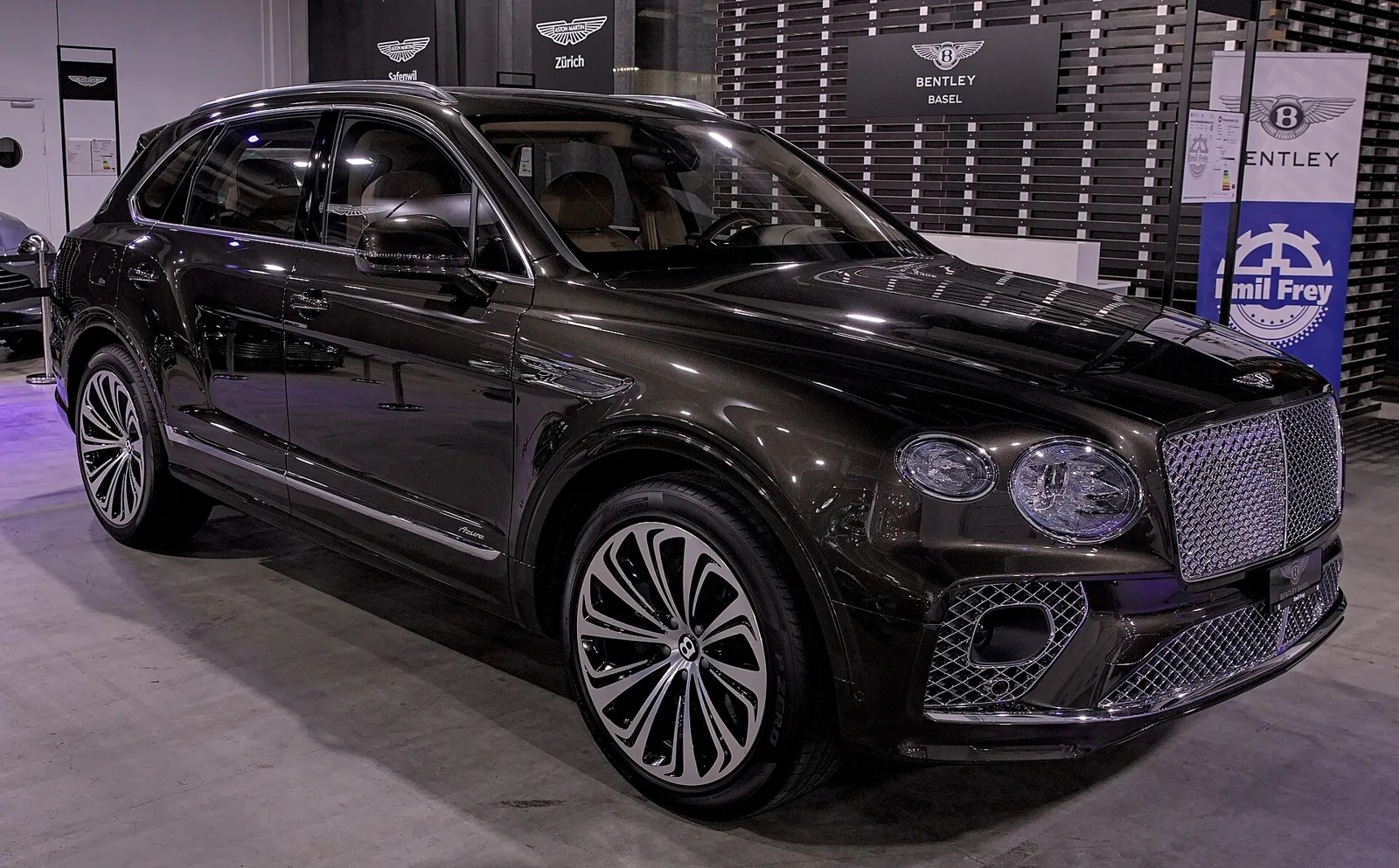
Crewe's answer to the same brief is a much more opulent proposition. Bentayga buyers can pick from four, five or seven seats, and the 2020 facelift introduced a 10.9-inch touchscreen with Apple CarPlay and Android Auto, USB-C ports, air ionisers, wireless charging and an embedded SIM, plus a digital instrument display and a head-up display that serves up more information than before. For audio, a twelve-speaker setup is fitted as standard, while an optional Naim system powers twenty speakers.
Those riding in the back of the updated car received ventilated seats, an additional 100 mm of knee room and a detachable 5.0-inch touchscreen tablet. The revision likewise introduced 3D elliptical tail-lights with animated LEDs, a number plate relocated to the bumper, the word 'Bentley' written across the tailgate, a larger rear spoiler, fresh side vents, new 22-inch wheels, oval split tailpipes and heated wipers with 22 washer jets per arm. Alongside it came two extra paint shades. With the Blackline option the chrome is darkened, the Bentayga S gains tinted light clusters, black lower-body panels and a black oval sports exhaust, while the Azure trim adds Azure badging aft of the front wheel, chromed grilles and a 'jewel' filler cap. Limited editions are the responsibility of Mulliner, Bentley's customisation division, which also provides a Breitling clock.
How do the Urus and Bentayga differ in character?
Compare the two directly and their differing characters become clear. The Urus comes across as a tall supercar, its shape defined by sharp creases and Aventador cues; an early 2012 concept hinted at a 5.2-litre V10 borrowed from the Gallardo with a theoretical 600 PS, before the road-going version adopted a twin-turbo V8 and a substantially reworked body. Six drive settings - Strada, Sport, Corsa, Terra, Sabbia and Neve - span circuit use to desert dunes, although the final three might be offered only alongside the off-road pack, which adds altered front and rear bumpers. In 2024 the SE arrived, revising the exterior and introducing plug-in hybrid power.
Among these SUVs, the Bentayga holds the most senior position. Bentley intended it to be its best-selling vehicle, and that is precisely what happened; the lukewarm response to the EXP 9 F concept obliged the company to rework the design considerably, giving the production car a more conventional SUV silhouette and toning down the retro detailing. The Urus is built around lap times, whereas the Bentayga is built around comfort and ease, with the S version representing its most aggressive interpretation. In 2022 the Extended Wheelbase took over from the Mulsanne at the pinnacle of the range, a measure of just how thoroughly the SUV now dominates Bentley's line-up.
Where are the Urus and Bentayga built?
Production of the Urus takes place at Lamborghini's updated Sant'Agata Bolognese plant, which was enlarged so that output could exceed the original goal of roughly 3,500 vehicles annually; the first customer cars were handed over in early 2018. A milestone was reached in July 2020, and 20,000 had been built by 2022, a pace that made the Urus the fastest-selling model in the company's history.
The route Bentley takes to build its cars is a longer one. Body shells are produced in Germany, at Volkswagen's Zwickau-Mosel factory, before being painted and put together at Crewe in the UK, a shift that followed the end of body shell work at Bratislava in late 2016. Production at Crewe was guaranteed by a deal with the British Government, and Bentley put 800 million pounds into a new assembly site while taking on 1,000 more staff. Initially, the model had been intended for Volkswagen's Bratislava facility in Slovakia. The choice paid off in sales terms: Bentley had forecast 3,500 units for 2016 but shifted 5,586, which made the Bentayga its best-selling model that year, while roughly 6,370 were sold in 2022. In November 2016, 378 cars were recalled over seats that had not been fixed properly.
Which one should you choose?
Choose the Urus when outright speed and maximum visual impact matter most. Compared with a number of its rivals, among them the BMW X6 M, the Bentayga and the Rolls-Royce Cullinan, it weighs notably less, and its chassis technology is the boldest on offer. The SE plug-in hybrid brings real electric-only range while keeping performance intact. Massive carbon ceramic discs handle stopping, its torque vectoring sends drive to the rear, and its design makes no attempt to pass unnoticed.
Choose the Bentayga if luxury, space and effortless torque matter more than lap times. It offers up to seven seats, a broader engine range including a diesel and a plug-in hybrid, and a level of hand-finished detail that Sant'Agata does not attempt. The Speed's 626 hp (467 kW; 635 PS) is ample, the Extended Wheelbase is a genuine limousine alternative, and the Azure trim prioritises comfort over confrontation.
Both cars prove the same point from opposite directions: the ultra-luxury performance SUV is not a compromise but a distinct genre, and these two defined it.
_PHEV_-_Nero_Helene_-_02-2025,_Front.jpg)