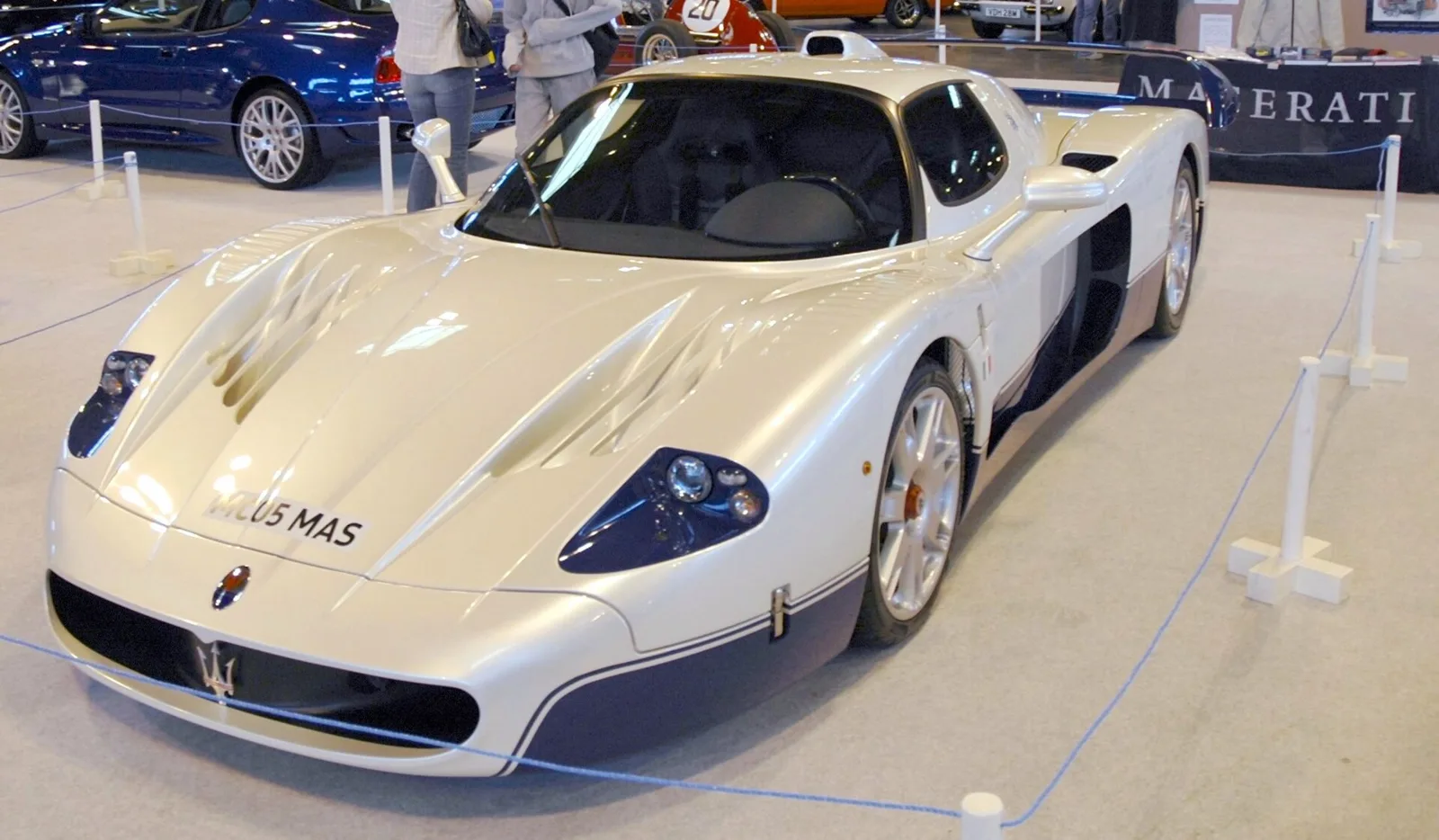
A two-seat coupe with Ferrari Enzo underpinnings, built to qualify a GT1 racer and then raced in the FIA GT Championship.
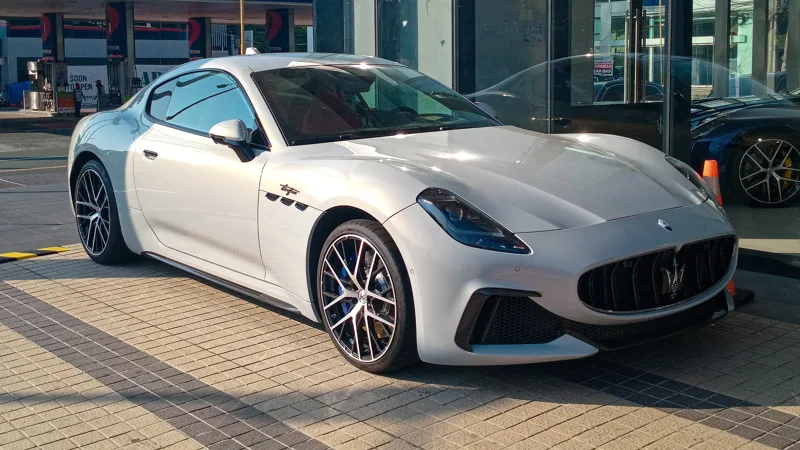
Maserati's MC12 was a limited two-seat coupe built from 2004 to 2005 on Ferrari Enzo underpinnings. Fifty road cars were sold, and twelve racing cars were built to compete in GT1 events. The racers won races and the 2005 manufacturers title.
The Maserati MC12 was a two-seat sports car that Maserati built in 2004 and 2005 so that its racing version could compete in the FIA GT Championship. It was built on the chassis of the Ferrari Enzo, but its body was longer, wider and taller. Fifty road cars were sold to customers, and twelve racing cars brought the total to 62.
Why did Maserati build the MC12?
The MC12 marked Maserati's return to racing after 37 years. FIA GT rules required at least 25 road cars for homologation, so the road version existed to qualify the race car for the series. The first batch of 25 was built in 2004.
The race car debuted at Imola in 2004, but the FIA withheld points because its homologation was disputed. Even so, the team finished second and third. Maserati's first win came at Oschersleben, where Andrea Bertolini and Mika Salo took the car to victory.
At the final round of the year, at Zhuhai, the FIA agreed to homologate the cars and allow them to score points. The MC12 won again there, and the team finished seventh in the teams championship for the season.
A two-seat Enzo relative built to qualify a race car, then sold in 62 examples in total.
Who developed the MC12?
Giorgio Ascanelli directed development of a race car that was first called the MCC, short for Maserati Corse Competizione. It was developed alongside a road version named the MCS, Maserati Corse Stradale, and the two cars shared most of their engineering. Frank Stephenson, then director of Ferrari-Maserati concept design, did most of the body styling.
The initial shape came out of wind-tunnel work that started with an idea from Giorgetto Giugiaro. Andrea Bertolini was chief test driver through the whole process, and Michael Schumacher also tested the MCC at the Fiorano Circuit. The MCC name was dropped once the official name, MC12, was settled.
How much of the Enzo did the MC12 share?
The MC12 used a slightly modified Ferrari F140 V12, along with the Enzo's gearbox, renamed the Cambiocorsa. Its chassis track matched the Enzo's, but the body was unique. The windscreen is the only externally visible component the two cars share.
The MC12 body is wider, longer and slightly taller than the Enzo. That extra size creates more downforce across the car's surfaces, which works alongside a rear spoiler that is two metres (79 in) wide. The spoiler is only 30 mm (1.2 in) thick, and the underside is smooth.
How does the MC12 handle its weight?
The MC12 uses a mid-rear layout, with the engine between the axles but behind the cabin. That keeps the centre of gravity near the middle of the car, which helps stability and cornering. The standing weight split is 41% front and 59% rear.
Speed changes the picture. At 200 km/h the rear spoiler shifts the balance to 34% front and 66% rear, so the downforce works mainly on the rear axle.
How powerful is the MC12 engine?
The MC12 uses a 5,998 cc V12 mounted longitudinally in a 65-degree layout. The engine has four valves per cylinder, a dry sump and a compression ratio of 11.2:1. It makes 652 Nm (481 lb ft) of torque at 5,500 rpm and 463 kW (630 PS; 621 hp) at 7,500 rpm.
The engine weighs 232 kg (511 lb). Unlike the Enzo, which uses chains, the MC12 drives its camshafts through gears. The redline sits at 7,500 rpm, although the engine is considered safe up to a higher figure, while the Enzo revs to 8,000 rpm.
How fast is the MC12?
Maserati quotes 3.8 seconds to 100 km/h (62 mph), while Motor Trend recorded 3.7 seconds. The car reaches 200 km/h (124 mph) in 9.9 seconds and has a top speed of 330 km/h (205 mph).
A standing quarter-mile takes 11.3 seconds, and the car crosses the line at 200 km/h (124 mph). A standing kilometre takes 20.1 seconds. The Enzo's top speed of 350 km/h (217 mph) is 20 km/h (12 mph) higher, and the Enzo also accelerates and brakes more quickly.
Because the MC12 shares much of its mechanical basis with the Enzo, the differences in performance come mainly from its extra size and mass, which the Maserati engineers accepted in return for the downforce.
How does the MC12 gearbox work?
Power reaches the rear wheels through a six-speed automated manual called the Maserati Cambiocorsa. It shifts in 150 milliseconds through a 215 mm twin-plate dry clutch. The gearbox is the same design as the Enzo's, tuned to different ratios.
Because the transmission is an automated manual with a dry clutch, the car has no clutch pedal, and the driver relies on the paddles or the automatic mode to change gear.
The chassis is a carbon and Nomex monocoque with aluminium sub-frames at the front and rear, and it includes a roll bar for strength. Double wishbones carry pushrod-operated coil springs. A cabin button raises the front suspension for speed bumps and hills.
The brakes are Brembo discs with a Bosch anti-lock system. The front discs are 380 mm across with six-piston calipers, and the rear discs are 335 mm with four-piston calipers. The wheels are 19 inch, with Pirelli P Zero Corsa tyres sized 245/35 ZR 19 at the front and 345/35 ZR 19 at the rear.
The centre-lock wheel nuts are colour-coded, red on the left side of the car and blue on the right, so the two sides are easy to tell apart.
Did critics like the MC12?
Reviews were mixed. Critics called the car hard to drive, overpriced and too large, and some pointed to the lack of a boot, a rear window, a spare tyre and a radio. Reviewers also criticised the way the engine's output was restricted.
Top Gear tested one, and its test driver The Stig set a 1:18.9 lap on the show's track. That was 0.1 seconds faster than his lap in the Enzo. Jeremy Clarkson drove the car as well, compared it unfavourably with the Maserati Biturbo, and still praised its smooth ride.
Motor Trend's Frank Markus was more positive, saying the car was even more forgiving at the limit than an Acura NSX. Automobile magazine's Preston Lerner called it user-friendly and praised the way its traction control allowed a driver to have fun before intervening.
What is the interior like?
The car was designed as a homologation vehicle and modified from a racing car, yet the interior was intended to be luxurious. The cabin mixes gel-coated carbon fibre, blue leather and a silver synthetic called Brightex, a material judged too costly even for fashion use.
The centre console features the Maserati oval analogue clock and a blue ignition button. Critics pointed out that it has no radio, no car stereo and no place to fit an aftermarket sound system, and that drew criticism in reviews.
How did the MC12 perform in GT1 racing?
The 2005 manufacturers' title went to Maserati, which scored 239 points in the FIA GT Manufacturers Cup, almost twice the 125 scored by Ferrari. Vitaphone Racing and JMB Racing finished first and second in the teams championship that year, with Vitaphone winning by a clear margin.
Vitaphone Racing won the teams championship in 2006, 2007 and 2008, scoring 115 points in 2007 and 122.5 in 2008. In 2009 the team claimed a fifth consecutive Team Championship, while Andrea Bertolini and Michael Bartels shared the 2006 drivers' title, then took it outright in 2008 and 2009.
In 2007 Vitaphone won the GT1 teams championship again, ahead of Scuderia Playteam, which finished second. Maserati also took the manufacturers' cup by a significant margin that year, while Thomas Biagi won the drivers' championship.
Racing Box also won the non-championship 6 Hours of Vallelunga in 2005 and again in 2006. Team Goh planned a Super GT entry in Japan in 2006, but it withdrew after testing at Suzuka showed the car losing more than a second per lap in the corners.
Did the MC12 race in America?
Yes, though not easily. The car's length and width exceeded the class limits of the American Le Mans Series, so in 2005 IMSA allowed it as a guest with no championship points and a weight penalty. The Risi Competizione car scored no wins that season.
In 2007 Fredy Lienhard and Didier Theys prepared a former FIA GT MC12 for the series. It finished third in the GT1 class at Road America.
What is the MC12 Versione Corse?
The Versione Corse was a track-only variant derived from the GT1 race car and released in mid-2006. Twelve were sold to selected customers at EUR 1 million (US$1.47 million) each, and three more were built for testing and publicity.
Maserati looks after storage, upkeep and maintenance, and the cars are only driven at organised track days. The engine makes 555 kW (755 PS; 745 hp) at 8,000 rpm, which is 90 kW (122 PS; 120 hp) more than the road car. Three examples were later converted for road use by Edo Competition.
Those Edo conversions also made a little more power, used a butterfly-valve exhaust intake and had adjustable road suspension, so they could be driven on public roads.
The car came in one standard colour, Blue Victory, although paint could be customised on request. Its steel and carbon racing brakes lacked an anti-lock system.
What was the Birdcage 75th concept?
The Birdcage 75th was a concept car designed by Pininfarina and based on the MC12 chassis. It was shown at the 2005 Geneva Auto Show as a celebration of Pininfarina's 75th anniversary.
The concept drew its inspiration from the Maserati Tipo 61 Birdcage of the 1960s, which connected the modern car to the marque's earlier racing history.
Frequently asked questions
How many MC12s were built?
Maserati produced 62 cars in total. Fifty were road cars made in two batches of 25, and the remaining 12 were racing cars. The second batch was 150 mm shorter to meet the rule change.
How does the MC12 compare with the Enzo?
The MC12 has a larger body and a modified version of the Enzo's V12, and its top speed is 330 km/h against the Enzo's 350 km/h. The Enzo accelerated more quickly and braked over a shorter distance.
Did the MC12 win the drivers' title?
Bertolini and Bartels shared the 2006 drivers' championship and won it again in 2008 and 2009. In 2005 Gabriele Gardel took the title for Ferrari, leaving the Maserati drivers within four points of the lead.
Did the MC12 race in Japan?
The Super GT entry was dropped after a driver fell ill and testing at Suzuka left the car slower in the corners than hoped. On the straights it was quicker than its rivals.
Why is there no rear window?
The MC12 was designed with a body that left out a rear window, a choice that drew criticism from reviewers. The car's large size and the lack of a rear view make parking a challenge.