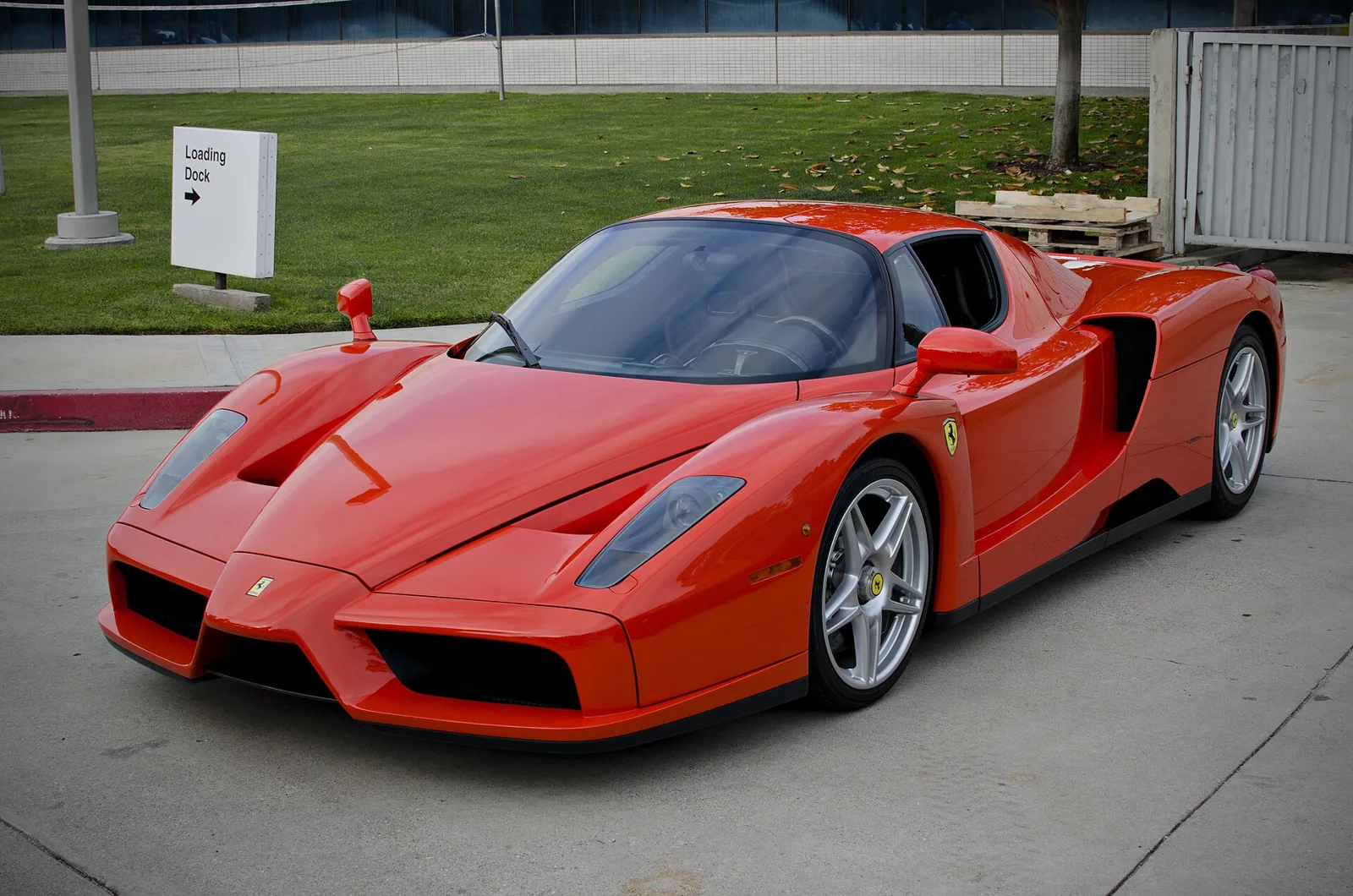
A carbon-bodied, paddle-shift V12 from 2002, the track spin-offs it spawned and a limited run that still shapes supercar history.
The Ferrari Enzo was a mid-engined V12 supercar that Ferrari introduced in 2002, with Formula One technology throughout. Its 6.0-litre engine made 660 PS, and the car reached 97 km/h (60 mph) in 3.14 seconds. Only 498 were built, and its track derivatives became famous in their own right.
The Ferrari Enzo was a mid-engined supercar that brought Formula One thinking to the road. Built in a run of 498 cars from 2002, it was named for the company's founder and became the basis for some of Ferrari's most extreme track machines.
This profile covers the car's origins, its engine and chassis, performance figures, reception and the track and one-off models that grew from it. Metric figures lead, with imperial values in brackets.
Where did the Ferrari Enzo come from?
The Enzo was developed in 2002 and first shown at that year's Paris Motor Show. It was designed by Ken Okuyama, then Pininfarina's head of design, and it was offered only to existing customers of the F40 and F50. A total of 498 units were eventually built, more than the first 399-unit plan.
During development the car was called the Ferrari FX. The Enzo name was chosen as a homage to the company founder. Three development mules were built, named M1, M2 and M3, and each used the bodywork of a 348.
The 400th production car went to the Vatican as a charity donation in 2004, and it later sold at Sotheby's for US$1.1 million. The third mule was offered alongside the 400th car in June 2005 and sold for 195,500 euros (US$236,300).
A supercar that carried Formula One ideas onto the road and then spawned a family of track machines.
What technology did the Enzo borrow from Formula One?
The Enzo used a carbon-fibre body and a paddle-shift gearbox derived from Formula One, along with ceramic composite brake discs. It also carried active aerodynamics, a technology Formula One did not permit at the time. The road car therefore mixed race ideas with features that a racing series would never allow.
Downforce was a serious part of the package. Front underbody flaps, a small adjustable rear spoiler and a rear diffuser worked together to produce 343 kg (756 lb) at 200 km/h (124 mph) and 775 kg (1,709 lb) at 300 km/h (186 mph). Downforce fell back to 585 kg (1,290 lb) at top speed.
Weight distribution was 44% front and 56% rear. The wheels were 19-inch (482.6 mm) units wearing Bridgestone Potenza Scuderia RE050A tyres, and the brakes used 15-inch (381.0 mm) discs from Brembo.
The suspension was four-wheel independent with anti-roll bars at both ends, and the shock absorbers could be set from the cabin. Together those choices gave the Enzo a chassis that was stable at speed and still adjustable for track days.
How powerful was the Enzo's V12?
The F140B is a naturally aspirated 65 degree V12 with a displacement of 5,998.80 cc (6.0 L; 366.1 cu in). It produces 660 PS (485 kW; 651 hp) at 7,800 rpm and 657 N m (485 lb ft) of torque at 5,500 rpm, with a redline of 8,200 rpm.
The engine was built with DOHC layout and four valves per cylinder. Its power was delivered through the rear wheels from a longitudinally mounted unit, which suited the car's mid-engined balance.
The gearbox was a paddle-shift unit built by Graziano Trasmissioni with a shift time of 150 milliseconds. LED lights on the steering wheel told the driver when to change, but the first-generation clutchless design drew complaints about abrupt shifting. The suspension used push-rod shock absorbers that could be adjusted from the cabin.
How fast was the Ferrari Enzo?
The Enzo reached 97 km/h (60 mph) in 3.14 seconds and 161 km/h (100 mph) in 6.6 seconds. Its quarter mile took about 11 seconds, and the top speed has been recorded as high as 355 km/h (221 mph).
Motor Trend tested the car without downhill or rollout assistance and recorded 0-60 MPH in 3.3 seconds, with a quarter mile of 11.1 seconds. Skidpad grip reached 1.05g, which gave the car a strong feel through fast corners.
Lap times told a similar story. Evo ran a 7:25.21 at the Nordschleife, and at Bedford Autodrome West the car lapped in 1:21.3. That was 1.1 seconds slower than the Porsche Carrera GT.
Fuel use was 34 L/100 km (6.9 mpg-US) in the city and 29 L/100 km (8.1 mpg-US) combined.
How did critics and magazines rate the Enzo?
Sports Car International placed the Enzo third on its list of top sports cars of the 2000s in 2004, and Motor Trend Classic ranked it fourth among the ten greatest Ferraris. Bloomberg Businessweek, however, included it among the fifty ugliest cars of the past fifty years.
The critics pointed at the V-shaped bonnet, the scooped doors and the bulbous windscreen, which they felt went too far in its curves and angles.
The car also appeared in film. Before its Paris debut, the show car was flown to the United States for Charlie's Angels: Full Throttle, and Demi Moore drove it along a beach. It was then flown to France for the Motor Show.
What are the Ferrari Enzo specifications?
The table below summarises the core figures for the standard road car. Where a value comes from a timed test or a variant, the row says so, so the road car figures are not mixed with the FXX or MC12 numbers.
| Specification | Detail |
|---|---|
| Engine | F140B naturally aspirated 65 degree V12, DOHC |
| Displacement | 5,998.80 cc (6.0 L; 366.1 cu in) |
| Power | 660 PS (485 kW; 651 hp) at 7,800 rpm |
| Torque | 657 N m (485 lb ft) at 5,500 rpm |
| Redline | 8,200 rpm |
| Gearbox | Paddle-shift F1 unit by Graziano Trasmissioni, 150 milliseconds |
| 0-97 km/h (0-60 mph) | 3.14 seconds |
| Top speed | 355 km/h (221 mph) recorded |
| Downforce | 775 kg (1,709 lb) at 300 km/h (186 mph) |
| Fuel use | 29 L/100 km (8.1 mpg-US) combined |
| Units built | 498 |
Read the table as the baseline for the whole family. The FXX and the MC12 Versione Corse used the same basic idea but produced far higher output for track use.
Why was the Enzo built in such small numbers?
The Enzo was sold only to selected existing customers, and it was first announced with a limited run of 399 units. The final count reached 498 units, each one built for a selected client.
The invitation-only method kept buyers within Ferrari's existing circle.
How fast was the FXX track car?
The FXX programme began in 2005 and used Enzo technology with a 6.3-litre V12 making approximately 800 PS (588 kW; 789 hp). The FXX reached 97 km/h (60 mph) in 2.8 seconds, and its initial price was 1.3 million euros. Clients took part through invitation, but the cars stayed with Ferrari.
Ferrari used the FXX to gather data from customers and its racing team. The car's telemetry and recording systems fed directly into future road cars, which made the programme more than a showpiece.
The Evoluzione kit refined the gearbox and aerodynamics. Its V12 made 860 PS (633 kW; 848 hp) at 9,500 rpm, and the car reached 0-100 km/h (0-62 mph) in 2.5 seconds with a top speed of 365 km/h (227 mph). The FXX programme continued until 2009.
Michael Schumacher set a 1:10.7 lap in an FXX on the Top Gear test track, a record that was taken off afterwards because the car was not suited to road use.
What other cars grew from the Enzo?
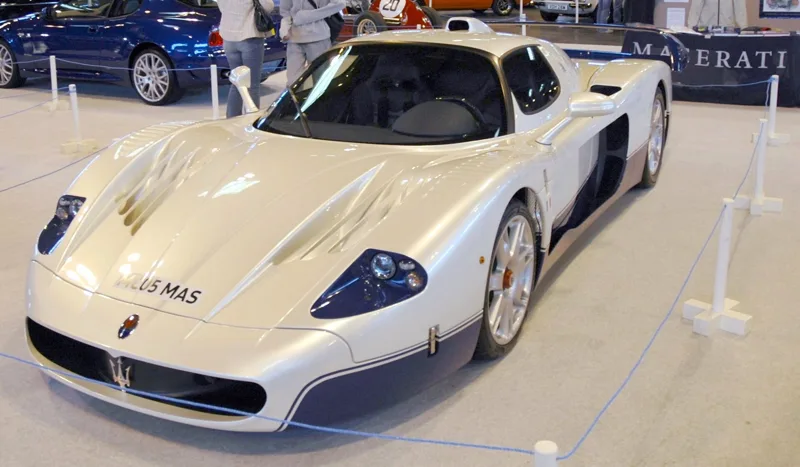
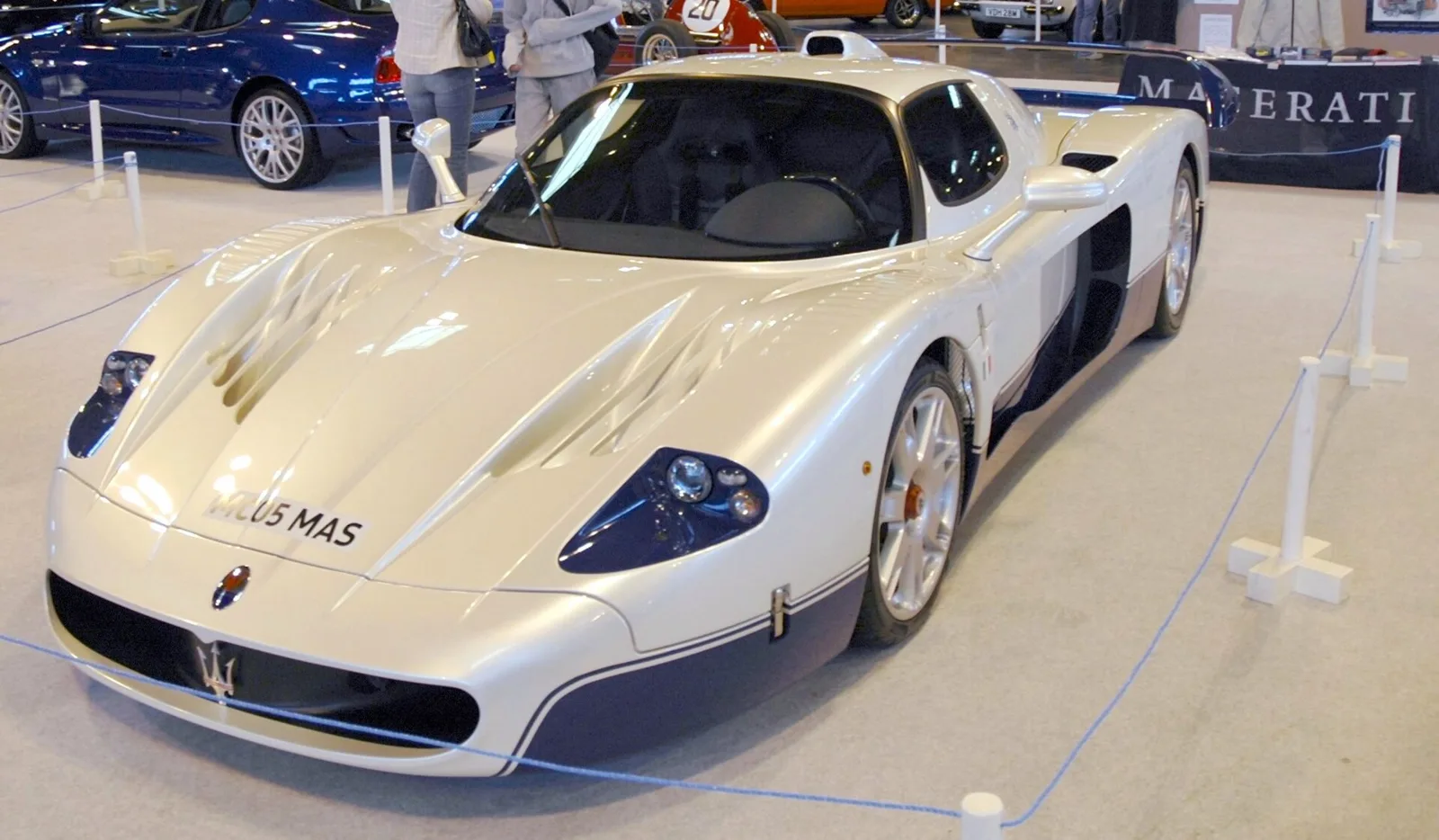
The Ferrari P4/5 by Pininfarina, unveiled at the 2006 Pebble Beach Concours d'Elegance, was built on the last unregistered US-spec Enzo chassis. The Maserati MC12 was a derivative built for GT racing, with 50 units made. Each car used Enzo parts in a different way.
Pininfarina wanted a special one-off, and American Ferrari collector James Glickenhaus agreed to back the project by commissioning his car. The P4/5 was a modern homage to great Ferrari sports racers, and it was later badged as an official Ferrari.
The Maserati MC12 shared the Enzo's engine, chassis and gearbox, and its only visible Enzo component was the windscreen. Homologation needed a minimum of 25 road versions. The MC12 reached 0-100 km/h in 3.8 seconds and had a top speed of 330 km/h (205 mph).
The MC12 Versione Corse was the track-only version. Only twelve were sold at 1 million euros (US$1.47 million) each, and its 755 PS (555 kW; 745 hp) at 8,000 rpm came from the GT1 engine. The Millechili prototype, with its 104.3-inch (2,650 mm) wheelbase and F430 aluminium space frame, was a concept rather than a planned car.
Did the MC12 beat the Enzo on track?
In some cases, yes. The Maserati MC12 was slower in a straight line, reaching 100 km/h in 3.8 seconds and topping out at 330 km/h (205 mph), but it has lapped some circuits faster than the Enzo. That result is usually linked to tyre grip rather than engine power.
The MC12's bodywork had a sharper nose and smoother curves, and its tyres were Pirelli P-Zero Corsa units with more grip than the Enzo's Bridgestone rubber. Those differences showed up on fast circuits, where the MC12 was quicker through the corners.
Top Gear and the Nordschleife both produced lap times that favoured the MC12. The MC12 was designed for racing homologation, and a minimum of 25 road versions had to be produced before it could compete in the GT series.
How did the Enzo's technology reach later Ferrari cars?
Ferrari used the FXX programme as a laboratory for Enzo technology, gathering data from owners and its racing team. That telemetry fed directly into future sports cars. The programme ran until 2009, when the Evoluzione kit was the final step in its development.
The car's onboard recording and telemetry systems let Ferrari see how it behaved on track. Engineers then used that feedback to refine suspension, aerodynamics and gearbox design for the next generation of road cars.
Unlike the Enzo, FXX cars were kept and maintained by Ferrari, with owners using them on selected circuits and during private track sessions. That arrangement gave the company tight control over how its most extreme cars were used.
Frequently asked questions
What did the Enzo's charity car sell for?
The 400th production car was donated to the Vatican for charity in 2004 and later sold at a Sotheby's auction for US$1.1 million. The sale turned a charity gift into one of the best-known stories of the car's early life.
Was the Enzo's gearbox well received?
It was quick at 150 milliseconds per shift, but drivers complained that it shifted abruptly. The design was a first-generation clutchless unit,
How fast was the FXX Evoluzione?
The Evoluzione kit was the final stage of the FXX programme, sharpening aerodynamics and gearbox response. Its sprint to 100 km/h took 2.5 seconds, and its top speed reached 365 km/h (227 mph) on the test figures. The kit was built for owners who wanted the most extreme version of the car.
Did the Maserati MC12 come from Ferrari?
Yes. Maserati developed the MC12 while under Ferrari's control, and it used the Enzo's engine, chassis and gearbox. Maserati built 50 units to meet the GT racing homologation rule.
Was the Millechili ever going to be built?
No, the Millechili was a prototype concept with no intention of production. It used the F430's aluminium space frame on a 104.3-inch (2,650 mm) wheelbase, and it was a technology study for lighter cars.
.jpg)