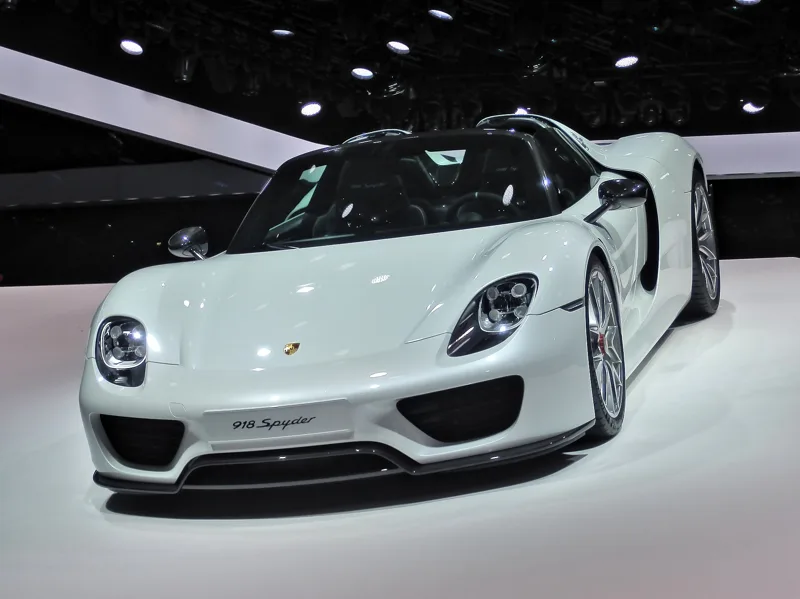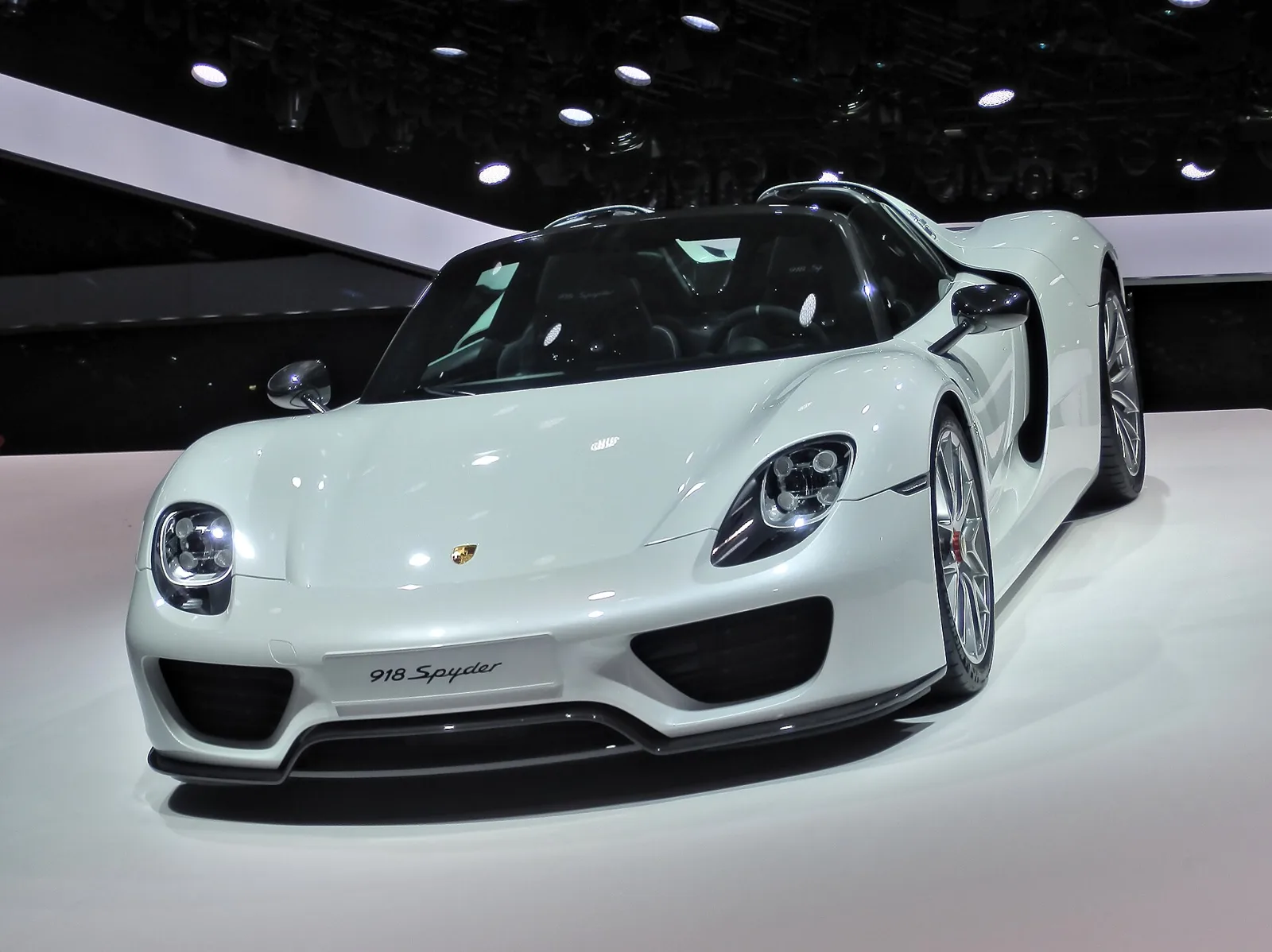
A limited run of 918 plug-in hybrids with a 4,593 cc V8 and two electric motors, built to show what hybrid performance could do.
The Porsche 918 Spyder was a limited-run plug-in hybrid from Porsche, built from 2013 to 2015. Its 4.6-litre V8 and two electric motors produced 652 kW combined. Porsche built 918 units, sold out by December 2014, and the car sits at the heart of its hybrid story.
The Porsche 918 Spyder was a limited-production plug-in hybrid sports car from Porsche, built in a run of 918 cars between 2013 and 2015. It paired a naturally aspirated V8 with two electric motors to produce a combined output that few road cars of its era could match. This profile covers the car's development, engineering, performance and the variants around it.
The 918 mattered to Porsche as a statement of intent. It showed that hybrid technology could deliver performance first, with efficiency as a welcome by-product rather than the main goal.
What is the Porsche 918 Spyder?
The 918 Spyder is a mid-engined plug-in hybrid sports car from Porsche. It was built in a limited series of 918 units and sold from late 2013 until production ended in June 2015. Its combined system delivers 652 kW (887 PS; 875 hp) from a V8 and two electric motors.
The car was the second plug-in hybrid Porsche had built, following the 2014 Panamera S E-Hybrid. That sequence shows how quickly the company moved from family saloon hybrids to a far more specialised machine.
Porsche paired the V8 with electric drive so the car could run on electric power alone for short distances, or use every system together for maximum performance. The flexibility was the core of the car's appeal.
A hybrid built around a high-revving V8 and two electric motors, the 918 proved that electric power could serve the track as well as the road.
How did the 918 come to production?
The 918 was first shown as a concept at the Geneva Motor Show in March 2010. The supervisory board approved series development on 28 July 2010, after 2,000 declarations of interest. The production version was unveiled at the September 2013 Frankfurt Motor Show, with production starting on 18 September 2013.
Development was carried out in Weissach, and assembly took place in Zuffenhausen. The car sold out by December 2014, well before production ended in June 2015 as scheduled.
The RSR racing variant was shown at the 2011 North American International Auto Show. It never reached production, but it previewed the hybrid ideas that the road car would later use in a more usable form.
How does the V8 work with its electric partners?
The engine is a 4,593 cc naturally aspirated V8 producing 447 kW (608 PS; 599 hp) at 8,700 rpm. Porsche says it weighs 135 kg (298 lb) and delivers 540 N m (398 lb ft) of torque at 6,700 rpm.
Two electric motors add to it. A 115 kW (156 PS; 154 hp) motor drives the rear wheels in parallel with the engine, while a 95 kW (129 PS; 127 hp) motor drives the front axle. The motor on the rear also serves as the main generator.
The total system delivers 652 kW (887 PS; 875 hp) and 1,280 N m (944 lb ft) of torque. A seven-speed gearbox using Porsche's PDK double-clutch system carries the power to the rear axle.
The bore stayed at 95 mm while the stroke rose to 81 mm, and the engine ran to 9,200 rpm. That layout gave the V8 the high-revving character that sets it apart from more conventional hybrid powertrains.
How do the battery, charging and running modes work?
The energy store is a 312-cell, liquid-cooled 6.8 kWh lithium-ion battery mounted behind the passenger cell. It charges from a plug, from regenerative braking and from spare engine output when the car is coasting.
Charging times depend on the supply. The supplied Universal Charger needs seven hours on a typical 120 V household socket, while a DC station can restore full capacity in 25 minutes. Refuelling is the other half of the story, since the engine can recharge an empty battery using about one litre of fuel.
The car offers five running modes, including E-Drive for electric running and Race mode, where a push-to-pass Hot Lap setting adds extra electrical power for a short burst of speed.
How fast was the 918 Spyder?
Porsche claimed 0-100 km/h in 2.6 seconds and 0-200 km/h in 7.2 seconds, with a top speed of 345 km/h (214 mph). Independent testers recorded 2.5 seconds to 100 km/h and a top speed of 352 km/h (218.7 mph).
Car and Driver measured 0-60 mph in 2.2 seconds. Motor Trend recorded a stop from 60 mph in 94 ft (29 m), a figure that backed up the car's reputation for braking as well as acceleration.
What did the Weissach Package and the Nurburgring record add?
The Weissach Package was a weight-saving and aerodynamics option, costing $84,000 in the US. It added magnesium wheels, an extended rear diffuser and interior parts covered in Alcantara instead of leather, and it also brought carbon fibre to the windscreen frame, roof and mirrors.
A 918 fitted with the Weissach Package set a Nurburgring lap of 6:57 in September 2013. That was the first time a street-legal production car had broken the seven-minute barrier on the road course, and it cut the previous record by 14 seconds.
What was the RSR racing variant?
The RSR was a racing variant of the 918 Spyder with a V8 that was a further development of a race car's direct-injection engine. It produced 414 kW (563 PS; 555 hp) at 10,300 rpm, and the variant never reached production.
Instead of plug-in hybrid technology, the RSR used a flywheel accumulator KERS system beside the driver. Its electric motors each added 150 kW (200 PS; 200 hp), giving a peak output of 564 kW (767 PS; 756 hp) and a six-speed gearbox developed from the race car unit.
How many 918s were built, and where did they sell?
A limited series of 918 units was built, with the United States the largest market for orders at 297 units. China and Germany had about 100 orders each, and Canada ordered 35 units.
JATO Dynamics registered 105 units in the first nine months of 2014, and the car was eligible for a US federal tax credit of up to US$3,667 depending on its battery size.
What are the Porsche 918 Spyder specifications?
The table gathers the core figures for the standard 918, from the 2013 production start to the June 2015 finish. Each row names the system or figure it covers, so the engine, electric and efficiency numbers are easy to separate.
| Specification | Detail |
|---|---|
| Production | 18 September 2013 to June 2015 |
| Units | 918 |
| Engine | 4,593 cc naturally aspirated V8 |
| V8 output | 447 kW (608 PS; 599 hp) at 8,700 rpm |
| System output | 652 kW (887 PS; 875 hp) |
| System torque | 1,280 N m (944 lb ft) |
| Battery | 312-cell, 6.8 kWh lithium-ion |
| Electric range | 19 km (12 mi), EPA |
| CO2 emissions | 79 g/km under NEDC |
| EPA petrol-only | 22 mpg-US (11 L/100 km) |
| Claimed 0-100 km/h | 2.6 seconds |
| Claimed top speed | 345 km/h (214 mph) |
| Nurburgring | 6:57 |
| Starting price | 781,000 euros; US$845,000; 711,000 pounds |
The figures show a hybrid built around a high-revving V8, with a battery sized for electric running over short distances rather than long journeys.
Why did the 918 matter to Porsche's hybrid plans?
The 918 showed that a hybrid could be a performance statement rather than a fuel-saving compromise. Porsche used the car to explore how electric torque and a high-revving combustion engine could work together in a single sports car.
The earlier Panamera S E-Hybrid had shown the company's approach in a family saloon. The 918 took the same logic into a limited sports car, where the performance benefits were far easier to see and to sell.
The car also carried a message about efficiency. Its 3 L/100 km NEDC figure and 79 g/km of CO2 sat beside 652 kW of system output, a combination that made the car stand out from its peers.
Limited production made the 918 a test bed as well as a product. Each car offered a chance to see the systems in real use, and those lessons informed how the company approached hybrids afterwards.
Could a 918 be used every day?
A 918 could be used day to day by an owner who accepted its charging needs and its limited-production status. Its electric modes covered short trips without fuel, while the V8 took over for longer runs and faster driving, which kept the car flexible.
Charging was the practical hurdle, and the gap between home and fast charging was large. Owners on an ordinary socket faced a long wait, which made a DC station the more convenient route when time was short.
The EPA figures highlight the split between the two modes. All-electric running was rated at 50 kWh per 100 miles, while petrol-only driving returned 22 mpg-US, or 11 L/100 km, on the EPA combined cycle.
How did the 918 perform in independent testing?
Independent testers broadly backed Porsche's claims and in several cases beat them. Their figures included a standing kilometre in 17.75 seconds, which put the car among the quickest production models of its time, underlining how conservative the official figures were.
The Weissach Package was one of several factors that helped the car achieve those results. Its magnesium wheels and carbon details saved weight, and a lighter car has less mass to move through every corner.
Independent figures were gathered under varied conditions, so they are best read as a sign of the car's capability rather than as a single definitive number.
What is the 918's legacy?
The 918 is remembered as the car that proved a plug-in hybrid could share the stage with the most extreme sports cars. Its limited run, a recall history and a rapid sell-out all shaped the way collectors view it today.
Its recall history, which spanned suspension and seat belt problems, was a reminder that a complex limited-production car brings its own maintenance challenges.
Its successor, the Mission X, was shown in June 2023, and the company's hybrid thinking has carried on in other models since then.
Owners and collectors who study the car tend to focus on how its systems work together, since the hybrid logic is the heart of the 918. Understanding when each mode takes over is the key to using the car well.
Its place in Porsche's history is secure, because it showed that a sports car could combine a high-revving engine with electric assistance without losing the character buyers expected from the brand.
For many readers the 918 is the reference point for what a modern hybrid sports car can be. Its combination of a high-revving V8, electric torque and a limited run keeps it in discussions long after the production line stopped.
Frequently asked questions
What did a 918 cost?
It started at 781,000 euros in Europe, US$845,000 in the US and 711,000 pounds in the UK, before options.
Was there a racing version?
Yes. The RSR, shown in 2011, used a flywheel KERS system instead of plug-in hybrid technology and never reached production.
What replaced the 918?
The Porsche Mission X was presented in June 2023 as the car's intended successor, with production planned for 2025.
How many recalls affected the 918?
The car has been the subject of half a dozen recalls, covering issues from control arms to seat belts.