Porsche's first series production electric car, from the Mission E concept to the 2024 refresh, with an 800-volt charging system and estate versions.
The Taycan is an electric luxury saloon from Porsche, with two estate models, and it runs on the J1 platform shared with the Audi e-tron GT. Porsche first showed the design as the Mission E in 2015 and launched the production car in 2019.
The Porsche Taycan is an all-electric luxury sports saloon with shooting brake variants, built by the German carmaker Porsche. As its first series production electric car, it is sold at several performance levels, and two estate models sit beside the saloon. The underpinnings are shared with the Audi e-tron GT.
Porsche previewed the idea as the Mission E concept, and the road car followed years later. The name points back to a horse on the coat of arms of Stuttgart, the city that also appears on the Porsche crest.
Where did the Taycan come from?
The concept came first. Porsche revealed the Mission E at the 2015 Frankfurt show, and the production car appeared at the 2019 show, four years on. It became the first electric car that Porsche built in series.
The Mission E had suicide doors and no B pillars. Production dropped both features, but kept most of the concept's design elements, including the general proportions and the light-led rear end.
The Turbo badge refers to power rather than turbochargers, since the electric motors deliver increased output. Turkish gives the name two meanings: tay for a young horse and can for liveliness.
Porsche's first electric production car grew out of a 2015 concept and kept most of that design through to the road.
How did the Mission E set the brief?
The concept used two permanently excited synchronous motors, one on each axle. Porsche Torque Vectoring managed all four wheels individually, and projected motor ratings exceeded 440 kW (598 PS; 590 hp).
Projected figures put 0-100 km/h (62 mph) under 3.5 seconds and 0-200 km/h (124 mph) under 12 seconds. The range goal was over 500 km (311 mi), and the system voltage was 800 V DC.
Porsche claimed that its Turbo Charging system could push up to 350 kW into the battery, reaching 80% in just 15 minutes. The concept could also be charged through an inductive plate instead of a cable.
How does the Taycan look?
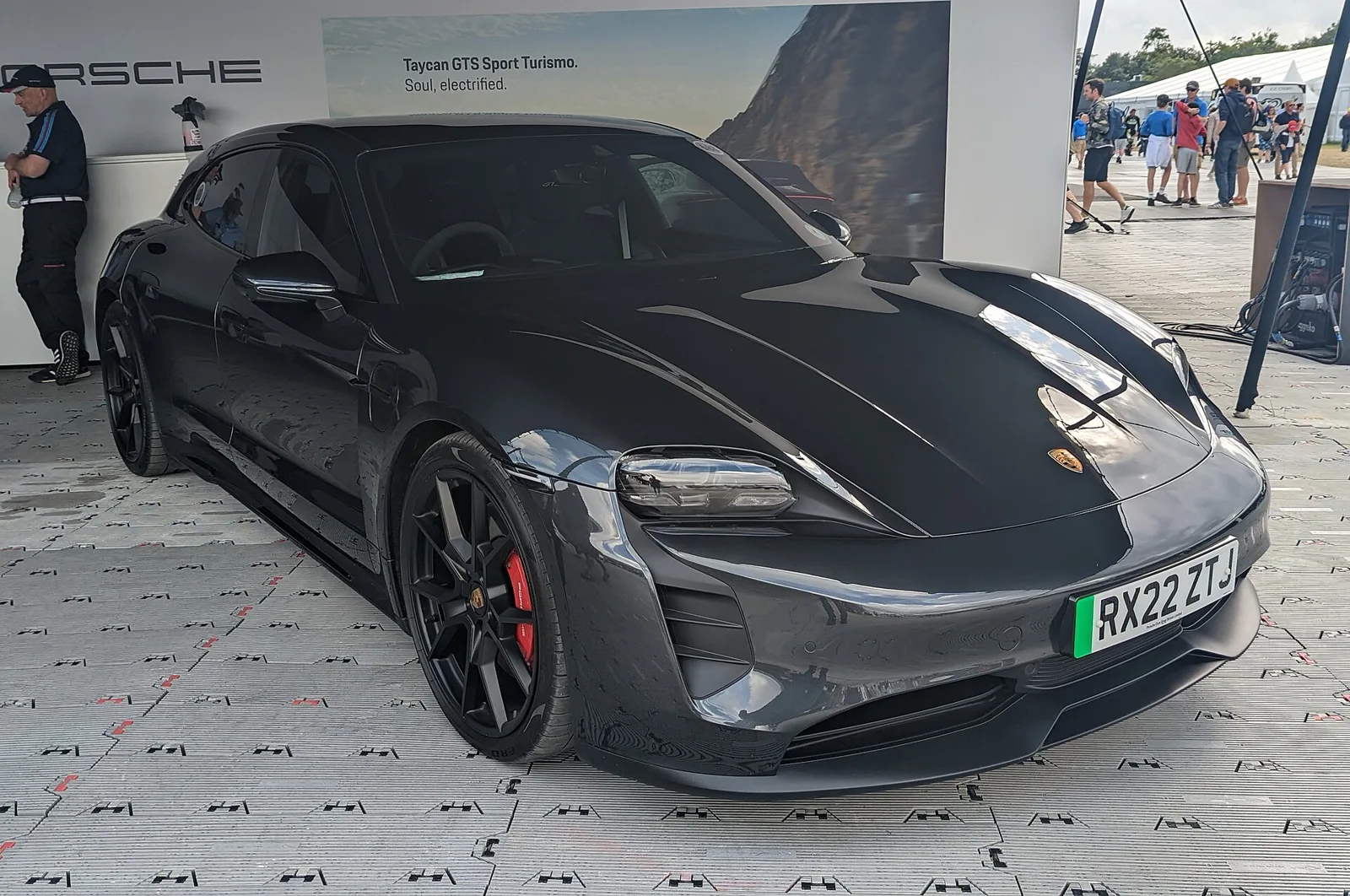
The exterior styling is by former Porsche exterior designer Mitja Borkert. Retractable door handles and a retractable rear spoiler are among its unusual details, and the front uses four-point LED daytime running lamps.
The short-nosed front follows traditional Porsche proportions, while the stretched rear draws on modern front-engine models. A short notchback boot lid carries a full-width light band that serves as both taillights and turn signals.
A compartment under the bonnet offers nearly 100 litres of storage. The Turbo and Turbo S add carbon fibre trim and 20-inch wheels, which mark them out from the standard cars.
What does the Taycan interior offer?
The cabin introduced Porsche's first fully digital instrumentation, with up to four digital displays. A curved, free-standing 430 mm (16.8 in) driver display sits ahead of the driver, and a 280 mm (10.9 in) central screen runs the infotainment.
A 210 mm (8.4 in) portrait touchpad screen on the centre console shows powertrain status, and an optional screen above the glovebox lets the front passenger customise the infotainment. An analog Porsche clock still sits at the top of the dashboard.
What battery does the Taycan use?
The original battery is a 93 kWh pack weighing 630 kg (1,389 lb) that doubles as a structural chassis component. Porsche also offers a smaller 79.2 kWh battery for the base Taycan and the 4S, which cuts weight by about 76 kg (168 lb).
The larger pack has 33 modules, each with 12 LG Chem pouch cells, for 396 cells in total. Recesses called foot garages are built into the pack to give rear passengers more legroom, and the 723-volt pack is branded Performance Battery Plus.
The smaller battery uses 28 modules of the same 12-cell design, giving 336 cells, and it works within a voltage window of 520 to 720 V.
How does the Taycan charge?
The Taycan uses an 800-volt charging system with a 270 kW fast charger, which takes the battery from 5% to 80% in about 22.5 minutes in ideal conditions. Older 400-volt stations can still be used at up to 150 kW through an onboard step-up converter.
Charge times depend on weather and infrastructure. The charging planner lets an owner set a departure time, and the car then warms or cools the battery so it reaches the right temperature before the next stop.
A charging dock and mobile charger for home use provide a 9.6 kW connector that charges the car in 11 hours. An energy manager can also be fitted to a home's electrical panel to control power flow, make use of solar power and provide blackout protection.
Buyers received three years of free access to speed-charging networks, either IONITY in Europe or Electrify America in the United States, both joint venture partners of Porsche.
Porsche released an official CCS-to-NACS adapter in September 2025, letting Taycans use Tesla Superchargers in North America. Elsewhere, Tesla uses the CCS2 standard that the Taycan already supports.
Where are the Taycan's charging ports?
The car has charging ports on both the driver's and passenger's sides, and only one can be used at a time. In the European, American and other CCS markets, AC sources can connect to either side, while DC sources connect only to the passenger side.
For Japan and China, which use different AC and DC connectors, the driver's side carries the AC port and the passenger's side carries the DC port.
What range can the Taycan achieve?
Range depends on the model, the driving style and the driving mode chosen. The EPA lists the 4S at 327 km (203 mi), while WLTP figures run from 566 to 645 km with a consumption of 30 kWh/100 km.
Five driving modes are available, and the Range setting is designed to keep power draw as low as possible. The Individual setting lets the driver customise the various systems to personal preference.
Regenerative braking reaches up to 265 kW in the original car, which gives a deceleration of 0.39 G. The figure rose after the 2024 refresh, as described below.
How is the Taycan drivetrain built?
The Taycan is all-wheel drive, with a permanent-magnet synchronous motor on each axle. The front axle uses a single-speed gearbox with an 8.05:1 ratio, while the rear uses a two-speed transmission and a limited-slip differential.
The rear gearbox has a short planetary first gear of 16:1 for maximum acceleration, and a long second gear of 8.05:1 for top speed and efficiency.
The 4S used a less powerful rear motor than the Turbo, while the front motor was shared across the 4S, Turbo and Turbo S. Later a base model dropped the front motor entirely.
What changed in the 2024 refresh?
A mid-cycle refresh arrived in February 2024 for the 2025 model year. Porsche raised battery capacity to 89 kWh (PB) and 105 kWh (PB+), and it fitted the more powerful rear traction motor from the Macan BEV.
Maximum regenerative braking rose from 290 to 400 kW, and maximum DC charging rose from 270 to 320 kW. Efficiency gains came with the new motor, which is also lighter than the unit it replaced.
The Turbo GT arrived in March 2024. It uses the Turbo's front motor with a rear motor that carries 900 A of maximum current, compared with 600 A on the Turbo and Turbo S.
Which Taycan body styles are available?
The Taycan is offered as a four-door saloon and as two estate models, the Cross Turismo and the Sport Turismo. Two-door coupe and convertible variants were planned if market demand justified them.
The Cross Turismo has extra body cladding, rugged black plastic trim and an off-road design package, and it is all-wheel drive throughout. Its base model is named Taycan 4 for that reason, while the Sport Turismo keeps the lower ride height of the saloon.
How much luggage space do the estates offer?
Both estate models hold up to 446 L (15.8 ft3) of luggage, against 407 L (14.4 ft3) in the saloon. With the rear seats folded, the estates offer up to 1,212 L (42.8 ft3) of cargo room.
How aerodynamic is the Taycan?
The Turbo has a drag coefficient of Cd=0.22, which Porsche says is the lowest of any current model in its range. The Turbo S is slightly higher at Cd=0.25, and the frontal area is 2.33 m2.
Those figures give a drag area of 0.513 m2 for the Turbo and 0.583 m2 for the Turbo S.
How did the Taycan perform in a real-world test?
Car and Driver ran 15 consecutive quarter-mile passes in the Turbo S and in a 2020 Tesla Model S Raven Performance. The aim was to test Porsche's claim that performance holds up as the battery discharges.
Porsche's results did not deteriorate significantly during the run, while the Tesla results were observed to be considerably worse.
What awards has the Taycan won?
What Car? named the 4S Performance Car of the Year in January 2021 and awarded the Taycan five stars out of five in its review. In April 2021 the Cross Turismo was named Best Estate at the 2021 Top Gear Electric Awards.
In December 2022 Bloomberg suggested the Taycan as an option for buyers who were considering the Tesla Model X.
Has the Taycan been used in motorsport?
Yes. A modified Taycan Turbo S is the current Formula E safety car, which places the car on track at the front of the field during races.
Taycan specifications
The table lists the main figures for the production car. Where a figure belongs to one trim, battery or model variant, the table names it so the numbers stay separate.
| Specification | Detail |
|---|---|
| Body | Saloon, Cross Turismo, Sport Turismo |
| Battery (PB+) | 93 kWh, 630 kg (1,389 lb) |
| Charging | 5% to 80% in 22.5 minutes on a 270 kW charger |
| Base model output | 240 kW (326 PS; 322 hp) |
| 4S output | 320 kW (435 PS; 429 hp) |
| Turbo and Turbo S output | 460 kW (625 PS; 617 hp) |
| Turbo GT peak | 760 kW (1,020 hp; 1,030 PS) |
| EPA range (4S) | 327 km (203 mi) |
| Drag coefficient (Turbo) | Cd=0.22 |
What is the Taycan built from?
The Taycan's body is mainly steel and aluminium, joined with several bonding techniques. Hot-formed steel is used for the B pillars, side roof frame and seat cross member, and boron steel for the bulkhead cross member, while forged aluminium covers the shock absorber mounts, axle mounts and rear side members.
All body panels except the front and rear bumpers are aluminium, which helps keep weight down. In total, 37% of the car is made of aluminium, and the battery pack also works as a structural part of the chassis.
Frequently asked questions
How quick was the Mission E concept projected to be?
Its projected figures were under 3.5 seconds from 0 to 100 km/h (62 mph) and under 12 seconds from 0 to 200 km/h (124 mph).
Can a Taycan use Tesla Superchargers?
The CCS-to-NACS adapter that Porsche launched in September 2025 covers North America. Outside North America, Tesla uses the CCS2 standard instead.
What is the Turbo GT?
The Turbo GT arrived in March 2024 with an upgraded rear motor, while its front motor is shared with the Turbo and Turbo S.
Which setting gives the most range?
The setting called Range is built to stretch each charge as far as possible by keeping power draw low.