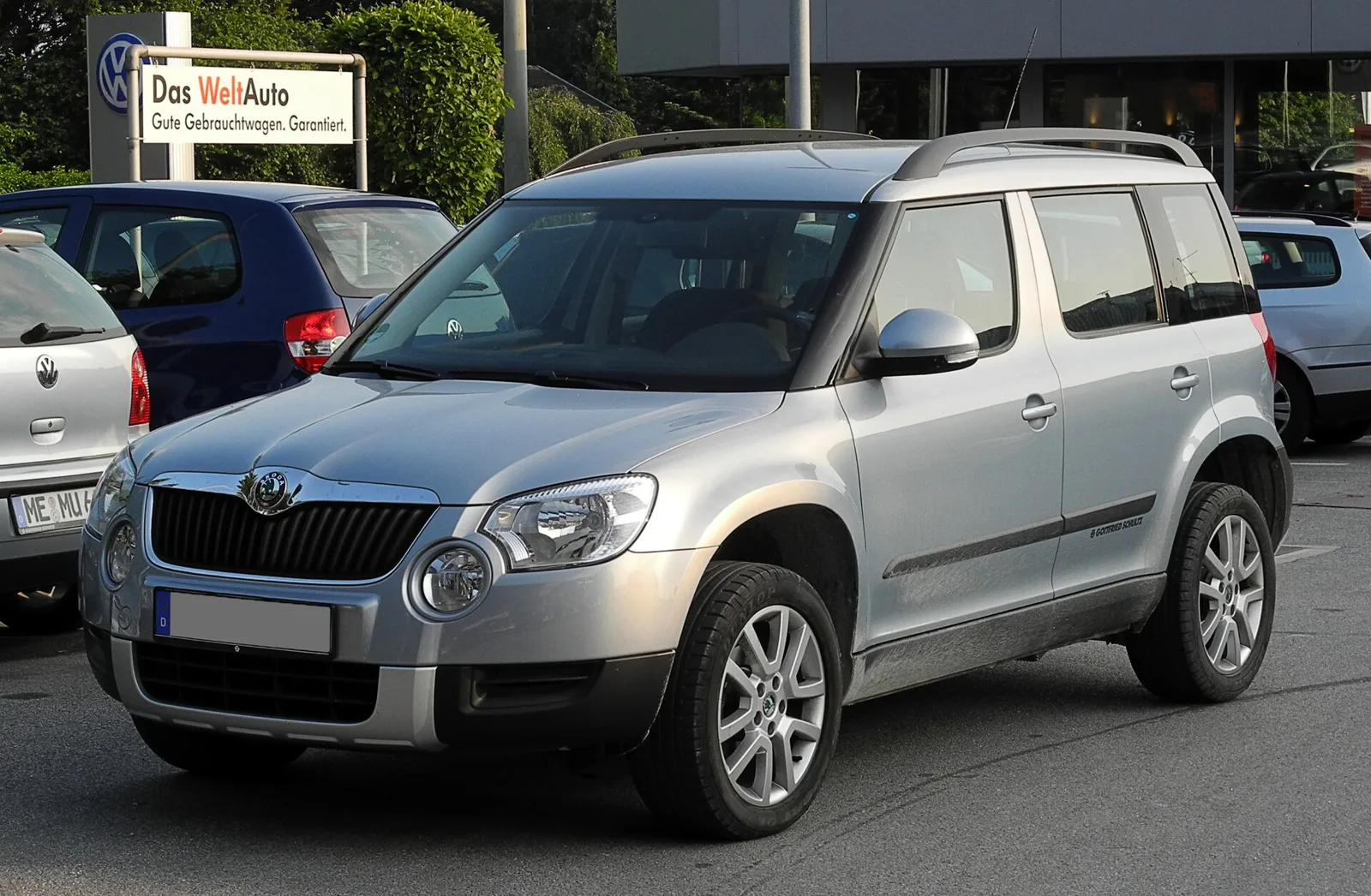
A compact crossover with flexible VarioFlex seating, optional four-wheel drive and five Euro NCAP stars, before the Karoq took over the role.
The Yeti was Skoda's first SUV, shown in production form in 2009 with VarioFlex seating and a choice of front or all-wheel drive. Euro NCAP awarded it five stars, and a 2013 facelift added a rear parking camera. Its successor, the Karoq, arrived in late 2017.
The Skoda Yeti is a compact crossover SUV built by Skoda Auto, and it marked the company's first move into the SUV market. The production car premiered at the 2009 Geneva Motor Show, and Top Gear magazine named it Family Car of the Year that year. The Karoq replaced it in late 2017.
Where did the Skoda Yeti come from?
The Yeti began as a concept at the 2005 Geneva Motor Show, with a single wiper sweeping the whole windscreen and a split tailgate for carrying bicycles. Those features did not reach production. Skoda premiered the production car four years later, built largely on the second-generation Octavia platform with a rear section from the Volkswagen Golf 4Motion.
The production car kept the rear seating idea from the Roomster. Three separate rear seats offer a backrest range of 13.5 degrees, and once the middle seat is removed, the outer seats slide 80 mm (3.15 in) toward the centre. That gives two rear passengers more room, and the front passenger seat folds flat for long loads.
Concept work did not end with the first show. Skoda's Yeti II convertible, with a combined hardtop and canvas roof, appeared at the 2005 Frankfurt Motor Show, while the Yeti I concept shown in Geneva was a blue SUV.
A compact crossover that put Skoda into SUVs with flexible seating and a clever four-wheel drive system.
How much luggage space does the Yeti offer?
Luggage capacity runs from 405 litres (14.3 cu ft) with the rear seats in place, up to 1,760 litres (62.2 cu ft) once they are removed. The car measures 4,223 mm (166.26 in) long on a 2,579 mm (101.54 in) wheelbase, and its width is 1,793 mm (70.60 in).
The rear seats fold forward and can be taken out completely, which gives owners a flat load floor when they need one. Skoda quoted a drag coefficient of 0.37 for the body.
How did the Yeti's rear seats work in practice?
The three rear seats could be adjusted for backrest angle and slid fore and aft, and the outer pair could move toward the centre once the middle seat was removed. Folding the seats forward and taking them out altogether gave the largest load area.
The arrangement carried over from the Roomster. With the rear seats removed, the luggage area grows toward the 1,760 litre figure, while the front passenger seat can be folded into a horizontal position for long objects. That combination is what made the Yeti practical for families and for loads that would not fit in a conventional hatchback.
Engines and transmissions
Every engine was a turbocharged four-cylinder that met EU5 emissions rules. Petrol units were fuel injected, while the diesels used common rail direct injection with a diesel particulate filter. Most engines were paired with six-speed manual gearboxes, and a seven-speed DSG was offered only with the 1.2 TSI petrol.
The two-litre diesel was rated at 103 kW (140 PS) and could be ordered with a six-speed DSG. A five-speed manual was reserved for front-wheel drive cars fitted with the 81 kW TDI engine.
The facelift reshuffled the line-up. The 1.6 TDI could be matched with a seven-speed DSG, while the five-speed manual survived only on the GreenLine version. The 125 kW two-litre diesel was paired with a six-speed DSG and all-wheel drive.
How did the Yeti's four-wheel drive work?
Four-wheel drive models sent power to the rear wheels through a fourth-generation Haldex multi-plate clutch, with fully independent multi-link suspension at the back. An Off Road button changed the throttle response and assistance systems, and hill descent control used gentle braking on steep slopes.
After the facelift the system moved to a fifth-generation Haldex unit, which sits at the rear axle in the same housing as the final drive. It was 1.4 kg lighter than its predecessor and dropped the oil pressure accumulator. Hill descent control worked in gears one to three, as well as in reverse and neutral.
Was the Yeti built for rough ground?
Only the all-wheel drive models carried the Off Road button and hill descent control, which together prepared the car for loose surfaces and steep descents. Outdoor versions added black lower bumpers and sills, because those parts face the most damage from rough terrain.
The off-road setting also changed how the car responded. The accelerator reacted less sensitively, which smooths power delivery on loose surfaces, and hill descent control held a constant speed on steep slopes by braking gently, whichever gear was selected.
The urban version kept its bumpers painted in body colour, and the Monte Carlo sports design was offered on that model. The two versions also differed in wheel designs and upholstery.
How safe is the Yeti?
The Yeti earned five stars from Euro NCAP. It scored 92 percent for adult occupant protection in frontal and side crash tests, 78 percent for child occupants and 46 percent for pedestrian safety. Its default Safety Assist equipment earned 71 percent.
Standard equipment included ESP with ABS and hydraulic brake assist, and buyers could specify up to nine airbags. Bi-xenon headlamps with AFS and a large two-piece panoramic sunroof were among the options that added to the car's safety and comfort kit.
The Yeti also performed well in the rear impact whiplash test, and seatbelt reminders for the driver and front passenger came as standard. Those details helped the range score well on default equipment, even before buyers added options.
What changed with the 2013 facelift?
The facelift premiered at the Frankfurt International Motor Show in September 2013 and split the range into standard and Outdoor versions. The Outdoor had black lower bumpers and sills, and the facelifted car became the first Skoda to offer a rear view parking camera.
The update also brought keyless entry and ignition, plus a rechargeable LED torch in the boot. Customers in China received a separate version with a 60 mm longer wheelbase and a spare wheel carried on a fifth door.
Did the DSG gearbox receive a software change?
Yes. In May 2017 Skoda Australia said Volkswagen had released a software update for DSG transmissions to reduce wear in the dual clutch assemblies. The update disengages the clutch without warning when clutch temperature reaches 200 degrees Celsius.
The same change introduced a variable delayed throttle response and shuddering in first gear. Skoda treated that behaviour as normal operation after the update, which is worth knowing when assessing a DSG car from that period.
Interior and equipment
The Yeti's cabin was built around practicality, and its equipment list ran from simple to fairly generous. Electrically adjustable seats and mirrors appeared among the standard and optional features, and buyers could add a rain sensor, front heated seats and automatic park assist. The navigation system used a 6.5 inch colour touchscreen with a 30 GB hard drive, and a large two-piece panoramic sunroof was among the roof options.
Parking sensors were available at both the front and the rear, and a tyre pressure monitoring system was offered as well. After the facelift, the rear camera switched on automatically when reverse gear was selected, showing the space behind the car and the driving line based on its width.
Which markets received special versions?
China received the most distinct version, with a wheelbase 60 mm longer than the European car and its spare wheel carried on a fifth door. India had its own line-up of Active, Ambition and Elegance trims, which reflected a different range of buyers.
Britain offered five trims, running from the entry-level E through to Elegance, while most of mainland Europe used Experience, Ambition, Track or Active. Those choices show how one body was adapted to suit different buyers and different sales networks.
Concepts and the Yeti Pickup
Skoda Auto created two concepts in 2005: the blue Yeti I at Geneva and the orange Yeti II convertible at Frankfurt. In 2014 the Yeti Xtreme appeared at the Worthersee meeting in Austria, finished in matte dark grey with yellow elements on the rims and roof.
The Yeti Pickup was a prototype built in 2012 and 2013 that never reached production. Its rear end used the axle and suspension from the third-generation Volkswagen Caddy Max. Skoda showed it again in an October 2022 press release alongside the other concepts. Skoda also unveiled a Yeti Xtreme design study at the 33rd GTI Treffen, adding one more styling idea to the Yeti story.
What replaced the Yeti?
The Karoq replaced the Yeti. Skoda officially announced it at the Frankfurt Motor Show in 2017, and it went on sale in late 2017. Before the announcement, Auto Bild published a rendering of the presumed successor, which it suggested would be larger and more expensive than the Yeti. The Frankfurt announcement brought the Yeti story to a close.
Skoda's chairman, Bernhard Maier, confirmed the news behind the Auto Bild report. The rendering was said to draw inspiration from the Kodiaq, which placed the new model above the Yeti in Skoda's range.
Specifications at a glance
The table collects the main dimensions, safety scores and equipment figures for the Yeti, so the numbers can be compared at a glance without wading through trim lists.
| Specification | Detail |
|---|---|
| Length | 4,223 mm (166.26 in) |
| Width | 1,793 mm (70.60 in) |
| Wheelbase | 2,579 mm (101.54 in) |
| Drag coefficient | 0.37 |
| Luggage capacity | 405 litres (14.3 cu ft) to 1,760 litres (62.2 cu ft) |
| Euro NCAP | Five stars; 92 percent adult, 78 percent child, 46 percent pedestrian |
| Maximum airbags | Nine |
| Facelift | September 2013, Frankfurt |
| Successor | Karoq, late 2017 |
Frequently asked questions
What engine did the Yeti use?
Every Yeti engine was a turbocharged four-cylinder. Petrol units were fuel injected, and the diesels used common rail injection with a particulate filter.
Was the Yeti available with all-wheel drive?
Yes. Four-wheel drive models used a Haldex clutch to send power to the rear wheels, and an Off Road button adjusted the assistance systems for rough ground.
How many airbags did the Yeti have?
Buyers could specify up to nine airbags, and the standard car came with ESP and ABS. The exact mix of airbags depended on the trim and market.
What trim levels were offered?
In most of Europe the Yeti came as Experience, Ambition, Track or Active. The UK offered E, S, SE, SE Plus and Elegance, while India had Active, Ambition and Elegance.
Which gearboxes came from the Volkswagen Group?
The seven-speed DSG was a Volkswagen Group Direct-Shift Gearbox, offered only with the 1.2 TSI petrol. The six-speed DSG was available with the two-litre diesel, so buyers could choose a dual-clutch unit with either petrol or diesel power.
Did the Yeti get a China version?
Yes. The China version had a 60 mm longer wheelbase and carried its spare wheel on a fifth door.
Is the Yeti related to the Octavia?
Yes, in part. The platform was mainly inherited from the second-generation Octavia, while the rear section came from the Volkswagen Golf 4Motion, and some parts were specific to the Yeti.