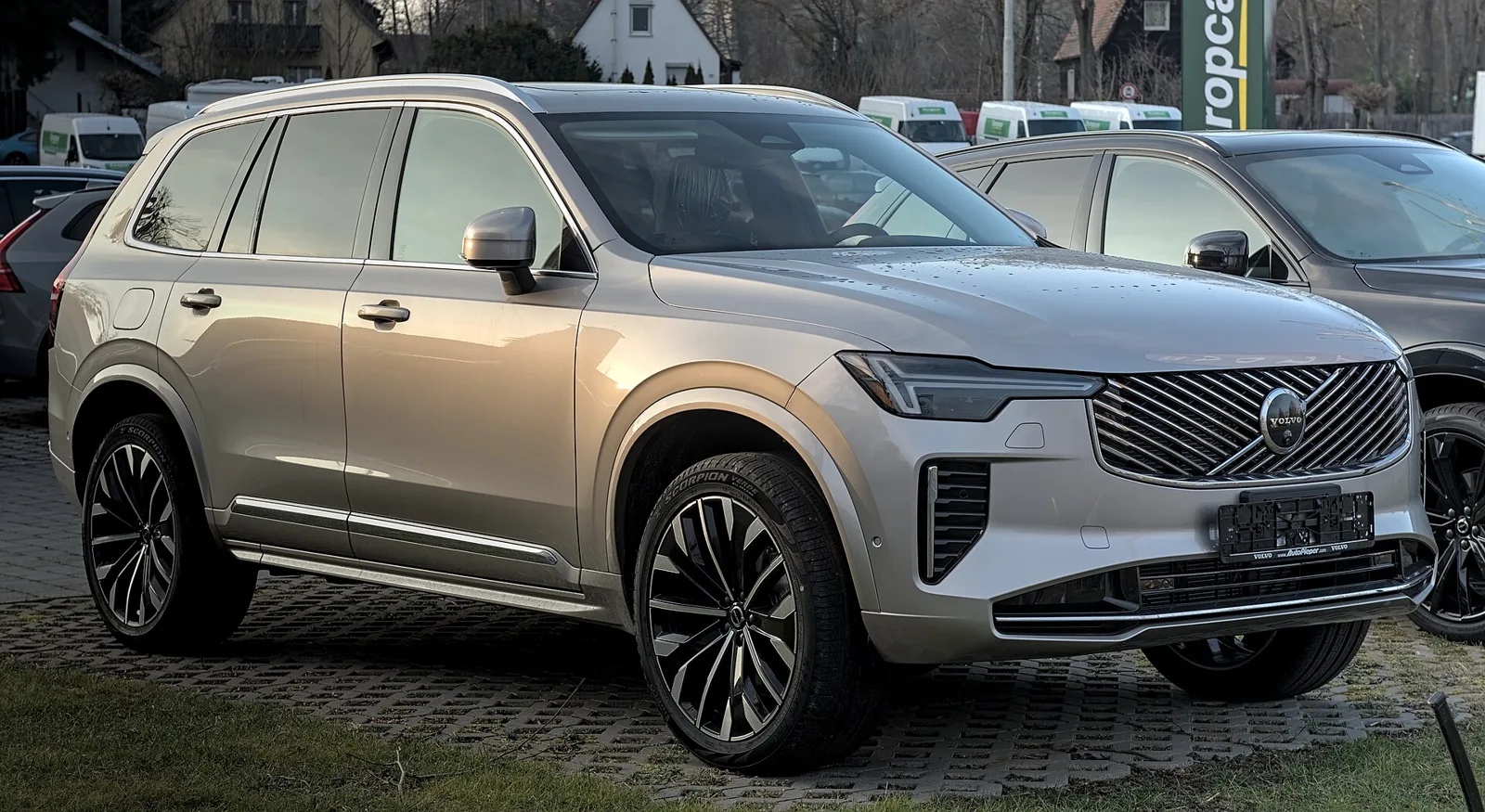
Volvo's first SUV, shown as a concept in 2001 and sold from 2002, grew into a two-generation family of petrol, diesel, plug-in hybrid and electric models.
The Volvo XC90 is a mid-size luxury SUV that Volvo Cars has built since 2002. It was the company's first SUV and is now in its second generation, which launched at the end of 2014 on the SPA platform. Both generations won Motor Trend's SUV of the Year award in their debut years.
The Volvo XC90 has been Volvo Cars' mid-size luxury SUV since 2002, and it is now in its second generation. It was the company's first SUV, previewed by a concept car and then built in Sweden before production moved elsewhere. Later versions added a plug-in hybrid, and an electric successor arrived in 2022.
Where did the XC90 come from?
The XC90 began as an Adventure Concept Car that Volvo showed at the North American International Auto Show in January 2001. A teaser of the production car followed in November 2001, and the full XC90 was unveiled at the same show in January 2002.
Production began in August 2002 at the Torslanda factory in Sweden, after Volvo's traditional mid-year shutdown. The styling of the production car recalled the concept closely, which helped the model feel like a clear step for the brand.
The first generation used the Volvo P2 platform, which it shared with the first-generation S80 and other large Volvos. Volvo later moved production equipment to China and ended Swedish production at the end of 2014. The China-built car was renamed the XC Classic.
Volvo's first SUV grew from a 2001 concept into a two-generation luxury family vehicle that also went plug-in hybrid.
What did the first-generation XC90 offer at launch?
At its North American launch for the 2003 model year, the XC90 came in two trim levels. The entry 2.5 T used a 2.5-litre turbocharged inline-five making 208 hp (155 kW; 211 PS), while the T6 used a 2.9-litre twin-turbo inline-six with 268 hp (200 kW; 272 PS).
The 2.5 T came with front-wheel drive as standard and a Haldex all-wheel drive system as an option. The T6 was offered only with all-wheel drive, and it paired its engine with a Volvo-modified four-speed automatic. The 2.5 T used a five-speed Aisin automatic.
A Yamaha-developed V8 arrived in 2005, with a 4.4-litre engine producing 232 kW (315 PS; 311 hp). North American sales reached about 40,000 units in 2005, the year the V8 arrived.
The XC90 won the North American Car of the Year award and Motor Trend's Sport/Utility of the Year for 2003. Volvo also introduced Roll Stability Control on the XC90 in 2003, an industry first according to the company.
How did the first-generation XC90 change over time?
The 2007 update freshened the front and rear and revised the interior. The 3.2-litre SI6 straight-six, producing 175 kW (235 hp), became the base engine for the US market, replacing the earlier five-cylinder. The 2007 model debuted in April 2006 at the New York Auto Show.
By 2010 all models had painted wheel arches, which had previously been optional. The 2013 refresh then added standard LED daytime running lights and taillights, along with body-coloured bumpers, rocker panels and silver trim in place of black plastic.
Pricing moved too. The refreshed model went on sale in late spring 2012 with a base price of US$40,395 for the front-wheel drive model, and the base price fell to US$39,700 for the 2014 model year.
What were the Sport trim and the Ocean Race Edition?
Two special versions stand out in the first generation. The Sport trim, sold from 2006 to 2008, came with stiffer suspension and different shocks, while the Ocean Race Edition of 2006 was a limited run of 800 cars tied to Volvo's sailing sponsorship.
In the Sport, engine power matched the regular XC90, but the suspension was markedly stiffer, with added roll bars that reduced body roll in corners. The Sport also borrowed a blue odometer background and wore five-spoke alloy wheels, and it was offered in Passion Red and several other colours.
The Ocean Race Edition had a special blue colour and a leather interior with contrast stitching. Volvo had become the main sponsor of the round-the-world sailing race in 2001, and the 2005 edition was the first in which every competitor used the same Volvo Open 70 yacht, which was 21.5 m (71 ft) long.
How did the XC90 perform in safety testing?
The XC90 earned the IIHS Top Safety Pick award and was rated good in front, side, rear and roof strength tests. Euro NCAP regarded the model as best in class, and Roll Stability Control had been introduced on the model in 2003.
Volvo set itself a target that by 2020 nobody would be seriously injured or killed in a new Volvo, and the XC90 was central to that message. The second-generation car brought City Safety with auto brake at intersections, which can stop the car when a driver turns in front of an oncoming vehicle.
The front end is designed to absorb frontal impacts and to deflect pedestrians up onto the bonnet rather than under the vehicle. The roof is reinforced with ultra-high-strength steel, a system Volvo markets as ROPS, and the rear structure uses a whiplash protection system.
A recall announced in 2007 covered 42,211 2005 model year XC90s because of a risk of battery short circuit and fire. The recall applied only in the US and Canada, and the company said there had been no reports of short circuiting.
What changed in the second generation?
The second-generation XC90 was unveiled in Stockholm on 26 August 2014 and reached buyers soon afterwards. It is longer, wider and lower than its predecessor, and it uses the Scalable Product Architecture platform, which Volvo says reduces weight while improving safety and efficiency.
Every engine in the new car is a 2.0-litre four-cylinder Drive-E unit paired with an eight-speed Geartronic automatic from Aisin. The T6 twincharged petrol makes 320 hp (239 kW; 324 PS) and 400 Nm, the T5 makes 254 hp (189 kW; 258 PS) and 350 Nm, and the D5 diesel makes 235 hp (175 kW; 238 PS) with 470 Nm.
The D4 diesel produces 190 hp (142 kW; 193 PS) and 400 Nm. The top model is the T8 Twin Engine plug-in hybrid, which combines the petrol engine at the front with an electric motor at the rear for 400 hp (298 kW; 406 PS) and 640 Nm.
What was inside the second-generation XC90?
The second-generation cabin centred on a 9-inch touch screen running the Sensus system, which offered connected apps, Apple CarPlay and Android Auto. The top audio system used a Class-D amplifier and 19 Bowers and Wilkins speakers.
The seats were redesigned with adjustable side bolsters, a seat cushion extension and massage. The second row offered three individual seats with recline adjustment, and a sliding function opened more legroom for the third row or more loading space.
Third-row seating became standard on every XC90 from the 2018 model year, except the Excellence trim. An air suspension with five modes was available, and the gear lever was made of Orrefors crystal.
How does the XC90 T8 plug-in hybrid work?
The T8 uses technology from Volvo's V60 plug-in hybrid. Its battery sits at the centre of the vehicle and can be charged from an electric vehicle charger, while regenerative braking adds energy as well. Volvo said the hybrid equipment took no passenger or cargo space.
The T8 emits 49 g/km of CO2 and offers an all-electric range of 43 km (27 mi) on the New European Driving Cycle. At launch the EPA rated its all-electric range at 14 miles (23 km), and the 2016 model year had a combined rating of 53 MPG-e.
Battery capacity grew over time, from 9.2 kWh at launch to 10.4 kWh for the 2018 model year, 11.6 kWh for 2020 and 18.6 kWh for 2023. The fuel tank was reduced to 50 litres for the 2016 to 2018 models, and the spare tyre was removed.
Plug-in sales were healthy from the start. Europe took 2,653 units in 2015, US cumulative sales reached 488 by February 2016, and the plug-in variant accounted for 20% of global XC90 sales by mid-March 2016.
Volvo XC90 specifications at a glance
The table lists representative figures for both generations, with the plug-in hybrid and first-edition details included. Where a figure belongs to one generation, the table says so.
| Specification | Detail |
|---|---|
| First generation platform | Volvo P2, 2002 to 2014 |
| Second generation platform | Scalable Product Architecture (SPA), from 2014 |
| Entry engine (2003) | 2.5-litre turbo inline-five, 208 hp (155 kW; 211 PS) |
| Top petrol (2003) | 2.9-litre twin-turbo inline-six, 268 hp (200 kW; 272 PS) |
| T6 (second generation) | 320 hp (239 kW; 324 PS), 400 Nm |
| D4 diesel (second generation) | 190 hp (142 kW; 193 PS), 400 Nm |
| T8 Twin Engine plug-in hybrid | 400 hp (298 kW; 406 PS), 640 Nm |
| T8 battery (2023) | 18.6 kWh |
| Seating | Five in two rows or seven in three rows |
| First Edition | 1,927 cars, sold out in 47 hours |
What was the XC90 First Edition?
The First Edition was a run of 1,927 individually numbered cars sold only through digital commerce. The batch sold out in 47 hours after orders opened on 3 September 2014, and the run number referred to the year the Swedish brand was launched.
Each car was finished in black with large alloy wheels and included every available option. Individually numbered tread plates and a distinctive rear badge marked each example, and buyers could choose their own number.
How has the XC90 sold outside Europe and North America?
The XC90 is sold across Asia as well. Models for Indonesia, the Philippines, Taiwan, Thailand and Vietnam come from Volvo's factory in Shah Alam, Malaysia, while India has received the car since September 2015 from the Bengaluru plant.
The United States was expected to account for at least a third of second-generation global sales, which shows how central the American market remained. In the UK more than 50,000 vehicles had been sold by 2018.
How did the XC90 change in its later facelifts?
The 2019 facelift for the 2020 model year brought revised front and rear styling, a new grille design, new wheel designs and Android Auto compatibility for the Sensus system. A kinetic energy recovery braking system was also added.
The 2024 facelift for the 2025 model year added new headlights, a modified front bumper and a larger touch screen, along with a repositioned wireless charging pad and recycled materials in the cabin. In 2021 the T8 powertrain was renamed XC90 Recharge.
Frequently asked questions
Did the XC90 win awards?
Yes. Motor Trend named it SUV of the Year in 2003 and again in 2016, and the car also took a North American award for 2003.
How much did the XC90 cost in the US?
The front-wheel drive base model had a price of US$40,395 when it went on sale in 2012. By the 2014 model year the base price was US$39,700.
How many XC90s did Volvo sell in North America in 2005?
North American sales that year were just over 40,000 vehicles, the year the Yamaha-developed V8 joined the range.
Is there an electric XC90?
The electric-only EX90 was introduced in late 2022 as the successor to the XC90. In September 2024 Volvo launched a second facelift for the XC90 and said both models would be sold together for the foreseeable future.