A longer power stroke than compression stroke is worth more than it sounds, as long as something else supplies the missing punch.
The Atkinson cycle, invented in 1882, uses an expansion stroke longer than the compression stroke to gain efficiency at the cost of power density. Modern engines mimic it by holding the intake valve open late. Toyota pairs it with electric motors in hybrids, while the Miller cycle adds a supercharger or turbo.
The engine in the first Toyota Prius traces its logic to a design that James Atkinson patented in 1882, partly to steer around somebody else's patents. His engine fitted all four strokes into a single turn of the crankshaft with an over-centre arm, and the real prize was a longer expansion stroke than compression stroke. That one idea, trade a little power for a lot more efficiency, now sits inside many hybrid cars and a growing number of ordinary ones.
Otto vs Atkinson cycle: what is the baseline?
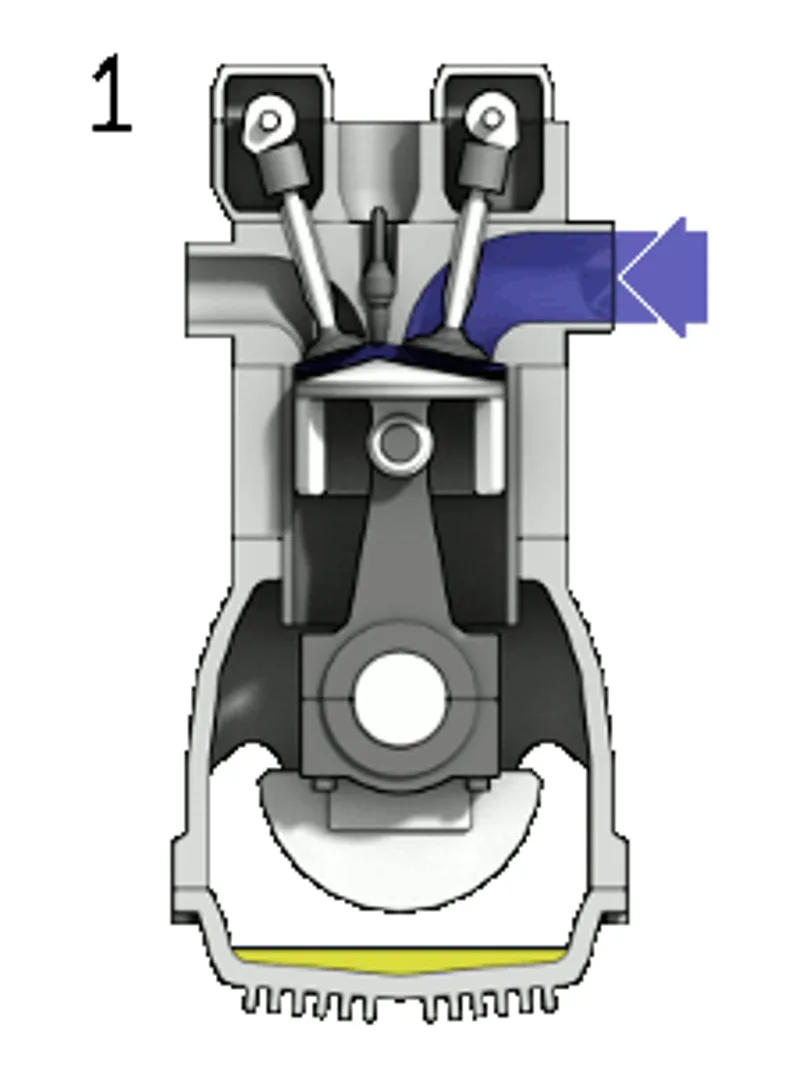
Almost every petrol car engine works on the Otto cycle, named after Nicolaus Otto, the German engineer who built the first working four-stroke engine, a stationary one running on coal gas mixed with air. The four-stroke principle itself had been patented earlier, in 1861, by Alphonse Beau de Rochas. In the cycle, air and fuel are drawn in by the descending piston, squeezed as the piston rises, ignited by a spark, expanded as the gas pushes the piston down, and finally exhausted on the second rise.
The key feature for this story is symmetry. In the ideal Otto cycle the expansion ratio equals the compression ratio, and for a typical engine that ratio is around 9 to 10:1. The piston squeezes the mixture by a certain amount and the burned gas is allowed to push it back down by the same amount.
Trade a little power for a lot of efficiency, and let an electric motor cover the difference.
What is the Atkinson cycle?
The Atkinson cycle was invented by James Atkinson in 1882 and is designed to deliver efficiency at the expense of power density. The unique feature is that the expansion stroke is longer than the compression stroke, and that is where the extra thermal efficiency over a conventional piston engine comes from.
Atkinson built three different engines. The first, the differential engine, used opposed pistons joined to one crankshaft through a toggle-jointed linkage. Its second and best-known design, the Cycle Engine of 1887, relied on poppet valves, a cam and an over-centre arm, which squeezed all four piston strokes into one turn of the crankshaft. Intake and compression were much shorter than expansion and exhaust. The odd mechanism also helped it sidestep patents held on Otto engines. Output ranged from a few horsepower to 100, and the engines were built in Britain and licensed to makers overseas.
The weakness was balance: the linkage was hard to balance at speed. Atkinson's answer was the Utilite Engine, which dropped the linkage for a more conventional layout that behaved much like a two-stroke, could run up to 600 rpm and produced power every revolution. It kept the short compression and long expansion. It tested as even more efficient than the earlier designs, but very few were built. Its British patent is dated 1892.
How does a longer expansion stroke improve efficiency?
In an ordinary spark ignition engine at wide-open throttle, the burned gas is still sitting near five atmospheres at the moment the exhaust valve opens, so there is work left in it that the piston never collects. A longer expansion lets the gas push on for longer. A modern Atkinson engine aims to let the gas expand until its pressure matches the air outside by the time the power stroke ends. At that point all the pressure has been put to work.
Heat still remains, because the exhaust is well above ambient temperature. There are several ways to use that residual heat, but turning it into mechanical energy is held back by low Carnot efficiency at such a moderate temperature. The principle is straightforward, though: give any charge of air a bigger expansion and more of its heat turns into motion, which makes the engine more efficient.
How does a modern engine do it with a normal crankshaft?
Atkinson's linkages are long gone. In the late twentieth century the name began to be used for an Otto-cycle engine with altered valve timing: the intake valve stays open past the usual point, and some air is pushed back out into the manifold during the early part of the compression stroke. Engineers sometimes call this the simulated Atkinson cycle. Toyota's 1NZ-FXE, fitted to the early Prius, works this way, as do the company's Dynamic Force engines.
The effective compression ratio falls, because for part of the stroke the air is escaping freely rather than being compressed. The expansion ratio stays the same, so the compression ratio is now smaller than the expansion ratio. Other approaches reach the same effect, such as offsetting the crankshaft centre-line from the cylinder centre-line, or using unconventional valve timing.
The cost is power density. Because less of the compression stroke is spent compressing the intake air, an Atkinson engine takes in less air than an Otto engine of the same size, and gives less power for the same displacement. Four-stroke engines that use the same valve motion but add forced induction to win the power back are Miller-cycle engines.
| Feature | Otto | Atkinson | Miller |
|---|---|---|---|
| Intake valve | Closes near the bottom of the stroke | Held open longer | Held open longer |
| Compression versus expansion | Equal ratios | Compression ratio smaller than expansion ratio | Same effective compression ratio, larger expansion ratio |
| Power density | Conventional | Reduced | Restored by a supercharger or turbocharger |
| Typical use | Most petrol cars | Hybrids such as the early Prius | Ships, power plants, locomotives and some cars |
What is a Miller cycle engine?
The Miller cycle was patented by the American engineer Ralph Miller as US patent 2,817,322 on 24 December 1957. The design suits two-stroke or four-stroke engines burning diesel, gas or a mix of the two. Boost from a supercharger or turbocharger covers for the power the Atkinson approach gives away.
The intake valve stays open longer than in an Otto engine, so the compression stroke effectively splits into two stages. The valve closes after the piston has travelled around 20 to 30% of its upward stroke. For that first part the piston pushes some of the mixture back through the open valve into the intake manifold, and only during the final 70 to 80% does it actually compress the charge. This two-stage compression is described as the fifth stroke that the Miller cycle introduces. Normally the lost charge would mean lost power, but the supercharger makes it up. A positive-displacement type, such as a Roots or screw design, is usually needed because it produces boost at low engine speeds. A turbocharger is more efficient when low-speed operation is not required, or can be supplemented with electric motors.
Cooling is part of the benefit. The charge is compressed above the pressure the engine cycle needs, cooled in an intercooler, and then the cylinder filling is reduced by the inlet valve timing. A lower charge temperature lets the ignition timing be advanced further before detonation sets in, and it lowers NOx in diesels, a major design concern in big diesel engines in ships and power plants.
The cycle has its costs. Driving a positive-displacement supercharger typically takes about 15 to 20% of the power the engine generates. A turbocharger is lighter on the engine but spools up slowly, which leaves the engine stuck in the Atkinson cycle at low revs. A device such as the MGU-H used in Formula 1 could in principle address that, but it has never been used on commercial engines. Larger displacement also brings friction and boosting-efficiency trade-offs that have to be balanced for each application.
Where do Miller and Atkinson engines appear?
Miller engines were first used in ships and stationary power plants and today drive certain railway locomotives, including the GE PowerHaul. Mazda adapted the cycle for its KJ-ZEM V6 in the Millenia and, in Australia, the Eunos 800. Subaru paired a Miller-cycle flat-four with a hybrid driveline in its concept B5-TPH, the Turbo Parallel Hybrid. Nissan has a small three-cylinder with variable intake valve timing; the company says it behaves as an Atkinson engine at low load, when low power density does not matter, and as a Miller engine under light boost.
Unboosted Atkinson-type engines mostly turn up in hybrid electric cars, where economy comes first and motors make up for the power the Miller approach would have recovered with a charger.
Why does Toyota use the Atkinson cycle in its hybrids?
The logic is a division of labour. A modified Otto engine on the Atkinson cycle gives good fuel efficiency but less power per unit of displacement than a traditional four-stroke. If demand for power comes in bursts, an electric motor can fill the gaps. The motors can work on their own or alongside the engine, giving the most efficient way of making the power the driver asks for. That is the basis of an Atkinson-cycle hybrid drivetrain. The first car to use it was the first-generation Toyota Prius, in late 1997.
Early on, this was exclusively a hybrid technique. Later hybrids and some non-hybrid cars now have variable valve timing, which can run the Atkinson cycle as a part-time regime. The engine gives good economy in Atkinson mode and conventional power density when it switches back to the Otto cycle.
Who else tried it first?
Atkinson was not alone in chasing a short compression stroke. A French patent by Charon in 1888 led to a four-stroke engine displayed at the Paris Exhibition in 1889, using a cycle similar to Miller's without a supercharger, now called the Charon cycle. Hugo Guldner argued in a 1914 book that Korting got there first, building a gas engine in 1891 that compressed briefly and expanded for longer, working from a design Otto Kohler proposed in 1887. Its load-dependent valve train lowered the compression at low and medium loads, which ultimately cut efficiency. In 1928 Roy Fedden at Bristol tested variable retard timing on the Bristol Jupiter IV engine, letting some of the charge spill back into the intake manifold.
The principle has even been tried in a rotary engine. A rotary Atkinson design can raise both power and efficiency compared with the Otto cycle and can use alternative fuels such as diesel and hydrogen, but the rotor tips must seal very tightly and friction between rapidly moving parts causes mechanical losses.